

Chongqing University Unveils Patent for Expandable and Contractible Cardiac Stent
Chongqing UniversityA patent for a cardiac stent was publicly disclosed in November 2023. The patent is for aCardiac Stents Capable of Expanding and Contracting with Blood Vessels, can be used in coronary arteries and has the effect of restoring normal blood flow function.
Stent implantation is the most effective approach for managing acute vascular occlusion. Although metallic stents can support occluded or stenotic vascular access, their inability to contract and expand in synchrony with vascular motion after drug elution is completed may lead to complications such as vascular inflammation, late-stage hyperplasia, and recurrent vascular occlusion. Therefore, there is an urgent clinical need for a cardiac stent capable of contracting and expanding in concert with vascular dynamics.
This patent enables the stent to contract and expand with vascular motion through a special braided structure, therebyReduces the risk of late-stage complications. Meanwhile, the patent also provides a simple method for filling degradable materials such as polylactic acid, which can precisely fill the assembly gaps between the expansion rod and the support rod,Saves Materials and Costs。
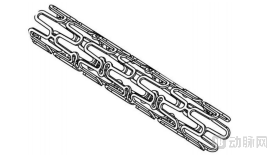
Product Schematic (Source: Patent Specification)
I. Development of Four Generations of Coronary Stents
In 1958, while performing an aortogram on a patient, Dr. Sones inadvertently inserted the catheter into the right coronary artery and injected contrast medium, thereby visualizing the vessel. This accidental discovery led physicians to recognize that arterial stenosis could be addressed through stenting.Thus, modern coronary intervention techniques were born.
Following the advent of coronary stents and the continuous accumulation of clinical data, physicians have discovered that coronary stents mayleading to rejection, hyperplasia, obstruction, etc., thereby improving the stent.
In 1997, German physician Gruentzig pioneeredRelay Balloon Angioplasty, completing the percutaneous coronary intervention. This type of intervention does not involve long-term placement within the coronary arteries; rather, the device is withdrawn after balloon angioplasty dilates the vessel. However, this procedure was associated with a postoperative restenosis rate of 40%–50%, which prompted physicians to begin researching long-term implants.
In 1986, Puol and Sigmart inventedBare-Metal Stent, which also serves as the prototype for modern metallic stents. Although this stent can provide long-term vascular support and maintain blood flow patency, immune rejection by the vessel wall may lead to hyperplasia, resulting in a restenosis rate of 20%–30%.
Subsequently, to reduce stent-induced thrombosis, hyperplasia, and other issues, there emergedDrug-eluting stents, coated stents, and biodegradable stents, the restenosis rate also decreases.

Development of Cardiac Stents
It is evident that cardiac device iterations are progressing toward enhanced safety and reduced complications. These advancements are inextricably linked to innovations in pharmaceuticals and biomaterials.
II. Domestic Substitution Achieved
As coronary stenting procedures have become increasingly mature, market demand for coronary stents has expanded accordingly. In 2023, mainland China alone performed 1,636,055 percutaneous coronary interventions (PCIs), representing a year-on-year growth rate of 26.44%.The market space is showing a broad trend.。
In terms of global market share, Abbott, Boston Scientific, and Medtronic hold the largest shares.. In the domestic market, Chinese-made products have developed rapidly in recent years, continuously breaking through core technologies and even offering more competitive pricing, resulting in a relatively high rate of domestic substitution.
Currently inIn the domestic market, MicroPort Medical, Lepu Medical, and Jiwei Medical hold relatively high shares., breaking the monopoly of foreign-funded products in the Chinese market.
In terms of innovative technology, domestically produced coronary stents are now on par with imported products. In 2021, the team led by Academician Han Yaling from the General Hospital of the Northern Theater Command, in collaboration with Lepu Medical, developedNeoVas Bioresorbable Scaffold, officially approved by the National Medical Products Administration (NMPA), becoming the first bioresorbable scaffold approved for market launch in China.
Clinical follow-up data over a three-year period demonstrate that the NeoVas bioresorbable scaffold outperforms international counterparts in terms of revascularization efficacy, safety profile, and restoration of vascular elasticity after degradation.
Additionally, there is the world's first commercially availableIron-based Bioresorbable Vascular Scaffold IBS Angel™, developed by Academician Ge Junbo's teamXinsorb Sirolimus-Eluting Bioresorbable Scaffoldetc., all possess independent Chinese intellectual property rights and have obtained registration approvals in multiple overseas countries, demonstrating that domestic coronary stents are gradually maturing and going global.