

Seragon Biosciences Files IPO Prospectus Highlighting SRN-901, a Breakthrough Anti-Aging Candidate Extending Mouse Lifespan by One-Third with Harvard and Mayo Clinic-Backed Technologies
Seragon Biosciences
Pharmaceutical Manufacturer
As the global population ages, the pursuit of health and longevity has intensified, making “anti-aging” a highly prominent field. Elite researchers and industry leaders are continuously exploring the mechanisms of aging in hopes of discovering methods to reverse aging and extend healthspan. However, to date, no true anti-aging interventions—whether pharmaceuticals or devices—have received regulatory approval for market launch.
However, the field of anti-aging drug research has recently witnessed a major breakthrough.Global biopharmaceutical company Seragon Biosciences (“Seragon”) announced that it has completed a preclinical study of its anti-aging drug candidate SRN-901.. The study yielded positive results—SRN-901 significantly extended the remaining lifespan of the test mice and markedly improved their health status.
Seragon, founded in 2013 and headquartered in California, USA, is an innovative enterprise dedicated to developing aging intervention products and services through a variety of innovative technologies to help people extend their healthspan.
To date, Seragon has achieved multiple milestone developments: in 2020, it launched GenomeScore, an AI platform designed to predict human aging rates and assess physiological function.™; In 2023, the anti-aging supplement RESTORIN was launched™, this supplement is the first aging intervention product developed using patented technologies from Harvard University, the Mayo Clinic, and The Scripps Research Institute; between 2021 and 2024, it completed preclinical studies on SRN-901, which represents one of the most comprehensive preclinical studies on aging interventions to date.
Seragon posits that aging is a natural consequence of cellular replication. During this process, coding errors may occasionally arise within the human genome, leading to dysfunction in the mechanisms responsible for maintaining normal physiological functions. As these dysfunctions accumulate with age, they cause a decline in the overall performance of bodily systems, ultimately resulting in aging and age-related health conditions, such as Alzheimer’s disease and type 2 diabetes.
In this context, Seragon aims to identify targets that can regulate metabolism and restore cellular function, with the goal of developing innovative technologies and therapies to improve age-related functional decline, thereby reversing aging and extending healthspan.
To this end, Seragon has taken the first step toward “reversing aging” by developing GenomeScore, an AI-powered prediction platform capable of forecasting human aging rates and comprehensively assessing physiological functions.™。
In August 2020, Seragon officially launched GenomeScore.™. According to their introduction,GenomeScore™It is the first AI platform to integrate epigenetic and transcriptomic analyses. Unlike other epigenetic age testing tools available at the time, GenomeScore™Based on proprietary epigenetic, metabolic, and gene expression marker data, it is possible not only to predict an individual’s biological age but also to assess the overall aging status and rate of the human body, while providing detailed and comprehensive measurements of the ages of different body regions.。
Importantly, by integrating transcriptomic analysis data, GenomeScore™It can predict the aging of other physiological functions, such as the immune and endocrine systems. If a particular organ in the human body is aging at an accelerated rate, the platform serves as an early warning system, alerting individuals to potential risks of related diseases.
To further integrate GenomeScore™To translate into clinical applications, Seragon has developed a GenomeScore-based™The algorithm-driven microarray chip makes this platform more accessible, thereby helping consumers better understand how lifestyle and other factors influence their aging process. Meanwhile, it assists scientists and physicians in developing more personalized medical services to meet future patient needs, based on a more comprehensive understanding of human aging.
NAD+ (Nicotinamide Adenine Dinucleotide) is an extremely important coenzyme in organisms, widely involved in various fundamental physiological activities such as mitochondrial respiration, DNA repair, and epigenetic modifications.
Extensive research has demonstrated that NAD+ metabolic levels are closely linked to aging. Researchers have found that during the aging process, NAD+ metabolism becomes impaired, leading to reduced synthesis and increased consumption, which ultimately results in decreased NAD+ levels. Furthermore, in age-related diseases such as cardiovascular disease, cancer, and neurodegenerative disorders, changes in patients' NAD+ levels coincide with disease progression. Therefore, elevating NAD+ levels has become a significant strategy for mitigating aging and age-related diseases.
Seragon's Anti-Aging ProductsRESTORIN™RESTORIN: An NAD+ Optimization Supplement.™Elevates cellular NAD+ levels through multiple core ingredients, thereby optimizing cellular metabolism and promoting healthy aging. According to its official website,RESTORIN™The first longevity supplement to simultaneously incorporate patented NAD+ and aging-decomposition technologies from Harvard University, the Mayo Clinic, and the Scripps Research Institute.。
RESTORIN™Composed of an NAD+ precursor complex, an SSA complex, and B-complex vitamins. The SSA complex includes components such as flavonols and isoprenylated flavonoids, representing a class of compounds with sirtuin (NAD+-dependent histone deacetylase) activation functions and senolytic properties.
Notably, sirtuins, known as “longevity proteins,” interact with other proteins to regulate critical processes such as cellular stress response, metabolism, aging, and apoptosis, holding significant importance for mammals, including humans. Sirtuin levels decline with age; activating and upregulating their activity can slow cellular aging and delay or prevent age-related diseases.
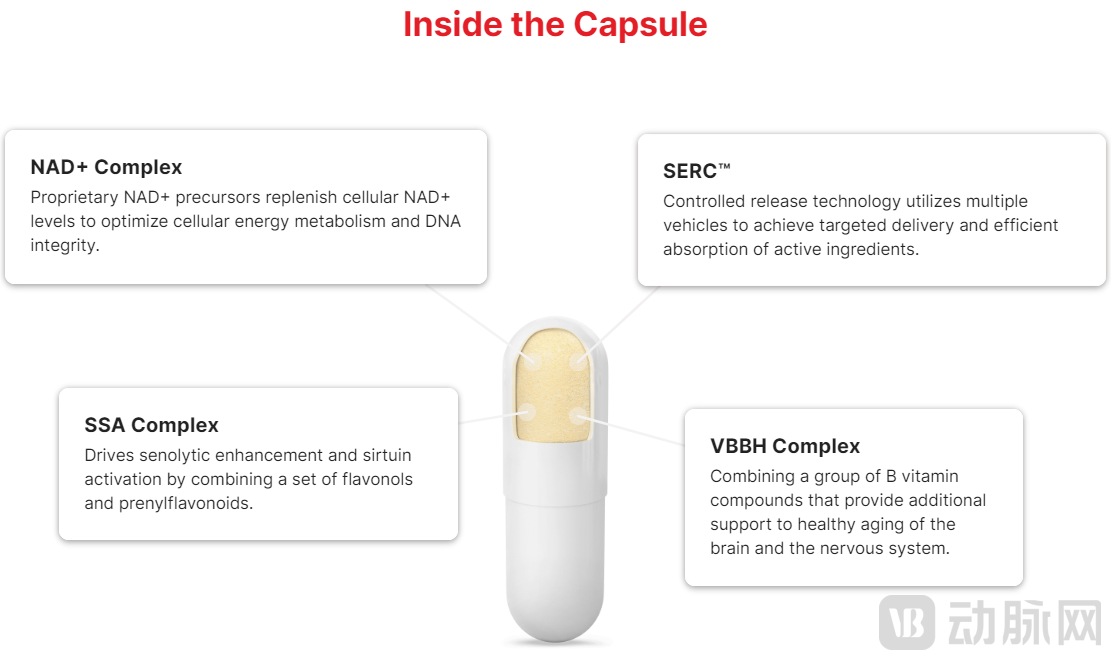
RESTORIN™ Ingredient Composition | Source: Seragon Official Website
RESTORIN™ leverages two core components—NAD+ precursor complexes and SSA complexes—to deliver potential anti-aging benefits through a dual mechanism. First, NAD+ precursors elevate intracellular NAD+ levels, helping cells maintain healthy energy metabolism. Second, senolytics clear senescent cells, thereby reducing the overall senescent burden. By combining NAD+ enhancement therapy with senolytic therapy, RESTORIN™ harnesses their synergistic effects, potentially achieving an anti-aging outcome where “1+1>2.”
Furthermore, to enhance RESTORIN™bioavailability, Seragon has developed a proprietary targeted delivery technology—SERC™Controlled-release technology utilizes carriers with varying water and lipid solubility, along with pH-responsive enteric delivery systems, to achieve targeted delivery and efficient absorption of active ingredients.
Building on existing aging research,Seragon is developing a novel anti-aging drug candidate, SRN-901, designed to reverse aging and restore physiological function.Dr. David Brown, Senior Scientist at Seragon Biosciences, stated, “SRN-901 incorporates multiple aging-intervention technologies, such as mTOR inhibition, activation of autophagy and mitophagy, NAD+ enhancement, and anti-aging stimulation, demonstrating significant potential as an aging-intervention measure.”
Previously, Seragon released the preclinical study results of SRN-901. The study, which commenced in 2021 and concluded in 2024, represents one of the most comprehensive analyses of aging interventions to date, covering the entire lifespan of over 300 mice. Furthermore, Seragon employed bioinformatics tools such as RNA sequencing and machine learning to conduct an in-depth analysis of the impact of SRN-901 on transcriptomic, metabolomic, and proteomic markers in the test mice. The company also measured a range of physiological functions and healthspan parameters in these animals to further elucidate the role of SRN-901 in enhancing overall health in mice.
Specific research data show that,Compared with untreated mice, middle-aged mice (equivalent to humans around 50 years old) treated with SRN-901 showed a one-third extension in their remaining lifespan.. Furthermore, multiple healthspan and metabolic markers were significantly improved in middle-aged mice treated with SRN-901.. Prior to treatment, middle-aged mice exhibited less than 20% of the endurance observed in young mice during treadmill endurance testing. Following treatment with SRN-901, the endurance levels of middle-aged mice reached more than 50% of those seen in young mice, accompanied by a significant reduction in their frailty scores.
Importantly,Compared with untreated mice, middle-aged mice treated with SRN-901 exhibited gene expression profiles similar to those of young mice, with the activity levels of multiple pro-longevity genes (Sirt6, Parp1, and Sod2) increased by more than 70% on average, while the levels of multiple anti-longevity genes (Igf1r, Ccl4, and IL6) decreased by more than 40% on average.。
Notably, after analyzing specific longevity-promoting pathways, researchers found that SRN-901 enhanced the activation of pathways associated with DNA repair, signal transduction, immune function, and programmed cell death. Furthermore, analysis of metabolic markers revealed that SRN-901 significantly increased levels of antioxidants such as γ-glutamine and glutathione, while markedly reducing metabolic markers associated with poor health status, including blood glucose and uric acid levels.
Dr. David Brown stated,Preclinical studies of SRN-901 have yielded significant results in lifespan extension, representing the greatest efficacy achieved to date by any oral anti-aging drug. Under identical conditions, the anti-aging effects of SRN-901 even surpassed those of rapamycin.。
Currently, Seragon is accelerating the advancement of RESTORIN.™Commercialization Progress in China. At the 6th China International Import Expo held in November 2023,China International Medical & Pharmaceutical Co., Ltd. (hereinafter referred to as “Sinopharm International”) and Seragon announced the joint establishment of a joint venture, Sinopharm Seragon, and held a new product launch event for RESTORIN™(Seragon) is introduced into the Chinese market to drive the upgrading of China’s aging intervention technology industry.。
Long before this, Seragon had already begun preparing for its entry into the Chinese market. In December 2020, Seragon established its Asia-Pacific headquarters in Beijing for the first time, for RESTORIN™laid the foundation for the commercialization of this and other candidate products in China. In the future, Sinopharm Seragon, the joint venture, will be responsible for RESTORIN™introduction of.
Currently, Seragon is also accelerating the supplementary analysis of the preclinical study data for SRN-901 and will officially release detailed results in the coming months. Notably, Seragon’s anti-aging product RESTORIN™will share multiple technologies with SRN-901; therefore, RESTORIN™It may become one of the best options for delaying aging and extending healthspan.
The preclinical research results for SRN-901 undoubtedly represent a major breakthrough in the field of anti-aging drug development, further highlighting the immense potential of such therapeutics. However, this does not signify that SRN-901 has achieved ultimate success; its scientific validity still requires support from additional clinical trials and studies. Currently, SRN-901 has only been evaluated in mouse models, and its safety and efficacy in humans remain to be confirmed through further research. Furthermore, detailed findings on SRN-901 are not yet fully elucidated, and Seragon Biosciences has not addressed potential challenges and issues that may arise during the trial process.
According to the “Research Report on the Development of the Global and Chinese Anti-Aging Industry and Consumer Demand (2022–2023)” released by iiMedia Research, the global anti-aging market size grew from USD 139.5 billion in 2015 to USD 216.0 billion in 2021, and is expected to maintain a high growth rate in the future. This indicates that innovative anti-aging interventions hold substantial market potential.
A key challenge facing the field of anti-aging interventions is,Rigorous scientific evidence is required to support the efficacy and safety of interventions.. Particularly in the field of anti-aging drug research, most studies are still in the early stages, and further clinical trials involving human subjects are needed to validate the findings and ensure that the potential benefits outweigh any risks or side effects.
Nevertheless, although the path to developing anti-aging drugs remains long and fraught with numerous challenges, the continuous accumulation of scientific achievements and ongoing breakthroughs in new technologies suggest that more anti-aging drugs will likely enter clinical trials and achieve successful commercialization in the future, truly helping people realize their aspiration to “delay aging and extend healthspan.”