

Kreep Biotech Files IPO Prospectus as Its Multiplex Immunohistochemistry Platform Gains Traction in Top-Tier Chinese Hospitals
William Osler, the father of modern medicine, once stated, “Pathology is the foundation of medicine.” The advancement of clinical medicine is largely reflected in the progress of pathology. Ensuring the diagnostic accuracy and reliability of pathology, improving the operational efficiency of pathology departments, and meeting the growing demand for more precise disease diagnosis are persistent practical challenges that pathology departments continue to address.
Centered on the key themes of high quality, high efficiency, convenience, and precision, pathological diagnostic technologies have continuously advanced, evolving from cytopathology and histopathology to immunohistochemistry, molecular pathology, and ultimately to next-generation diagnostic pathology.
Currently, next-generation diagnostic pathology has emerged as a new trend, driving profound changes in pathological diagnosis. However, the industry still lacks a systematic understanding of this field, and several key questions remain to be answered. For instance, what are the distinguishing features of next-generation diagnostic pathology compared to traditional pathology? Which technologies and products are poised for rapid growth? How can already-installed multiplex fluorescence immunohistochemistry products become a critical methodology in next-generation pathology? In light of these questions, VCBeat has conducted a comprehensive review of the core characteristics and technological landscape of next-generation diagnostic pathology.
Professor Bian Xiuwu, an academician of the Chinese Academy of Sciences, first proposed the concept of “Next-Generation Diagnostic Pathology” in the *Chinese Journal of Pathology*.
Traditional diagnostic pathology, with its morphology-based classification, is ill-suited to guide novel therapeutic approaches such as targeted small-molecule drugs, immunotherapies, and biological treatments involving immune cells or stem cells. It is even less capable of accurately analyzing the heterogeneity and evolutionary patterns of tumor cells and stroma, and lacks diagnostic frameworks for assessing the tumor microenvironment, which directly impacts treatment efficacy. The emergence of next-generation diagnostic pathology is precisely aimed at meeting the increasingly urgent clinical demand for personalized therapy.
Compared with traditional pathological diagnosis, next-generation diagnostic pathology can play a more decisive role in diagnosis and treatment, with the following connotations and characteristics:First,Intelligent Diagnosis Based on Integrated Pathological Phenomics: Integrating clinical symptoms and signs, laboratory and imaging data, as well as pathological morphological and molecular information to achieve an integrated “pathological phenome” diagnosis through an AI-assisted diagnostic system;Second,Standardization, Automation, and Intelligence in Pathological Specimen Collection and Sample Preparation;Third,To achieve in situ, non-invasive, or minimally invasive pathological diagnosis through high-resolution and real-time dynamic functional visualization based on molecular imaging; fourth, sharing of multicenter disease phenome resources.
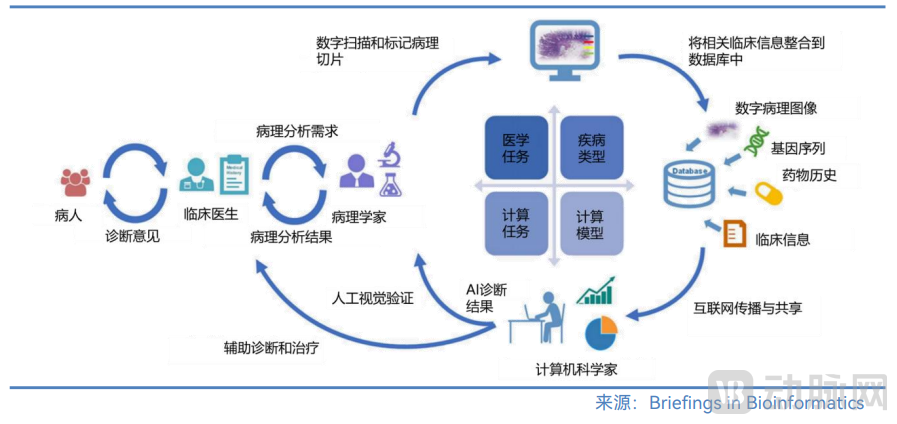
Workflow Diagram for Multimodal, Integrated Intelligent Pathology-Assisted Diagnostic Scenarios
Next-Generation Diagnostic Pathology to Achieve“Precision Diagnosis”and"Smart Healthcare"as the core objective. Based on this core objective, the development of next-generation diagnostic pathology should be supported by “two legs,” one beingOmics and Bioinformatics Technologies, secondlyDigital Intelligence Technology。
First, spatial omics can comprehensively decode the tumor microenvironment and is key to understanding immunotherapy responses and clinical outcomes. As spatial omics technologies are increasingly applied in pathological diagnosis, they provide strong impetus for the development of next-generation diagnostic pathology.
In recent years, the toolkit of pathology omics technologies has continued to expand, with spatial pathology experiencing robust growth. A diverse array of technical approaches has emerged, including multiplex fluorescent immunohistochemistry, single-cell sequencing, and multiplex immunofluorescence. These technologies generally feature multi-target detection, provide spatial localization information of tissue and cellular markers, and require AI-powered software for analysis, thereby meeting the demands of spatial pathological diagnosis. Currently, various omics technologies exhibit slight differences in terms of technical characteristics, application positioning, and maturity levels.
Secondly, the fully digitalized smart pathology department also represents the development direction of next-generation diagnostic pathology. The "14th Five-Year Plan for Digital Economy Development" issued by the State Council points out that it is necessary to accelerate the construction of smart hospitals and promote telemedicine. As a result, pathology departments have seized this opportunity to improve quality and efficiency, accelerating their digital and intelligent transformation.
Next-Generation Pathology Technologies: Pioneering New Breakthroughs
Within the expansive landscape of next-generation diagnostic pathology, multiplex fluorescence immunohistochemistry is emerging with its unique advantages.As a critical tool for predicting immunotherapy response and survival prognosis, it addresses multiple challenges in the clinical study of the tumor microenvironment.
Particularly for complex tertiary lymphoid structures, multiplex fluorescent immunohistochemistry enables the simultaneous labeling of multiple relevant immune cells on a single tissue section, providing a visual characterization of their architecture. This technique also distinguishes tertiary lymphoid structures by subtype and maturity level, while allowing quantitative assessment of parameters such as density and spatial distribution. This technological breakthrough not only offers new perspectives for research into the tumor microenvironment but also heralds a new direction for next-generation diagnostic pathology.
Quantitative Staining, Quantitative Imaging, and Quantitative Analysis
Traditional methods, such as H&E and chromogenic IHC staining, struggle to accurately detect and quantify tertiary lymphoid structures, failing to capture the depth and breadth of cellular interactions within the tumor microenvironment.
The core of multiplex fluorescence immunohistochemistry lies in its "triple quantification" advantage:Quantitative StainingEnsure that each type of immune cell is precisely labeled,Quantitative Imagingenabling clear visualization of complex cellular structures,Quantitative AnalysisData software is then used to accurately assess cell density, positive area, and other metrics, ultimately quantifying the types, functional localization, density, and spatial distribution of immune cells within different tumor regions through quantitative data.
This technological advantage has enabled multiplex fluorescent immunohistochemistry to demonstrate significant potential in predicting responses to tumor immunotherapy and assessing prognosis, thereby becoming a valuable tool for clinical diagnosis and treatment as well as scientific research. Currently, numerous high-impact articles have been published on topics related to the tumor microenvironment utilizing multiplex fluorescent immunohistochemistry.
Pioneer in the Clinical Implementation of Multiplex Fluorescent Immunohistochemistry
In the clinical implementation of multiplex fluorescence immunohistochemistry, Kuoran Bio has taken a leading position in the industry. With “clinical feasibility” as its premise, the company has overcome challenges related to cost, regulatory compliance, automation, and supply chain maturity, launching a comprehensive multiplex fluorescence immunohistochemistry solution.
The protocol'sAll products have obtained IVD certification., achieving full-process automation from staining to scanning and finally to result reporting. All image information is digitally stored, and test results can be automatically and intelligently interpreted. Meanwhile, Kuoran Biology has also launched six mature tumor microenvironment testing products, providing strong support for clinical diagnosis and treatment.
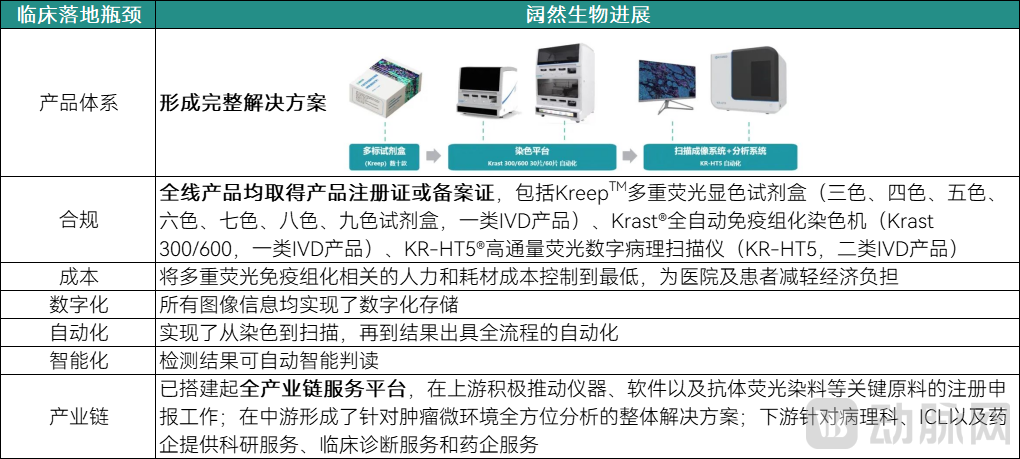
KuoRan Bio Multiplex Fluorescence Immunohistochemistry Solution
It is evident that China has made significant strides in the landscape of next-generation diagnostic pathology, with multiplex fluorescence immunohistochemistry (mF-IHC) technology now at the international forefront. Empowered by mF-IHC, pathological diagnosis is accelerating its transition toward next-generation diagnostic pathology, thereby enabling more precise and personalized patient care.
However, this is far from sufficient, as numerous gaps remain in next-generation diagnostic pathology. In the field of spatial pathology, a combination of multiple technologies is required to discover more biomarkers. Currently, only multiplex fluorescence immunohistochemistry has seen relatively rapid clinical progress. Various sub-technologies related to spatial proteomics, spatial transcriptomics, and spatial metabolomics have yet to overcome bottlenecks in cost, technical stability, and regulatory approval for equipment, making their clinical implementation a distant prospect. In the realm of digital pathology, there is a lack of unified quality control management. The construction of pathological big data, formed by integrating data from immunohistochemistry, molecular testing, TCR sequencing, and other sources, is still in its very early stages. Next-generation diagnostic pathology still faces numerous challenges that need to be addressed.
Based on the needs of clinical pathology in China and the current state of development in next-generation diagnostic pathology, VCBeat believes that,Two types of enterprises will be more competitive—Invest in companies with technologies that offer greater clinical accessibility, as well as those pursuing integrated development.
First, the next-generation diagnostic pathology technology with greater clinical accessibility is currently multiplex fluorescence immunohistochemistry. A surge of achievements is expected in the application of multiplex fluorescence immunohistochemistry, primarily driven by Kuoran Biology’s development of the Kreep™ Multiplex Immunofluorescence Kit and Krast®Fully Automated Multifunctional Immunohistochemistry Stainer, KR-HT5®High-throughput fluorescence digital pathology scanners have formed an integrated solution encompassing staining, imaging, and analysis, providing comprehensive product services for clinical research on the immune microenvironment and driving tangible progress in the clinical implementation of multiplex fluorescence immunohistochemistry.
Recently, Kuoran Bio'sKR-HT5®High-Throughput Fluorescence Digital Pathology Scanner and Krast®The Fully Automated Immunohistochemistry Stainer Was Successfully Installed at Fudan University Shanghai Cancer Center.Furthermore, at the Chinese Academic Conference on Tumor Markers, the CD8/PD-L1/CD20/CD23/Cytokeratin (Pan) Antibody Detection Kit (Multiplex Fluorescent Immunohistochemistry) submitted by Kuoran Biology was awarded the First Prize for “2023 Innovative Technology in Tumor Markers,” KR-HT5®The high-throughput fluorescence digital pathology scanner also won the Gold Award for Excellent Innovative Products in China’s In Vitro Diagnostics Industry at the 2023 “Star of Innovation” Awards.
Next is business integration. The core direction of next-generation diagnostic pathology is “multimodal, integrated intelligent pathology-assisted diagnosis.” Driven by this concept, industrial convergence will further accelerate, the boundaries between various segments will gradually blur, and companies will hasten to extend their industry chains and expand their business layouts. Quest Diagnostics, a leading independent clinical laboratory in the United States, recently announced the acquisition of certain assets from PathAI, marking its entry into AI-powered pathology—a clear manifestation of such industrial convergence.
In this regard, Kuoran Biotechnology has ventured into multiple business areas, including multiplex fluorescence immunohistochemistry, molecular pathology, and digital intelligent pathology, covering the two core objectives of next-generation diagnostic pathology: "precision diagnosis" and "smart healthcare." Among these, the company’s multiplex fluorescence immunohistochemistry technology, combined with molecular pathology, enables an integrated diagnostic and therapeutic approach spanning from genes to proteins and phenotypes. Additionally, its domestically produced smart digital pathology instruments can acquire high-quality images, making testing faster and more accurate.
Overall, current technological products in the pathology industry are not yet capable of meeting the higher demands of next-generation diagnostic pathology in areas such as multi-omics, cross-scale, and multi-dimensional integrated diagnosis. This situation presents abundant opportunities for reshaping the market landscape.
In the coming years, the field of pathology will enter an accelerated phase of technological innovation, with the rapid adoption of a series of mature spatial omics technologies and the strengthening of bioinformatics capabilities. At the hospital level, there will be active coordination among pathology, information technology, and other clinical and medical technology departments to jointly build next-generation pathology departments. At the society level, efforts will also be intensified to accelerate the development and refinement of relevant industry standards. It is reported that several large tertiary A hospitals in China are currently constructing next-generation pathology departments, and multiple landmark achievements are expected to emerge intensively within the next two to three years.