

Modern Dental Group: China's Top Oral Healthcare Exporter with Global Revenue of HK$3.172 Billion in 2023
As domestic dental companies scramble to prepare for global expansion, one enterprise has already established a deep presence in Europe, North America, Australia, and other markets, completing its global footprint. In 2023, it achieved exceptionally high revenue of HK$3.172 billion (approximately RMB 2.949 billion).
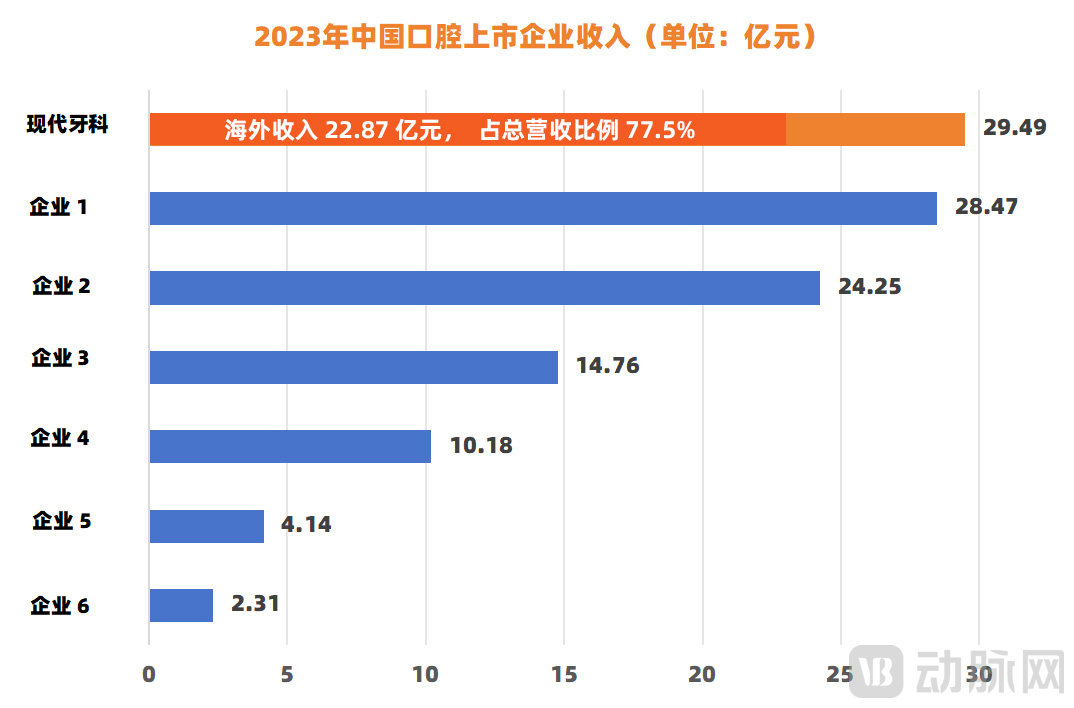
(Data source: corporate financial reports; revenue figures reported in Hong Kong dollars were converted at an exchange rate of 1 HKD ≈ 0.9301 CNY; revenues of listed companies using fiscal years that differ from the calendar year were excluded from the statistics)
This revenue achievement not only belongs to2023The leading dental company in China, with the highest degree of internationalization.——Overseas revenue reached HK$2.458 billion (approximately RMB 2.287 billion), accounting for 77.5% of the company’s total revenue, approaching 80%.
The company is named Modern Dental. Financial reports indicate that Europe has become Modern Dental’s highest-revenue region, with revenue reaching HK$1.399 billion in 2023, followed by North America (HK$594 million in 2023) and then the Greater China region (mainland China, Hong Kong, and Macau). Undoubtedly, Modern Dental has emerged as a leading Chinese dental enterprise expanding into overseas markets.
As going global becomes the new trend for dental enterprises, what lessons can be drawn from the case of Modern Dental Group Limited? How did it achieve its global layout step by step? And how did it build its corporate moat? This article will attempt to answer these questions.
The story of Modern Dental Group Limited dates back to 1986.
At that time, Chen Guanbin, a dental technician, saw the potential in the denture business and founded Modern Dental Group Limited in Hong Kong. By establishing denture manufacturing facilities, the company gradually began producing custom-made denture appliances for local dental clinics in Hong Kong.
It is important to note the following industry background: Within the entire dental industry chain, denture manufacturing factories occupy the midstream position, belonging to the processing and manufacturing segment. Their upstream suppliers provide consumables (including resins, metals, ceramics, titanium alloys, zirconia, etc.) and equipment, while their downstream clients are dental healthcare service providers.
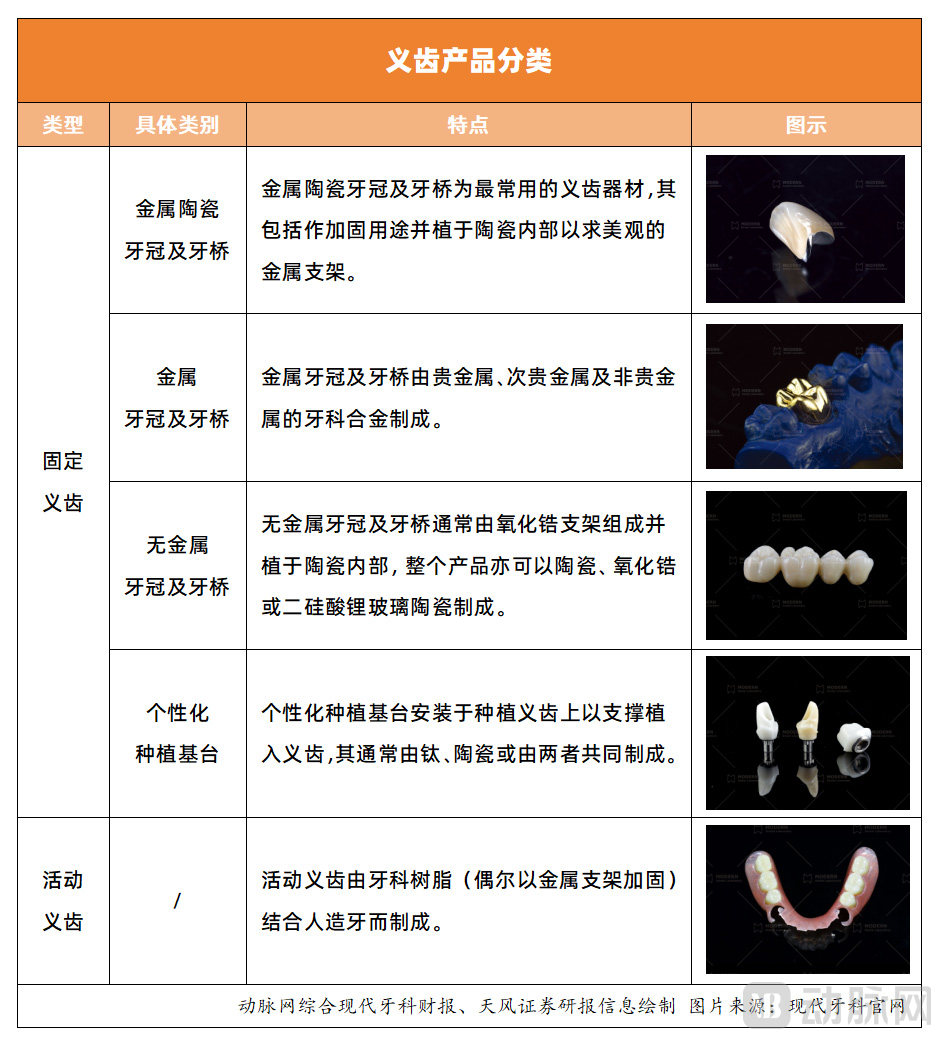
At that time, due to the relatively complex manufacturing processes for denture materials, the barrier to entry in the denture market was relatively high, which resulted in higher gross profit margins. It was preciselyWith high product barriers and solid profitability, Modern Dental Group Limited quickly established its footing, capturing half of the denture market share in Hong Kong. However, it soon encountered a bottleneck.
On one hand, the Hong Kong market is not particularly large, causing Modern Dental Group Limited’s performance to stagnate after capturing more than half of the local market share, with the growth ceiling for its dental prosthetics business proving difficult to break through. On the other hand, as a non-standardized industry, the expansion of the dental prosthetics business requires close collaboration with downstream medical service providers to acquire more patient data and convert it into customers.
Furthermore, due to the high labor costs in Hong Kong, the competitiveness of Modern Dental’s denture products in the local market has been gradually declining, whereas their product prices remain highly competitive in developed countries. According to details previously disclosed by Wei Shengjian, Executive Director of Modern Dental Group Limited, in a media interview, more than two decades ago, dentists in Hong Kong were dissatisfied with Modern Dental’s pricing, while customers in Europe and the United States remarked that “the prices are so affordable.”
These factors have all driven Modern Dental Group Limited to expand overseas in search of larger markets, thereby achieving faster growth.
In response, Modern Dental has taken a two-pronged approach: first, it actively conducted overseas visits and acquired established distributors in Europe and the United States, thereby establishing connections with local dental healthcare service providers; second, it sought more cost-effective manufacturing bases suitable for large-scale production—in 1992, Modern Dental established its first large-scale production base in Shenzhen.
Following this supply chain, Modern Dental Group delivers denture products to global customers from Shenzhen in the form of subcontracted processing with supplied materials.
Certainly, Modern Dental also capitalized on the dividends of the era during this process. In 1992, benefiting from favorable policy winds, Shenzhen was at a critical juncture of vigorous manufacturing development, offering abundant low-cost labor and preferential land policies. The establishment of Modern Dental’s large-scale production base there helped bolster the global competitiveness of its dental prosthetics.
Thus, the globalization of Modern Dental Group Limited benefited from “human harmony” (precise strategic formulation and efficient execution by its management), “geographical advantage” (Hong Kong’s status as an international financial center), and “favorable timing” (supportive policy tailwinds).
As the business expands, Modern Dental Group LimitedIn terms of global expansion, we continue to strengthen two key pathways: overseas mergers and acquisitions, and factory construction.
· In terms of overseas mergers and acquisitions, Modern Dental Group Limited has been accelerating its pace in recent years. For instance, in 2016, Modern Dental Group acquired MicroDental Laboratories Inc. and its affiliates, a move that provided significant support for the company’s entry into the North American market. According to incomplete statistics compiled by VCBeat from public sources, Modern Dental Group has carried out at least 10 global M&A transactions between 2014 and 2024.
· In terms of factory construction, following Shenzhen, Modern Dental Group Limited commenced construction of its Phase I and Phase II production bases in Dongguan in December 2016 and April 2021, respectively; in March 2023, the ACESO production base established by Modern Dental Group Limited in Dong Nai, Vietnam, broke ground.
By 2024, Modern Dental Group Limited had established a global distribution and sales network, as well as production bases in Shenzhen, Dongguan, and Dong Nai, Vietnam.
Global Expansion Drives Global Revenue. Financial reports indicate that Modern Dental Group Limited’s operations are segmented into five major regions: Europe, North America, Greater China, Australia, and Others. In 2023, its overseas revenue totaled nearly HK$2.5 billion. Among these, the European market generated the highest revenue, reaching HK$1.399 billion in 2023—an increase of HK$218 million from 2022—reflecting a sustained upward trend.
Undoubtedly, the story of Modern Dental’s global expansion, from Hong Kong to the world, has borne fruit.
To establish a foothold in the global market, product development is of paramount importance.
According to the financial report, Modern Dental Group Limited's currentThe product portfolio and core business operations can be categorized into three major segments: (1) fixed prosthodontic devices (crowns and bridges); (2) removable prosthetic devices (dentures); and (3) other customized devices (orthodontic appliances, anti-snoring devices, and sports mouthguards).
In terms of revenue proportion, fixed prosthodontic devices generated HK$1.985 billion in 2023, accounting for approximately 66.6% of total revenue; removable prosthodontic devices recorded HK$712 million in 2023, representing about 23.9% of total revenue; and other custom-made devices brought in HK$283 million in 2023, making up roughly 9.5% of total revenue. Evidently, fixed prosthodontic devices constitute the primary revenue driver for Modern Dental Group Limited.
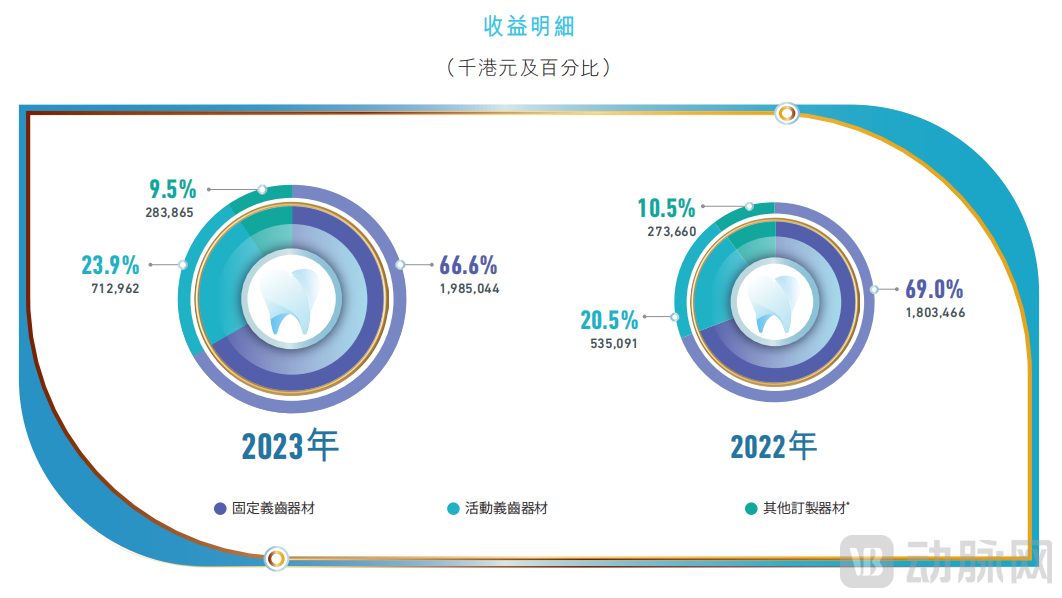 (Image source: Modern Dental Group Limited 2023 Annual Report)
Modern Dental’s products generate nearly HK$2.5 billion in revenue globally. What is the unique secret behind this success? VCBeat believes there are two main reasons.
1. High degree of digitalization.A senior figure in the oral care industry previously stated that, in the past, denture fabrication was integrated with traditional dental practice, with dentists handling both restorative procedures and prosthetic work. Individual dentists or small dental clinics could fabricate dentures in-house. With the global trend toward chain-based dental institutions and increased market specialization, independent denture processing laboratories have gradually become more prevalent. In the early stages of industry development, product manufacturing in these laboratories relied primarily on manual operations by dental technicians, resulting in low efficiency. When faced with growing demand for denture fabrication, these laboratories often struggled to meet capacity requirements.
Furthermore, the mainstream technology for previous denture fabrication was casting, which involved multiple intermediate steps and a highly detailed workflow, including wax pattern creation, investing, casting, grinding, polishing, and porcelain layering. At times, collaboration among more than ten personnel was required to complete the process. The complexity of these procedures made errors inevitable, and the greater the number of steps, the larger the accumulated errors.
Thus, starting in 2007, Modern Dental Group Limited embarked on its digital transformation, becoming an early adopter of CAD/CAM technology within the industry and introducing digital equipment. Financial reports indicate that the company currently operates five digital production centers located in Hong Kong, the United States, Australia, Malaysia, and Germany, having established a centralized digital workflow, infrastructure, and network.
Thanks to digital investments, dentists can create 3D digital impressions for patients using intraoral scanners. Modern Dental Group Limited then designs denture framework models based on these impressions using technologies such as CAD, and finally manufactures the final products using automated machinery, significantly simplifying the entire process.
Moreover, digitalization has enhanced the competitiveness of Modern Dental Group Limited. Financial reports show that as of December 31, 2023, the number of digital solution cases produced at Modern Dental’s manufacturing facilities in mainland China increased to approximately 857,000, representing a year-on-year increase of 55.9% from approximately 549,000 during the same period in 2022, driven by greater adoption of intraoral scanners by customers.
Second, expand product categories.Around 2020, Modern Dental Group Limited launched its self-developed clear aligner brand, TrioClear, formally entering the clear aligner orthodontics market. According to financial report data, TrioClear’s sales revenue in 2023 was approximately HK$33.686 million, representing a 30.7% year-on-year increase from HK$25.761 million in 2022.
Behind this lies the fact that, after successfully expanding overseas, Modern Dental Group Limited’s core competitive advantage is shifting from cost-effective products to a global network of dentists. Through this network, the company can theoretically provide more dental products and solutions to oral health patients worldwide.
Why, then, is the strategic bet being placed on the clear aligner orthodontics sector? The core rationale lies in its sustained market growth. According to the “Global Clear Dental Aligners Market Report 2023–2029” published by QYResearch, the global market size for clear dental aligners is projected to reach USD 350 million by 2029, with a compound annual growth rate (CAGR) of 17.5% over the coming years. Modern Dental Group Limited’s entry into this field at this juncture is also aimed at capitalizing on the dividends generated by the industry’s rapid expansion.
However, as a latecomer, Modern Dental Group Limited, despite its advantages in global distribution channels, will still need time to catch up with leading players in the clear aligner sector, such as Invisalign, Angelalign, and Smartee; its future performance remains to be seen.
In summary, leveraging its globalized network, Modern Dental Group has advanced digitalization while continuously expanding its product categories, thereby refining its product portfolio. This strategy has enabled the company to maintain robust growth and emerge as a representative Chinese dental enterprise in overseas markets.
Over the past three years, driven by a series of factors including the centralized procurement of dental implants and slowing economic growth,China's dental market enters the "stock" era, with increasing competition in the dental sector.
The most intuitive manifestation is the “price war.” Across the industry, prices are being lowered to capture customers, whether in the device and consumables segment represented by dentures or in clinical services. A dental industry practitioner told VCBeat that under normal circumstances, the processing fee for zirconia is around RMB 200. However, in a bid to win clients, some dental laboratories have quoted zirconia processing fees as low as RMB 60, forcing many material suppliers into intense competitive pressure.
Even more exaggerated is the situation in the field of dental implants, where numerous private dental clinics have rolled out promotional offers and steep price cuts, with some even advertising slogans such as “90% off the first dental implant” and “Get a free car with your implant.”
The above cases are too numerous to count. In the face of these challenges, an increasing number of enterprises are seeking ways to break through.
Going global has become an important choice.VCBeat has observed that numerous dental companies, including Aidite, Upcera, Angelalign, Smartee, Woodpecker, Resun, Fussen Technology, Hugel, and DeepCare, are expanding overseas—either by establishing a local market presence or by attending exhibitions for market research.
Taking Angelalign as an example, the companyIn 2023, the commercialization of international business was officially launched, entering more than 30 countries and regions. According toAnnual report data shows that Angelalign achieved a total of 245,000 cases last year, a year-on-year increase of 33.2%. Among these, international market cases reached 33,000, accounting for 13.5% of the total cases.This indicates that the growth in case volume in international markets has become a key driver of Angelalign’s overall case volume growth.
In terms of destination selection, Angelalign entered the mainstream international orthodontic markets in Europe, Australia, and the Americas. In 2022, leveraging the international resources of its controlling shareholder, Shuangbai Investment, Angelalign announced the acquisition of a 51% equity stake in Aditek, a local Brazilian orthodontic product manufacturer.
Similarly, as a leading enterprise in China’s clear aligner orthodontics sector, Smartee has also entered markets such as the United Kingdom, Singapore, Spain, Colombia, and Saudi Arabia, with its product lines—including Smartee Ge, Smartee α, Smartee Teen, and Smartee Kinder—all being used in clinical practice overseas.
However, it is also important to recognize thatThe prospects for global expansion appear promising, but actual implementation is not as straightforward as imagined.Whether it is the significant differences in cultural environments, regulatory processes, approval systems, and distribution channels across various countries, or the challenges of aligning corporate strategies, controlling overall costs, and recruiting and managing international talent, all these factors have substantially increased the difficulties for dental enterprises expanding into overseas markets.
Therefore, it is particularly important to learn from industry leaders by studying and observing their successful experiences and the pitfalls they have encountered, thereby reducing the likelihood of taking detours.
Beyond Going Global,Expanding into multi-category products and evolving into platform enterprises has also become a choice for many companies.In the field of dental consumables and instruments, it is often difficult for a single product to sustain a company with high revenue and high growth. A review of the current top ten global dental brands reveals that only Invisalign follows the strategy of focusing on a blockbuster product, while others, such as Dentsply Sirona, Danaher, and Straumann, are all platform-based enterprises.
This is because the oral care sector comprises numerous niche segments, each with limited actual market size and a relatively low growth ceiling. Relying on a single product makes it difficult to build a great enterprise. Moreover, companies with a single product line have poor risk resilience; without formidable competitive barriers, they often find themselves in a passive position when facing events such as volume-based procurement (VBP) or aggressive market share grabs by competitors, which will adversely affect their scale expansion and profitability.
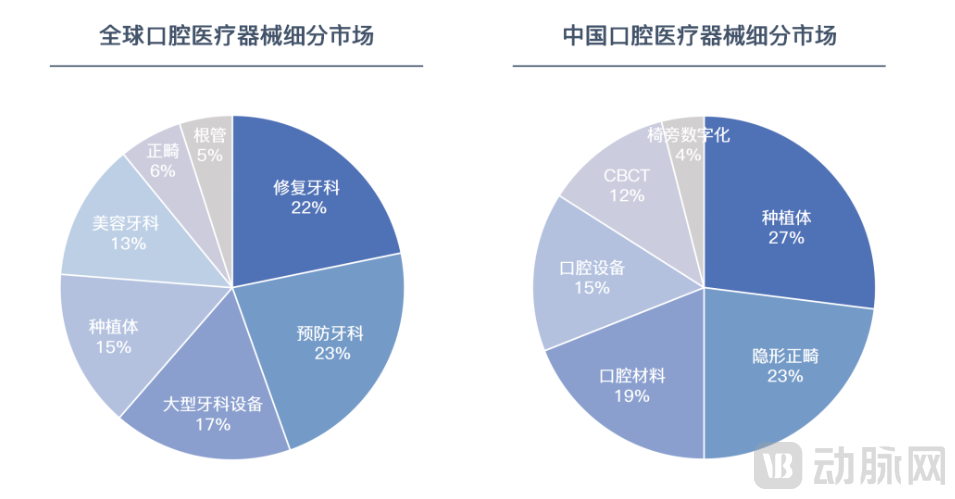 (Breakdown of Global and Chinese Dental Medical Device Markets by Segment; Source: Gaogu Capital)
In this regard, GaoHu Capital pointed out in its article “The Upstream Dental Sector: The ‘Chain Masters’ Behind the Golden Track and Three Major Trends Launching a New Journey” that platform-based enterprises have significant room for synergy in branding, R&D, and distribution channels. This facilitates the sharing of successful product experiences and domestic and international channel resources, thereby accelerating product R&D cycles and enabling cross-selling (such as sales across different product lines and between domestic and overseas markets). From the perspective of patient experience, achieving a closed-loop digital treatment journey also relies on the coordination of multiple product lines.
Of course, compared with companies focusing on blockbuster products, platform-based enterprises face greater management challenges and must pay closer attention to controlling their development stages and pace.
Regardless, as an increasing number of Chinese dental companies embark on dual strategies of global expansion and platformization, China’s industrial innovation narrative is poised to resonate more prominently on the international stage, delivering a compelling business story.
References:
1: Official Website of Modern Dental Group Limited
https://www.moderndentallab.com/
2: “Modern Dental Acquires Denture Distributors in Norway, Germany, and Other Countries to Expand Its European Distribution Network” — 36Kr
https://36kr.com/coop/xiaozhi/5052915.html
3: “After Dental Centralized Procurement, Angelalign Bets on AI and Global Expansion” — Jiemian News
https://baijiahao.baidu.com/s?id=1801739197159878758&wfr=spider&for=pc
4: “Upstream of the Oral Care Industry: The ‘Chain Master’ Behind the Golden Track, Three Major Trends Kick Off a New Journey” – Gaohu Capital
https://mp.weixin.qq.com/s/KNtocE9ZSMu6N8fvM2rdKw