

Nanjing Drum Tower Hospital Announces Patent for a Novel Anti-Migration Cardiac Stent
Recently, Nanjing Drum Tower Hospital Had a New Cardiac Stent Patent Published.This patent is for a stable, anti-migration cardiac stent., which can reduce the potential for deformation at stent junctions, enhance stent support strength, and improve therapeutic efficacy.
Traditional coronary stents expand and support the coronary arteries upon reaching the lesion. However, due to their uniform thickness, the stent connectors are highly prone to deformation during expansion as a result of uneven pressure distribution, which significantly compromises their radial support. These factors may lead to insufficient postoperative blood flow and in-stent restenosis, potentially causing secondary harm to patients.
This patent employs a novel braiding technique that enables all elliptical rings and helical rods to contract synchronously, thereby enhancing the stability of the device.This improvement not only provides the cardiac stent with robust radial support but also prevents displacement of the cylindrical stent, thereby reducing the risk of repeat surgery.
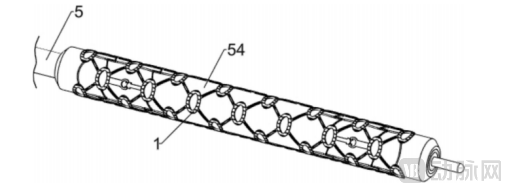 Image source: Patent specification
I. Three Major Development Characteristics of Cardiac Stents
The Development of Coronary Stents Has UndergoneBare-metal stents, drug-coated stents, drug-eluting stentsandBioabsorbable StentsFour Stages.
Beyond the overarching trends, advancements in industrial technology have given rise to new developments in cardiac stent R&D, such as personalization and precision, intelligence and remote monitoring, and biomimetic design with enhanced functionality.
3D printing technology can personalize the shape and size of stents to best suit a patient’s specific anatomical structures and physiological characteristics, thereby improving surgical success rates and treatment outcomes.However, no 3D-printed cardiac stents have been commercialized to date, with most products still undergoing regulatory review.For instance, Beijing Aimed Medical has developed AMSorb, a 3D-printed fully bioresorbable coronary stent. Manufactured using 3D multi-axis precision printing technology, this stent is a drug-eluting device made from biodegradable materials. Currently, the product has entered the National Innovative Medical Device Special Review Channel and is undergoing randomized controlled trials (RCTs).
According to public information, Amet possesses globally leading “3D multi-axis precision rapid printing patent technology” and complete independent intellectual property rights. This not only breaks the technological monopoly held by overseas companies in the preparation of absorbable polymer scaffolds using laser cutting technology, but also improves production efficiency and reduces costs.
Biomimetic and smart cardiac stents are currently under development, with no commercialized products available on the market at present.In 2018, Guo Baolin’s team at Xi’an Jiaotong University publicly unveiled an achievement titled “Three-Dimensional Bionic Scaffold Mimicking the Natural Myocardial Tissue Structure.” By integrating conductive nanofiber bundles with photocurable hydrogel technology, the team fabricated a composite three-dimensional bionic scaffold for the construction of engineered three-dimensional myocardial tissue. This bionic scaffold not only provides the structural support characteristic of conventional scaffolds but also promotes the repair and regeneration of myocardial tissue.
II. Significant Increase in Market Share of Domestically Produced Products Following Centralized Procurement
In 2020, coronary stents were included in the national centralized volume-based procurement program. In the initial procurement round, a total of 11 companies participated in the bidding, with 26 coronary stent products registered and marketed in China taking part.
Following the volume-based procurement (VBP) program, the price of coronary stents dropped by more than 90%, with the average price falling to RMB 700–800. This price reduction directly stimulated the expansion of the market size for domestically produced coronary stents in China. Based on the share of winning bids in the 2022 national VBP for coronary stents, domestic manufacturers such as Lepu Medical, MicroPort Scientific, and Blue Sail Medical have ranked among the top tiers, indicating that import substitution has been largely achieved in this sector.

The Three Major Tiers of Centralized Procurement in 2022
From the perspective of market share,MicroPort, Boston Scientific, Medtronic, Blue Sail Medical (its cardiovascular subsidiary is Shandong Jiwei)andLepu MedicalThe total winning bid volume exceeded 1.616 million units, accounting for 87%.
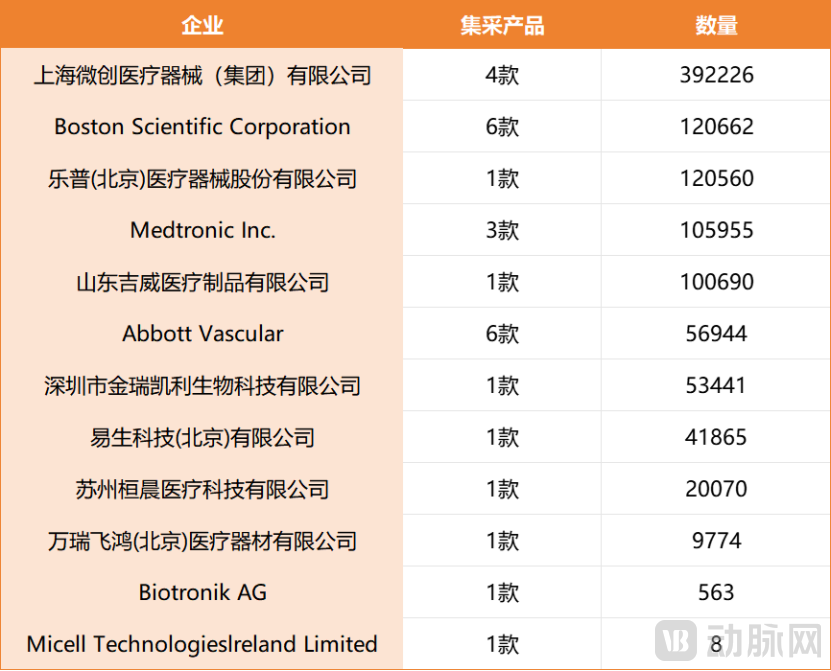 Summary Table of Intended Procurement Volumes for the First Year (Data Source: National Centralized Volume-Based Procurement Documents for Coronary Stents)
Currently, domestic enterprises are also actively expanding into overseas markets.According to statistics, Lepu Medical’s products have obtained 33 U.S. FDA approvals and 171 EU CE certifications, with its sales network covering more than 160 countries and regions worldwide. Meanwhile, MicroPort®’s Toumai® endoscopic surgical robot system has also received EU CE certification under the Medical Device Regulation (MDR). MicroPort Endovascular’s Hyperflex® balloon dilation catheter has gained registration approval from Japan’s Pharmaceuticals and Medical Devices Agency (PMDA).