

Chinese Medtech Firms Win Big with Wave of German Company Acquisitions

Optimum Medical
Medical Device Developer

Endovastec
Developer and Manufacturer of Aortic and Peripheral Vascular Interventional Medical Devices
On July 1, Endovastec announced its intention to acquire the European medical device company Optimum Medical for $65 million. Upon completion of the acquisition, Optimum Medical’s subsidiariesLombard Medical will becomeEndovastecBusiness Hub for the European Market. By leveraging Lombard Medical, Endovastec will enhance its sales network and channel resources in the European market, enrich its product pipeline, and drive the company’s sales performance.
In fact, not only Endovastec but also other innovative medical enterprises in China regard the European market as one of their core destinations for global expansion.For example, in April 2024, Optimum Medical, an orthopedic consumables company, acquired the German high-end dental implant manufacturer HT Dental for €3.246 million. This acquisition provides Optimum Medical with the opportunity to further expand its overseas market by leveraging HT Dental’s distribution channels and sales networks in regions such as the European Union, Mexico, and Malaysia.
In December 2023, Acotec Medical acquired the German cardiovascular company Eucatech AG for €2.4 million. This acquisition not only enriched Acotec Medical’s product portfolio but also strengthened its distribution network and market position. In the same month, Mindray Medical acquired DiaSys, a well-known German in vitro diagnostics (IVD) company, for €115 million, enabling it to rapidly establish an overseas supply chain platform and enhance its IVD product offerings.
In addition, innovative medical companies such as Wobi Medical, Leno Medical, MicroPort Medical, and Tianying Medical have also increased their investments in the European market through acquisitions, with targets covering high-end medical device sectors including neurointervention, endoscopy, ECMO, and dental lasers.
Driven by the collective efforts of numerous domestic medical device enterprises, China’s medical device exports to the EU market reached USD 2.018 billion in the first quarter of 2024, a year-on-year increase of 7.8%. The growth in exports to mature markets such as the EU and the United States has also helped China’s medical device sector return to positive growth, ending four consecutive quarters of decline.
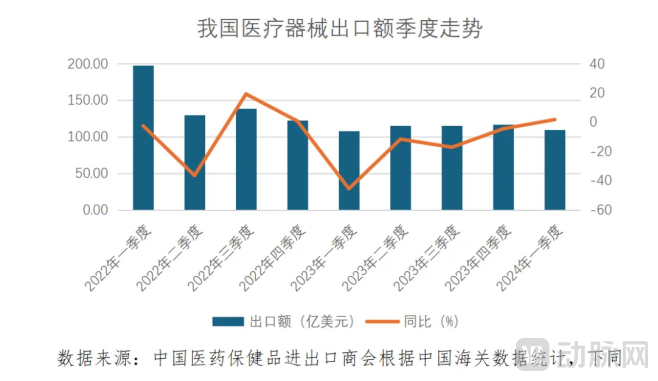
It is worth mentioning that,Some domestic companies (such as those mentioned above) have chosen to accelerate their expansion into the European market by acquiring German medical enterprises.This is because German medical devices enjoy a high reputation in the global market, and acquiring relevant German companies allows acquirers to gain access to their high-quality products and brand endorsement. Meanwhile, approximately two-thirds of medical devices manufactured in Germany are exported, meaning these companies possess established overseas market channels. Acquiring such enterprises enables the acquirer to directly obtain their sales networks, thereby facilitating rapid international expansion.
Furthermore, Germany is one of the core markets in Europe, accounting for approximately 25% of the total European market. Its market size is twice that of France and three times that of Italy, the United Kingdom, and Spain. Based on historical data, Germany has consistently ranked among the top ten export destinations for China’s medical devices, often securing the second or third position.
As one of the top three export markets for China's medical devices, what makes the German market so appealing?
In 2023, the total value of medical devices exported from China to Germany amounted to approximately USD 2.402 billion, representing a 42.98% increase from USD 1.68 billion in 2019. This indicates that a growing number of Chinese medical device companies are expanding into the German market.
Why Is Everyone Expanding into Germany?
First, the German healthcare market is substantial in scale. Germany has nearly 1,900 hospitals, 2,500 medical supply stores, 1,151 rehabilitation centers, 2,023 independent pharmacies, 140,000 physician clinics, and 378,600 physicians. Based on its population (approximately 84.7 million), economic level, and medical resources, Germany has been the largest medical device market in Europe for many consecutive years.According to data released by MedTech Europe, the size of Germany's medical device market in 2022 was approximately €43 billion (equivalent to RMB 336 billion).。
Meanwhile, the German market demonstrates stronger purchasing power for high-end medical devices. Although Germany has a population of only 84.7 million, its healthcare expenditure has long ranked among the highest globally. In 2020, Germany’s healthcare spending reached €440.6 billion, a year-on-year increase of 6.5%, accounting for 13.1% of its gross domestic product (GDP). By comparison, China’s total health expenditure accounted for approximately 7% of its GDP in 2022.
Zhou Zhifu, an industry insider with extensive experience in the German market, stated, “At present, the sales volume and revenue of innovative medical devices such as continuous glucose monitoring (CGM) systems in Germany are both higher than those in the domestic market.”
Secondly, the German market offers higher profit margins. Unlike the domestic market, price wars in Germany are not fierce, and companies all strive for a certain level of profitability. For some medical devices that face intense competition in China,Its profits in the German market can be several times higher than those in the Chinese market.。
Zhou Zhifu stated, “After engaging with numerous medical device companies in Germany, I found that firms in the German market typically do not deliberately lower product prices or sacrifice their profits merely to boost revenue.”
Once again, Germany and China maintain robust trade relations. The Federal Statistical Office of Germany (Destatis) previously reported that the volume of goods traded between Germany and China reached €254.5 billion in 2023, with China remaining Germany’s most important trading partner for the eighth consecutive year.
Finally, due to its strategic location and role as a lead market, Germany is regarded by many Chinese companies as a bridgehead for expanding into Europe. Geographically, Germany is situated in Central Europe, bordering Poland and the Czech Republic to the east, Austria and Switzerland to the south, the Netherlands, Belgium, Luxembourg, and France to the west, and Denmark to the north. It has the largest number of neighboring countries in Europe and is a key member state of the European Union.
In terms of transportation, Germany boasts the world’s fourth-longest highway network and a nationwide railway system. The German railway network spans approximately 38,000 kilometers, connecting not only domestic regions but also extending to multiple countries and territories, including France, the United Kingdom, the Netherlands, Belgium, Luxembourg, and Switzerland. Additionally, Germany has developed inland waterway transport channels leveraging rivers such as the Danube and the Rhine, enabling corporate products to reach the Port of Rotterdam in the Netherlands via inland waterways for overseas export.
Moreover, the German market is both pioneering and influential. Once companies achieve success in Germany, they find it easier to expand into other European markets such as the Netherlands and France. Hu Bo, Director of Regulatory Affairs for China at ELLECOM, stated, “German standards exceed EU standards. Leveraging its globally leading high-quality clinical resources and numerous internationally renowned clinical experts and professors, Germany’s clinical research and clinical trials are recognized worldwide.”
The RMB 336 billion market opportunity is too tempting to resist, but breaking into the German market is no easy feat. Just as innovative medical devices encounter numerous challenges in the Chinese domestic market, they face even greater and more complex difficulties in Germany due to factors such as cultural differences, regulatory policies, workforce dynamics, and collaboration landscapes.
According to Dr. Sun Qian, the person in charge of Midea Yin’s overseas expansion project in Germany, entering the German market with medical devices typically involves several stages: market research, compliance analysis, registration and certification, market access, academic promotion, marketing, and after-sales service.
"Know yourself and know your enemy, and you will never be defeated in a hundred battles."The first step to entering the German market is undoubtedly thorough market research.Only with a thorough understanding of the target market can tailored marketing strategies be formulated. Generally, research components include local epidemiological analysis in product-related fields, niche segment analysis, policy and application market studies, regulatory compliance assessment, and competitive analysis.
Previously, Meidiyin collaborated with a renowned domestic medical enterprise, leveraging localized market analysis and feedback on market demands to help the company upgrade its IVD testing products to meet the usage needs of the target population in Germany. Subsequently, Meidiyin assisted the enterprise in obtaining qualification certification for the upgraded products, making them among the first in their category to receive EU approval. This enabled early entry into major distributor channels and achieved a significant market share.
According to reports, MedRhein is a full-process service provider that facilitates the expansion of medical device companies into German-speaking markets. It identifies market demands in these regions and assists Chinese enterprises with preliminary market research, product compliance (including registration and clinical trials), warehousing and logistics, product localization, and market sales. To date, MedRhein has established partnerships with over 50 domestic medical device manufacturers.
Following market research, the next phase is registration and market access.Hu Bo, Director of Regulatory Affairs for China at ELLECOM, stated: “When registering and certifying medical device products, if domestic enterprises have not established a physical business presence within the European Union, they are required to appoint an EU Authorized Representative. This Authorized Representative will serve as the liaison between domestic enterprises and the competent authorities of EU member states, assisting companies with product registration and certification, collaborating with distributors to handle safety incidents and Field Safety Corrective Action (FSCA) reports, and providing up-to-date copies of technical documentation or CE Declarations of Conformity for regulatory inspections.”
It is reported that ELLECOM is a regulatory solutions service provider based in Germany and Switzerland, offering regulatory solutions and market access services for medical devices in the European Union, Switzerland, India, and China. It provides EU Authorized Representative registration and clinical validation services for manufacturers of medical devices and in vitro diagnostics.Throughout its years of service, it has been observed that some companies have failed to complete registration in a timely manner, thereby delaying product launches, due to the lack of corresponding technical documentation, risk management files, or ISO 13485 quality management system certification documents.。
At present, due to the updates and iterations of EU regulations, medical devices and in vitro diagnostic (IVD) products are facing stricter supervision and more cumbersome registration processes under the new Medical Device Regulation (MDR) and In Vitro Diagnostic Regulation (IVDR). Dr. Sun Qian from Midea stated, “Previously, only about 20% of medical devices required review by EU-designated Notified Bodies during the registration process. However, now approximately 80% of registered products will be subject to such review. While the workload of Notified Bodies has increased significantly, the number of officially designated bodies has sharply decreased compared to before. Domestic enterprisesFailure to plan in advance will leave its products stuck in the pending review stage of market access, causing it to miss first-mover advantages.”
To achieve compliant, rapid, and efficient registration and market access, Chinese companies may consider collaborating with local contract research organizations (CROs). By leveraging local CROs, Chinese companies can minimize unnecessary errors and complications, while establishing connections with local clinical experts and distributors introduced by the CRO partners, thereby laying the foundation for subsequent commercialization.
Following market access, the product enters the commercialization phase., encompassing channel positioning and selection, academic promotion and marketing, after-sales service, and more.
In Germany, there are nearly 1,900 hospitals, 2,500 medical supply stores, 1,151 rehabilitation centers, 2,023 independent pharmacies, and 140,000 physician clinics. Different medical devices can access different terminal markets. For instance, interventional medical devices and large-scale medical equipment need to enter the hospital market; home-use medical devices can be sold in medical supply stores; and certain other medical devices can be sold in pharmacies, clinics, and rehabilitation centers.
For different end markets, companies need to adopt distinct sales strategies and distribution channels. For instance, in the retail pharmacy sector, domestic medical enterprises can negotiate directly with chain pharmacy groups to enter the market through measures such as profit-sharing. However, for hospital-based sales, getting medical devices approved for hospital use requires more strategic effort.
Zhou Zhifu stated: “For innovative or high-end medical devices to gain hospital access, it is essential to earn physicians’ trust and recognition. This requires collaboration with clinical experts to conduct clinical studies at corresponding clinical centers, thereby demonstrating the product’s safety, efficacy, and other advantages.such as superior health economic benefits and simpler, more convenient surgical procedures. Upon endorsement by clinical experts, hospital formulary inclusion can be facilitated with their support, followed by subsequent academic promotion and expert lectures.”
Dr. Sun Qian added, “With the endorsement of clinical experts, innovative products will more easily gain the trust and recognition of other physicians. However,”Given Germanywith China inHealthcare SystemAspectdifferences, domestic enterprises establish cooperation with German physiciansthe method ofDomestic SituationMeetingvaries."In Germany, the healthcare system does not impose stringent research and publication requirements on clinicians. While professors and physicians at university hospitals typically engage in research activities, the majority of clinical practitioners face no such pressures; excellence in clinical practice is sufficient."
Previously, Dr. Sun Qian had encountered cases where Chinese companies faced setbacks in expanding into the German market due to their unfamiliarity with the differences between the two countries’ regulatory systems.
To seek collaboration with German clinical experts, companies must present a clear and compelling cooperation proposal at the outset. Typically, Medical Science Liaisons (MSLs) maintain close contact with healthcare professionals—including clinical experts, researchers, and other key opinion leaders (KOLs)—to understand their clinical needs, research interests, and latest ideas, thereby facilitating more effective partnerships between the company and clinical experts. Therefore, domestic companies may consider collaborating with local service teams in Germany to establish partnerships with clinical experts more efficiently and rapidly.
It is worth noting that the majority of German hospitals have joined various purchasing consortia. These consortia play a significant role in the procurement of medical devices and consumables, primarily engaging through key account managers from within the industry. Chinese enterprises should make advance preparations for this landscape.
Hospital listing is not the end goal, but rather the starting point for formal commercialization.After Chinese medical devices enter the German hospital market, they still face formidable local competitors. On one hand, Germany has nurtured world-class medical device giants such as Siemens, Sartorius, Dräger, Zeiss, Richard Wolf, B. Braun, and Erbe. These companies not only enjoy home-field advantage in the German market but also possess comprehensive strengths in capital, brand recognition, and sales channels.
On the other hand, Germany has built an innovative medical device industry cluster, attracting and incubating numerous innovative enterprises. For example, Tuttlingen, a small county-level town in Germany, covers an area of only 734.35 square kilometers but is home to more than 400 medical technology companies. The surgical instruments produced by these companies account for 55% of the global market share, with an annual production and sales volume of 20 million units, representing more than half of the global surgical instrument market.
Furthermore, the German market also attracts other industry giants. Multinational corporations such as Johnson & Johnson and Medtronic have established subsidiaries or production facilities in Germany. Leveraging their strong product portfolios, brand influence, and comprehensive sales channels, these companies have secured a significant presence in the German market.
Dr. Sun Qian stated, “When faced with a multitude of suppliers and products, many end-user hospitals tend to favor trustworthy partners that offer comprehensive pre-sales and after-sales services.” Therefore, for domestic companies to stand out in market competition, they must not only ensure superior product quality and high cost-effectiveness but also build robust pre-sales and after-sales service teams.
Finally, Chinese enterprises expanding into Germany must be mentally prepared: entering the German market inevitably requires significant investment of capital and time, and rapid product scale-up cannot be achieved in the short term. By making these preparations and formulating a clear international expansion strategy before going global, companies may avoid unnecessary setbacks.