

MicroPort Announces Firesorb® (Huo Hun®), the World’s First Next-Gen Bioresorbable Cardiac Stent, Receives NMPA Approval

MicroPort
Innovative High-End Medical Device Group
Recently, MicroPort Scientific Corporation (hereinafter referred to as “MicroPort”) announced thatThe World's First Next-Generation Bioresorbable Cardiac Stent: Firesorb®(Fire Ibis®) Having passed the registration review by the National Medical Products Administration (NMPA), it is about to obtain certification.
Currently Huohuan®The three phases of clinical studies, spanning five years—FUTURE I (first-in-human trial), FUTURE II (randomized controlled trial), and FUTURE III (single-arm target value study)—have been completed, enrolling a total of 1,468 patients. Clinical results demonstrate that HuoNiao®It can restore the patient's diseased blood vessels to their original state, fully degrading into water and carbon dioxide, leaving no foreign bodies in the patient's body.The incidence of thrombosis was only 0.34%.
I. Continue Targeted Elution Technology, Upgrade Thin-Wall Technology
Scarlet Ibis®It is the second-generation thin-strut bioresorbable scaffold developed by MicroPort, indicated for patients with ischemic heart disease caused by de novo coronary lesions.
This product continues the legacy of the first-generation Firehawk.®(Fire Eagle®) ofTargeted Elution Technology, with the drug loaded only on the surface of the stent struts in contact with the vessel wall, thereby reducing the overall drug load. This technology can significantly minimize long-term drug retention in the body and lower the risk of late adverse events.
In terms of material and thin-wall design, Huo Guan®Another breakthrough has been achieved. The stent is made of poly-L-lactic acid (PLLA), which is non-toxic, non-irritating, and biodegradable. Additionally, the team has overcome technical challenges related to “thin-wall technology.”Its wall thickness is only 100–125 µm., than Huoying®It is also 50–55 µm thinner. The thin-wall design facilitates rapid endothelialization after stent implantation and minimizes the impact on hemodynamics, thereby reducing the incidence of in-stent thrombosis postoperatively.
Fire Ibis®YesCurrently the first targeted bioresorbable scaffold with thickness reduced to a level comparable to metallic stents while maintaining equivalent strength, and as a bioresorbable scaffold capable of achieving full-lesion coverage and suitable for the treatment of small-vessel disease, it addresses the challenge of accessibility of bioresorbable scaffolds in small-vessel lesions.
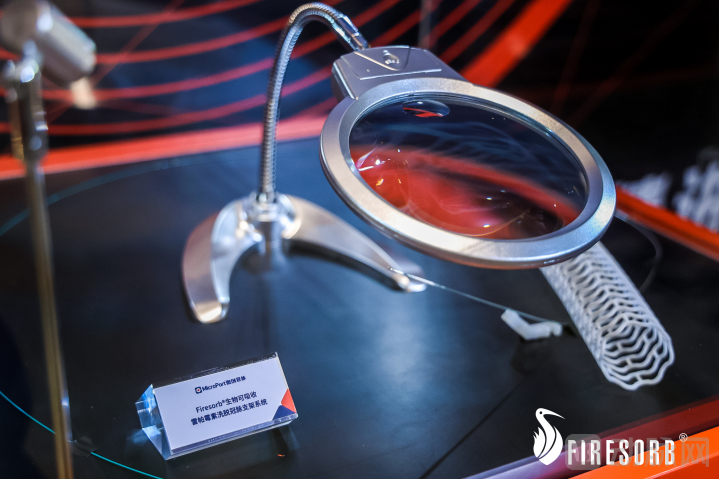 Scarlet Ibis®Stent (Image source: MicroPort)
II. Fierce Competition in Bioresorbable Stents
Implantation of cardiac stents for interventional therapy is currently the most effective method for treating coronary heart disease, but traditional metal stents remain permanently in the body. Therefore, since 2000, many companies both domestically and internationally have been researching bioresorbable stents.
According to public information from the National Medical Products Administration, as of July 2024, except for Firehawk®In addition, there are two other domestically produced bioresorbable stents already on the market in the cardiovascular field.
In February 2019, the National Medical Products Administration approved, upon review,LepuInnovative Products Developed by (Beijing) Medical Device Co., Ltd."Bioabsorbable Coronary Sirolimus-Eluting Stent System"registration.
This product is the first bioresorbable stent in China for treating intravascular stenosis in patients with primary coronary atherosclerosis. The stent backbone and drug-carrier coating are made of the absorbable materials poly-L-lactic acid (PLLA) and poly-D,L-lactic acid (PDLLA), respectively, allowing both the stent backbone and coating to undergo gradual biodegradation and absorption in vivo.
In March 2020, the National Medical Products Administration, upon review, approved ShandongHua'an BiotechInnovative Products Manufactured by Technology Co., Ltd."Bioabsorbable Coronary Sirolimus-Eluting Stent System"Registration. Indicated for the treatment of intravascular stenosis in patients with primary coronary atherosclerosis, to improve coronary blood flow and prevent restenosis. Notably, this stent is compatible with MRI and CT imaging; furthermore, it facilitates repeat stent intervention in the event of restenosis at the target lesion.
Currently, bioresorbable scaffolds marketed in overseas markets includeBiotronik DREAMS 3rd Generation Series, Elixir Medical DESolveetc. And the world's first drug-eluting bioresorbable scaffold for human useAbbott Absorb BVS, it was withdrawn from the market in 2017 due to the long-term risk of target lesion failure and a higher risk of in-stent thrombosis compared to bare-metal stents.