

Fangzhou YunKang Successfully Lists on HKEX, Spearheading the Next Wave of Digital Chronic Care

Fangzhou Pharmaceutical
Chronic Disease Service Platform
On July 9, Fangzhou Cloud Health Holdings Limited (6086.HK, hereinafter referred to as “Fangzhou Cloud Health”) officially listed on the Hong Kong Stock Exchange, with an offering price of HK$8.18 per share and a market capitalization of HK$11 billion. Under its umbrella is the well-known brand “Fangzhou Jianke” (Fangzhou Pharmaceutical), which focuses on online chronic disease management as its core business. Targeting the growing population of patients with chronic conditions, the company provides comprehensive medical services and online retail pharmacy services. Leveraging its extensive resources and deep industry insights, it also offers customized content and marketing solutions to pharmaceutical and medical device companies. According to data from Frost & Sullivan, Fangzhou Cloud Health was China’s largest online chronic disease management platform in 2023, measured by average monthly active users.

Persisting in its journey through internet healthcare, Fangzhou YunKang is now embarking on the next chapter. As the first domestic healthcare company to go public in the second half of the year, Fangzhou YunKang is poised to boost industry confidence.
If 2014 is regarded as Year One of internet healthcare, the industry has now advanced for exactly ten years. In the early stages, various service entry points emerged in rapid succession, with platforms for appointment registration, online consultations, O2O medical accompaniment, diabetes management, internet-based medical aesthetics, and physician communities flourishing in diverse abundance.
Today, some of these platforms have faded from public view, while others have adapted to changing circumstances by continuously correcting their course or iterating their models. Of course, new participants have also joined or exited along the way. Through this process of trial and error, the industry has at least validated the following perspective:Single-point or single-link service models are not viable; a multi-point or systematic service model layout is required.
On one hand, offline medical consultations have given rise to numerous pain points due to the uneven distribution of medical resources and the fragmentation of healthcare services. One of the objectives behind the emergence of internet-based healthcare is to address these challenges, which requires a systematic service model to optimize the allocation of medical resources and enhance the continuity of care.
On the other hand, the healthcare service system is inherently complex. The seemingly simple act of seeking medical consultation involves multiple stakeholders; this holds true for offline services and remains unchanged in the online realm.
Therefore, in recent years, internet healthcare has not only provided basic services such as online follow-up consultations but also continuously enriched its service offerings to meet the diverse needs of patients and users. These include services highly aligned with platform positioning, such as online Multidisciplinary Team (MDT) consultations, intelligent drug inserts, disease management, patient recruitment, and live broadcasts by medical experts.
Founded in 2015, Fangzhou YunKang has witnessed nearly the entire development trajectory of internet healthcare. In this process, it has built an H2H (Hospital to Home) smart chronic disease management service platform (hereinafter referred to as the “H2H Service Platform”).
In 2019, with the launch of the Jianke Doctor app and mini-program, Fangzhou YunKang attracted a large number of registered physicians and users. In 2021, its business line providing customized content and marketing solutions for pharmaceutical and medical device enterprises experienced rapid growth. In 2023, Guangzhou Science City Pharmacy, under Fangzhou YunKang, integrated online payment and settlement via the medical insurance “dual-channel” system, better meeting the medication needs of patients covered by medical insurance.
Overall, Fangzhou HealthCloud has established clear and stable business segments, namely: comprehensive medical services, online retail pharmacy services, and customized content and marketing solutions.
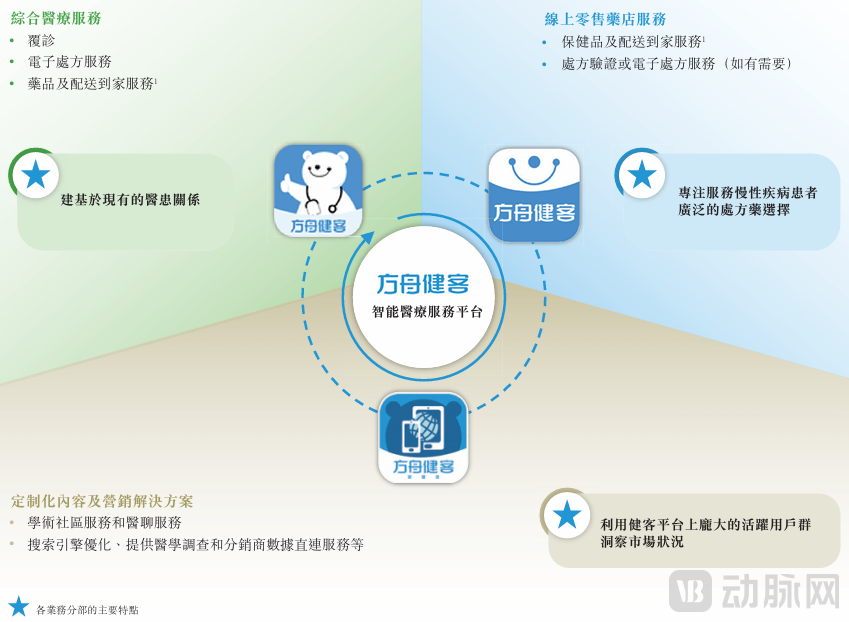
Fangzhou Health Cloud’s Business Segments and Main Service Offerings. Image source: Prospectus
As its business structure stabilized and operations deepened, Fangzhou Yunkang’s revenue continued to grow: it recorded revenues of RMB 1.759 billion, RMB 2.204 billion, and RMB 2.434 billion in 2021, 2022, and 2023, respectively.Certainly, underpinning the company’s performance growth is the systematic value delivered to all stakeholders by its three major business lines.
Fangzhou Health Cloud provides professional, efficient, convenient, and accessible medical and chronic disease management services to patients, especially those with chronic conditions.
Patients with chronic diseases have relatively frequent medical care needs. The Fangzhou Health Cloud H2H service platform reduces the waiting time for patients in processes such as traveling to and from hospitals, queuing, and obtaining prescriptions and medications. Furthermore, the platform offers value-added services including medication guidance, follow-up visit reminders, and patient education, which can enhance treatment adherence and improve long-term therapeutic outcomes.
Fangzhou Yunkang provides physicians with patient management tools, as well as learning and academic exchange platforms, to support their professional development.
In traditional medical services, physician interventions for patients with chronic diseases are primarily confined to in-hospital settings. Due to limitations in manpower and management tools, physicians struggle to implement large-scale, end-to-end patient management. Fangzhou YunKang leverages digital technologies to enhance physicians’ efficiency in patient management, extending intervention beyond the hospital setting. Furthermore, the academic community built into the Fangzhou YunKang app provides a platform for physicians to learn and exchange ideas, helping them stay abreast of cutting-edge information. This not only accelerates their professional growth but also enables them to develop optimized management plans for patients.
For pharmaceutical and medical device companies, Fangzhou YunKang has opened up digital marketing channels, reducing marketing costs.
Amid the trend of digital transformation, pharmaceutical and medical device companies need to identify efficient and compliant marketing channels. Fangzhou YunKang provides these enterprises with a variety of customized content and marketing solutions, precisely delivering the latest information—such as disease-related health education and therapeutic advancements—to users, thereby enhancing both physicians’ and patients’ understanding of treatment options.
Leveraging comprehensive services, Fangzhou Health Cloud enhances the operational efficiency of high-quality resources within the healthcare service system.
Specifically, online chronic disease management platforms can complement physical medical institutions by diverting patients with common conditions and those requiring follow-up care for chronic diseases to online channels, thereby alleviating the consultation burden on large hospitals. Meanwhile, registered physicians establish long-term, mutually trusting doctor-patient relationships with patients online. When offline services are required, these physicians can refer patients to their affiliated medical institutions; given the opportunity, patients are also inclined to choose physicians with whom they have established long-term consultative relationships.
What are the key points within complex service systems and intertwined networks of value propositions?
Pharmaceuticals represent the segment of internet healthcare services that can most rapidly achieve scale-driven revenue or profitability, which has also sparked industry controversy over the perception of internet healthcare as merely “selling drugs.” It should be recognized that while pharmaceuticals are indeed an indispensable component of disease treatment, online services encompass far more than just drug sales, and online chronic disease management extends well beyond this scope.
As with Fangzhou Pharmaceutical, meeting the needs of patients with chronic diseases is the foundation of its business model, with all services centered on this key aspect of patient needs.
Centered on patient needs, Fangzhou YunKang has established a professional medical network.This network comprises in-house medical professionals and online registered physicians, fostering collaboration among internal and external teams, across different roles, and between physicians at various levels to more comprehensively meet patient needs.
In terms of registered physicians, as of the end of December 2023, Fangzhou Health Cloud’s H2H service platform had 212,000 registered physicians from 15,600 medical institutions, with 58.8% originating from tertiary hospitals.
After years of accumulation, Fangzhou Pharmaceutical has established a robust pharmaceutical supply chain to meet patients' medication needs.
As of the end of 2023, the Company had partnered with more than 760 pharmaceutical companies, including multinational corporations and large domestic pharmaceutical firms such as Pfizer Inc., Gilead Sciences, Novartis AG, and Baiyunshan Pharmaceutical; it procured products from over 1,400 suppliers and offered sales of more than 212,000 drug SKUs.
Fangzhou YunKang has also established a medical science popularization matrix, enabling patients to access highly relevant health and disease-related content.
Through its “Fangzhou Medical Chat” product, Fangzhou Cloud Health delivers a vast array of professional health information via short videos, articles with images, comics, audio content, and Q&A sessions, enhancing patients’ understanding of diseases and treatment plans and facilitating their transition from passive treatment adherence to active engagement in personal health services.
By consistently aligning services and business layout with user needs, this approach has been directly reflected in operational data—Fangzhou YunKang has seen substantial growth in its paying users, which reached 2.54 million, 3.88 million, and 4.44 million in 2021, 2022, and 2023, respectively, with user retention rates of 77.3%, 78.7%, and 79%, respectively.
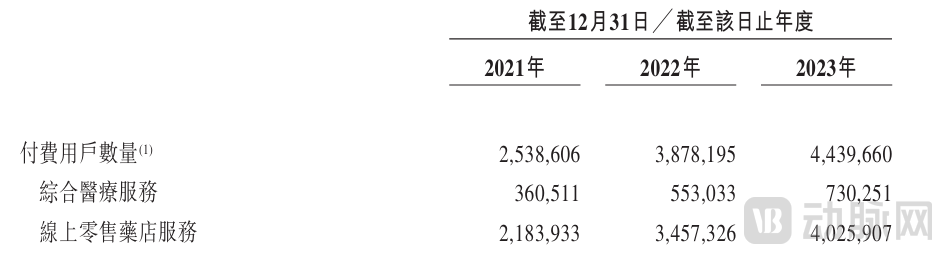
Number of Paying Users of Fangzhou YunKang, Image Source: Prospectus
(Note: There is an overlap between paying users of integrated medical services and online retail pharmacy services; the total number of paying users is calculated on a unique basis.)
As industry evolution deepens, internet healthcare has long transcended its early “Internet+” model. Multi-point, systematic services are no longer a simple 1+1=2 equation; instead, they build upon care for disease-specific populations to deliver more personalized medical and health services centered on individual patient needs.
Personalized healthcare services are tailored to patients’ varying circumstances, such as age, lifestyle, and health status, thereby enhancing service quality. Such personalization also enables more precise allocation of medical resources, reducing resource consumption. For users, it helps promote and maintain health, while lowering disease risk and healthcare costs.
Building on nearly a decade of exploratory practice, Fangzhou YunKang will further expand the breadth and depth of its services in the future, driving online chronic disease management toward greater personalization.
The prospectus discloses that Fangzhou YunKang will allocate approximately 25% of the funds raised to promote user growth and maintain a highly active user base; in particular,Attract more outstanding physicians, expand H2H services to additional specialties—such as cardiology, cerebrovascular disease, infectious diseases, dermatology, psychiatry, and gynecology—and meet the diverse needs of patients with chronic conditions in these specialty areas.
Professional medical personnel and interdisciplinary talents with both medical backgrounds and technological expertise constitute a vital force in online chronic disease management. Following its public listing, Fangzhou Cloud Health expects to allocate approximately 23.1% of the funds raised from the offering to talent recruitment.Aggressively expand the recruitment of talent with extensive experience in media- and technology-driven healthcare services, as well as expertise in chronic disease management; additionally, establish a senior team for innovative business development to explore collaborative opportunities with other stakeholders in the healthcare and medical industry.
In the past, Fangzhou YunKang has invested substantial resources in research and development (R&D). Of the funds raised through its initial public offering, Fangzhou YunKang expects to allocate approximately 16% to R&D activities over the next five years.
In accordance with its R&D roadmap, Fangzhou YunKang will introduce new modules and features to its chronic disease management platform, thereby enhancing service quality and strengthening engagement between doctors and patients. The plannedNew features include standardized guidance for physicians on chronic disease management, intelligent medication guidance for patients, big data analysis of medication data and patient feedback, and in-depth research into specific diseases.
Meanwhile, Fangzhou YunKang will also enhance the application of AI and big data analytics in chronic disease management, optimizing infrastructure to more accurately capture user habits and improve user experience.
Multiple strategic plans indicate that Fangzhou YunKang will further strengthen its technological attributes. Empowered by digital technologies and aiming for personalized management, the company seeks to amplify the value of online chronic disease management within the healthcare service system.
Amid trends such as population aging, the onset of chronic diseases at younger ages, and the transformation of major diseases into chronic conditions, it is undeniable that the population with chronic diseases will continue to grow.
According to data from the 2022 study “Projections of China’s Population Decline and Aging Trends” by the Center for Population and Development Research at Renmin University of China, the number of people aged 60 and above in China is projected to reach 387 million in 2030, accounting for 27.64% of the total population; by 2035, these figures are expected to rise to 437 million and 31.48%, respectively.
The aforementioned data highlights the inevitable trend of growth in the elderly population with chronic diseases, as older adults are typically a high-risk group for such conditions. Meanwhile, chronic diseases are also showing a trend toward affecting younger populations. At the 2023 Healthy China Development Conference, the National Health Commission revealed that the prevalence of hypertension among residents aged 18 and above in China reached 25%, while the rate of dyslipidemia stood at 40%.
With advancements in medical technology, the five-year survival rates for certain major diseases have improved in recent years. The “Healthy China 2030” Planning Outline further proposes to achieve chronic disease health management for the entire population across the full life cycle by 2030, and to increase the overall five-year cancer survival rate by 15%. Cancer treatment has entered an era of chronic disease management centered on patients.
As the number of patients with chronic diseases continues to rise, digital technologies will undergo continuous iteration and be increasingly applied to online chronic disease management. In the future, more digital applications will be integrated into physicians’ workflows; the number of approved products such as medical AI and digital therapeutics will grow, expanding the range of covered disease areas; large language models will more effectively enhance the proactivity and interactivity of patient services, thereby improving care continuity and treatment outcomes.
Driven by multiple factors, the rapid growth of the online chronic disease management market has become inevitable. According to data from Frost & Sullivan, the market size of China's online chronic disease management (measured by Gross Merchandise Volume) is projected to grow from RMB 178.1 billion in 2023 to RMB 1,153.9 billion in 2030, representing a compound annual growth rate of 30.6%.
In this trillion-dollar market, companies that genuinely prioritize patient needs and leverage the boundless potential of digital technologies to empower all stakeholders will hold a distinct competitive advantage. The listing of Fangzhou Health Cloud signifies that the company has firmly established its market position by capitalizing on these strengths, and its performance in the next phase post-listing is highly anticipated.