

BingJing Intelligence Files for IPO: Building a Full-Stack Intelligent Interventional Ultrasound Imaging Platform with End-to-End Technology Integration

ICE
Next-Generation Intracardiac Ultrasound Device Developer
Chinese companies are ramping up efforts in the intracardiac echocardiography sector.
Earlier this year, ICE, an interventional ultrasound imaging platform company, announced that it had secured two rounds of financing within six months, with one round amounting to tens of millions of yuan. Recently, VCBeat learned thatICE is set to launch a new round of financing to accelerate the market promotion of its ICE-related products, as well as the research and development of its 4D-ICE product and other specialized interventional ultrasound devices.
Unlike many domestic companies that are focusing on the intracardiac echocardiography sector,ICE positions itself as an “interventional ultrasound imaging platform company,” planning to use its cardiac interventional ultrasound platform as an entry point to comprehensively deploy across the interventional ultrasound imaging industry.
In other words, from a business perspective, ICE’s primary objective in entering the interventional ultrasound industry is to leverage the compounding effects of its technology platform, continuously refining and deepening its expertise in interventional ultrasound to consistently meet surgeons’ demands for intraoperative imaging. This approach stands in contrast to the “comprehensive specialty care solutions” model—often a fragmented portfolio of offerings—currently adopted by most multinational corporations.
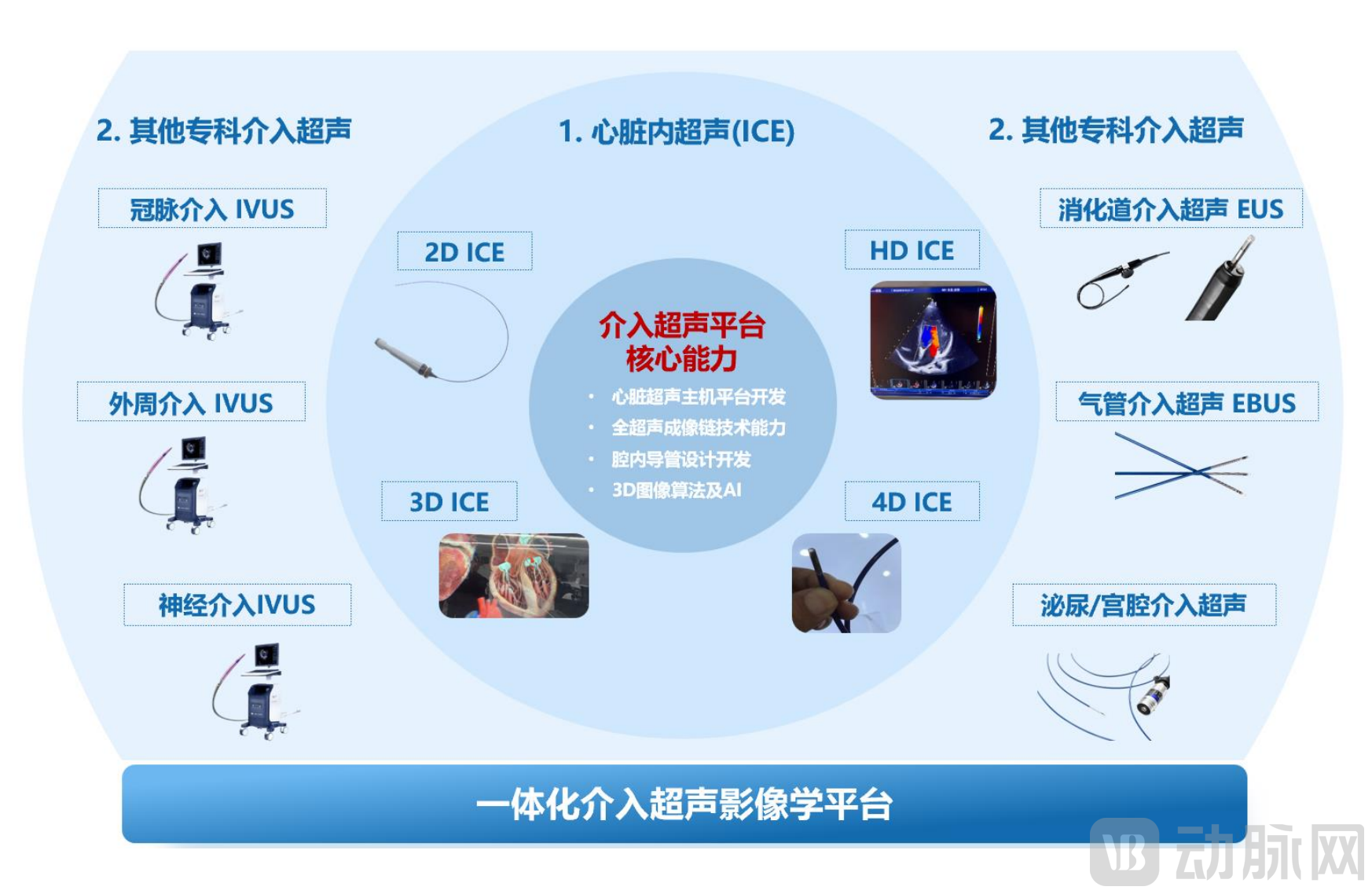
ICE Intelligent Product Portfolio
Therefore,From a horizontal perspective (track layout), ICE has laid out many interventional ultrasound tracks, including intracardiac echocardiography.For example, interventional ultrasound of the digestive tract, tracheal interventional ultrasound, and urological/uterine cavity interventional ultrasound.
From a vertical perspective (industrial chain layout), ICE has covered the entire value chain of interventional ultrasound, including R&D of key upstream components, midstream probe design and development, mainframe system and algorithm design and development, downstream AI imaging and algorithm R&D, as well as a research collaboration platform integrating medicine and engineering, and even a technical cooperation platform with related surgical instruments, ultimately forming a closed-loop technology ecosystem.
Taking intracardiac echocardiography (ICE), the current strategic focus of ICE Intelligent Healthcare, as an example, the company has further segmented the specific imaging equipment needs of different physician groups and comprehensively deployed its portfolio across 2D-ICE, 3D-ICE, HD-ICE, and 4D-ICE.
Among them, according to Zhang Jihong, founder of ICE,ICE’s 2D-ICE product has initiated clinical trials and is expected to enter commercialization next year; HD-ICE has completed clinical trials and is awaiting formal approval; the 3D-ICE product has completed prototype development and animal studies; as for the 4D-ICE product, ICE has adopted a novel technical approach for its development, which has now entered a critical R&D phase.This is also one of the primary objectives for ICE’s planned Series A financing round.
Intracardiac Echocardiography: The Rising Star in the Field of Interventional Ultrasound in Recent Years
On the one hand, driven by the increasing prevalence of cardiac interventional procedures and their growing trend toward precision, the demand for cardiac interventional imaging equipment within the industry has become increasingly substantial and urgent. On the other hand, intracardiac echocardiography (ICE) boasts a wide range of applications, being extensively utilized in various procedures such as atrial fibrillation ablation, left atrial appendage closure, atrial septal defect closure, mitral valve plasty, and endomyocardial biopsy. These applications cover a broad spectrum of cardiac conditions, including arrhythmias (such as atrial fibrillation and premature ventricular contractions), congenital heart diseases (such as atrial septal defect), and valvular heart diseases (such as mitral and tricuspid regurgitation, and aortic stenosis).
Moreover, in the interview, Zhang Jihong also revealed to VCBeat: “Currently, a trend of combining PFA with intracardiac echocardiography has emerged in the global market.” The application potential of intracardiac echocardiography is still being continuously explored, and its scope of application is constantly expanding.
Furthermore, VCBeat’s previous estimates indicate that China’s overall interventional ultrasound market holds immense potential, with the intracardiac echocardiography (ICE) catheter market expected to exceed RMB 10 billion and the ICE console market projected to surpass RMB 1.4 billion.
And this figure represents only the market size for intracardiac echocardiography (ICE). Furthermore, according to Zhang Jihong, if the interventional ultrasound markets of other specialties are included, the overall size of the entire interventional ultrasound market exceeds RMB 25 billion.
However, similar to many other high-end medical devices, overseas companies continue to dominate this vast market, while domestic enterprises remain in the early stages of development. Taking intracardiac echocardiography (ICE) technology as an example, its high barriers to entry and significant development challenges mean that it will take considerable time to narrow the gap between domestic and international companies.
In the interview,Zhang Jihong also provided VCBeat with a concrete illustration of the development challenges associated with intracardiac echocardiography (ICE). Taking imaging capability—the most core aspect of imaging equipment—as an example, the imaging chain of an ultrasound device generally comprises three major conversion processes: conversion of ultrasonic signals into electrical signals, conversion of electrical signals into computer data, and conversion of computer data into displayed images.
AndFrom the perspective of product development, this process involves three key stages: the design and development of the main unit’s imaging system and probe structure; the holistic development of the imaging chain system comprising the main unit and probes; and the integration and debugging of the coupling between the ultrasound device and other surgical equipment networks.
However,“This is merely a simplified imaging process; while it appears to involve only three steps, it actually encompasses more than 200 stages and hundreds of electronic components, all of which are intercoupled.”Zhang Jihong further explained, “The so-called coupling relationship encompasses two layers of meaning. The first is that if any single link is not executed properly, the overall outcome will be suboptimal. The second is that, conversely, even if every link is executed properly, the overall outcome may still fall short. Two analogies can illustrate this: the first is the ‘bucket effect,’ which dictates that there must be no weak links; the second can be simply understood as a relationship where 1+1 does not equal 2. In other words, when each individual link is optimized to the extreme, poor coordination among them can lead to counterproductive results.”
This actually sends a signal: the development of intracardiac echocardiography (ICE) devices cannot rely on “single-point breakthroughs” alone, but requires comprehensive development capabilities spanning from probes to main units.“This is, in fact, one of the main reasons for the gap between domestic and foreign companies in intracardiac echocardiography equipment,” said Zhang Jihong.
However, the “gaps” and “high development difficulty” have clearly failed to halt Chinese companies’ march into the intracardiac echocardiography (ICE) market. Each company is launching a sustained offensive in this field from its own unique perspective. ICE Intelligent Healthcare has chosen to focus on fully meeting interventional cardiologists’ needs for interventional ultrasound imaging.
So, what are the demands of cardiologists for intracardiac echocardiography?
From the perspective of market supply, physicians' demand for intracardiac echocardiography (ICE) has shown a trend toward stratification.
Specifically, for physicians who have not previously used intracardiac echocardiography (ICE), an ICE system equipped with “core functionalities” can address their critical intraoperative imaging needs. For physicians already proficient in ICE, requirements vary depending on the diseases being treated; some may prioritize higher image clarity, while others demand more comprehensive multidimensional visualization of cardiac structures. For instance, procedures such as mitral and tricuspid valve stenosis interventions place greater emphasis on the detailed depiction of cardiac anatomy.
In this regard,ICE has launched a series of intracardiac echocardiography (ICE) products, including conventional 2D-ICE, HD-ICE for high-definition imaging requirements, and 3D-ICE and 4D-ICE to meet the demands for high-fidelity cardiac structure visualization.
AndA summary of market demand reveals that physicians’ requirements for intracardiac echocardiography (ICE) products essentially boil down to two key aspects: clear imaging and ease of use.
Let us take ICE’s HD-ICE as an example to analyze how it is dedicated to achieving high intensity, high precision, and rapid performance. According to Zhang Jihong, the HD-ICE adopts a new-generation acoustic energy conversion system, which effectively enhances signal acquisition and transmission efficiency as well as image clarity. Furthermore, the HD-ICE incorporates a specialized processing system for high-definition cardiac images, leveraging the latest algorithmic technologies to enable faster imaging speeds.
Specifically,Compared with conventional 2D-ICE, HD-ICE offers more than a tenfold improvement in spatial resolution and over a threefold increase in temporal resolution. Currently, the product has completed clinical trials and is expected to receive regulatory approval shortly, paving the way for its official market launch.
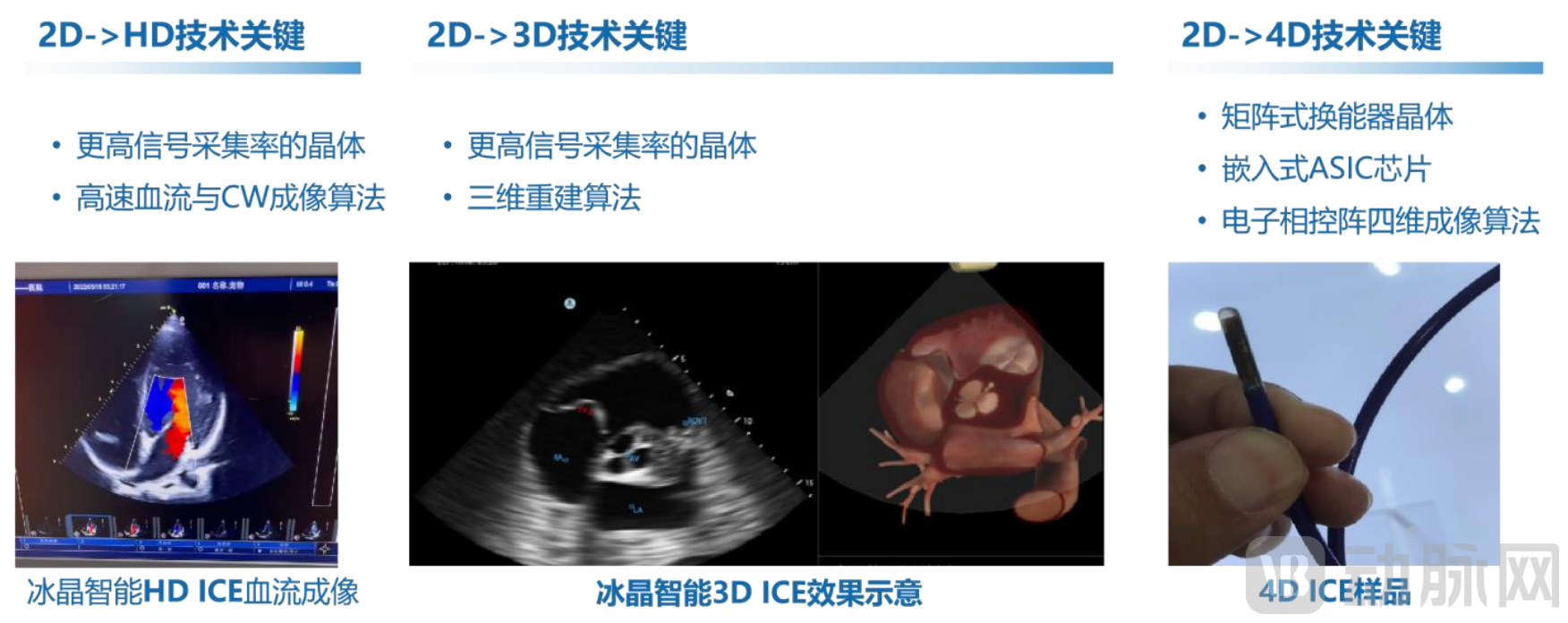
ICE Product Technology Comparison
As for “ease of effective use,” it refers to three aspects: first, doctors require a short learning curve to master the device; second, the device is convenient and ergonomic to operate, akin to simply putting on a pair of high-definition glasses; and third, where possible, it provides value-added empowerment to physicians.
In this regard,ICE first established an AI-based simulation platform that can replicate real surgical scenarios as accurately as possible,Simulate possible scenarios during surgery.
Secondly, based on this simulation platform, ICE’s intracardiac echocardiography (ICE) products can rapidly assist physicians in accurately locating and visualizing surgical planes, thereby enhancing their “spatial imagination” by providing real-time prompts on the cardiac structures reached.
Finally, ICE’s intracardiac echocardiography (ICE) product also features surgical navigation capabilities, enabling real-time guidance of the surgical pathway during procedures.
Thus, we have gained a general understanding of how ICE has developed its intracardiac echocardiography (ICE) products that enable physicians to “see clearly” and “use effectively.” It is particularly noteworthy that ICE has established a comprehensive layout across the entire value chain of interventional ultrasound, forming a closed-loop technological system that includes the research and development of upstream key components.。
This is closely related to the background of ICE’s core team. Since its inception, ICE has consistently emphasized that entrepreneurship in China’s medical device sector requires a tripartite integration of medicine, engineering, and business.
Take Zhang Jihong, Founder & CEO of ICE, as an example. He has accumulated over a decade of end-to-end experience in the ultrasound industry, spanning product development to operational sales. His educational and professional background encompasses three major fields: materials science, medical imaging engineering, and artificial intelligence.
Zhang Shaoxiang, Head of Consumables Technology at ICE, is one of the drafters of industry standards for implantable materials and possesses 16 years of experience in innovative research on basic biomedical materials as well as in the design and development of medical devices.
He Ligang, Head of AI Technology, has 13 years of experience in the design and development of medical AI and medical IT software systems, and has led the design and development of multiple medical AI imaging software products.
Liu Simeng, the Head of Operations, graduated from a top-tier Chinese medical university with a clinical specialization in cardiology. She has over ten years of experience working in research and development, clinical affairs, marketing, and operations at well-known domestic and multinational pharmaceutical companies.
Wang Jianhui, Head of Product and Commercialization, brings over a decade of experience in clinical technology, marketing, and sales at top-tier multinational corporations. As one of the first technical experts in China to adopt and utilize ICE technologies, he has supported thousands of ICE-guided procedures, possessing extensive expertise in interventional ultrasound.
The core team’s extensive industry experience has laid a solid foundation for ICE Intelligent Healthcare’s exploration and breakthroughs in intracardiac echocardiography (ICE) and interventional ultrasound. This enables the team to continuously accumulate technical expertise, transform it into a robust technology platform, and leverage the resulting technological compounding effects to achieve successive breakthroughs across niche segments within the interventional ultrasound field.
Not only that, in the interview, ICE also revealed to VCBeat: “ICE has achieved in-house research, development, and manufacturing of core components, significantly reducing product costs.”
In the field of intracardiac echocardiography (ICE), achieving in-house research, development, and manufacturing of core components is no easy feat. VCBeat has learned that most domestic ICE catheters currently rely heavily on imports, and their required cabling largely follows the technical pathways of a well-known foreign company, which may expose them to patent challenges in international competition.
Meanwhile, Zhang Jihong stated that due to the significant foreign monopoly on intracardiac echocardiography (ICE) and the fact that most domestic companies align their technological pathways with those of foreign firms, domestic enterprises have weak bargaining power from an upstream supply perspective. Consequently, upstream manufacturers show limited willingness to provide customized supplies on demand. The primary reason ICE Intelligent Healthcare has achieved in-house research, development, and production of core components is that “we continued tracing up the supply chain and identified our suppliers’ suppliers.”
Furthermore,As an interventional ultrasound imaging platform company, ICE adopts a slightly different market promotion strategy—opting for direct coverage in certain core markets. On this basis, ICE is more inclined to partner with disease solution companies to jointly promote the development of innovative interventional procedures based on interventional ultrasound imaging equipment that are applicable to a wide range of diseases, such as those related to electrophysiology and structural heart disease.
When discussing future development, Zhang Jihong stated that the interventional ultrasound imaging industry will exhibit three major trends: first, closer integration with surgical treatments; second, specialization; and third, widespread application of artificial intelligence. Specialization refers to further segmenting the demands for interventional ultrasound imaging equipment across different medical specialties (such as obstetrics and gynecology, cardiology, gastroenterology, pulmonology, and urology) to develop corresponding products. This is also the reason why ICE Intelligent Healthcare is expanding its presence in interventional ultrasound for other specialties.
Meanwhile, ICE will continue to refine its end-to-end development capabilities for interventional ultrasound imaging systems and deliver more intelligent interventional ultrasound imaging devices to overseas markets.“To sum up in one sentence what we will do next, we aim to build an intelligent ecosystem for the catheterization lab, with interventional imaging at its core,” summarized Zhang Jihong.