

Chinese Lab Mice Are Testing Drugs for the World: A Global Expansion Story Led by Biocytogen

Biocytogen
Antibody Drug Developer
“The sun is shining. I’ve spent more time in the U.S. this year than in the past decade combined.” This was how Shen Yuelei, founder of Biocytogen, reflected in a WeChat Moments post in late June. The following month, he invited others to recommend antibody talent to join Biocytogen’s Boston team, breaking free from existing frameworks to design next-generation antibody therapeutics. As one of China’s three publicly listed companies specializing in laboratory mice, Biocytogen saw rapid growth in its overseas business last year, with revenue surpassing that of its domestic market.
Laboratory mice know no borders, but their breeders do. China’s experimental mouse industry, which only began to take off after the turn of the millennium, has rapidly expanded by riding the wave of star targets such as PD-1 and capitalizing on the dividends of innovative drug development. It now possesses the capacity to serve R&D needs in the world’s largest pharmaceutical market. Beyond Biocytogen, financial reports from GemPharmatech and Shanghai Model Organisms Center reveal that overseas revenue in 2023 became a key driver of overall corporate performance.
The Chinese mice, left reeling by the sudden winter chill in the innovative drug sector, seem to be recovering.
Go to the Global Epicenter of Pharmaceutical Innovation
For Chinese pharmaceutical companies, expanding overseas is nothing new. In any given niche sector, one can find a few fortunate enterprises that have managed to generate profits in challenging overseas markets. However, it is rare for listed companies to see their performance growth driven uniformly by overseas operations, much like laboratory mice.
In 2023, Biocytogen achieved operating revenue of RMB 717 million, a year-on-year increase of approximately 34%. Among this, overseas business generated operating revenue of RMB 408 million, a year-on-year increase of approximately 66%, with overseas revenue surpassing domestic business and accounting for 57% of total revenue. In the same year, GemPharmatech’s overseas market generated revenue of RMB 92.9516 million, a year-on-year increase of 39.94%, significantly higher than the 20.57% growth in total revenue, with the proportion of overseas revenue rising to 14.94%; Shanghai Model Organisms Center achieved operating revenue of RMB 366 million, a year-on-year increase of 20.99%, recording overseas market revenue of RMB 40.2306 million, a year-on-year increase of 23.06%, which was higher than the overall revenue growth rate.
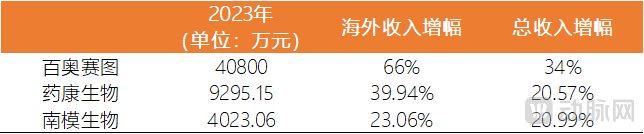
Financial Data on Overseas Operations of Domestically Listed Laboratory Mouse Companies in 2023. Data Source: 2023 Annual Reports of Each Company
The mouse models they leverage for their ventures are essential tools in modern drug development. Mice are the most widely used model organisms in scientific exploration and drug development due to their strong reproductive capacity, short generation time, structural similarities in tissues, organs, and cellular functions to humans, and high genomic homology with humans. More importantly, by employing various gene-editing techniques to insert or delete target DNA fragments in mouse cells, thereby modifying endogenous genes, researchers can construct diverse mouse models that mimic specific human physiological, pathological, and cellular characteristics. These models provide more intuitive references for target identification and efficacy evaluation of new drugs.
In China, the laboratory mouse industry started relatively late. Around the year 2000, the now-mainstream domestic commercial companies specializing in laboratory animal mouse models were established one after another. After more than two decades of development, leading companies in the industry have achieved considerable scale, with certain categories of mouse models ranking among the best globally, such as gene-knockout strains and humanized strains. In terms of technology, Chinese enterprises are now at the forefront worldwide in model research and development.
However, overall, the concentration of China’s laboratory mouse industry remains relatively low, and its commercial application models and regulatory standards still need improvement. According to data released by Frost & Sullivan, in 2019, Vital River held the largest market share of 7.7% in China’s laboratory mouse product and service market, ranking first. GemPharmatech was the second-largest laboratory mouse enterprise in China by market share, accounting for 6.7%.
“At present, GemPharmatech and Biocytogen are leading the way in exporting experimental mice,” pointed out Liu Dan, Managing Partner of Dingfeng Capital’s China region. “Exporting has become a trend within China’s experimental mouse industry, with various companies attempting to expand overseas. However, due to factors such as the lack of established international reputation and insufficient overseas experience, substantial progress has yet to be achieved.”
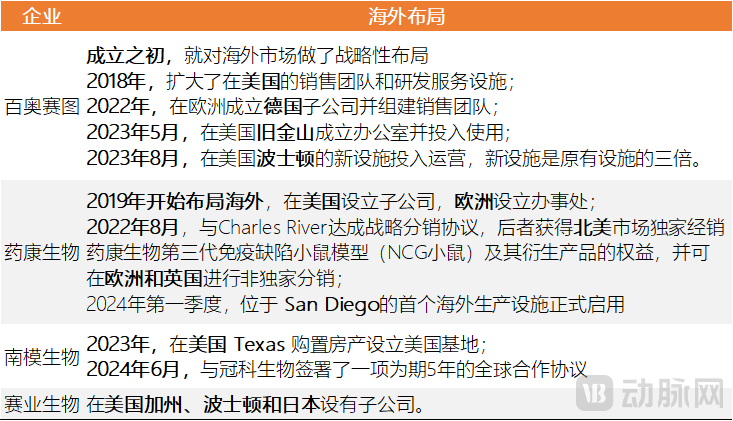
Overseas Business Layout of Major Domestic Laboratory Mouse Enterprises | Data Source: Compiled by VCBeat based on public information
Among them, Biocytogen was the earliest to expand into overseas markets. Founded in 2009, Biocytogen strategically positioned itself for global expansion from its inception. Starting in 2018, the company progressively upgraded its sales networks in North America, Europe, and the Asia-Pacific region, establishing a comprehensive global sales network system.
Following closely is GemPharmatech. At the end of 2019, GemPharmatech embarked on its internationalization journey by establishing a U.S. subsidiary and a European office. In August 2022, GemPharmatech entered into a strategic distribution agreement with Charles River, one of the world’s largest suppliers of animal models, for the marketing of NCG mice in the United States, Europe, the United Kingdom, and other regions. By the first quarter of 2024, GemPharmatech’s first overseas production facility was established and officially commenced operations in San Diego.
Shanghai Model Organisms Center’s internationalization efforts began relatively late. In 2023, the company purchased property in Texas, USA, to establish its U.S. base. It plans to collaborate with the local municipal government to jointly set up a biopharmaceutical incubator, attracting select biopharma startups and providing CRO services. However, Shanghai Model Organisms Center acknowledged that it has not yet invested in renovating animal facilities at its U.S. base. Additionally, in June 2024, the company signed a five-year global cooperation agreement with ChemPartner to deliver higher-quality model resources and CRO services to the market. Shanghai Model Organisms Center stated that in 2024, it will continue to expand its overseas business development (BD) team, particularly intensifying BD recruitment in biopharmaceutical hubs such as Boston and California.
In addition, Cyagen Biosciences has established a subsidiary in California, USA. Judging from the overseas expansion of domestic laboratory mouse providers, the regional focus is consistently placed on North America. The underlying reason is that North America, as a hub for active pharmaceutical innovation and R&D, is also the world’s largest animal model market.
Unlike the sudden cooling of new drug development in China, the global pharmaceutical R&D pipeline continued to expand in 2023. According to data from Pharma Intelligence, the global pharmaceutical R&D pipeline reached 21,292 projects in 2023, representing a year-on-year increase of 5.89%. Although this growth rate was lower than that of 2022, it remained higher than that of 2021. More than half of these R&D pipelines are concentrated in the North American market. The sustained growth of the pharmaceutical R&D pipeline continues to raise the market ceiling for laboratory mice.
Growth Code: Seizing Opportunities in the Drug Efficacy Evaluation Market
Of course, the pharmaceutical innovation ecosystem in the North American market is relatively mature, and the competitive barrier for domestic laboratory mice to share in this market’s growth is not low.
“At this stage, Chinese laboratory mice are primarily exported to serve the overseas pharmaceutical industry market, with some presence in the scientific research sector; however, demand from the pharmaceutical industry is relatively robust.” Liu Dan observed, “In this regard, the faster delivery pace of domestic companies can also establish a certain competitive advantage in the international market.”
Notably, in overseas markets, Chinese laboratory mouse enterprises are not confined to the role of pure experimental animal providers; instead, they offer specialized technical services for specific stages of new drug development, thereby differentiating themselves from traditional giants in the laboratory mouse industry. In fact, Charles River, the global leader in laboratory mice, primarily sells low-margin standard mice in the highly competitive and mature overseas market. In 2020, Charles River’s overall gross profit margin was only 36.72%. In contrast, in 2023, the gross profit margins of GemPharmatech and Model Animal Research Center’s overseas businesses reached 75.05% and 79.31%, respectively. This is because their laboratory mouse products have a higher proportion of premium strains, resulting in greater business value-added.
In modern pharmaceutical settings, laboratory mice are primarily used for efficacy and safety evaluations during new drug development. Chinese mouse models mainly provide related services focused on efficacy evaluation in overseas markets. Efficacy studies involve verifying the effectiveness of drugs in different systems or models, characterizing the dose-response and time-response relationships of drug actions, exploring dosing regimens, and elucidating mechanisms of action. This stage is a critical component of the new drug development process, and pharmacodynamic studies conducted in disease-related animal models serve as important evidence to support proposed clinical indications and dosing regimens.
Take GemPharmatech and Biocytogen, which have substantial overseas business operations, as examples. In 2019, GemPharmatech launched its “Spot Mouse” project. The sale of commercialized mouse models constitutes GemPharmatech’s core business, encompassing Spot Mice, immunodeficient mouse models, humanized mouse models, disease mouse models, and basic strain mice. The essence of GemPharmatech’s Spot Mouse project is to develop high-quality models that research clients can use directly, while industrial clients can further optimize them for product development. In overseas markets, GemPharmatech leverages the Spot Mouse platform to provide technical services related to efficacy evaluation for its users.
Over the past few years, Biocytogen has continuously invested in R&D expenses to build its “Thousand Mice, Ten Thousand Antibodies” initiative. According to its 2023 financial report, this initiative has completed its initial phase, marking a significant step forward in the company’s vision of becoming a source hub for new drug development. In practice, the “Thousand Mice, Ten Thousand Antibodies” program offers products and services that are more upstream than GemPharmatech’s “Spotted Mouse” program, aiming to directly deliver Preclinical Candidate Compounds (PCCs). However, this approach entails high costs; therefore, in most scenarios, Biocytogen focuses on helping clients streamline the business workflow from animal models to efficacy evaluation.
In fact, Biocytogen has expanded from the front end to the back end of new drug development, while PharmAbiome’s business path is exactly the opposite, but both ultimately focus on efficacy evaluation. “From the current perspective, domestic laboratory mouse companies going global must halt their expansion before achieving GLP (Good Laboratory Practice for Non-Clinical Laboratory Studies) compliance,” Liu Dan told VCBeat. In these stages, there is limited demand for scientific research services; laboratory mouse companies primarily serve the efficacy departments of pharmaceutical companies, especially competing with CROs that offer faster response times and lower costs for mature pharmaceutical firms’ efficacy evaluation businesses.
In the process of evaluating drug efficacy, different CROs each have their areas of expertise. Experimental mouse companies participate by leveraging their unique advantages and, within a sufficiently large market space, do not face overly intense competition or cutthroat rivalry. For instance, GemPharmatech excels in comprehensive gene-editing capabilities, offering a more integrated product portfolio that covers various fields, whereas Biocytogen focuses deeply on oncology, exploring the potential of this vertical sector to build differentiated competitive barriers. “Furthermore, some domestic companies whose IPOs have been stalled are beginning to expand into overseas drug efficacy markets, though each has its own focus, with differences existing across niche segments,” added Liu Dan.
Is Global Expansion a Guaranteed Win?
So, can the successful path of experimental mice going global be replicated?
Objectively speaking, the overseas market for laboratory mice features strong demand, relatively mild competition in niche segments, and no particularly stringent qualification requirements, making it an ideal growth path for Chinese laboratory mouse companies. Industry practitioners told VCBeat that mouse laboratories typically need to meet certain internationally recognized certifications and microbial control standards to ensure standardized and hygienic animal care and use. “Leading Chinese laboratory mouse enterprises often already comply with these standards.”
However, relocating the laboratory mouse business overseas and ensuring its smooth operation remains fraught with challenges.
First, establishing brand recognition is crucial, but Chinese enterprises still have a long way to go. Overseas, researchers hold experimental mice from established suppliers such as The Jackson Laboratory and Charles River in extremely high regard. For instance, mice from The Jackson Laboratory are considered the “gold standard.” Previously, the director of laboratory animal resources at a major domestic CRO told Southern Weekly reporters that, internationally, for new drug approvals and academic publications, academic institutions and regulatory authorities “only recognize mice from those few companies.”
The underlying logic is that experimental mice serve as a critical data source in research, yet their inherent stability is difficult to control. Typically, during the publication of life science research findings and the clinical trial application process for new drug development, it is necessary to clearly disclose the source of the experimental animals; well-known brands help enhance the credibility of the experimental results. Meanwhile, switching suppliers of experimental mouse strains may introduce uncertainty into research, which already suffers from low reproducibility in many cases. For a new brand of experimental mice to gain market acceptance, it requires a long-term accumulation of high-quality service experience.
Secondly, establishing a stable and professional talent team overseas is also a lengthy process. The breeding of laboratory mice is a task that places extremely high demands on personnel. The research and development of genetically modified animal models encompasses processes such as model construction, colony expansion, and phenotypic analysis. Model construction alone involves multiple stages, including strategy design, vector construction, transfection of mouse embryonic stem cells, microinjection into zygotes and embryos, genotyping, and model breeding. Each of these stages comprises numerous procedural steps, making this a high-tech industry characterized by intensive R&D, continuous innovation, knowledge intensity, and a high degree of reliance on multidisciplinary integration.
Efficient delivery of laboratory mice imposes high demands on a company’s model R&D capabilities and animal breeding systems. It requires substantial support from high-level, multidisciplinary talent, as well as skilled technicians proficient in molecular biology, cell culture, microinjection, and other techniques for daily operations. At present, Chinese laboratory mouse companies often establish their own teams to expand into active new drug R&D regions such as North America and Europe. Building a talent team with core competitiveness in mature markets with higher labor costs undoubtedly presents a significant challenge.
Third, expanding into the overseas laboratory mouse market is a capital-intensive business that imposes higher demands on a company’s financial strength and operational sustainability. Typically, the generation and breeding of genetically modified animal models must be conducted in controlled environments. Companies are required to build standardized laboratories and animal facilities, as well as procure specialized equipment, to ensure that breeding conditions meet requirements such as constant temperature and humidity, and Specific Pathogen-Free (SPF) standards. This necessitates significant investment in high-cost infrastructure.
Meanwhile, the efficiency and yield of generating and expanding genetically modified animal models are processes that require long-term accumulation. As living products, genetically modified animal models may exhibit variability in product stability. The phenotypes of laboratory mice are influenced by strain background, methods of genetic modification, and husbandry conditions; even differences between experimental facilities can lead to variations in mouse phenotypes, thereby affecting experimental outcomes. In this sense, the facility operations and management of laboratory mouse enterprises face extremely high demands. Companies must continuously strengthen their R&D capabilities and optimize product development to consistently meet the requirements of experimental production.
Experimental Mice Going Global: Testing Drugs for the World and Delivering Substantial Commercial Returns to Mouse Model Companies, This Shift Has Boosted Confidence Among Chinese Pharmaceutical Professionals. However, Companies Should Act Within Their Means When Seeking Opportunities in Overseas Markets.