

YanYin Tech Files IPO Prospectus: Pioneering Global-First Molecular Cloning Workbench Integrated with ELN, Adopted by 150+ Universities and Enterprises
In June 2024, pharmaceutical giant Eli Lilly announced positive Phase II clinical trial results for its GLP-1 product tirzepatide in treating patients with metabolic dysfunction-associated steatohepatitis (MASH) at the annual meeting of the European Association for the Study of the Liver (EASL). Subsequently, the long-awaited advisory committee meeting on the marketing application for donanemab, its Alzheimer’s disease antibody therapy, proceeded as scheduled, with the FDA’s Peripheral and Central Nervous System Drugs Advisory Committee (PCNSAC) unanimously voting in support of donanemab’s efficacy. Driven by these two major breakthroughs within a single week, Eli Lilly’s stock price surged, pushing its market capitalization to $822.1 billion.
Alongside the growth in Eli Lilly’s market capitalization, its R&D expenditures have also risen. According to Eli Lilly’s 2023 financial results, the company reported full-year revenue of $34.124 billion, a 20% year-over-year increase; net profit at period-end amounted to $5.240 billion, representing a 16% year-over-year decline. The primary reason for the drop in profits was increased R&D investment, which reached $9.313 billion in 2023, a 30% year-over-year increase.
In recent years, the rising proportion of R&D investment by pharmaceutical companies both domestically and internationally has become a significant trend. Among them,Since the second half of 2021, the proportion of sales expenses invested by pharmaceutical companies in China has gradually decreased, while the proportion of R&D expenses has increased year by year, with the growth rate accelerating gradually.On the other hand,Continuous investment in R&D funding has not truly led to improved efficiency.According to data disclosed by the FDA, over the past decade, despite continuous growth in biopharmaceutical R&D spending, a proportional increase in output has not been observed. Industry R&D efficiency—roughly measured as the number of FDA-approved drugs per billion dollars of real R&D expenditure—has been declining.
Pharmaceutical R&D is a technology-intensive field that is complex, relies on highly skilled labor, and involves numerous procedural and managerial considerations. During the new drug development phaseChallenges are immense, with high costs, long development cycles, and low success ratesToday, the cost pressures imposed by time and funding have compelled pharmaceutical companies of all stripes to take measures to reduce costs and improve efficiency, making it imperative to adopt digital and intelligent tools that can tangibly enhance efficiency in the R&D process.
In March 2024, Yanin Technology, a company dedicated to building a digital research collaboration platform for biomedicine, announced the completion of its angel financing round worth tens of millions of RMB, merely six months after its establishment.
The Boom in Macromolecular Drug R&D: Intelligent Tools as a Breakthrough to the “Double Ten” Law
Dr. Chen Zeping, Founder and CEO of Yanyin Technology, previously served as Vice President at Taimei Medical Technology, where he facilitated marketing digital transformation for over 200 biopharmaceutical companies. Earlier in his career, he was General Manager of Business Process Robotics at SAP Greater China, and served as Product Lead for SAP’s Outpatient Solutions in China and for SAP’s AI-powered Medical Imaging Interpretation products. Concurrently, he serves as Chief Expert on the Artificial Intelligence Committee of the China-Germany Intelligent Manufacturing Cooperation under the Ministry of Industry and Information Technology (MIIT).
Co-founder and CTO Shi Huihui previously served as R&D Director at ConvertLab, where he oversaw the end-to-end development of the core product DM Hub, leading the team to build the product from scratch and serve hundreds of industry-leading clients. He also worked as a Product Architect at SAP China Research Institute, with his products serving major biopharmaceutical enterprises and central state-owned enterprises.
Professional experience has given the founding team a deep understanding of the pain points in pharmaceutical R&D. Chen Zeping cited examples from both “horizontal” and “vertical” collaboration scenarios. He pointed out that certain experiments or projects require coordination among two to three individuals, with one person responsible for overall planning and data consolidation while the others handle execution. During project advancement, experimental data coordination often relies on verbal communication and manual import/export across multiple systems. Due to the lack of standardized collaborative processes, experimental data are prone to loss, forcing teams to rework and verify information, thereby delaying project progress. In “vertical” scenarios, various submitted experimental records await review by superiors, and the process of reviewing and verifying these records still consumes considerable time and effort.
On one hand, R&D faces significant challenges, including non-standardized experimental data recording, low levels of domestic informatization, severe information silos, and security risks in the long-term storage of experimental data. On the other hand, biopharmaceutical R&D is booming. Both domestically and internationally, the proportion of large-molecule pipelines in new drug development has risen from 10% to over 40%, with this share expected to grow further and market share continuing to expand.
Moreover, in recent years, large-molecule drugs—such as those involving gene therapy, cell therapy, antibody-based therapeutics, small nucleic acid drugs, and synthetic biology—have witnessed substantial advancements and garnered significant favor from investors. Meanwhile,Amid financial pressures, an increasing number of enterprises, particularly startups, are seeing growing demand for digital transformation.。
Yanyin Zhiyan Cloud: Reshaping Research Users’ LAB 365 Efficiency Suite with AI
In March 2024, Yanyin Technology completed a financing round of tens of millions of RMB, led by Qiming Venture Partners, to focus on building the next-generation Yanyin Intelligent Research Cloud 2.0. Leveraging large AI models for biopharmaceuticals and partnering with leading industry AI players, Yanyin Technology jointly develops intelligent biopharmaceutical applications, such as AI-powered literature analysis, Biopharma Co-Pilot, 3D protein structure prediction, and intelligent experimental design. By utilizing artificial intelligence and big data analytics, the platform monitors key data and metrics affecting experimental progress, generates experimental insights, and helps researchers conduct efficient experimental simulations.
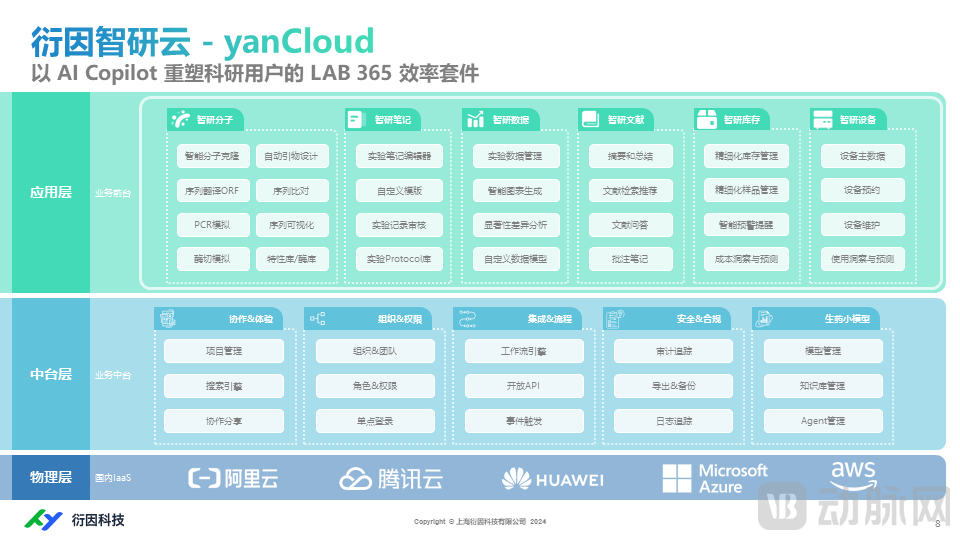
Yanyin Intelligent Cloud, image from Yanyin Technology
As early as the market research phase, Yanin Technology believed that there was an urgent demand for digital tools in the R&D of macromolecular drugs; however, at the same time, areas such as laboratory records within digital tools were subject to strict regulatoryLow entry barriers, no technological moats, and numerous competitorsTherefore, Yanin Technology has decided to start with the most challenging aspect of new drug development—molecular biology tools.
Currently, the most comprehensive molecular biology sequence editing tool on the market is SnapGene, which enjoys high adoption rates within the industry; there is still no robust domestic alternative available. However, Yanin Technology has not been content with merely creating a domestic substitute, but rather aims toDifferentiate by integrating molecular biology tools with electronic laboratory notebooks, ensuring seamless business process integration alongside underlying data connectivity.: Researchers can efficiently edit and visualize DNA sequences directly within molecular biology tools, and convert all relevant data from molecular cloning into electronic lab notebooks with a single click. This design completely eliminates the cumbersome steps of manually constructing molecular clones and then encoding them, achieving a seamless transition from construction to documentation and enhancing research efficiency.
Yanyin Technology's Electronic Laboratory Notebook System,Drawing on the user experience design of a Feishu-like platform tailored for the biopharmaceutical industry, it not only ensures smooth interaction but also embeds a rich library of biopharmaceutical experimental methods and templates.These customized offerings make the Yanyin Intelligent Cloud Platform stand out in the industry. Chen Zeping pointed out that Yanyin Technology focuses on in-depth research in the field of macromolecules, further reinforcing the professionalism of its molecular biology tools. Meanwhile, compared with peers who have focused on small-molecule research for the past decade, Yanyin Technology’s platform, with its greater emphasis on macromolecules, has developed more specialized and refined service features.
“Globally,We pioneered the launch of a molecular cloning workbench that integrates the experimental methods relied upon by 90% of users in the market.“, becoming a leader in this field,” introduced Chen Zeping. This breakthrough became the key for Yanin Technology to precisely enter the market in 2023—starting with cutting-edge molecular biology tools while ensuring deep integration with electronic laboratory notebook systems, thereby forming an integrated scientific research collaboration platform.
However, Yanin Technology not only provides pioneering molecular biology tools and an electronic laboratory notebook platform but is also committed to building a comprehensive and interconnected research ecosystem. Its product design philosophyDeeply rooted in the practical needs of scientific research, each product module is closely interconnected to form a closed loop.。
Taking experimental records as an example, these records are not merely a simple account of the procedures; they also comprehensively document the materials, equipment, and inventory consumption involved in the experiments. By digitizing these entities into the system, this high level of interconnectivity enables Yanin Technology to further extend its platform capabilities to areas such as equipment reservation management and inventory monitoring, thereby achievingOptimized Allocation of Scientific Research Resources。
Furthermore, Yanyin Technology believes that AI integration can further empower existing platform capabilities and has deeply explored the potential of AI models in digital research collaboration within the biopharmaceutical sector. For instance, Yanyin Technology’s AI-powered literature tool aims to accelerate knowledge acquisition and innovation for researchers, while its AI-driven automatic primer design feature seeks to eliminate the manual effort required for primer design. All these initiatives are centered on the daily needs of research users, creating aThe ‘Office 365’ of the Scientific Research Community—LAB365 Research Suite, a one-stop solution that meets all needs, ranging from literature review and experimental record-keeping to the use of molecular biology tools, as well as data, equipment, and inventory management during experiments.
“Given that we operate in a vertical industry application sector and firmly believe that integrating vertical industry models can deliver greater value, we have decided to extensively adopt advanced technologies in our underlying architecture. Meanwhile, we have also independently trained small AI models tailored to specific scenarios, as relying solely on general-purpose large models cannot fully meet the refined requirements of our biomedical research field,” introduced Chen Zeping.
Currently, the modules included in YanCloud, China's new-generation AI-powered scientific research collaboration platform for biomedicine, are as follows:Molecular Biology Tool – yanMolecule, Electronic Lab Notebook – yanNote, R&D Data Tool – yanData, Inventory and Equipment Management Tool – yanInventory, and Literature and Knowledge Base – yanLibrary。
Multi-Party Collaboration Drives Product Upgrades; International Launch Imminent
With the completion of financing and the launch of Yanyin Intelligent Research Cloud 2.0, Yanyin Technology has further introducedSafety & Compliance Module, a GxP-compliant cloud platform for biopharmaceutical compliance validation. The Biopharmaceutical Compliance Validation Cloud adheres to the regulatory standards of US FDA 21 CFR Part 11, EU GMP Annex 11, and China’s GMP Appendix on Computerized Systems. It has obtained Level 3 certification under China’s GB/T 22240-2020 “Information Security Technology—Guidelines for Grading of Cybersecurity Multi-Level Protection,” as well as global ISO 27001 information security certification and ISO 9001 Quality Management System (QMS) certification.
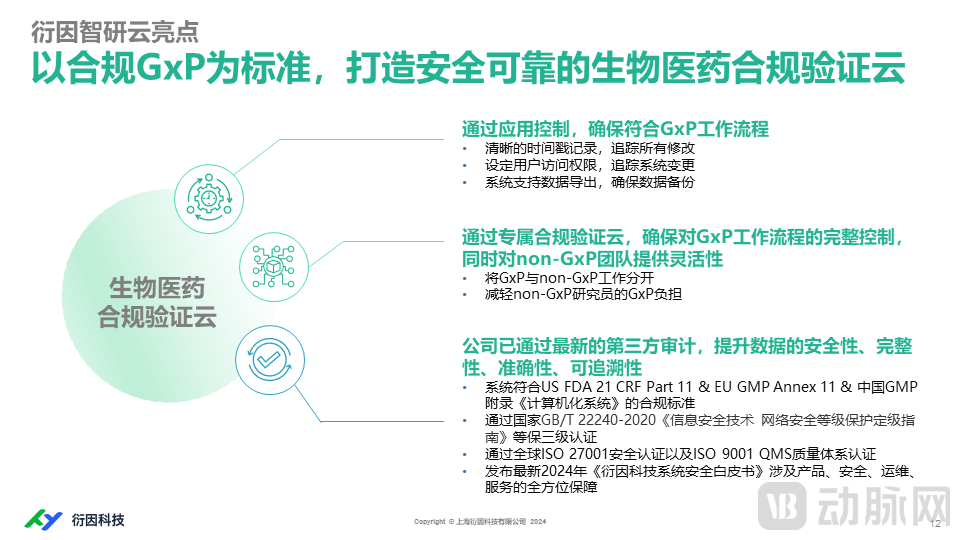
Highlights of YanYin Intelligent Cloud Data Compliance, image from YanYin Technology
On the foundation of ensuring data security, Yanin Technology has engaged in active commercial collaborations. On April 23, 2024, Yanin Technology entered into a strategic partnership with Xinsu Technology, which is dedicated to developing high-throughput synthesis platforms based on “semiconductors + microfluidics + micro-bioreactor control.” Yanin Technology specializes in providing artificial intelligence-driven research collaboration platforms and solutions for the biopharmaceutical sector, encompassing multiple dimensions such as an intelligent molecular biology platform, a large model library for biopharmaceuticals, electronic laboratory notebooks, and a scientific research big data platform.Joint Release of China’s First Integrated Hardware-Software Solution for High-Throughput Synthesis。
Furthermore, Yanyin Technology has partnered with Aixin Zhiyao, an innovative drug R&D enterprise, to provide the molecular biology module yanMolecule of the Yanyin Zhiyan Cloud Platform;and collaborate with leading large-model enterprises in the industry, such as iFlytek, DP Technology, and Zhipu AI, to jointly develop industry-level applications of AI large models for biopharmaceuticals. The School and Hospital of Stomatology at Wuhan University has also introduced the Yanyin Zhiyan Cloud Platform. According to feedback, Yanyin Technology’s platform has optimized its research workflows, while the security and compliance features of Yanyin Technology’s products have ensured secure data storage, significantly enhancing data traceability and integrity.
It is worth noting that Chen Zeping pointed out that in the process of building a digital research collaboration platform for biomedicine, user education is both a crucial and highly challenging component. To address this, Yanin Technology has focused on strengthening this aspect through three major strategies: first, it has adoptedJoint Innovationmodel, working closely with several core customers, product requirements are directly derived from users' real needs, rather than being developed in isolation; secondly, to deepen professional capabilities,A Ph.D. from Tsinghua University specializing in molecular biology has been recruited as a full-time member., bringing rich professional expertise and unique insights to the team; furthermore, carefullyCultivate a cohort of seed users, with each product iteration and update, we invite them to be the first to experience it and continuously optimize based on their feedback. This process effectively enhances product usability and cultivates user habits.
Today, Yanyin Zhiyan Cloud has launched a free Academic Edition for universities and research institutions, a Professional Edition for individual researchers, and an Enterprise Edition suitable for businesses of various sizes. However, Yanyin Technology is not content to rest on its laurels. “The original intention behind founding this company was to develop the global market. Our next step will be to identify one or two seed customers to jointly explore standards for an International Edition, with marketing promotions across both online and offline channels expected to roll out next year.”