

Orum Therapeutics Enters $945M Global Collaboration with Vertex Pharmaceuticals to Develop Up to Three Degradation-Antibody Conjugates (DACs)
Orum Therapeutics
Cancer Treatment Drug Developer
Vertex
Breakthrough Small Molecule Drug Developer
On July 16, South Korean pharmaceutical company Orum Therapeutics announced that it had entered into a global multi-target research and licensing agreement with Vertex Pharmaceuticals. Under the agreement, Vertex has the right to use Orum’s TPD² (Targeted Protein Degradation) technology platform to discover innovative conditioning agents for gene-editing therapies, which will be jointly developed.
Up to three antibody-drug conjugate (DAC) drugs.
Under the terms of the agreement, Vertex will pay a $15 million upfront payment and milestone payments of $310 million per program, with the total collaboration value reaching up to $945 million.
Proprietary Technology Platform: $100 Million Upfront Payment for BMS to License a First-in-Class Drug
Targeted Protein Degradation (TPD) is a class of small-molecule drugs that leverage the cell’s normal ubiquitin-proteasome system to degrade previously “undruggable” targets, thereby achieving therapeutic effects.
However, Orum believes that traditional targeted protein degraders are typically small molecules that indiscriminately enter many cells throughout the body, whereas traditional antibody-drug conjugates (ADCs) require internalization via cell surface receptors, thus being limited by cell surface targets and their expression levels, which in turn restricts their applicability to certain indications. Based on this, Orum has developed its proprietary TPD² platform, which combines protein degradation with ADC technology. This platform relies on antibody-conjugated delivery to transport small-molecule targeted protein degraders into tumors, thereby enabling the development of innovative, best-in-class, tumor-selective novel targeted protein degraders (TPDs). These TPDs link the payload to an antibody for specific delivery to cancer cells on one end, while on the other end, they specifically degrade target proteins within cancer cells via the E3 ubiquitin ligase pathway, leading to tumor cell death.
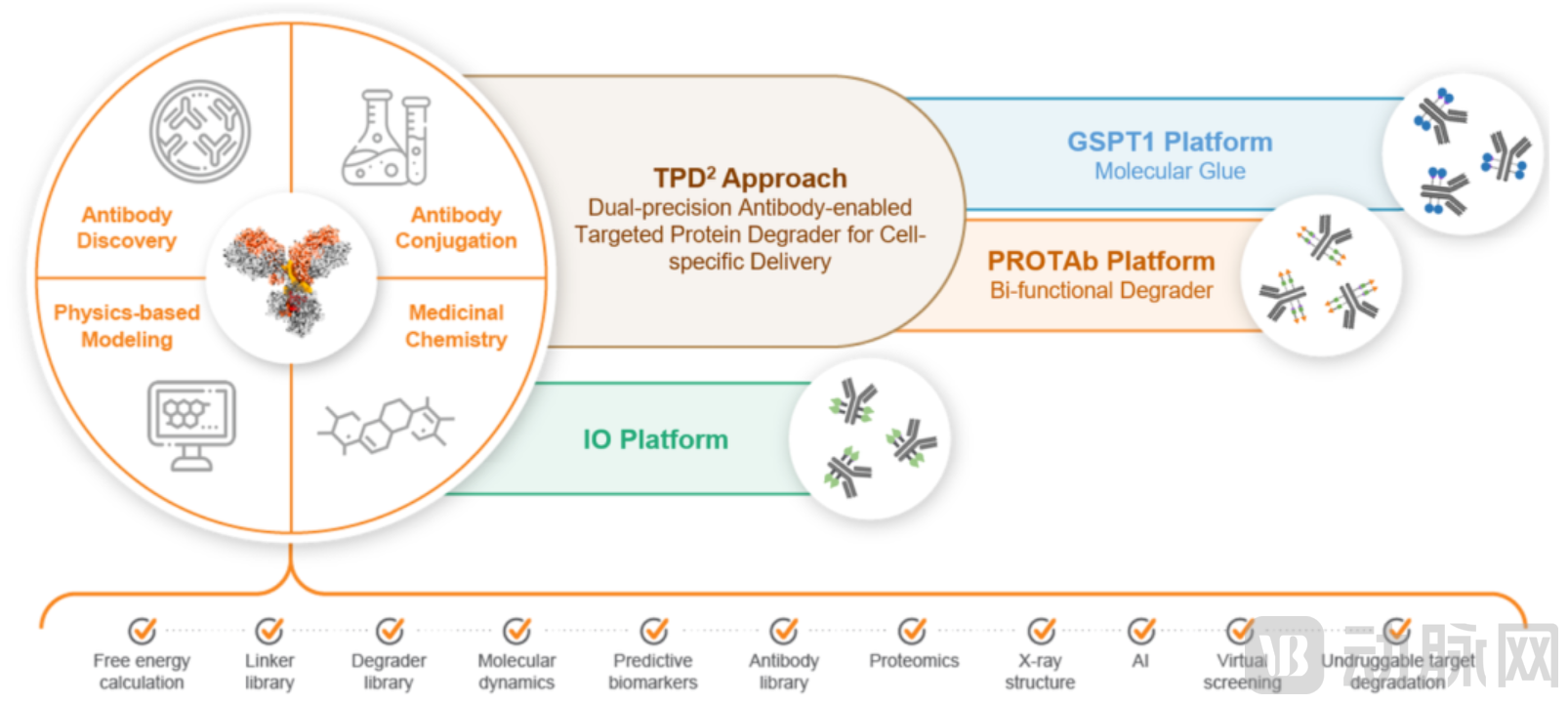 TPD² Platform. Image source: Orum official website
According to the Orum website, the advantages of the TPD² platform are as follows:
Efficacy: Preclinical experiments have demonstrated that antibody-mediated delivery methods can enhance the potency of protein degraders by 1,000-fold.
Safety: Antibody-conjugated degraders are inactive until they are internalized and released from the antibody. The internalization of these antibodies depends on binding to specific cell surface antigens, thereby reducing the exposure of non-target cells to the protein degrader.
Pharmacokinetics and Pharmacodynamics: Coupling small-molecule protein degraders with antibodies can increase the half-life and drug exposure of the payload
On November 6, 2023, Bristol Myers Squibb (BMS) announced the in-licensing of Orum’s first-in-class candidate drug ORM-6151 for an upfront payment of $100 million. ORM-6151 is an anti-CD33 antibody degrader conjugate currently undergoing Phase I clinical trials under FDA authorization, targeting patients with acute myeloid leukemia and those with high-risk myelodysplastic syndromes.
In addition, Orum has another candidate therapy developed via its TPD² GSPT1 platform, ORM-5029, which is currently in Phase I clinical trials and targets HER2-expressing solid tumors in breast cancer patients. Meanwhile, Orum has also established two additional development platforms, TPD² PROTABB and TPS² Cbl-b, with their respective pipelines all at the discovery stage.
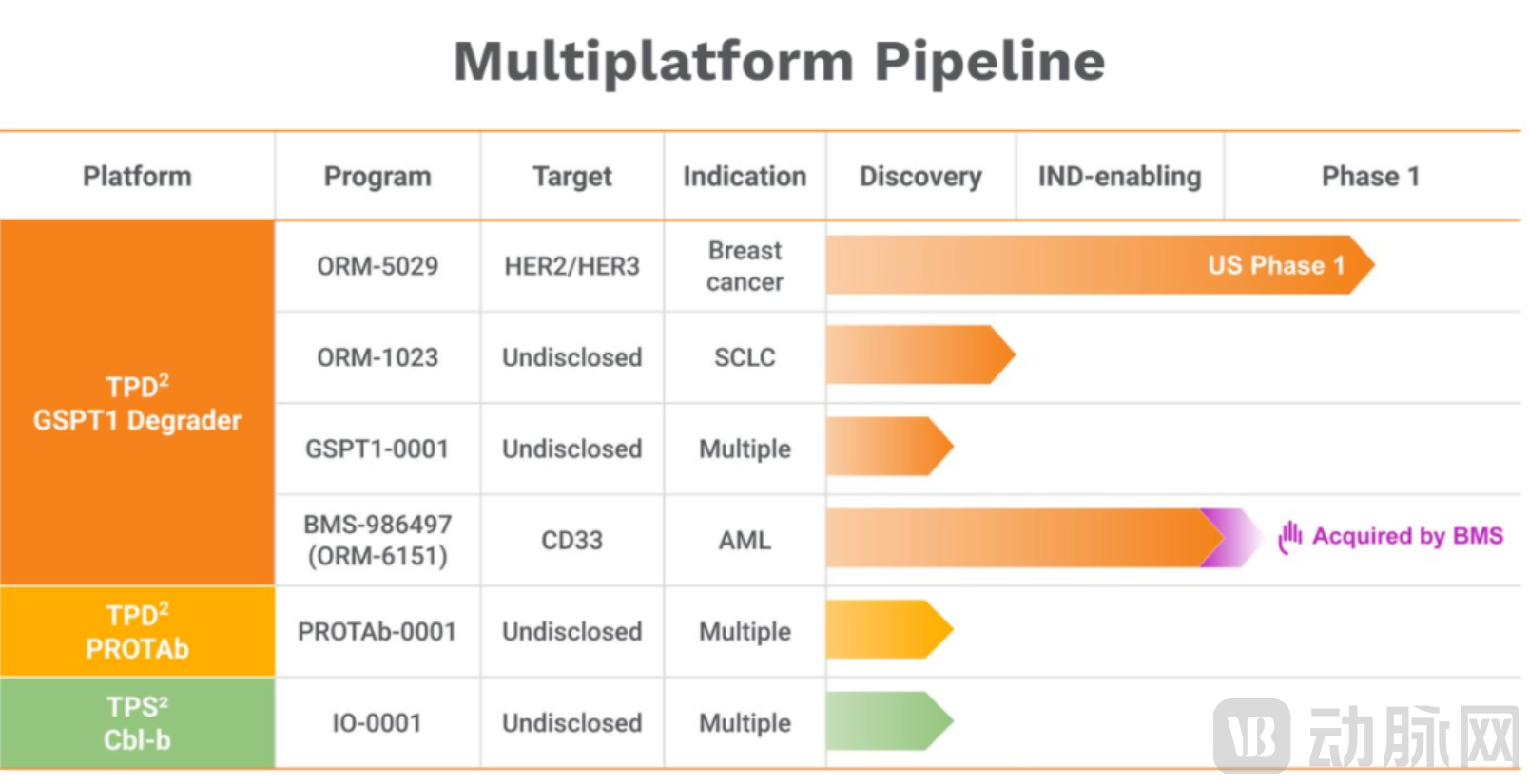 Orum Pipeline Source: Orum Official Website
Protein Degradation + ADCs Gain Momentum; Vertex Bets on Antibody Endocytosis
In addition to Orum, two development collaborations for DAC drugs were reached in 2023, namely Nurix with Seagen and Merck & Co. with C4 Therapeutics. Among them, C4T has entered into eight transactional collaborations with domestic and international enterprises, including Merck & Co., Merck KGaA (Germany), Roche, Biogen, and Betta Pharmaceuticals, with a cumulative total transaction value of up to $4.813 billion.
Beyond seeking to develop new drugs, the deeper rationale behind Vertex’s collaboration with Orum lies in its interest in the antibody internalization effect of ADCs. On March 1 last year, Vertex also entered into a collaboration agreement with ImmunoGen, whereby ImmunoGen licensed Vertex to use its ADC technology for the research and development of novel targeted modulators for gene editing. The upfront payment was $15 million, with milestone payments totaling $337 million.
Antibody internalization refers to the process whereby antibodies bound to their corresponding antigens on the cell surface are transported into the cell via the cell’s intrinsic molecular transport system, forming antibody-antigen complexes that exert specific biological effects intracellularly. The internalization pathways of antibody-drug conjugates (ADCs) can be categorized into two types based on clathrin dependence: clathrin-mediated endocytosis (CME) and clathrin-independent endocytosis. Clathrin-independent endocytosis is further subdivided into caveolin-mediated endocytosis, clathrin-independent carrier/GPI-anchored protein-enriched early endosomal compartment (CLIC/GEEC) pathway, and macropinocytosis.
As the “missile” of antibody-drug conjugate (ADC) therapeutics, the antibody possesses targeting functionality, enabling it to specifically recognize antigens on the surface of tumor cells. Upon binding to these cell-surface antigens, the complex undergoes endocytosis, thereby delivering the cytotoxic payload into the tumor cells to exert its toxic effects.
However, the efficacy of antibody internalization often depends on two critical factors: one is the expression level of the antigen, and the other is the intrinsic internalization capacity of the antigen itself. For Vertex, which has already established collaborations with two different platforms, more time will be needed to validate its exploration into new therapeutic areas following the approval of its first CRISPR gene-editing therapy, Casgevy.
References:
Don’t Overestimate Antibody Internalization: Vertex Partners with Orum on Three DACs for $945 Million | Antibody Research