

Tempus AI: The Healthcare AI Company Behind 86% Revenue Growth and Endorsements from Seven Wall Street Firms

Tempus
Precision Medical Technology Researcher
A Medical AI Company Has Recently Gone Viral!
This company'sThe stock has surged 31% for consecutive sessions (as of July 16) and has recently been highlighted by numerous Wall Street analysts with upgraded buy recommendations.. Analysts at Morgan Stanley projected that its revenue would grow at a compound annual growth rate (CAGR) of 27%, setting a price target of $44, which represents a potential upside of up to 34% from the then-current share price. Analysts from seven other prominent Wall Street firms, including Stifel, BofA Securities, and JPMorgan Chase, also set their target prices at similar levels.
The company has just emerged from the capital “winter,” becoming one of the first digital health firms to list on U.S. stock exchanges since 2022, and has attracted partnerships with industry giants such as SoftBank and Google.
What is the unique appeal of Tempus AI, and what insights can it offer for the commercialization of medical AI? VCBeat has analyzed its business operations and recent developments to provide valuable reference.
In fact, Tempus AI’s achievements over the past month have been quite impressive.
On June 14, Tempus AI listed on the Nasdaq, becoming the second digital health company to go public in the U.S. stock market since 2022., together with Waystar, which had just gone public a week earlier, jointly broke the “ice” for digital health IPOs in the U.S. stock market.
In 2021, 20 digital health companies went public on the U.S. stock market, but most of them delivered lackluster performance. Due to various factors, only two digital health firms listed on U.S. exchanges in 2022. Subsequently, the IPO market for digital health companies in the U.S. entered a “deep freeze,” with no such listings throughout 2023.
The successive IPOs of Waystar and Tempus AI have brought an end to this prolonged “freeze.”
In this IPO, Tempus AI issued 11.1 million shares at a price of $37 per share, with a fundraising target of $410.7 million, making itThe valuation reached $6.1 billion. Its stock performed impressively on the first day of listing, surging 15% to $42 at one point, and still closed at $40 for the day, up 9% from the opening price.。
Tempus AI’s stock price subsequently dipped, but has since returned to the $40 level following a sustained rally that began in early July.
In fact, Tempus AI did not only begin to attract capital enthusiasm in the secondary market. As early as in the primary market, it had already drawn the attention of many industry leaders.Tempus AI completed nine rounds of public financing prior to its IPO, raising a cumulative total of $1.3 billion. Its investor roster includes prominent names such as Nova Holdings (a major shareholder in Novo Nordisk), Google, and SoftBank.。
Just half a month after its market launch,SoftBank Extends Another Olive Branch to Tempus AI. The Two Companies Announced on June 27 That They Will Establish a Joint Venture in Japan. As planned, the joint venture named SB TEMPUS Corp. is expected to be established as early as July 2024, at which timeEach party will invest JPY 15 billion in the joint venture, bringing its registered capital to JPY 30 billion (approximately USD 190 million).。
The joint venture plans to leverage Tempus AI’s capabilities to sequentially roll out precision medicine services in Japan, including genetic testing, medical data analytics, and AI-driven treatment regimens. It will advance pharmaceutical research in Japan through collaborations with Japanese healthcare institutions, pharmaceutical companies, biotechnology firms, medical device manufacturers, third-party testing laboratories, and insurance providers, while delivering personalized treatment plans for local oncology patients.
Beyond its progress in the capital markets, Tempus AI has also achieved milestone advancements in regulatory and clinical domains over the past month.
June 26,Tempus AI’s Tempus ECG-AF algorithm has secured FDA 510(k) clearance, enabling the use of AI to identify patients at potentially increased risk of atrial fibrillation. This also marks the FDA’s first approval for an atrial fibrillation indication within the “machine learning-enabled cardiovascular notification software” category.。
This algorithm primarily collects and analyzes resting 12-lead electrocardiogram (ECG) records from patients aged 65 years or older (with no known history of atrial fibrillation or other specific medical conditions) to detect signs associated with the incidence of atrial fibrillation in the following year, thereby assessing the patient’s future risk of atrial fibrillation.
In early July,Tempus AI’s xT CDx assay and PurIST algorithm test have successively been granted reimbursement codes by regulatory authorities。
The xT CDx test has been granted Advanced Diagnostic Laboratory Test (ADLT) status by the Centers for Medicare & Medicaid Services (CMS), enabling phased reimbursement at prescribed rates. This marks Tempus AI’s first approved companion diagnostic test, designed to identify patients who may benefit from targeted therapies listed in the companion diagnostic indications, as specified in the approved therapeutic product labeling. Previously, in May 2023, the U.S. Food and Drug Administration (FDA) approved Tempus AI’s Premarket Approval (PMA) application.
The PurIST algorithm has obtained a Proprietary Laboratory Analyses (PLA) code from the American Medical Association (AMA). It is also the first Current Procedural Terminology (CPT) code to serve as a generic procedural term for describing purely algorithmic analysis of transcriptomic data from previously sequenced laboratory-developed tests, which holds significant implications for the reimbursement of AI algorithms.This novel RNA expression assay can identify patients with the classical subtype of pancreatic ductal adenocarcinoma, thereby enabling stratification of overall survival among classical-subtype patients receiving either of the two first-line therapies, which may help inform first-line treatment management.
It is worth noting that,Tempus AI Recently Published Its 500th Research Article, marking a milestone in academic achievements. Over the past eight years, Tempus AI has published 143 peer-reviewed articles (106 authored by Tempus), presented clinical and research data at major scientific conferences 291 times, and delivered 31 oral presentations, demonstrating its widely recognized influence in global oncology research.
It is only natural that Tempus AI has won the favor of Wall Street, having achieved so many milestones in just one month.
Tempus was founded in 2015 by billionaire Eric Lefkofsky. Its name has undergone several changes, from Bioin at its inception to Tempus Health, then to Tempus Labs. It was not until 2023 that it was renamed to its current name, Tempus AI.
Prior to founding Tempus, Eric Lefkofsky had co-founded multiple companies, including Groupon, once ranked by Forbes as the fastest-growing company in history; Echo Global Logistics, a freight and logistics firm; InnerWorkings, which provides print procurement services; Mediaocean, offering advertising management services; industry analytics firm Uptake; and Pathos AI. Additionally, Lefkofsky is the Co-Founder and CEO of Lightbank, a Chicago-based venture capital firm.
The rationale behind Eric Lefkofsky’s founding of Tempus AI is quite common in the healthcare industry. At the time, Lefkofsky’s wife was diagnosed with breast cancer. While accompanying her through treatment, he discovered that genomic sequencing could precisely identify genomic information in cancer patients, thereby enabling targeted cancer therapies. However, there was a lack of reliable clinical data to ensure the efficacy and safety of these targeted drug treatments.
Integrating genomic sequencing with clinical data to provide more precise treatment plans for cancer patients was the original motivation behind Eric Lefkofsky’s founding of Tempus AI. This requires establishing the technical systems necessary for precision medicine, thereby obtaining structured clinical data and combining it with structured molecular data, machine learning, AI, and other analytical technologies.
To create such a clinical and molecular diagnostic database, Lefkofsky assembled a team comprising data scientists, software engineers, bioinformaticians, computational biologists, and research scientists, and set out to establish a series of data pipelines to enable the large-scale collection, cleaning, and analysis of data, thereby advancing precision medicine.
However, although there were already many relevant enterprises in the fields of clinical and genomic data at that time, none could meet Tempus’s expected requirements for data cost and quality. Tempus had to rely on its own efforts, starting from scratch, which became key to building its future core competitiveness.
First, Tempus established its own certified automated laboratory to provide low-cost sequencing services for patients. At that time, it was able to serve over 100,000 patients annually, completing sequencing within two to three weeks after receiving samples. While collecting patient genomic information, Tempus pioneered the integration of AI into bioinformatics to analyze data on patient genome and transcriptome expression levels, including variant analysis, potential treatment options, and suitable clinical trials.
As part of its broader strategy, Tempus provides cost-effective data structuring, image analysis, and biological modeling services to hospitals, oncologists, and cancer centers, with the primary aim of collecting and integrating diverse clinical patient data. In this process, Tempus AI structures these clinical data, thereby establishing a high-quality data foundation for subsequent services and AI training.
Subsequently, by integrating genomic data with structured clinical data, Tempus provides physicians with comprehensive diagnostic tools, highlights key data points in real-time clinical reports, and suggests potential actionable treatment plans. Its interactive platform enables physicians to access real-world evidence from similar patients to analyze relevant therapies and outcome data, thereby helping them select the most appropriate treatment pathway for patients amidst a complex array of therapeutic options.
On one hand, the founder brought with him a gold-standard network and a proven track record of successful entrepreneurship; on the other, there was indeed substantial demand for Tempus AI’s concept. Consequently, the company successfully closed multiple funding rounds shortly after its inception. In just three years, Tempus AI completed seven financing rounds, raising a cumulative total of $320 million.
Backed by strong support, Tempus has also achieved rapid development, establishing what is arguably the most comprehensive database in the industry in just three years by leveraging advanced machine learning, next-generation sequencing, and AI-assisted image recognition technologies.。
These technologies also empower physicians to help patients make data-driven decisions in real time, thereby enabling Tempus AI to cultivate a cohort of clinical partners as business supporters. Since the launch of its data platform in 2016, Tempus AI has directly established approximately 450 data channels with more than 2,000 hospitals across the United States, the majority of which are bidirectional. Meanwhile,Tempus has also established partnerships with more than 60% of academic medical centers and over half of oncologists in the United States.。
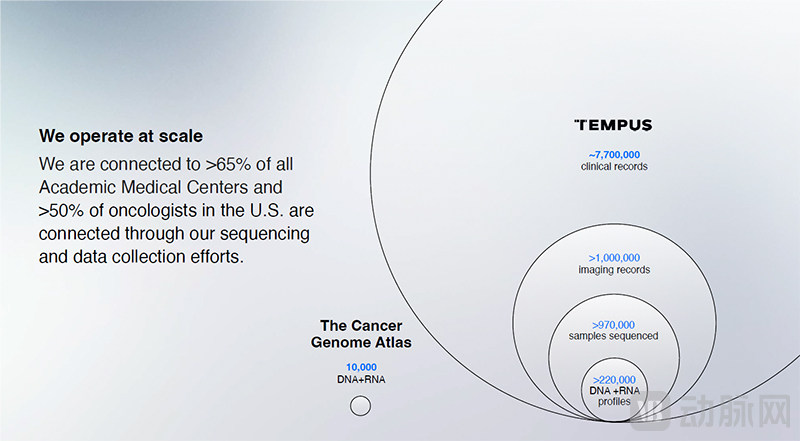
Vast Amount of Medical Data Accumulated by Tempus AI (Screenshot from Tempus AI’s Public Presentation)
Currently,Tempus AI has accumulated over 900 million documents, comprising massive amounts of multi-dimensional data including clinical data, genomic data, pathology data, and medical imaging data.. These data encompass more than 5.6 million de-identified patient records, approximately 1.3 billion pages of clinical text, over 1 million medical imaging datasets, more than 900,000 genomic information-linked matched clinical records, and over 22 datasets with complete transcriptomic profiles.
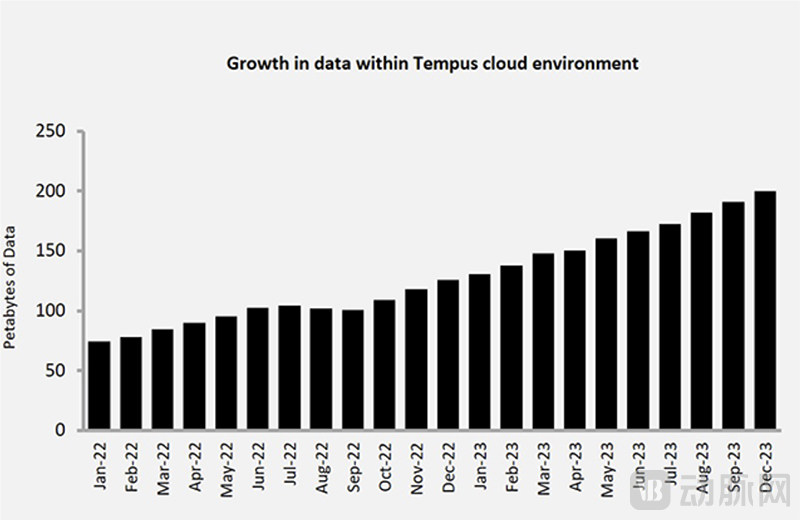
Tempus AI’s accumulated medical data volume is growing rapidly (screenshot from Tempus AI’s prospectus)
These data have experienced extremely rapid growth. In January 2022,Tempus AI had accumulated approximately 75 PB of data (1 PB = 1,024 TB). By the end of 2023, this data volume had reached 200 PB and continues to grow.。
These de-identified massive datasets have unlocked significant value within Tempus AI’s business model, successfully achieving data monetization. In its business model, data is the most critical asset: the more data it collects and the higher the data quality, the more intelligent its testing becomes and the more data-driven applications it can launch. This, in turn, attracts more healthcare institutions to join its platform, further expanding its data ecosystem and thereby generating value for pharmaceutical companies.
To date, Tempus has established three core business lines: genomic sequencing, healthcare data services, and AI-driven recommendations for personalized therapies.
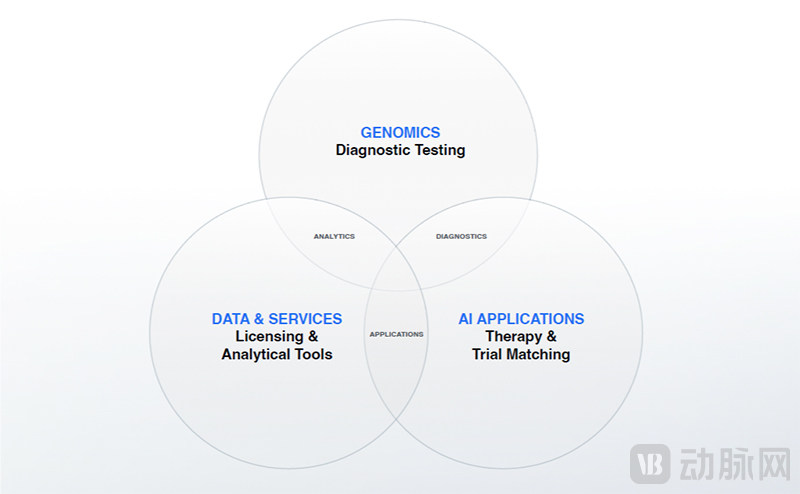
Tempus AI Has Formed Three Core Business Segments (Screenshot from Tempus AI’s Prospectus)
In the field of genomic sequencing, Tempus AI’s three laboratories offer NGS diagnostics, PCR analysis, and other anatomical and molecular pathology tests. As of March 2024, Tempus AI’s flagship genomic sequencing portfolio comprised six oncology-related genetic tests and one psychiatry-related genetic test.
Tempus AI’s data services business primarily facilitates pharmaceutical companies’ product development through data analytics and the facilitation of clinical trials. Additionally, Tempus AI has established an oncology-derived biological modeling (or organoid) laboratory to provide modeling and screening services to its pharmaceutical clients.
Pharmaceutical researchers can access the ultra-large-scale multimodal medical data accumulated by Tempus AI and leverage its data tools. This has, to some extent, transformed the traditional drug development processes of pharmaceutical companies, enabling Tempus AI to collaborate with them throughout the entire drug development lifecycle—from biomarker discovery and clinical development to final commercialization.
Based on the final data, pharmaceutical companies are highly satisfied with Tempus AI’s data services. According to its prospectus,Nineteen of the top 20 global pharmaceutical companies have partnered with it, and its net revenue retention rate in 2023 reached 125% compared to the same customers in the same period of 2022. This indicates that these customers have not only been retained but have also intensified their collaboration with the company.。
Tempus AI has also demonstrated its strengths in advancing clinical trials for pharmaceutical companies. It leverages its extensive network of oncologists and academic institutions to provide clinical trial matching services. Tempus AI generates revenue by matching eligible patients with trials and successfully enrolling them.
Such nationwide matching has historically been extremely challenging. However, with the continuous advancement of Tempus AI’s genomic sequencing services and their integration with clinical data, this challenge is gradually being resolved. Tempus AI can precisely identify patients who match clinical trial criteria, filter inclusion or exclusion criteria using patient clinical data, and ultimately ensure that suitable patients are successfully enrolled.
According to the prospectus, since Tempus AI launched this service in mid-2019, more than 230 clinical trials have been integrated into its network. As of March 2024, over 30,000 patients had been identified as potential candidates for enrollment.
AI-assisted and personalized therapy recommendations focus on the development and provision of auxiliary diagnostic tools. Leveraging its vast accumulation of multimodal data, Tempus AI can train more precise generative AI models to facilitate the identification of patients in the early stages of disease, thereby enabling treatment during the phase when interventions are most effective.
Currently, Tempus AI has developed multiple sets of AI algorithms in the fields of oncology, cardiovascular disease, medical imaging, and pathology, with some of these algorithms already having received regulatory approval. However, its AI business remains in an investment phase and is not yet generating significant revenue. For instance, its AI algorithms in oncology are currently bundled as part of genomic testing services rather than being billed separately. Looking ahead, as AI applications and regulatory frameworks mature, Tempus AI aims to secure reimbursement for its AI algorithms at rates comparable to those for existing reimbursable tests.
It is not difficult to see that Tempus AI’s business spans multiple sectors, positioned at the intersection of healthcare and data/AI. It also empowers pharmaceutical companies to conduct smarter and more efficient R&D, indicating a vast market opportunity. According to analysts’ estimates,Tempus’s total addressable market is approximately $190 billion, comprising $70 billion in genomics and nearly $120 billion in data services.。
Among these,Tempus AI has the highest expectations for its AI business, as evidenced by its name change to “Tempus AI.” Its prospectus also indicates that the potential market opportunity for its AI business is substantial, with the future market size potentially exceeding the combined total of its genomics and data services businesses.。
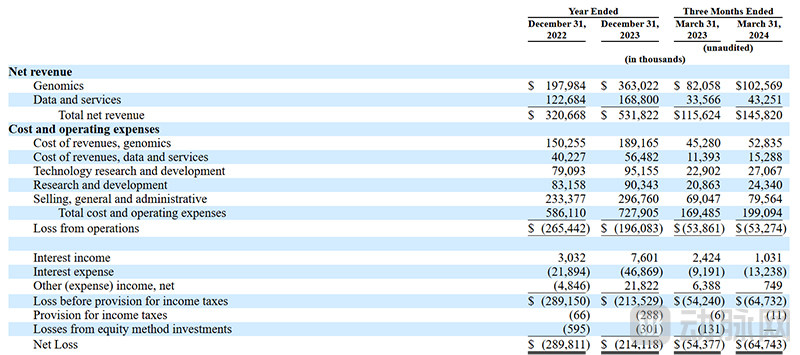
Tempus AI Financial Revenue (Screenshot from Tempus AI Prospectus)
However, as previously mentioned, AI is still in the investment phase, and gene sequencing remains the primary revenue driver for Tempus AI. In 2023, its gene sequencing business generated $363 million in revenue, an 83% increase from the $198 million recorded in 2022. Amid such explosive growth, the performance of data services appeared lackluster—although this segment still achieved a 37.6% year-over-year growth, reaching $168.8 million in annual revenue.
Combined, the two account forTempus AI achieved annual revenue of $531.8 million in 2023, representing a 65.8% increase from $320.7 million in 2022.. Nevertheless, its net loss widened from $214.1 million in the previous year to $289.8 million in 2023. However, with $167 million in cash and cash equivalents on hand, plus over $400 million raised from this IPO, the company has sufficient resources to support its operations for the next two years.
Judging from the fact that analysts have been upgrading their ratings to “Overweight,” Wall Street is clearly optimistic about the future of Tempus AI.
It is not difficult to see that Tempus AI offers us insights in two aspects.
First, the core of Tempus AI’s competitiveness stems from the massive amount of data it has accumulated; without such high-quality data, Tempus AI’s business model would be nothing more than a pipe dream. This alsoThis underscores the immense value inherent in high-quality medical data and offers valuable insights for China’s healthcare big data sector, gene sequencing industry, and other industries that possess vast amounts of data.Currently, the Chinese government attaches great importance to the market-oriented circulation of data, and the healthcare sector is one of the first 12 key areas implementing the “Data Element ×” initiative. As this initiative deepens, the market-oriented circulation of medical data will eventually become a reality. At that time, the value of medical data will be unleashed—provided, of course, that the data are truly high-quality and valuable.
Secondly,Tempus AI’s Foray into AI-Driven Clinical Care Holds a Bright FutureCurrently, AI-driven clinical applications have become a highly promising investment hotspot abroad. By leveraging disease phenotypes and genetic information, AI in clinical settings can facilitate the selection of clinical indications, optimization of clinical endpoints, and identification of eligible subjects. Furthermore, AI can assist pharmaceutical companies in identifying hospitals with a higher concentration of patients meeting enrollment criteria and enhance clinical monitoring capabilities. These applications support decision-making by analyzing and synthesizing large volumes of data.
Beyond this, other application scenarios of AI in clinical settings also hold immense value. For instance, digital twin technology can simulate clinical records and comprehensively model clinical outcomes based on standard-of-care protocols, thereby achieving higher success rates with smaller patient cohorts. Alternatively, in clinical R&D, analysis of real-world data can be leveraged to assess trial feasibility and optimize study designs, thus accelerating the clinical development process.
Precisely because of these advantages, multinational pharmaceutical companies have placed significant emphasis on collaborations integrating AI with clinical trials in recent years, even making direct investments. According to FDA data, the adoption of AI-designed clinical trials in the United States has advanced rapidly, with nearly 200 such trials conducted by 2023. As China’s innovative drug sector continues to develop, it will inevitably drive the implementation of AI-integrated clinical solutions domestically, thereby offering new avenues for the expansion of medical AI in China.
As a key player in the “ice-breaking” wave of digital health IPOs, Tempus AI has delivered an impressive performance in the month since its listing. VCBeat will continue to monitor its future trajectory.
References:
Tomi Kilgore,morningstar.com:Buy this healthcare company's stock because it's an AI play, analysts say