

Shanghai Ninth People's Hospital Transfers Two Hemodialysis Patents for RMB 3.6 Million to Shanghai Shenlian Tech
Recently, Shanghai Ninth People’s Hospital, Shanghai Jiao Tong University School of Medicine, announced the transfer of two invention patents—“LIPO Dialysate” (Patent No.: ZL202110008666.1) and “LIPO Peritoneal Dialysis Solution” (Patent Application No.: 2023104343211)—to Shanghai Shenlian Technology Service Co., Ltd. for RMB 3.1 million and RMB 500,000, respectively, totaling RMB 3.6 million. The public notice period for both transactions has now expired.
According to the public disclosure by Shanghai Ninth People’s Hospital, Shanghai Jiao Tong University School of Medicine, the inventors of these two patents are Dr. Ding Feng and his team. Dr. Ding currently serves as the Director of the Department of Nephrology at Shanghai Ninth People’s Hospital, Shanghai Jiao Tong University School of Medicine. He pursued advanced training in blood purification at the BioArtProducts Institute in Germany from June 1999 to June 2000, and conducted further studies in blood purification and tissue engineering in Professor Humes’ laboratory at the University of Michigan, USA, from September 2007 to November 2008. Dr. Ding has long been engaged in clinical practice and scientific research in nephrology, having published more than 100 papers, including over 20 indexed by SCI. He has successively undertaken four projects funded by the National Natural Science Foundation of China, one sub-project under the National Key Technology R&D Program, one key project and one general project funded by the Shanghai Municipal Science and Technology Commission, as well as a startup fund for returned overseas scholars supported by the Ministry of Education.
Compared with conventional dialysis, the fat emulsion dialysate provided by this group of patented inventions demonstrates a clear advantage in the removal of protein-bound toxins, features a simpler preparation process and lower cost, and exhibits good stability and safety. It remains stable at room temperature for 14 days without significant precipitation.
Uremia, also known as end-stage renal disease (ESRD), represents the final stage of various kidney diseases. According to Frost & Sullivan analysis, the number of ESRD patients in China reached 3.91 million in 2022 and is projected to grow to 6.89 million by 2030. Data from the National Center for Medical Quality Control in Nephrology indicates that there were 844,000 individuals undergoing hemodialysis in China in 2022, suggesting that the existing demand for dialysis treatment remains significantly unmet.
Notably, the primary triggers for uremia are undergoing a subtle yet significant shift. Historically, chronic kidney disease (CKD) was the leading cause of uremia; however, chronic underlying conditions such as diabetes have now emerged as more prominent drivers. According to data from the 2023 Annual Academic Conference of the Nephrologist Branch of the Chinese Medical Doctor Association, diabetic nephropathy accounted for 21.1% of all dialysis cases in 2022, ranking second. Among new dialysis patients in 2022, diabetic nephropathy surpassed primary glomerulonephritis for the first time, with a proportion of 29.9% compared to 28.7%, thereby becoming the leading cause of hemodialysis.
The blood environment of patients with uremia is extremely complex, primarily characterized by three major categories of toxins: water-soluble small-molecule toxins, water-soluble medium-to-large-molecule toxins, and lipid-soluble small-molecule toxins. The successful clearance of each toxin category serves as a significant indicator of markedly improved hemodialysis efficacy.
Reviewing the evolution of hemodialysis technology, the first generation focused on the clearance of water-soluble small-molecule toxins, effectively prolonging patient survival. However, complications associated with middle- and large-molecule toxins emerged as a new challenge. The second generation of hemodialysis technology, namely hemofiltration, achieved the purification of middle- and large-molecule toxins on this basis, significantly reducing inflammatory complications and further improving patients' quality of life. Nevertheless, the presence of lipid-soluble small-molecule toxins continues to threaten patients' cardiovascular and cerebrovascular health, representing a critical "peak" that hemodialysis technology urgently needs to conquer.
Although traditional formulations containing glucose osmotic agents and lactate buffers can achieve the removal of toxins and excess fluid, their low pH, high glucose content, and the generation of glucose degradation products (GDPs) and advanced glycation end products (AGEs) during production and storage may lead to peritoneal neoangiogenesis, epithelial-to-mesenchymal transition (EMT) of peritoneal mesothelial cells, and peritoneal fibrosis, thereby impairing peritoneal function.[1]。
Against this backdrop, Professor Ding Feng’s team developed an innovative solution: lipid emulsion dialysate. This formulation comprises long-chain triglyceride oil, medium-chain triglycerides, antioxidants, sodium oleate, glycerol, phospholipids, and a solvent. Its key innovation lies in the incorporation of small-particle-size oil phases as highly efficient adsorbents, which significantly enhance the dialysate’s binding affinity for protein-bound uremic toxins—such as p-cresyl sulfate (PCS), indoxyl sulfate (IS), and indole-3-acetic acid (3-IAA). Consequently, this approach effectively improves the clearance of protein-bound toxins, reduces the incidence of cardiovascular complications, prolongs patient survival, and enhances quality of life, positioning it as a third-generation blood purification technology.
Furthermore, the preparation method for LIPO dialysate/peritoneal dialysis fluid is simple and cost-effective, with excellent stability and safety. It remains stable at room temperature for 14 days without significant precipitation, demonstrating broad prospects for clinical application and industrialization.
Five Major Manufacturers Dominate Over 80% of the Market,
Under Centralized Procurement, Domestic Hemodialysis Manufacturers Are Poised to Break Through
Hemodialysis, as the most widely used blood purification therapy, extensively benefits patients with acute and chronic renal failure. The treatment process relies on a series of precision devices and consumables, primarily including hemodialysis machines, dialyzers, hemodialysis concentrates, extracorporeal circulation tubing for hemodialysis, and fluid replacement tubing for blood purification.
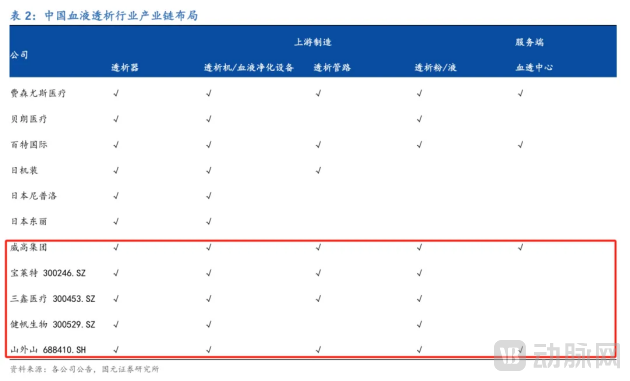
From the perspective of market structure, the hemodialysis machine sector has long been dominated by foreign companies. According to a research report by Guolian Securities, foreign manufacturers hold over 70% of the market share in the hemodialysis machine segment, while domestic companies represented by Weigao, Biolight, and Chongqing Sunwowa account for less than 30%. In the consumables segment, specifically hemodialyzers, import and domestic manufacturers each hold approximately 50% of the market. Hemodialysis tubing and hemodialysis powder/concentrate are primarily supplied by domestic enterprises, resulting in relatively intense competition.
Hemodialysis products belong to a technology-intensive industry, with hemodialysis machines and dialyzers presenting the highest technical barriers. For a long time, the five major traditional foreign manufacturersFresenius, B. Braun, Nikkiso, Baxter, NiproIt has nearly monopolized more than 80% of the domestic market share. However, with theJafron Biomedical, Chongqing Sunwatt, Sanxin Medical, BiolightAs domestic manufacturers rise, the “hegemonic” status of foreign enterprises is being challenged.
At the policy level, many important signals have recently emerged. In May this year, the Tianjin Medical Insurance Bureau issued the “Notice on Carrying Out Centralized Maintenance of Hemodialysis Medical Consumables and the Reporting and Public Disclosure of Historical Bid-Winning Prices,” explicitly stating that the centralized maintenance of hemodialysis medical consumables, along with the reporting and public disclosure of historical bid-winning prices, would commence on May 24, 2024.
On June 1, the volume-based procurement of hemodialysis medical consumables, led by Henan Province and involving 23 provinces, officially entered its implementation phase. This initiative marks the largest and most extensive centralized procurement in the hemodialysis industry to date. The procured items primarily include five major categories: hemodialyzers, hemofilters, extracorporeal circulation tubing for blood purification devices, arteriovenous fistula puncture needles, and indwelling needles for dialysis.
Although domestic enterprises are still in the ramp-up phase, those with substantial winning bids will rapidly capture market share following multiple rounds of large-scale centralized procurement.
When it comes to hemodialysis, home hemodialysis (HHD) is a highly focused area.
Home Hemodialysis is a form of hemodialysis treatment performed at home by the patient, either independently or with assistance from family members, after the establishment of dialysis access and the installation of a hemodialysis machine and related equipment in the home. Compared with traditional center-based dialysis, the greatest advantage of HHD lies in the freedom it affords patients in terms of time and space, eliminating the need for frequent trips to the hospital.
Overseas practice has demonstrated that, compared with center-based hemodialysis, home hemodialysis (HHD) can reduce medical costs to 60% of the former. By eliminating the burden of frequent travel, it significantly enhances patients’ quality of life and well-being, improves treatment outcomes, and extends survival time.
HHD is not a new concept; it has a history of over 60 years in Europe and the United States. Major medical device companies such as Medtronic, Fresenius, and Baxter, as well as next-generation hemodialysis innovators like NxStage, Outset, and Quanta, have all established their presence in this field.
In contrast, although China has made significant progress in the field of hemodialysis treatment, domestic home hemodialysis remains in its early stages of development due to high technical barriers for home hemodialysis machines, long R&D cycles, and stringent operational requirements for patients. On this occasion, VCBeat’s Orange Bureau provides a brief overview of companies involved in this sector. Should any be omitted, please feel free to contact us.
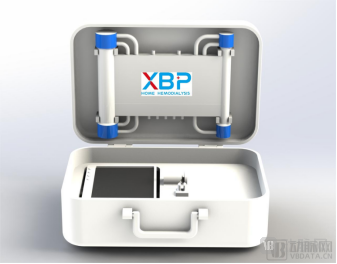
Xinguang Biotech: Developing a Portable Dialysis Machine, Large Animal Testing Completed
Shanghai Xinguang Biopharmaceutical Co., Ltd. (hereinafter referred to as “Xinguang Biopharma”) was established in 2018. Its independently developed portable dialysis platform utilizes a unique dialysate regeneration technology, eliminating the need for complex water treatment systems. The entire system weighs only 8 kilograms, reduces fixed capital investment by 70%, and is designed for easy portability and rapid deployment.
Notably, Xinguang Biotech has abandoned the traditional power mechanism based on tubing and peristaltic pumps, opting instead for pneumatic diaphragm pump technology. This shift not only significantly enhances flow rate precision but also reduces equipment costs and simplifies operational procedures. The integration of consumables into a cartridge-based design enables fully automated device operation. By utilizing different cartridge modules, the platform can provide multiple therapeutic functions, including hemodialysis, peritoneal dialysis, and continuous renal replacement therapy (CRRT). Operators simply need to insert the cartridge into the device to achieve one-touch operation, substantially lowering the professional requirements and learning curve for nursing staff.
Currently, Xinguang Biology has successfully developed the second-generation engineering prototype and verified the feasibility of its advanced technology and design through rigorous testing. According to Li Xianghai, founder of Xinguang Biology, the device has completed large-animal trials in sheep, using a model with complete loss of renal function. After nine treatments over 21 days, the animals’ mental status and various physiological indicators all met clinical standards.
In April this year, Xinguang Biology also secured tens of millions of RMB in Pre-A financing, jointly invested by Haipude Venture Capital, Shanghai Tianxiang Industrial, and existing shareholders.
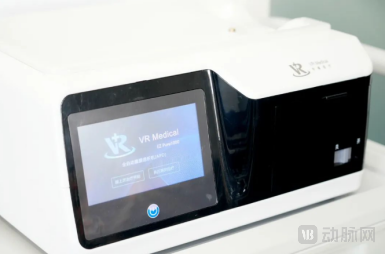
Weirui Medical: Developing a Power-Driven Smart Home Peritoneal Dialysis Machine to Establish an Integrated Management System for Home-Based Smart Peritoneal Dialysis Therapy
Kunshan Weirui Medical Technology Co., Ltd. (hereinafter referred to as “Weirui Medical”) was founded in 2009. Its independently developed home automated peritoneal dialysis machine utilizes dynamic principles and employs a diaphragm pump to achieve the infusion and drainage flow of dialysate. Compared with traditional gravity-based peritoneal dialysis machines, dynamic systems demonstrate significant improvements in both safety and efficacy.
It is reported that Weirui Medical’s proprietary automated peritoneal dialysis (APD) home-based nocturnal therapy allows patients to complete their daily treatment during sleep by simply connecting the device, thereby freeing up daytime hours for normal life, study, and work. The Weirui Automated Peritoneal Dialysis Machine features a self-developed “Digital-Enabled Home Dialysis Therapy System and Multi-Source Information Management Platform,” making it suitable for both in-hospital and home-based treatments.
Before initiating home-based treatment, patients must obtain a prescription from their physician and complete peritoneal equilibrium testing (PET) and operational training within the hospital. The device is user-friendly and easy to operate. In terms of safety, it is equipped with comprehensive control, monitoring, and alarm systems; if any abnormality is detected, treatment will be automatically suspended to ensure patient safety.
It is reported that the company has partnered with the Friendship Branch of Kunshan First People’s Hospital and the Kunshan Independent Dialysis Center to establish a comprehensive, integrated management system for home-based smart peritoneal dialysis therapy.
References
[1] Shanghai Ninth People's Hospital, "Ding Feng: Iteration of Hemodialysis Technology Continuously Extends the Time to the 'End Point'"
[2] Guo Hongxia, Tang Wen. Research Progress on Novel Peritoneal Dialysis Solutions [J]. Chinese Journal of Blood Purification, 2020, 19(06): 403-405.
[3] “A National First! WeiRui’s Independently Developed Power-Type Smart Home Peritoneal Dialysis Machine”
[4] Cailan Medical Devices, “Beijing-Tianjin-Hebei ‘3+N’ Initiative Launches Centralized Procurement for Hemodialysis”》