

NovoNutrients Aims to Disrupt the $2.3 Billion Carotenoid Market with CO₂-Based Fermentation, Slashing Prices from $7,000 to $2,000 per kg

NovoNutrients
Protein Developer
Global aquaculture feed producers, particularly Chinese feed companies, have repeatedly emphasized in recent years that they are more concerned with whether the prices of novel alternative products are comparable to those of traditional feeds than with the source of feed nutrition. Once price parity is achieved, they will immediately switch to novel synthetic feeds.
The above remarks were made at a meeting of F3. F3 is the Future Feed for Fish Collaboration, a joint initiative by non-governmental organizations, researchers, and businesses to accelerate and support the adoption of innovative alternative aquaculture feed ingredients—such as bacterial meal, plant-based proteins, algae, and yeast—with the aim of replacing wild-caught fish.
Meanwhile, the sharp rise in global energy prices and the resulting inflation are quietly becoming a potential force driving the booming development of the alternative protein industry. F3 also points out that alternative energy sources can minimize energy costs thanks to their planned logistics. In contrast, fisheries logistics are unpredictable, requiring expensive diesel-powered vessels for fishing, which makes aquaculture feed, represented by fish meal, more costly. Therefore, novel feed nutrients developed through synthetic biology are expected to open up new markets.
At the conference, F3 specifically highlighted a startup named NovoNutrients, which initially pivoted from the innovative energy sector to aquaculture nutrition before expanding into the food industry. Leveraging a microbial fermentation platform, the company converts carbon dioxide into single-cell protein with a quality comparable to that of beef. Furthermore, the company claims that its carbon capture process can sequester approximately two tons of carbon dioxide for every ton of protein produced. F3 stated that manufacturers of such alternative ingredients possess additional advantages.
Aquaculture Investor Pivots, Onboards Four Technical Executives at Once
NovoNutrients, originally named Oakbio, was established in 2008 and commenced operations in 2009; however, its technology platform was initially designed for the biomanufacturing of n-butanol and polyhydroxyalkanoates (PHAs), a class of biopolymers.
The true turning point occurred in 2017.
David Tze, who specialized in aquaculture investments at the time, was first introduced to Oakbio at the Fish Feed Without Fishmeal Workshop in January 2017. According to him, after graduating from Princeton University, he joined a consulting firm and later co-founded several internet companies. In 2004, he entered the venture capital sector, focusing on investments in the aquaculture industry.

David Tze
Recalling Tze’s experience, on the third and final day, there was a small trade show where several vials of protein powder were displayed on one of the tables. “As I probed further, I realized that the company was pursuing something truly remarkable: producing protein from carbon dioxide emitted by industrial processes.” Deeply impressed, Tze spent approximately six months investigating a laboratory team in California and continuously evaluating NovoNutrients, including hiring three PhDs to conduct two technical due diligence assessments to verify its scientific validity. Subsequently, with the approval of Brian Sefton, founder of NovoNutrients, Tze joined the company as a full-time employee.
Subsequently, he officially began leading the company’s transformation. First, the company name was formally changed from Oakbio to NovoNutrients. Furthermore, Tze’s keen business acumen, honed over many years in the aquaculture market, guided the company’s gradual exit from fuel development and its formal entry into the promising field of aquaculture nutrition R&D—and this was only the beginning.
To reach new heights and expand the company’s business beyond merely developing nutrients for aquaculture into the food sector, the company claims it will use industrial carbon dioxide, low-cost hydrogen, and natural microbes to produce high-quality proteins for human and animal consumption.
To this end, NovoNutrients began introducing a new management team. In 2022, Tze, who had become the CEO of NovoNutrients, announced the appointment of four technical team leaders.
Joachim Ritter serves as the Chief Technology Officer of NovoNutrients. For the past two decades, he has led teams at the Central Research and Development facility of DuPont, a U.S. chemical giant. Previously, Ritter served as Vice President of Research and Technology at Zymergen, where he was responsible for leveraging Zymergen’s microbial bio-manufacturing platform to design and scale up chemical products.
Kedar Patel, the newly appointed Senior Vice President of Biology, is responsible for developing and enhancing NovoNutrients’ core capabilities in molecular biology and microbiology, ultimately leading to the creation and characterization of the production cell lines central to its products. Previously at Zymergen, Patel led teams in building and operating high-throughput platforms for DNA assembly and microbial engineering across a broad range of industrially relevant organisms, including bacteria, yeast, and filamentous fungi. He also helped Amyris establish an automated strain engineering pipeline for high-throughput yeast engineering. With over 20 years of experience in the synthetic biology industry, Patel is an author or inventor on more than 20 patents and publications.
Satish Lakhapatri, Vice President of Engineering, oversees scale-up, reactor design, and process development. Prior to joining NovoNutrients, he served as Director of Engineering at the industrial biotechnology company Calysta for nearly four years and held positions at Codexis and Siluria Technologies for several years. Lakhapatri is also an author/inventor on multiple patents and publications related to reactor design and process scale-up.
Bhupendra Soni has joined NovoNutrients as Director of Food Technology, bringing with him 30 years of experience in biological sciences and fermentation. He previously served as Vice President of Fermentation at MycoTechnology, where he helped lead food fermentation projects for over five years. Soni is the inventor of 12 issued patents and 8 pending patent applications, several of which relate to food protein applications. Among the more than 20 papers he has published, one focuses on the optimization of gas fermentation.
The Transition Path from Energy to Food
In September 2020, three years after its transformation, NovoNutrients’ novel feed protein product was tested by Skretting, a leading fish feed manufacturer. In July 2021, NovoNutrients announced that it had raised $4.7 million in financing, led by Happiness Capital. Combined with the previously raised $4.3 million, NovoNutrients had accumulated $9 million in equity financing.
According to Tze, NovoNutrients’ transformation has not been as difficult as anticipated. Leveraging the valuable process and technical resources accumulated during its Oakbio era, the shift from energy to nutritional products is more akin to an innovation built on the shoulders of giants.
During the Oakbio era, PHA products were naturally produced by microorganisms under nitrogen-deficient conditions. Therefore, when NovoNutrients shifted its focus to producing a nutritional product, its technical strategy leaned more toward minimizing PHA production, as PHA serves as an energy storage mechanism for bacteria, analogous to how humans store energy as fat.
On this basis, the technology for synthesizing PHA from carbon dioxide is equally applicable to the production of synthetic nutrients. Since the feedstock (carbon dioxide) remains unchanged, existing bioreactors of the same type do not require complete redesign but only minor modifications. The primary differences between synthesizing PHA or n-butanol and producing synthetic nutrients lie in genetic engineering and downstream processing. Coincidentally, while this poses a significant challenge for n-butanol synthesis, it is relatively straightforward for the production of single-cell protein.
NovoNutrients needs to develop a platform for synthetic microbial consortia based on its existing technologies and processes. Synthetic microbial consortia refer to co-culture systems artificially created from two or more known microorganisms under specific, controllable environmental conditions.
NovoNutrients’ patent applications name dozens of species, including bacteria, yeast, other fungi, and microalgae. Mastery over these microorganisms constitutes NovoNutrients’ competitive moat. Among them, bacteria represent the core focus of NovoNutrients’ in-depth development. This approach, akin to a synthetic functional microbial consortium platform, enables NovoNutrients to deliver customized products. For instance, it can adjust the amino acid and fat content in plant-based steaks, or optimize specific amino acids and fats used in infant formula.
The process of converting the most common gas, carbon dioxide, into nutrients such as protein forms the foundation of NovoNutrients’ circular platform. NovoNutrients’ technical team dissolves carbon dioxide gas in water—along with oxygen, ammonia, and a minimal growth medium for organisms—and ensures that this minimal medium is enriched with inexpensive sulfur, phosphorus, and potassium (typically supplied as inorganic mineral salts) to create a microbial culture medium. All of these processes take place within fermenters. Notably, the fermenters used by NovoNutrients are custom-designed with a proprietary shape that is not disclosed to the public. According to Tze, the company’s intellectual property and trade secrets are embedded in this fermentation step.
Subsequently, NovoNutrients adopted a continuous feeding and harvesting process, dehydrated the wet biomass, and performed corresponding downstream processing based on different product characteristics. Single-cell protein is precisely the product with the simplest operational workflow, requiring only centrifugation or filtration, followed by drying, sterilization, and texturization.
A key feature of NovoNutrients’ technology is its ability to synthesize single-cell protein using mixed or untreated emission gases—namely, abundant and low-cost carbon dioxide, hydrogen, and oxygen—without requiring laboratory-grade carbon dioxide or hydrogen, thereby eliminating substantial upstream processing costs. Furthermore, the recycling of gases and liquids minimizes wastewater generation. Meanwhile, NovoNutrients has patented a process that enables waste culture media to be repurposed as growth media for other fermentation processes.
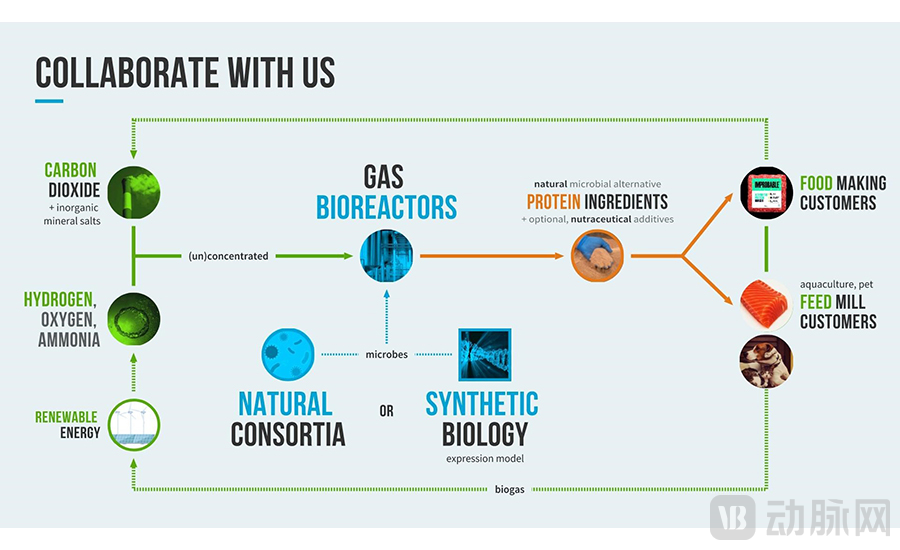
NovoNutrients’ Core Circular Value Chain: Inputs (green, left) are captured and fed to microorganisms in bioreactors (blue), where the microorganisms ferment these nutrients into protein (orange) for use in food and feed products (green, right); the resulting emissions can be recycled back into the bioreactors.
The food protein product synthesized via a proprietary method demonstrates significant efficacy, achieving a Protein Digestibility Corrected Amino Acid Score (PDCAAS) of 1.14 in children aged three years and older—equivalent to the score for beef. Furthermore, this single-cell protein is 100% digestible and is particularly rich in branched-chain amino acids compared to soy and algae. Meanwhile, the amino acid profile of NovoNutrients protein surpasses that of all common plant-based alternative proteins, with negligible carbohydrate content. This low fat percentage contributes to an extended shelf life. Additionally, the absence of common anti-nutrients, such as phytates or lectins, ensures enhanced nutritional bioavailability.
Equally important, NovoNutrients has also worked on the taste of its products and is preparing a dedicated “taste-testing panel.” According to CEO Tze, who has already sampled the product multiple times, it has a “savory, umami aroma reminiscent of broth.”
Regarding the business model, Tze stated that the company’s financial plan relies on the sale of microbes and licenses for the construction, operation, and maintenance of facilities. The customized product business is conducted primarily through commercial partnerships, with NovoNutrients also responsible for product marketing and business development. Currently, NovoNutrients is focusing its initial efforts on the pet food market. Since 2023, NovoNutrients has been in negotiations with pet food manufacturers to open up new potential markets for the company. According to a survey by BENEO of 2,500 pet owners across five countries, 80% of respondents consider sustainability factors when choosing food for their pets, and more than half choose plant-based proteins due to climate concerns.
Business Collaboration Further “Scaled Up”: Joining Forces with Energy Giants to Enter the $2.3 Billion Carotenoid Production Market
In April 2023, the company signed a $3 million technology development agreement with energy giant Woodside Energy to support the construction and operation of a larger-scale pilot system, under which NovoNutrients will establish a pilot-scale plant. Woodside Energy is Australia’s largest independent oil and gas company, ranking among the top ten globally with a market capitalization of $37.26 billion. Meanwhile, NovoNutrients announced its entry into carotenoid production, with current capacity reaching the tonne scale, and is expected to expand to hundreds or even thousands of tonnes by 2025.
Carotenoids are a class of lipophilic isoprenoid pigments, appearing red, orange, or yellow, produced by plants and certain photosynthetic microorganisms. They generally exhibit absorption peaks in the wavelength range of 300–600 nm. As antioxidants, carotenoids are natural pigments predominantly found in plants and marine organisms, responsible for vibrant colors such as the orange of carrots or the red of tomatoes. Specific carotenoids provide enhanced palatability and other benefits for humans, dogs, cats, and fish, contributing to good vision, immune system function, and more.
Currently, natural carotenoids are considered the most effective, with astaxanthin, a keto-carotenoid, being the most renowned. Natural astaxanthin is valued at over $7,000 per kilogram for pure-grade product. Compared to synthetic petrochemical-derived alternatives, it is regarded as having higher bioactivity and bioavailability; synthetic astaxanthin typically sells for around $2,000 per kilogram. NovoNutrients’ innovative technology provides a competitive advantage by producing high-quality natural carotenoids at prices approaching those of synthetic petrochemical products.
Expert Market Research has also given NovoNutrients high praise, stating that it enables natural carotenoids to be sold at synthetic prices and is poised to become a major player in the global carotenoid market. Approximately 850 naturally occurring carotenoids have been reported to date, and the market size for natural carotenoids is projected to reach $2.3 billion by 2027.
And the partnership with Woodside Energy will solidify NovoNutrients’ service-oriented positioning: licensing its core technology, providing companies with advice on plant construction and operations, and helping to identify buyers for end products.
NovoNutrients Announces $18 Million (€16.5 Million) Raise in Latest Series A Funding RoundIn July 2024, NovoNutrients announced that it had raised $18 million (€16.5 million) in its latest Series A funding round. The round was co-led by Woodside Energy and China-based sustainable materials investment firm CM Venture Capital, with participation from IndieBio, Decarbonization Consortium, Happiness Capital, The Jeremy and Hannelore Grantham Environmental Trust, and Audacy Ventures. Consistent with Woodside Energy’s assessment, NovoNutrients continues to expand its capital base to support its ongoing business growth.