

Traditional Chinese Medicine Embraces Large Language Models: Innovation, Challenges, and Real-World Applications
Judging by the fervor surrounding the launch of numerous new products in 2024, the fierce competition in large language models has extended to the field of Traditional Chinese Medicine (TCM). Tech giants, TCM innovation enterprises, research institutions, and even local governments have all joined this intense race to develop TCM-specific large language models.
Applying the "large model" label is not difficult, but large models will hold greater practical value and significance only when the efficiency and boundaries of Traditional Chinese Medicine (TCM) truly achieve qualitative improvements.
For a long time, traditional Chinese medicine (TCM) has been a subject of mixed reviews. Behind the acclaim that TCM and large language models (LLMs) are a “match made in heaven,” skepticism likening the endeavor to “computerized fortune-telling” has persisted. Is the integration of TCM with LLMs merely riding the hype wave, or does it address a genuine need? VCBeat spoke with several enterprises and research institutions at the forefront of TCM-LLM research to provide insights for the industry.
The main points of this article are as follows:
1. Beyond Cyber TCM, Drug R&D and Clinical Diagnostic Assistance Have Already Yielded Results
2. Deep learning and knowledge graphs are two distinct technological pathways; only their integration yields synergistic effects greater than the sum of their parts.
3. Data as the Foundation: Six Key Elements Constituting a High-Quality Corpus for Traditional Chinese Medicine Diagnosis and Treatment
4. Challenges such as interdisciplinary talent, user acceptance, and intellectual property rights remain to be addressed
5. Only those that are usable, beneficial, validated, and grounded in real-world scenarios qualify as large language models for Traditional Chinese Medicine
It seems as if a floodgate has been opened over the past two years, with a surge of large language models (LLMs) dedicated to traditional Chinese medicine (TCM). According to incomplete statistics, dozens of TCM-related LLMs have been introduced since 2023.
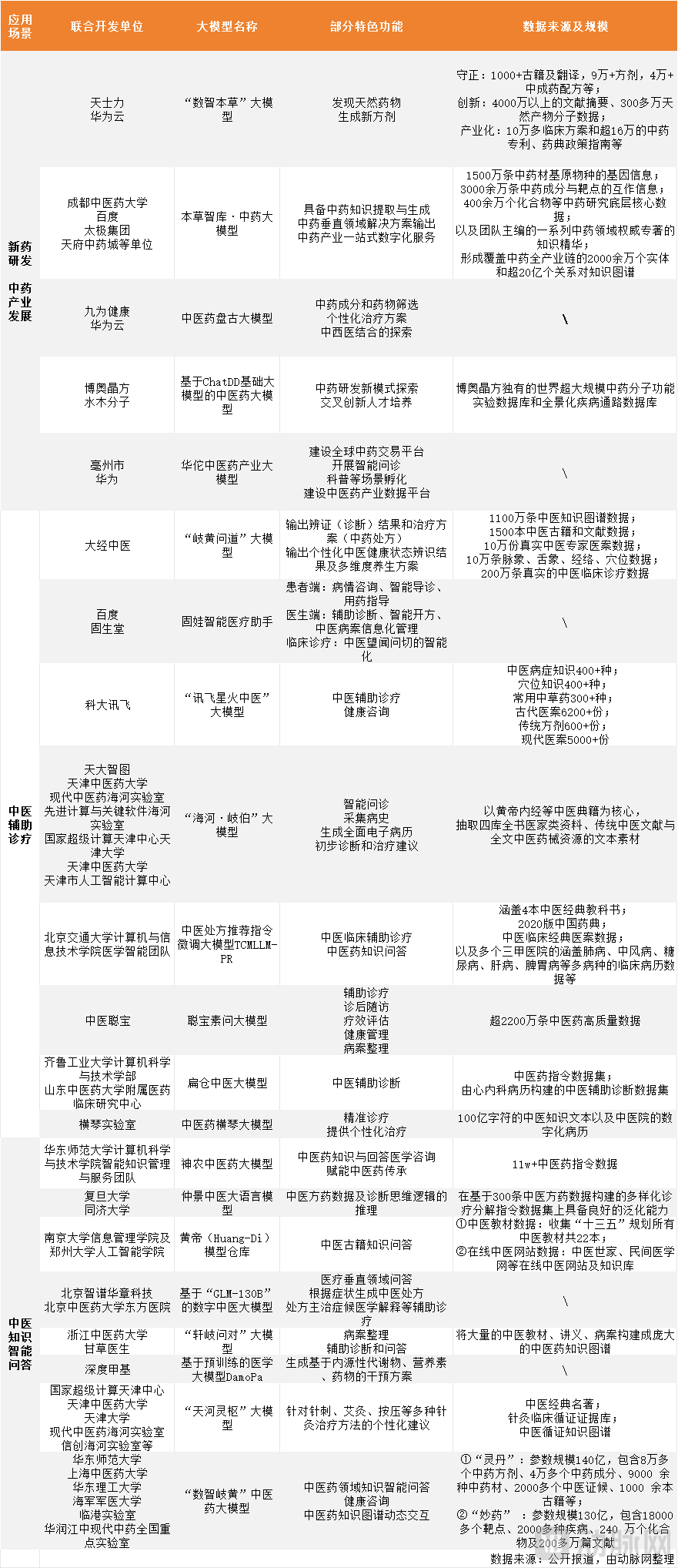
Some Large Language Models for Traditional Chinese Medicine
Numerous industry articles have compiled and listed the current large language models for Traditional Chinese Medicine; this paper will not reiterate them.It is important to note that current large language models (LLMs) for Traditional Chinese Medicine (TCM) have multiple application scenarios. The above table provides only a simplified classification and does not imply that an LLM is limited to a single application scenario or function.. Tech giants such as Huawei, Baidu, Alibaba, and iFlytek are leveraging their advantages in computing power and algorithms to actively collaborate with vertical sectors, including traditional Chinese medicine (TCM), to develop industry-specific large models. Research institutions such as Tsinghua University and the China Academy of Chinese Medical Sciences are also actively utilizing advanced technologies like large models to promote the inheritance and innovation of TCM.
Certainly, the race to develop large language models for Traditional Chinese Medicine (TCM) is by no means lacking in “native” players from the TCM industry. These include renowned TCM enterprises such as Yunnan Baiyao, China Resources Jiangzhong, Taiji Group, and Tasly, as well as innovative companies like Dajing TCM and Zhongyi Congbao, which have been specializing in TCM artificial intelligence for many years.
Furthermore, in regions with an established foundation for the traditional Chinese medicine (TCM) industry, local governments are actively promoting the development of large language models (LLMs) tailored to TCM. In June, Bozhou City announced a partnership with Huawei to officially build the Huatuo TCM Large Model, an industry-specific LLM for traditional Chinese medicine. During the same period, the Hengqin TCM Large Model was officially launched in the Guangdong-Macao In-Depth Cooperation Zone in Hengqin. Earlier, the “Tianhe·Lingshu” and “Haihe·Qibo” large models—the first LLMs oriented toward the field of TCM acupuncture—were respectively released and opened for internal beta testing, developed through a joint effort by multiple government, academic, research, industrial, and medical institutions in Tianjin.
The sheer proliferation of large language models (LLMs) evokes a sense of “a hundred flowers blooming, a hundred schools of thought contending.” To rapidly convey the technological foundations and functional features of their products to users, and to establish a unique emotional resonance and brand identity, Chinese-developed LLMs have invested considerable effort in their naming strategies. Drawing from mythological figures, sages and philosophical schools, Daoist terminology, as well as names of flora and fauna, a diverse array of monikers has emerged, staging what can be described as a “Investiture of the Gods” for large language models.
Major TCM large language models have also invoked founding luminaries such as Bian Que, Hua Tuo, Shennong, the Yellow Emperor, Qibo, and Zhang Zhongjing, or incorporated high-frequency TCM terms like “Bencao,” “Lingshu,” “Qihuang,” and “Xuanqi,” to embody the spirit and mission of inheriting and innovating traditional Chinese medicine.
The ritualistic naming, to some extent, reflects the industry’s expectations for the future development potential of large language models (LLMs). However, LLMs are, at their core, a revolution in productivity and must ultimately return to real-world scenarios to address practical problems. This is the ultimate destination of technology and the beginning of the healthy development of LLMs.
AI-powered traditional Chinese medicine (TCM) robots, now appearing in many hospitals and health checkup centers, have been jokingly dubbed “Cyber TCM Doctors” due to the striking contrast of their ability to take pulses and prescribe remedies like seasoned TCM practitioners. While this moniker carries a touch of humor, it has indeed drawn greater public attention to the modernization and contemporary relevance of traditional Chinese medicine.
Multiple interviewees stated that the current application scenarios for large language models in Traditional Chinese Medicine (TCM) primarily include new drug development, consultation and triage, assisted diagnosis and treatment, and rehabilitation and health management.
Chairman of TCM CongbaoGu GaoshengIt is believed that "Traditional Chinese Medicine + Large Language Models" represents a revolution in traditional TCM services,Health and Wellness Services for Consumer-Oriented Settings Such as Elderly Care Facilities, Pharmacies, and ClinicsThis is currently the most promising application scenario for the implementation of large language models (LLMs) in Traditional Chinese Medicine (TCM). Of course, consumer-facing (2C) scenarios hold greater market potential. “These scenarios involve intensive language interaction requirements, which align well with the technical advantages of LLMs in semantic understanding and generative interaction. In assisted diagnosis and treatment scenarios, the capabilities of LLMs in training on and processing multimodal data, as well as image recognition, are put to the test; these areas also boast strong application prospects. For instance, Congbao’s TCM Master Specialist Disease Robot, based on deep learning technology, achieved a system upgrade after integrating LLM technology. This integration reduced pre-training time by 20% and improved prescription similarity by 10%.”
The “Congbao Suwen” large language model, developed by TCM Congbao, provides comprehensive answers to user inquiries on traditional Chinese medicine (TCM) and employs “guardrail” technology to ensure the scientific rigor and precision required for health and wellness applications. Notably, the “Congbao Suwen” model has been upgraded to version 3.0. For instance, the “Intelligent TCM Triage Service” launched by the Hangzhou Municipal Health Commission uses chatbot-based Q&A to match users with “suitable TCM practitioners,” and the system has been integrated into the “Zheliban” platform. With increasingly diversified application scenarios, the model leverages multimodal data and expert experience data to empower healthcare institutions, physicians, insurance companies, and pharmaceutical enterprises.
The Support of Traditional Chinese Medicine Large Models for New Drug Development and the Development of the Traditional Chinese Medicine Industry,It has also attracted the attention of a large number of traditional Chinese medicine enterprises.
For instance, Tasly’s “Shuzhi Bencao” large language model can assist researchers in mining and summarizing evidence for traditional Chinese medicine (TCM) theories, and can also rapidly screen and optimize medicinal herbs and formulas by integrating relevant algorithms. According to information from the “Tasly Research Institute,” Tasly has utilized a natural product molecular large model within its LLM framework to screen natural product molecules for diabetic nephropathy and pulmonary fibrosis. Through high-throughput virtual screening, the company accurately predicts and optimizes the efficacy and safety of candidate molecules, thereby accelerating the discovery and development of new TCM component-based drugs.
Furthermore, the “Herbal Intelligence Hub · Traditional Chinese Medicine (TCM) Large Model,” jointly developed by Sinopharm Taiji as a think tank, incorporates over 20 million core foundational data points on TCM research covering the entire TCM industry chain. This initiative assigns a “genetic ID card” to Chinese herbal materials, achieving an organic integration of core foundational TCM research data with key segments of the TCM industry chain, thereby delivering significant value to critical links such as herbal cultivation, quality control, and drug development.
TCM-assisted diagnosis and treatment is a capability that most large TCM-focused AI models aim to achieve, yet the R&D pathways pursued by different vendors vary significantly.Founder and CEO of Dajing TCMLi WenyouIt is worth noting that the digitization and intelligentization of Traditional Chinese Medicine (TCM) diagnosis and treatment have always been one of the key directions in the modernization of TCM. Following the trajectory of technological evolution, this process has undergone three major stages: symbolic logic, machine learning, and deep learning. With technological advancements and the expansion of model scales, models have demonstrated the capability of “knowledge emergence.” Thus, artificial intelligence has entered a new era of “Generative AI.” It can be said that large TCM models are iterative products of certain TCM intelligent auxiliary diagnosis and treatment systems, driven by large-model technology.
In August 2023, Dajing TCM released the “Qihuang Wendao” large language model, which was developed based on its comprehensive knowledge graph system. Leveraging eight years of accumulated high-quality traditional Chinese medicine (TCM) data and advancements in digital-intelligent TCM computing, Dajing TCM constructed a complete TCM knowledge graph system and integrated it into its TCM Clinical Decision Support System (CDSS). Furthermore, over 11 million natural semantic TCM data entries generated through the transformation of this knowledge graph served as the training dataset for Dajing TCM’s “Qihuang Wendao” large language model.
Deputy General Manager and Head of R&D, Dajing Traditional Chinese MedicineZhao JingHe stated that although knowledge graphs and large language model-based deep learning represent two distinct technological pathways, they can be integrated through multi-technology convergence. “First, we should leverage the advantages of knowledge graphs in interpretability, trustworthiness, and knowledge standardization to enhance every stage of the lifecycle of large models—from pre-training to application—thereby improving training effectiveness and the usability of inference results. Conversely, we should also capitalize on the technical strengths of large models in semantic understanding and content generation to enhance every stage of the knowledge graph lifecycle—from construction to application—thus boosting the efficiency and quality of knowledge graph generation.”
“Without real-world scenarios, subsequent data feedback cannot be generated, rendering large language models for traditional Chinese medicine nothing more than castles in the air.” Multiple interviewees stated that large models must be deployed in specific application scenarios to achieve optimization through practical use.
There is an industry consensus that, in the training of large language models for Traditional Chinese Medicine (TCM),How to Collect and Organize High-Quality Traditional Chinese Medicine Data Is the Primary Challenge in Developing Large Language Models for TCMHere, we must first clarify: what constitutes high-quality traditional Chinese medicine (TCM) data?
According to Li Wenyou of Dajing Traditional Chinese Medicine, the TCM knowledge chain comprises six core elements: people, diseases, symptoms (symptoms and signs), syndromes (pathological generalizations), therapeutic principles (treatment methods), formulas (medical prescriptions), and medicinal substances. Such data are considered high-quality when these six categories are complete and the relationships among them are authentic.
First, static data such as traditional Chinese medicine (TCM) classics, well-known classical formulas, and professional literature can serve as a key source of high-quality data after undergoing rigorous authentication to distinguish genuine content from forgeries. As shown in the aforementioned table, such data constitute a significant portion of the training datasets for many large language models.
For instance, the “Haihe-Qibo” large model is centered on traditional Chinese medicine (TCM) classics such as The Yellow Emperor’s Inner Canon. It extracts textual materials from the medical section of the Complete Library in Four Branches of Literature, traditional TCM literature, and comprehensive resources on TCM instruments and devices. By treating fundamental TCM concepts, knowledge, theories, basics, herbs, and formulas as nodes, and the relationships between these nodes as edges, it constructs a complete knowledge graph. Tasly’s “Shuzhi Bencao” large model also incorporates data from ancient TCM texts, herbal formulas, proprietary Chinese medicine formulations, literature abstracts, clinical protocols, TCM patents, and pharmacopoeia policy guidelines, reaching a total parameter count of 38 billion.
Another important source of high-quality data for large Traditional Chinese Medicine (TCM) models is the clinical data generated daily during real-world diagnosis and treatment, such as pulse conditions, tongue manifestations, meridian and acupoint data, as well as medical case records and diagnostic and therapeutic experiences from TCM experts.
However, there are two major challenges in unlocking the value of such data:First, clinical data records are incomplete or inconsistent in their descriptions; second, a significant amount of clinical data remains siloed within various medical institutions and the studios of renowned veteran TCM practitioners, exhibiting a high degree of opacity.
Specifically, traditional Chinese medicine (TCM) electronic medical record (EMR) systems need to document not only the content specified in Western medicine standards but also numerous TCM-specific diagnostic findings, such as pulse diagnosis, tongue diagnosis, and facial diagnosis. However, the absence of a unified national template for TCM EMRs, inconsistent standards, varying documentation habits among TCM practitioners, and non-standardized use of professional terminology all adversely affect, to varying degrees, the quality of TCM medical records and the effectiveness of large language model training.
Furthermore, the proliferation of diverse academic schools in Traditional Chinese Medicine (TCM), each with its unique diagnostic and therapeutic methodologies, coupled with the longstanding TCM tradition that “the Dao is not transmitted to the unworthy, and methods are not shared beyond the master and disciple,” has resulted in generally low quality of publicly available TCM data, while high-quality data remains highly proprietary.
In the data collection phase, TCM Congbao gathers clinical traditional Chinese medicine (TCM) data through two pathways. On one hand, leveraging its scalable and replicable Intelligent TCM Medical Consortium/Urban TCM Brain, TCM Congbao has aggregated more than 5,000 medical institutions across 18 provinces and municipalities in China; the “live data” generated daily within the system can be utilized after de-identification. On the other hand, TCM Congbao has independently developed an Intelligent TCM Inheritance and Innovation Platform to facilitate the practical application of clinical experience from renowned senior TCM practitioners representing diverse schools of thought across China.
The quality of data directly impacts the performance of the model.. Following data collection, the development team must also design strategies and rules for data cleaning and preprocessing, employing techniques such as text processing and reinforcement learning to automate data preprocessing. This process is combined with manual review to eliminate erroneous and inaccurate data, thereby achieving human-machine collaborative preparation of large-scale traditional Chinese medicine (TCM) diagnosis and treatment corpora and establishing a high-quality TCM diagnosis and treatment corpus.For instance, Dajing TCM spent eight years developing one of the few standardized terminological dictionaries for TCM symptoms and signs in China.
Within Dajing TCM’s Qihuang Wendao large language model, TCM experts participate in the model’s adjustment and feedback processes to enhance its understanding of TCM knowledge and TCM thinking patterns, thereby ensuring the accuracy and consistency of the model’s responses. By integrating the LLM’s “foundational capabilities” with TCM’s “domain-specific expertise,” the TCM-focused LLM acquires specialized abilities such as extraction, classification, imitation, inference, and recognition within the vertical TCM domain. Furthermore, through integration with diverse business scenarios in the TCM industry, it becomes a practical and deployable TCM large language model.
Observations indicate that the largest existing traditional Chinese medicine (TCM) large language models are trained on datasets at the scale of tens of billions. Although this is modest compared to general-purpose large language models, which often utilize datasets measured in trillions, these TCM datasets consist entirely of high-quality, curated data. The value of a single high-quality TCM data point may far exceed that of hundreds of generic internet content entries.
Traditional Chinese Medicine (TCM) large language models, in addition to requiring a continuous supply of high-quality TCM data,It is also necessary to understand industry know-how, that is, to possess specialized knowledge of the traditional Chinese medicine (TCM) industry, which demands a higher level of comprehension.
Li Wenyou from Dajing Traditional Chinese Medicine stated that large models for traditional Chinese medicine (TCM) primarily serve as a digital and intelligent inheritance of ancient TCM wisdom. During the research and development process, attention must be paid to the consistency and rationality of TCM thinking logic, the precision and effectiveness of personalized treatment plans, and the capability of large models for continuous learning and self-iteration to adapt to evolving medical knowledge and clinical needs. Meanwhile, in terms of R&D team building, emphasis should be placed on diversity and interdisciplinary integration to foster innovation and development of these large models.
In addition to identifying real-world application scenarios and accumulating large volumes of high-quality data, the Deputy Director of the Intelligent Traditional Chinese and Western Medicine Research Center at Peking University Chongqing Big Data Institute, and CEO of Zhiyi CunneiHuang Xintingbelieves that,User acceptance is another dimension that warrants attention.“To improve acceptance among physicians and patients, it is essential not only to achieve favorable diagnostic and therapeutic outcomes but also to avoid imposing any usability burden on users.”
Gu Gaosheng of TCM Congbao mentioned,China currently faces challenges such as being "strangled" in algorithmic computing power, high operational costs, and issues with revenue distribution.. Gu Gaosheng noted that traditional Chinese medicine has long been divided into various schools of thought; to achieve compliant, lawful, and rational industrialization, it is necessary to improve policy measures related to intellectual property rights.
Additionally, the interviewees also mentionedCultivation of Interdisciplinary Talents with Expertise in Traditional Chinese Medicine and AI Capabilities, and Definition of Data Ownership by Regulatory Authoritiessuch issues.
Finally, let us confront the skepticism surrounding the integration of traditional Chinese medicine with large language models.
Huang Xinting from Zhiyi Cunnei stated that the industry currently lacks standardized definitions for large language models (LLMs) specialized in Traditional Chinese Medicine (TCM). “Although numerous LLMs have been launched in China, it remains challenging to develop models that truly align with the distinctive characteristics of TCM-specific LLMs.”Usable, user-friendly, validated, and based on real-world application scenarios, I believe these are several important features that a large language model for Traditional Chinese Medicine should possess.”
Gu Gaosheng of TCM Congbao believes that,“Good therapeutic efficacy” is the ultimate evaluation criterion for large language models in traditional Chinese medicine.Meanwhile, large language model-based informatics systems for Traditional Chinese Medicine can facilitate more efficient and multi-dimensional interactions with patients, which also exemplifies new quality productive forces.
In the view of Li Wenyou from Dajing Traditional Chinese Medicine, there is a significant degree of homogeneity between traditional Chinese medicine (TCM) and artificial intelligence. The field of TCM is subject to considerable debate, largely because many individuals unfamiliar with it perceive TCM as overly vague and indeterminate. In reality,If we conceptualize Traditional Chinese Medicine (TCM) as a “black box” system—where patient symptoms and signs are input to yield an effective herbal formula—we find that this process is analogous to the input-data and output-result mechanisms of AI systems.
Zhao Jing from Dajing TCM added that Traditional Chinese Medicine (TCM) is a medical system with a long history and rich in philosophical depth. Its core lies in the therapeutic principles of syndrome differentiation and individualized treatment. This highly personalized and holistic diagnostic and therapeutic approach of TCM is complementary to the capabilities of large language model technologies in handling complex correlations, pattern recognition, and deep learning.
In summary, Traditional Chinese Medicine (TCM) cannot turn away from large language models (LLMs), as this is an inevitable trend of the times. With their powerful data processing and analytical capabilities, LLMs have injected new vitality into the inheritance and innovation of TCM. However, we must clearly recognize that LLMs are merely tools; the unique principles of TCM—such as the four diagnostic methods (inspection, listening/smelling, inquiry, and palpation), the holistic concept, and syndrome differentiation and treatment—remain the soul of Traditional Chinese Medicine.