

Molecular Assemblies Files IPO Prospectus Highlighting Its Fully Enzymatic Synthesis Platform Capable of Producing 400nt Single-Stranded Oligonucleotides

Molecular Assemblies
Enzyme DNA Synthesis Technology Developer

Codexis
Protein Engineering Technology Developer
DNA Synthesis TechnologyDNA synthesis technology is one of the key enabling technologies in synthetic biology, providing the foundational materials for both basic research and applied fields within this discipline. By precisely synthesizing DNA with specific sequences, researchers are able to modify and construct genes, genomes, and even entire living organisms.
Currently, chemical synthesis remains the mainstream technology for DNA synthesis. It is widely applied in processes such as nucleotide activation and coupling, reaction condition control, and product separation and purification within column-based and chip-based synthesizers, and has reached a high level of commercial maturity. However, this approach faces insurmountable limitations regarding DNA strand length and synthesis costs, making it difficult to meet the growing demand for long DNA fragments in the field of synthetic biology. Furthermore, the separation and purification steps in chemical synthesis generate substantial amounts of impurities and waste liquids. These wastes may contain unreacted chemical reagents, by-products, high concentrations of organic solvents, heavy metal ions, and other pollutants, thereby imposing a certain environmental burden. Consequently, the DNA synthesis industry is increasingly shifting towards more efficient and environmentally friendly innovative solutions.
Against this backdrop, enzymatic DNA synthesis technology has emerged as a standout solution among numerous alternatives. It is a biotechnology that leverages enzymatic catalysis to synthesize DNA molecules. Compared with traditional chemical synthesis methods, enzymatic DNA synthesis offers significant advantages in multiple aspects, including synthesis length, efficiency, and cost, and is regarded as the next-generation technology poised to lead a transformative shift in DNA synthesis.
Molecular Assemblies (“Molecular”), an innovative company founded in 2013 and headquartered in San Diego, USA, is developing enzymatic DNA synthesis technology.Molecular is dedicated to developing novel enzymatic DNA synthesis technologies.
After nearly 10 years of R&D, Molecular has developed a Fully Enzymatic SynthesisTM,FESTM) technology.FESTMIt is a two-step enzymatic DNA synthesis process that can provide high-purity, sequence-specific DNA on demand by using water-soluble, non-toxic reagents and minimizing post-synthesis purification and processing steps. Notably, FESTM can be extended to longer DNA sequences without the need for a template.。
Molecular was co-founded by two DNA sequencing industry experts, J. William Efcavitch and Curt Becker.. Prior to co-founding Molecular Assemblies, they both held key positions at Applied Biosystems, Inc. (hereinafter referred to as “ABI”), a pioneer in DNA synthesis and sequencing, and jointly drove the commercialization of the phosphoramidite synthesis method.
ABI is a renowned brand under Thermo Fisher Scientific. Its ABI Prism 3700 capillary sequencer is hailed as the world’s first truly fully automated sequencing instrument. In 2008, ABI merged with Invitrogen to form Life Technologies. The merged entity launched the Ion PGM sequencer, recognized as the world’s first semiconductor-based personal genome machine (PGM). In 2014, Life Technologies was acquired by Thermo Fisher Scientific, and its robust molecular diagnostics platform and technologies have since become a key pillar of Thermo Fisher Scientific’s diagnostics portfolio.
In 1983, J. William Efcavitch was the ninth employee of ABI.During his tenure at ABI, J. William Efcavitch established a technical R&D team and led the launch of the 380A DNA Synthesizer, further advancing the commercialization of phosphoramidite oligonucleotide synthesis.. In addition, he spearheaded the development of numerous biotechnology instruments and reagent systems, such as the AB 1700 Expression Array System, Model 3900 DNA Synthesizer, ABI Prism 377 and Model 3700 Sequencers, ABI Model 310 Genetic Analyzer, and Model 230A Micro-preparative Electrophoresis System, among others.
After nearly three decades of development, J. William Efcavitch and Curt Becker observed that the demand for long, high-fidelity, sequence-specific DNA is rapidly increasing across many industries—such as synthetic biology and precision medicine—as well as in emerging applications like data information storage, nanomachines, and bioelectronics, with this growth outpacing the speed of DNA synthesis. Meanwhile, traditional chemical DNA synthesis methods face challenges such as high cumulative error rates, time-consuming and non-scalable processes, and numerous post-synthesis purification and separation steps.
In this context, J. William Efcavitch and Curt Becker sought to develop a novel DNA synthesis technology to produce high-purity, sequence-specific, and scalable DNA. Thus, Molecular Assemblies was born.
Since its establishment, Molecular has attracted talent from the fields of DNA synthesis, sequencing, and biopharmaceuticals.Chairman of the Board and Interim CEO Larry G StambaughWith over 40 years of experience in corporate management, has served as CEO, board member, and chairman of the board for multiple publicly listed and private companies.Dr. Phil Paik, Chief Technology OfficerWith over 16 years of experience in technological innovation and platform development, formerly served as Associate Director of Engineering at Illumina, responsible for the architecture and development of fluidic systems for instruments and integrated cartridge platforms.
Leveraging its team strengths and technological expertise, Molecular has completed nine rounds of financing totaling $87.2 million (approximately RMB 630 million), with 17 investors.
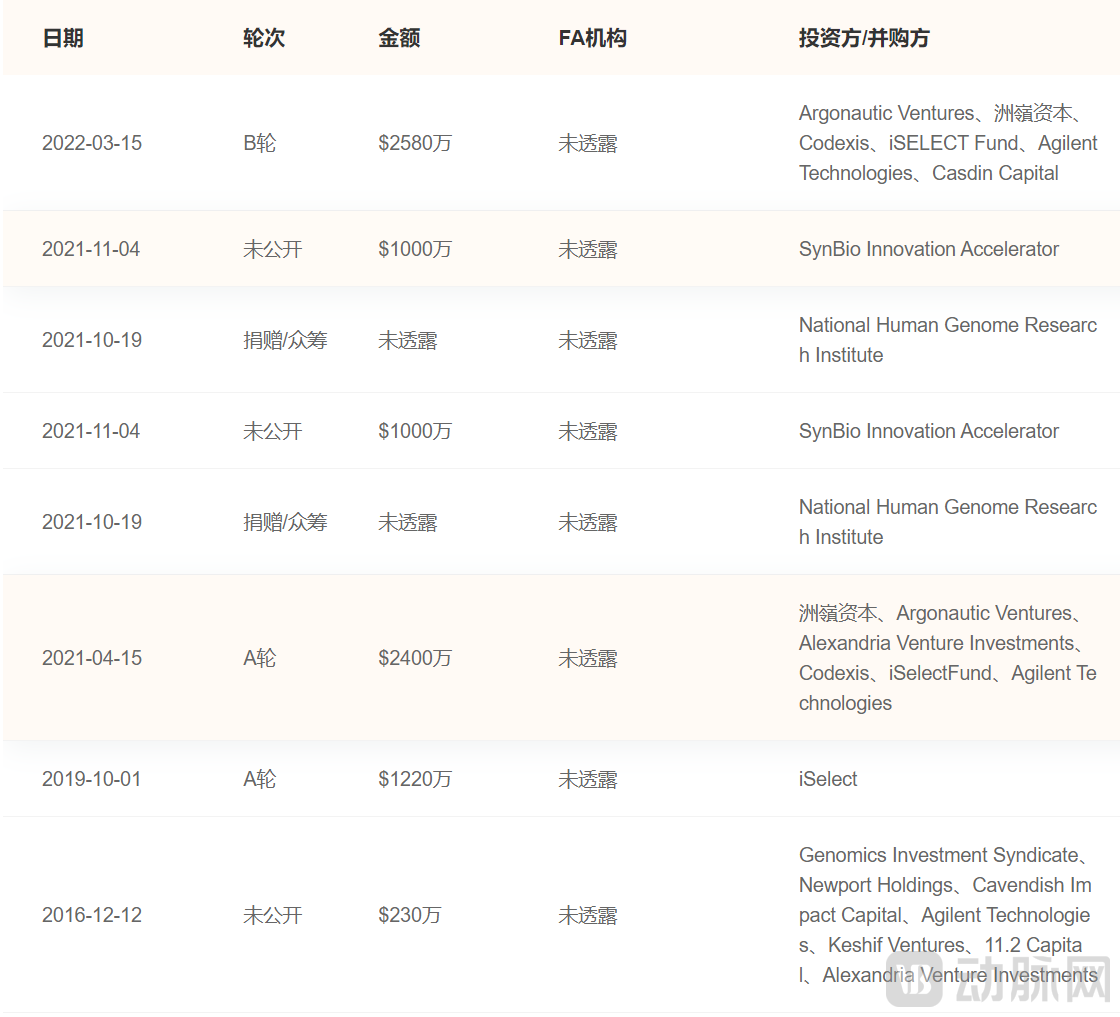 Molecular Assemblies’ Funding History | Image source: VCBeat
Enzymatic DNA synthesis refers to the de novo synthesis of DNA molecules through enzymatic catalysis without relying on a DNA template.The implementation of this technology relies on a key raw material—terminal deoxynucleotidyl transferase (TdT), which catalyzes the enzymatic reaction.。
TdT is a template-independent single-stranded DNA polymerase that exhibits rapid, template-independent polymerization activity. It enables the synthesis of long-chain DNA without requiring denaturation, annealing, or extension steps during the entire catalytic process. Importantly, TdT displays low substrate selectivity and maintains a fast catalytic rate for all dNTPs. Any deoxynucleoside triphosphate (dNTP), ribonucleoside triphosphate (rNTP), or modified nucleoside triphosphate analog can serve as its substrate.
However, natural TdT can only randomly add new dNTPs to the ends of DNA strands and cannot precisely control the strand synthesis process, making it difficult to meet the practical demands of artificial DNA synthesis. Therefore, researchers are working to achieve precise DNA synthesis by TdT through approaches such as constructing reverse systems.
Molecular Assemblies is one of the innovative companies breaking through the limitations of natural TdT.In 2020, Molecular Assemblies partnered with Codexis, a veteran company in synthetic biology, to co-develop high-efficiency TdT, thereby advancing the development of its FES™ technology.。
In April 2022, Molecular Assemblies and Codexis announced the successful development of a proprietary, highly evolved TdT polymerase. Compared with naturally occurring TdT, this TdT polymerase enables the synthesis of longer DNA sequences in aqueous solutions with fewer errors.. Codexis President and CEO John Nicols stated in the press release that this TdT polymerase exhibits unprecedented coupling efficiency and speed at high temperatures.
Currently, the solid-phase phosphoramidite triester method is a commonly used chemical synthesis technique. This chemical synthesis method requires at least 4–5 reaction steps, and errors may occur in each step. Although the single-step synthesis efficiency of this technology has reached as high as 99.6%, its overall efficiency and yield decrease when the error probability associated with adding each new base is taken into account.
When the length of DNA synthesis reaches 200 bp, the yield may drop to approximately 35%. This implies that as the synthesis length increases, the total percentage of “failed” products also rises, which is why chemical synthesis methods are typically limited to producing DNA sequences of around 200 bp in length. To synthesize oligonucleotides at the kilobase (kb) scale, a single-step synthesis efficiency of over 99.9% is required to achieve comparable yields. Meanwhile, achieving industrial-scale synthesis also necessitates improvements in synthesis speed.
To address these issues, Molecular’s FES™ technology has been optimized and improved in terms of synthesis length, purity, steps, and other parameters.According to the Molecular website, compared with other DNA synthesis technologies, FES™ technology has the following advantages:
In terms of synthesis length, FES™ can rapidly synthesize ultra-long oligonucleotides. Data shows thatFES™ is capable of synthesizing single-stranded oligonucleotides up to 400 nt in length.。
In terms of synthetic purity,FES™ operates with a cycle efficiency greater than 99.9%, regardless of length or sequence complexity, FES™ generates high-purity DNA without the need for post-synthesis purification steps.
In terms of delivery time,FES™ integrates synthesis and purification into a single step, enabling the selective removal of incompletely synthesized oligonucleotides during the synthesis process, thereby shortening product delivery time.Data shows that Molecular can rapidly produce customer-required DNA synthesis products within one week.
In terms of environmental impact, the DNA synthesis production process of FES™ is conducted entirely under neutral pH conditions. The entire catalytic synthesis process is green and environmentally friendly, generating no hazardous substances such as strong acids or strong bases.
Currently,Molecular can design donor template DNA or long guides for various CRISPR editing types, including HDR knock-in, prime editing, and base editing, and is capable of synthesizing long and complex oligonucleotides that encode antibodies, regulatory elements, or variable regions of other proteins.. In addition, Molecular will also launch genome assembly services.
In the second half of 2022, Molecular Assemblies launched a “Key Customer” program to provide select researchers with custom long single-stranded oligonucleotides synthesized using FES™. This initiative is expected to accelerate customers’ research in CRISPR gene editing and other applications requiring long oligonucleotides. In return, customers will provide usage feedback to facilitate the optimization and improvement of FES™.
On March 14, 2023, Molecular Assemblies announced the commencement of shipments of oligonucleotide products synthesized using FES™ technology to its initial customers. Within just two months, Molecular Assemblies successfully delivered products to six customers.
Building on feedback from its “Key Accounts” program, Molecular Assemblies has launched a new initiative to provide more customers with differentiated, cost-effective DNA synthesis solutions.On May 7, 2024, Molecular announced the launch of a “Partner” program to license its FES™ technology for DNA synthesis in specific applications.. Through this technology, Molecular aims to leverage FES™ to accelerate the production of longer, purer, and more accurate DNA, thereby fueling the development of rapidly emerging next-generation therapeutic and diagnostic technologies.
Molecular stated,Modular FES™ can be installed in high-capacity laboratories and is capable of synthesizing long, accurate oligonucleotides at the picomole or femtomole scale to meet various application needs.. Pursuant to the “Partner” program agreement, a select group of members will gain access to Molecular’s automated synthesis platform, all proprietary reagents and enzymes, any enhancements or improvements to FES™, and the necessary licenses required to use FES™ in their facilities for research purposes.
In addition to Molecular Assemblies, several other companies have entered the field of enzymatic DNA synthesis, including Ansa Biotechnologies, DNA Script, Evonetix, and Touchlight Genetics, with many of these firms achieving breakthrough progress.
In June 2020, DNA Script launched Syntax, the world’s first benchtop DNA printer utilizing enzymatic technology. According to the company, this DNA printer can produce synthetic DNA oligonucleotides on demand, with a rapid synthesis speed that allows for the production of 96 oligonucleotides in just 6–13 hours.
In March 2023, Ansa Biotechnologies announced the successful de novo synthesis of a 1,005-base DNA sequence. Notably, this 1,005-base sequence encodes key components of adeno-associated virus (AAV) vectors used in gene therapy development and features complex characteristics such as strong secondary structures and high GC content. One month later, Ansa Biotechnologies launched an Early Access Program for cloned synthetic genes to help researchers obtain DNA sequences that are difficult to synthesize.
Major Breakthroughs in Enzymatic DNA Synthesis Research in ChinaSignificant breakthroughs have also been achieved in China in the field of enzymatic DNA synthesis. For instance, in February 2022, a new enzyme design team led by Researcher Jiang Huifeng at the Tianjin Institute of Industrial Biotechnology, Chinese Academy of Sciences, identified an avian terminal deoxynucleotidyl transferase (TdT) with high catalytic activity and engineered it to obtain novel TdT mutants. Based on this achievement, the team developed a two-step cyclic enzymatic DNA synthesis technology, increasing the average accuracy of DNA synthesis to 98.7%.
In addition, Zhonghe Gene Technology Co., Ltd. (hereinafter referred to as “Zhonghe Gene”), a life sciences enterprise, has also made significant progress in this field. Established in 2022, Zhonghe Gene is centered on third-generation enzymatic gene synthesis technology and focuses on the development, production, and sales of related equipment. In February 2024, Zhonghe Gene announced the completion of its Pre-A financing round, raising tens of millions of yuan. The funds will be used to accelerate the iterative upgrading of DNA biosynthesizers and related equipment, as well as market expansion. The company expects to launch commercial models of probe synthesizers and gene synthesizers in 2024.
The core of synthetic biology lies in the precise control and programming of biological components, thereby creating biological entities capable of performing specific tasks. As such, the advancement and maturation of enabling technologies, including DNA synthesis and gene editing, are critical to the progress of synthetic biology. In the future, with the continuous innovation and development of technologies such as enzymatic DNA synthesis, it may become possible to synthesize longer DNA fragments, better serving the application prospects of large-scale, high-throughput DNA synthesis and ultimately driving the advancement of synthetic biology.