

Bevagen and VALENINA: Indonesia's First Locally Manufactured Bevacizumab and PCV13 Vaccines Set to Become Exclusive Reimbursed Products

Etana
Oncology Drug Manufacturer

Innovent
High-end Biologics Developer
Walvax
Human Vaccine Research and Development, Manufacturer
Good News from the Indonesian Pharmaceutical Market!
VCBeat has recently learned exclusively that,PT Etana Biotechnologies Indonesia (ETANA), an Indonesian biotechnology company, has completed localized large-scale production and obtained marketing approval from the Indonesian Food and Drug Supervisory Agency (BPOM) for Bevagen (bevacizumab injection; Indonesian trademark: Bevagen), transferred from Chinese pharmaceutical companies Innovent Bio and Walvax Biotechnology, as well as the 13-valent pneumococcal polysaccharide conjugate vaccine (Chinese brand name: “Woanxin”; Indonesian brand name: “VALENINA”; hereinafter referred to as “13-valent pneumococcal conjugate vaccine” or “PCV-13”), to meet the growing demand in the Indonesian pharmaceutical market.
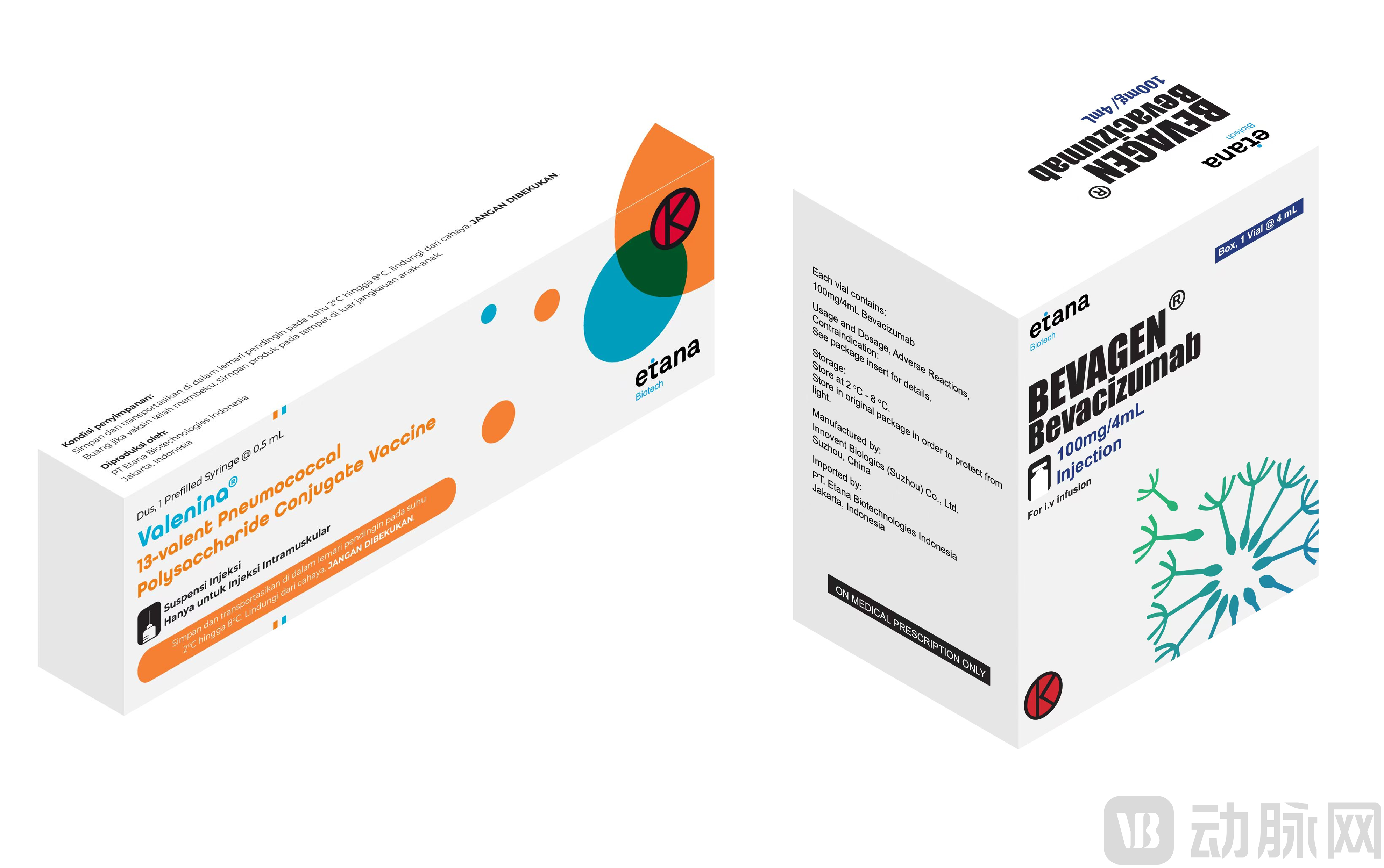
13-valent pneumococcal polysaccharide conjugate vaccine Indonesian brand name: VALENINA (Left figure)
Bevacizumab Injection, Indonesian Trademark: Bevagen (Right)
This marks the first milestone approval in Indonesia for locally produced antibody drugs and vaccines, signifying the first official Indonesian recognition of localized products following the technology transfer of Chinese pharmaceutical companies’ antibody and vaccine platforms to Southeast Asia. This achievement demonstrates the deep cooperation and mutual progress between both parties in the biopharmaceutical sector, ushering in a new era for Chinese pharmaceutical companies expanding into Southeast Asia.
Undoubtedly, going global has become a crucial pathway for domestic innovative pharmaceutical companies to explore their second growth curve. In the Southeast Asian market, Indonesia is undoubtedly a “battleground” that must be contested. Around 2019, Chinese investment firms represented by Legend Capital began conducting in-depth assessments of the Southeast Asian market and partnered with a group of Chinese pharmaceutical companies—including Innovent Bio, Walvax, and CanSino—to pioneer entry into the Indonesian market. Leveraging advantages in R&D, technology, and cost-effectiveness, Chinese pharmaceutical companies quickly gained a foothold in Indonesia, gradually unlocking the potential of its pharmaceutical market.
With the successful approval of this localized product, the potential for Chinese pharmaceutical companies and their drugs in the Indonesian market is expanding with unprecedented breadth and depth.

Upon approval, the localized product is expected to become the exclusive product included in Indonesia’s national health insurance scheme.
In April this year, just over ten days after officially winning the general election, Prabowo embarked on his first foreign visit, choosing China as the destination. This marks the first time in Indonesian history that a president-elect has undertaken an overseas trip before inauguration, with China as the inaugural stop. The visit is of significant importance.
As the largest economy in Southeast Asia, Indonesia has emerged as one of the most dynamic markets in the region, driven by its large population base and rapid economic growth. Public information indicates that over the past decade since China and Indonesia established a comprehensive strategic partnership, cooperation between the two countries has yielded fruitful results across various sectors, with China remaining Indonesia’s largest trading partner for ten consecutive years.
Yet behind this booming growth lies Indonesia’s relatively weak pharmaceutical industry. “In Indonesia’s pharmaceutical market, chemical generics and over-the-counter (OTC) drugs dominate, with virtually no domestic biologics industry and only a few imported products available,” said Qi Fei, Executive Director at Legend Capital. Since 2014, Indonesia has been implementing the JKN program to achieve universal health coverage, aiming to improve its healthcare system and enhance drug accessibility; it has already covered more than 90% of the population. According to prior public statements by Indonesia’s Social Security Agency (BPJS), 92% of the medicines on the essential drugs list, as adjusted under the JKN program, are low-cost generics.
Constrained by Indonesia’s relatively weak pharmaceutical industry and limited purchasing power, multinational pharmaceutical corporations find it difficult to implement significant localization strategies for the Indonesian market. Currently, only a few MNCs, such as Sanofi and Bayer, have established manufacturing facilities in Indonesia, producing only traditional pharmaceutical products.
To encourage foreign investment in establishing manufacturing facilities in Indonesia and boost the local manufacturing sector, the Indonesian government has specifically introduced the TKDN (Tingkat Komponen Dalam Negeri, i.e., Domestic Component Level) localization policy. Under this policy and the BMP (Benefit Multiplier Program), once domestically produced pharmaceuticals in Indonesia achieve a TKDN of at least 40%, other identical imported drugs will be barred from inclusion in Indonesia’s Essential Drugs List. In other words,Following approval, the localized products bevacizumab and PCV13 vaccine, which have achieved high TKDN scores, will have the opportunity to be included in Indonesia’s national health insurance scheme and enjoy exclusive access to the Indonesian market.
Amid Indonesia’s sustained annual economic growth of 5–6% over the past two decades, its per capita GDP reached USD 4,940.6 in 2023, officially marking the country’s strongest period of development in the last 20 years. According to public statements made last month by Indonesia’s National Development Planning Agency (Bappenas), the country aims to raise its per capita GDP to above USD 5,500 by 2025, thereby escaping the middle-income trap. This implies that, although the Indonesian pharmaceutical market remains dominated by low-cost generic drugs, it has begun to demonstrate the capacity to pay for innovative medicines and high-end biologics.
Now is not only the most prosperous period for Indonesia’s development in the past two decades, but also an excellent opportunity for Chinese pharmaceutical companies to enter the Indonesian market. Driven by globalization strategies and in response to China’s Belt and Road Initiative (BRI), the expansion of Chinese pharmaceutical firms into Indonesia represents more than a pursuit of a single market; it is a key component of their market diversification strategy. By establishing localized production in Indonesia, these companies can quickly gain a firm foothold in this vibrant land. Leveraging their technological advantages and innovation capabilities, they can lead technological advancements and product iterations in the local pharmaceutical industry, thereby supporting the ambitious goal of industrial upgrading. This process not only promotes the maturity and growth of Indonesia’s pharmaceutical market but also allows Chinese pharmaceutical companies to conduct preliminary market education locally. Furthermore, localized production offers significant cost efficiencies and risk diversification benefits. By further reducing production costs, leveraging local resources, and benefiting from potential policy incentives, Chinese pharmaceutical companies will achieve stronger price competitiveness, secure first-mover advantages, and realize steady financial growth.
ETANA: Rooted in Indonesia’s Healthcare Ecosystem, Leveraging Four Core Capabilities of BD+AMC to Achieve a Closed Loop of Technology Transfer, Production, and Sales
The most convenient and efficient way to enter the Indonesian market is to achieve localized production through technology transfer in collaboration with local Indonesian enterprises. The company that has set multiple “firsts” in Indonesia is ETANA, an Indonesian biotechnology firm focused on developing “high quality, affordable and innovative” localized products.
In 2019, Legend Capital and Innovent Bio jointly visited Indonesia to assess ETANA’s facilities, production, quality control, and other operational aspects. By the end of 2020, the Series A financing round, led by Legend Capital and participated in by Innovent Bio and UOB Venture Management (UOBVM), had its agreements signed. In 2021, ETANA entered into a pipeline collaboration with Innovent Bio, initiating the technology transfer for bevacizumab and comprehensively expanding its portfolio in oncology biologics. In 2022, ETANA secured investments from institutions including Yunfeng Capital, Honghui Fund, and DEG. In the same year, its COVID-19 mRNA vaccine, developed in partnership with Chinese enterprises, received emergency use authorization and Halal certification in Indonesia, making ETANA the first private vaccine manufacturer in the country. Subsequently, ETANA established extensive collaborations with prominent Chinese vaccine companies such as Walvax and CanSino, fully entering the fields of vaccines and anti-infectives.

In its collaboration with Chinese enterprises, ETANA has also delivered an outstanding performance. As one of the few manufacturers of antibody drugs and vaccine products in Indonesia, ETANA took the lead in “crossing the finish line” at an astonishing approval speed. “Taking the PCV13 vaccine as an example, we officially launched the sprint phase of product localization last December. Within six months, we completed the production of trial batches, engineering batches, and validation batches, obtained the GMP manufacturing license, and fulfilled all requirements including three-month stability testing. Finally, we compiled and submitted all reports and formally received marketing authorization from BPOM,” introduced Dr. Shi Qiuming, CTO of ETANA. This exemplifies one of ETANA’s core competencies—exceptionally high efficiency.Production Capacity (Manufacturing)。
From Etana’s perspective, the demonstration of this production capacity is inseparable from the support of multiple core competencies with competitive advantages.Leveraging years of deep engagement in the Indonesian pharmaceutical market, Etana has established robust communication channels and regulatory registration capabilities with Indonesia’s pharmaceutical regulatory authorities, becoming a key player in the country’s healthcare ecosystem.“We began laying the groundwork for ETANA around 2014. Despite the complete absence of a local biopharmaceutical industry base, we spent two years recruiting talent and then navigated a series of complex and critical steps, including building production facilities, sourcing suppliers, and engaging with regulatory authorities on standards and regulations. It was not until 2018 that we launched our first commercial product. In this sense, ETANA has been deeply involved in incubating the nascent stage of Indonesia’s biopharmaceutical industry,” said Dr. Shi Qiuming.

Today, backed by resources from Chinese investment institutions and pharmaceutical companies, ETANA has leveraged its technological advantages and innovative products to play a more in-depth role in building Indonesia’s biomedical industry ecosystem. From mid-2023 to early this year, Legend Capital co-hosted two “China-Indonesia Healthcare and Biotechnology Investment Forums” with the Indonesian Ministry of Health (MOH) and the Indonesian National Agency of Drug and Food Control (BPOM). At these forums, ETANA reached multiple cooperation agreements with Chinese biotech innovation enterprises, becoming a key link connecting Chinese capital, Chinese pharmaceutical companies, and Indonesian regulatory authorities.
Leveraging the resources of shareholders such as Legend Capital and Yunfeng Capital, ETANA has also securedStrong BD CapabilitiesAccording to reports, ETANA has successively established collaborations with leading Chinese pharmaceutical companies such as Innovent Bio, Walvax, CanSino Biologics, and BeiGene. These partnerships prioritize the deployment of therapeutic products that are urgently needed in the Indonesian pharmaceutical market and remain affordable within the country’s healthcare system. “Chinese enterprises are beginning to recognize the importance of Indonesia, the world’s fourth-most populous country. However, due to the underdeveloped state of the local pharmaceutical industry and significant differences in language, culture, politics, religion, and regulatory access, domestic companies require reliable local partners to successfully launch innovative drugs and high-end biologics,” said Qi Fei. Therefore, collaborating with local representative firms such as ETANA has emerged as a highly feasible strategy for entering Indonesia’s new drug market.
From the perspective of technology transfer, Etana also demonstrated a high level of professionalism by completing the technology transfer and its implementation in Indonesia at an exceptionally rapid pace.Within ETANA’s organizational structure, the technology transfer team constitutes a significant proportion. By communicating with regulatory authorities and facilitating product implementation, the team drives products to meet BPOM review standards. “It is worth noting that pharmaceuticals and vaccines produced locally in Indonesia must obtain Halal certification. Products certified as such will also have the opportunity to be promoted to 59 countries globally through the Organization of Islamic Cooperation (OIC), thereby reaching a larger population,” said Qi Fei.

Of course,Collaboration among Chinese innovative enterprises is also crucial in the process of technology transfer.“From the procurement of production equipment and materials, to overcoming technical challenges, and product quality control, our Chinese partners have provided strong support in all key areas, deeply engaging in the localization and implementation of our products,” said Dr. Shi Qiuming.
From business development (BD) through technology transfer, scaled manufacturing, and regulatory approval for market launch, ETANA has naturally not overlooked the critical component of commercialization. It is reported that ETANA has already established an extensive sales network across Indonesia. Historical data indicate that its previously approved bevacizumab biosimilar has captured more than half of the market share, demonstrating strong growth potential. Furthermore, following the completion of localized production, its PCV13 vaccine will bid for inclusion in the National Immunization Program, safeguarding the 4.5 to 5 million newborns born annually in Indonesia.
Amid the fierce competition in Southeast Asia’s pharmaceutical market, Indonesia holds an unparalleled strategic position, making it one of the preferred battlegrounds for Chinese companies expanding overseas. On this dynamic frontier, collaborations between Chinese pharmaceutical firms and local Indonesian enterprises have already yielded fruitful results, exemplified by ETANA’s partnerships with Innovent Bio and Walvax.
Looking ahead, as the Belt and Road Initiative continues to advance in depth, we anticipate seeing more Chinese pharmaceutical companies join hands with Indonesian partners to jointly develop pharmaceutical products that meet Indonesia’s growing demand, thereby driving medical innovation and international cooperation to a deeper level.