

How FastWave Became a Global IVL Leader in Just Three Years: An Exclusive Interview with Co-Founder JC Sun

FastWave
Medical Device Developer
On April 5, Johnson & Johnson (JNJ) and Shockwave Medical jointly announced that J&J would acquire all outstanding shares of Shockwave in cash at $335 per share, equivalent to approximately $13.1 billion (about RMB 94.8 billion). This “sky-high” acquisition news immediately caused a huge stir.
The acquisition price of nearly RMB 100 billion not only underscores recognition of the pioneering strength of IVL (Intravascular Lithotripsy), but also reflects strong confidence in the future prospects of this sector.
According to Frost & Sullivan, the global market size for intravascular lithotripsy (IVL) in coronary artery disease grew from USD 1.7 million in 2017 to USD 64.1 million in 2020, and is projected to reach USD 3.347 billion by 2030, highlighting the significant growth potential of this sector.
As the IVL sector heats up,The number of companies entering the market continues to grow. Among them, FastWave is undoubtedly a dark horse in the IVL sector. Since its establishment in 2021, it has advanced rapidly, becoming a globally recognized leading enterprise in this field within just three years., How did FastWave create this miracle?
Recently,VCBeat Conducts Exclusive Interview with FastWave Co-Founder JC Sun, we may find the answer in his profound insights and FastWave’s history of steady accumulation and breakthrough growth.
JC Sun, Co-founder and Chief Strategy Officer of FastWaveJC earned his bachelor’s and master’s degrees from Shanghai Jiao Tong University, then pursued doctoral studies in the United States, obtaining a Ph.D. in Mechanical Engineering and an MBA. With twenty years of deep expertise in the medical device industry, JC has held roles in R&D, venture capital, global marketing at a Fortune 500 multinational corporation (Medtronic), and cross-border M&A. He is an entrepreneur and inventor in the medical device sector and serves as an advisor to Stanford University’s SPARK program.
JC began his career in intellectual property and R&D within the medical device industry, later transitioning into commercialization and capital operations. Between 2010 and 2012, he was based in Switzerland, where he helped facilitate Medtronic’s $500 million acquisition and integration of Invatec. Since 2012, JC has served as a strategic advisor to dozens of early-stage companies in Europe and the United States, guiding them through multiple cross-border financing and M&A transactions. It was during this period that he developed the aspiration to launch his own venture.
Coincidentally, at that time, Scott Nelson, the current CEO and co-founder of FastWave, and Brady Hatcher, the current director and co-founder, approached JC with a proposal to jointly explore new models that could promote innovation and commercialization in the medical device industry. The parties quickly reached an agreement and subsequently founded FastWave.
Brady previously worked at Boston Scientific, where he accumulated extensive experience in the research, development, and manufacturing of medical devices. He is a seasoned expert in small-batch pilot production for new products and large-scale commercial manufacturing for mature products. Brady has founded multiple startups and successfully exited them through mergers and acquisitions. He and his team have assisted numerous startups and multinational corporations in completing various R&D outsourcing projects.
Scott began his career in sales, rising from a frontline sales representative to the head of national sales for a multinational corporation. He has held positions at companies such as Bard, Medtronic, and Covidien. Scott also founded JOOVV, an innovative medical company specializing in home-use red light therapy devices, achieving a breakthrough in annual sales from zero to $20–30 million within three years without any external financing. Additionally, Scott is the founder of MEDSIDER, a digital-native media company, and has interviewed two to three hundred entrepreneurs and CEOs in the healthcare sector.
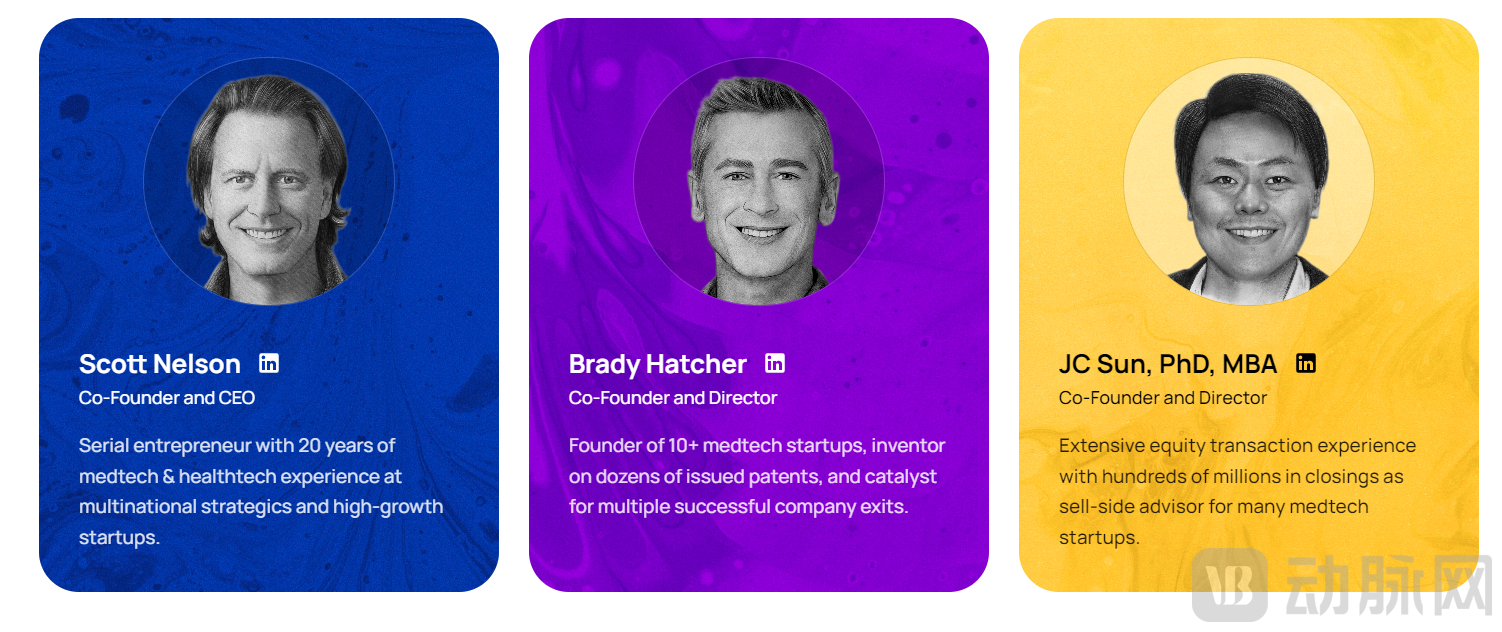 FastWave Founding Team
Over decades of deep engagement in the healthcare sector, the three co-founders have witnessed numerous successes and failures in the medical device industry, while continually reflecting on how to enhance the efficiency and success rate of innovation and entrepreneurship. To this end, the trio frequently engages in “brainstorming” sessions. Based on this,The founding team collaboratively developed a new business model for the startup: multi-channel integrated resource consolidation based on a CDMO platform.
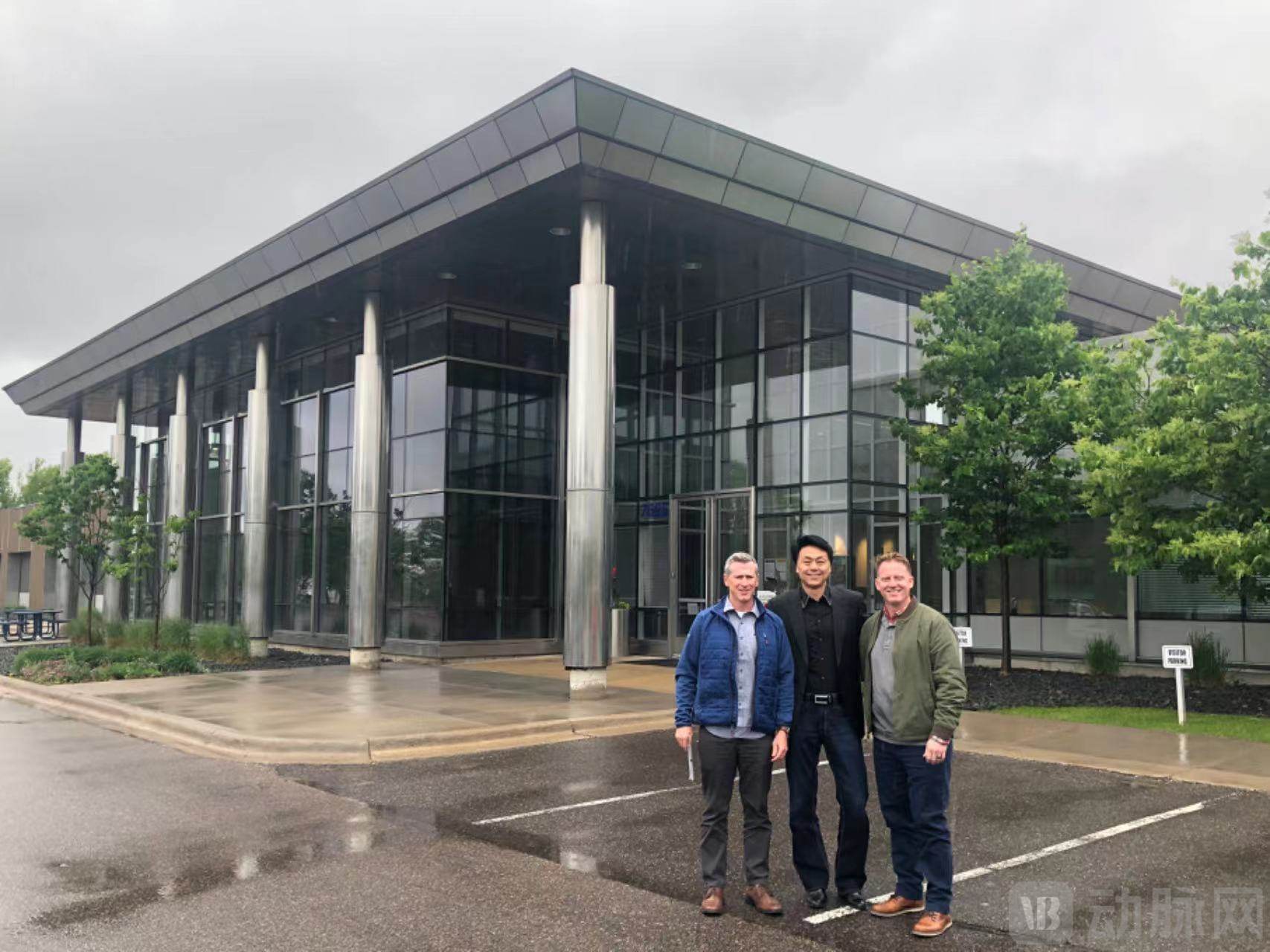
FastWave Founding Team: Brady Hatcher (left), JC Sun (center), Scott Nelson (right)
Therefore, prior to the official establishment of FastWave, the founding team already possessed a robust technical platform, comprising a CDMO facility spanning over 10,000 square meters and several CRO companies serving supportive functions. JC likened these assets to an “innovation greenhouse,” designed to provide the most fundamental and core technological support. “We built our startups on this foundation; in essence, each startup is effectively a product for us,” JC explained.
According to JC, for a startup to achieve explosive growth, it must simultaneously satisfy three elements—Team, Asset, and Timing—which JC summarizes as the “TAT” model.
The team is the primary factor for success. At the inception of the venture, the three co-founders’ extensive expertise in technology, marketing, and startup incubation and operations laid the foundation for FastWave’s rapid growth. AndRegarding “assets,” JC particularly emphasized that this element primarily comprises intangible assets such as intellectual property, technology, and industry resources, excluding capital funds.
So, with a team and assets in place, is it time to launch a startup in earnest? JC believes that this is still insufficient. “Entrepreneurship requires seizing the right moment and going with the flow; doing so will significantly increase the probability of success.”
Prior to the establishment of FastWave, the core founding team had been closely monitoring the intravascular lithotripsy (IVL) sector but had not yet formally pulled the trigger on market entry.
In December 2018, Cardiovascular Systems, Inc. (CSI), a prominent U.S. cardiovascular medical device company, filed petitions with the Patent Trial and Appeal Board (PTAB) of the United States Patent and Trademark Office (USPTO), challenging the validity of three patents held by Shockwave Medical, the pioneer of intravascular lithotripsy (IVL). In July 2020, decisions related to the inter partes review (IPR) proceedings concerning the patent disputes between CSI and Shockwave were sequentially released. Ultimately, all three of Shockwave’s core technology patents were declared invalid in the United States.
At this point, the founding team believed that the timing was ripe. They were not only able to circumvent intellectual property restrictions but also fully confident in developing an IVL system capable of significantly enhancing product performance. Additionally, Shockwave had already conducted effective market education, allowing them to capitalize on the momentum. Meanwhile,FastWave is also considering incorporating a laser technology platform.“Through extensive mathematical and physical calculations, simulations, and background research, we have determined that this technological pathway is undoubtedly feasible. Moreover, there are currently no laser-based intravascular lithotripsy (IVL) systems on the market. Given the numerous technical, clinical, and market factors, this approach holds immense potential,” explained JC.
Thus, in early 2021, the founding team formally entered the IVL (Intravascular Lithotripsy) sector. “Many people believe that fundraising is the most critical aspect for startups, a view with which I disagree. Moreover, attributing startup failure solely to an inability to secure funding is, in my opinion, a fundamental strategic error,” JC stated candidly. He explained that startup failures are not necessarily due to financial constraints but rather stem from issues within the three core elements of “TAT.” “If these three aspects are well executed, capital will naturally follow.” FastWave has substantiated this claim with tangible results: in the first half of 2021, the company initiated its fundraising round, completing the transaction within just a few months and securing a substantial amount. Since its inception, FastWave has never lacked interest from both domestic and international investors.
FastWave enjoyed a perfect convergence of favorable timing, strategic location, and strong team dynamics when it was founded in 2021. JC candidly stated that the company’s rapid growth over the past three years was primarily driven by the successful alignment of three critical elements—team, assets, and timing—and had nothing to do with so-called “luck.”
Backed by a robust team of scientific advisors and physician shareholders, FastWave is able to gain a more precise understanding of clinical needs and pain points, thereby ensuring that these clinical requirements are systematically integrated into the product design phase.
Specifically, FastWave has improved the design of its balloon catheters, addressing the bulkiness and clumsiness inherent in existing devices. By innovating electrode design, reducing the balloon’s crossing profile, and optimizing shaft design, the company has significantly enhanced the deliverability of its balloon catheters. Furthermore, FastWave’s streamlined, rupture-resistant balloon design offers superior trackability compared to current products.
“In real-world clinical practice, the region posing true clinical challenges for IVL is not the United States, but Japan. Japanese patients tend to have more severe intravascular calcification, with calcified plaques in the lower extremities often reaching 100%, compared to only 60–70% in the United States. This makes existing IVL products less effective in Japan,” said JC. ButWhen Japanese interventional cardiologists first saw FastWave’s IVL device, their initial reaction was surprise—the balloon catheter’s profile was so low that it did not appear to be an IVL product.“This is crucial and represents a significant improvement in aligning with clinical needs, because if the IVL catheter cannot smoothly cross the target lesion, higher pressures and more pulse deliveries are meaningless,” JC added.
FastWave’s IVL balloon is designed, material-selected, and manufactured entirely in-house, leveraging the core team’s deep industry expertise in the balloon catheter field. Director and Co-founder Brady, formerly with Boston Scientific, leads a team with years of R&D and manufacturing experience in balloon technologies. JC also played a key role in the acquisition and integration of Invatec, a well-known balloon company. This extensive industry background enables the team to possess a far deeper understanding of balloon R&D and production than typical startups.
In addition, FastWave has introduced innovative improvements to the electrodes and circuitry of its IVL system, enabling the delivery of higher-energy pulses. Furthermore, FastWave IVL demonstrates far superior acoustic intensity uniformity in both the circumferential and axial directions of the balloon compared to existing products.
FastWave pays particular attention to issues reported by physicians during the use of IVL, improves the system accordingly, and then re-interviews physicians to obtain further feedback. This approach has enabled the company’s IVL system to feature an intuitive and user-friendly interface, which not only allows physicians to access information more intuitively and enhances ease of use, but also reduces the likelihood of operational errors.
“Currently, our clinical understanding of calcified lesions remains in its preliminary stages. Many people believe that calcified plaques are simply hard masses within the blood vessels. In reality, it is not that simple; calcified lesion is a systemic disease,” JC explained. It does not necessarily originate from the vascular intima or endothelium; it may also arise from the tunica media. Moreover, many calcified plaques are asymmetric and do not exhibit a circumferential distribution.
With the advancement of medical imaging technology and a deepening understanding of intravascular calcification, clinical demands for therapeutic tools continue to rise. Therefore,IVL technology cannot be a static technological platform; rather, it must be continuously enhanced and developed.. This is precisely why FastWave has simultaneously pursued two technological pathways in IVL: an electrophysiology platform and a laser platform. According to JC,Among all IVL innovators worldwide, FastWave is the only company that possesses two technological platforms simultaneously.
“We cannot assume that resolving the few issues visible today constitutes a satisfactory outcome, as more challenges may lie ahead once these are addressed. Therefore, from the perspective of technological strategy, we must plan ahead and take proactive measures, rather than waiting until new problems emerge to realize that our existing technologies are inadequate and require updates—by which time it may be too late.”JC emphasized that product R&D must always be approached from a dynamic, developmental, and forward-looking perspective to better address unmet clinical needs.
Overall, compared with electrosurgical platform-based IVL, laser-based IVL offers more significant advantages, such as superior deliverability, higher consistency, and a greater number of acoustic shockwaves. JC likens this to a “dimensional reduction strike,” underscoring the technological leadership of laser IVL.
"When treating calcified vascular lesions near the heart using an electrohydraulic intravascular lithotripsy (IVL) platform, high-voltage electricity is required to generate electric arcs, which in turn produce shockwaves. 'The heart is a highly sophisticated organ with its own electrophysiological system. Repeatedly discharging thousands of volts at a frequency of at least one to two times per second in close proximity raises concerns about potential impacts on cardiac rhythm and myocardial integrity. This is particularly concerning for patients with implanted pacemakers,' pointed out JC. Currently, many clinicians have observed adverse events in practice and have expressed their concerns."
“However, by adopting a laser-based technological approach, this risk can be completely avoided,” JC pointed out. Therefore, FastWave’s laser-based IVL platform will initially target the coronary artery sector. Meanwhile, compared with peripheral vessels, coronary arteries are narrower; consequently, navigating the IVL balloon through calcified lesions in coronary arteries poses greater challenges. AndFastWave’s IVL laser platform is specially designed with a simplified balloon structure, offering excellent deliverability and holding promise for greater clinical value in the treatment of coronary artery calcification.
Recently, FastWave announced the success of its first-in-human (FIH) trial. In the FIH study targeting peripheral artery disease (PAD), FastWave IVL successfully treated 9 limbs in 8 patients, achieving 100% crossability at the lesion sites. The mean residual luminal stenosis was only 5.5%, representing a 93% reduction from baseline, which indicates near-complete elimination of the obstruction. During the study, the adverse event rate was 0%, with no balloon ruptures reported.
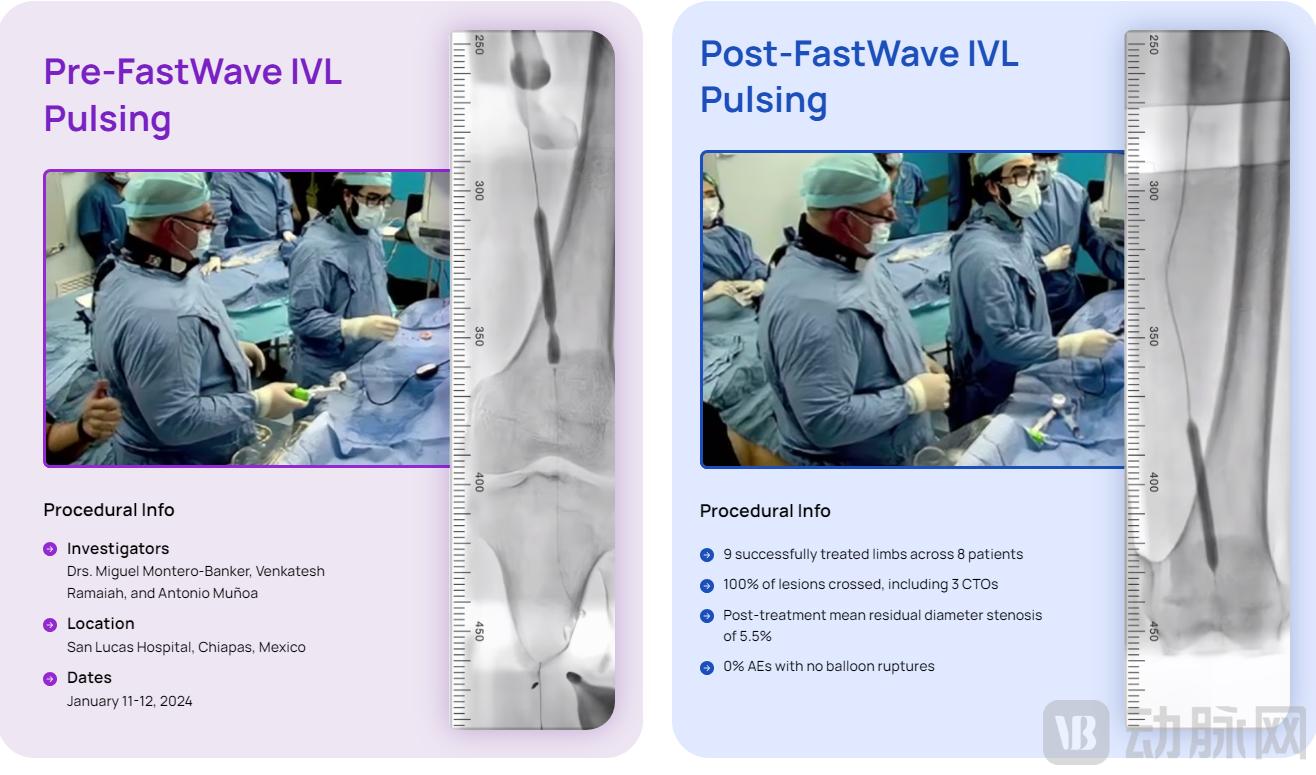
FastWave First-in-Human Trial
Currently, FastWave IVL has received positive feedback from numerous interventional cardiologists and vascular surgeons, who have highly praised its performance in bridging existing technological gaps, ease of use, and potential for treating calcified lesions.
Regarding the development prospects of the IVL sector, JC believes that with the continuous updates and widespread adoption of tools such as IVUS and OCT, more clinical needs will be uncovered, and the IVL market will continue to show a trend of sustained growth. JC predicts that the U.S. market can accommodate at least three to four mature IVL companies. From the perspective of indications, JC stated, “Currently, the application potential of IVL in coronary and peripheral vascular fields has not been fully exploited; many calcified lesion issues have yet to be properly addressed, leaving much work to be done. Furthermore, its applications may expand into structural heart disease, neurointerventional procedures, and many other areas.”
Going forward, FastWave will be headquartered in the United States, targeting the U.S. and Japanese markets as its primary focus, while the Chinese market will be managed by local partners. From an indication perspective, the company will continue to prioritize coronary and peripheral vascular applications, while also exploring potential uses in other clinical areas.As a company fully committed to independent R&D and autonomous innovation, what new miracles will FastWave create in the IVL field? And how will it continue to lead the new transformation of the IVL industry? Time will tell.