

BeiGene Invests $800 Million in New U.S. Biologics Manufacturing and Clinical R&D Center in New Jersey
BeOne
Developer of Molecular Targeted and Immune Anti-Tumor Drugs
BeOne Medicines (Nasdaq: BGNE; HKEX: 06160; SSE: 688235, hereinafter referred to as “BeOne Medicines”) announced on July 23, 2024, U.S. local time, the official opening of its new flagship facility at the Western Innovation Campus in Hopewell Township, near Princeton, New Jersey, representing an $800 million investment. According to BeOne Medicines, the site features world-class biologics manufacturing capabilities and a clinical R&D center, which will continue to enhance the company’s differentiated competitiveness as an innovator in oncology therapeutics.
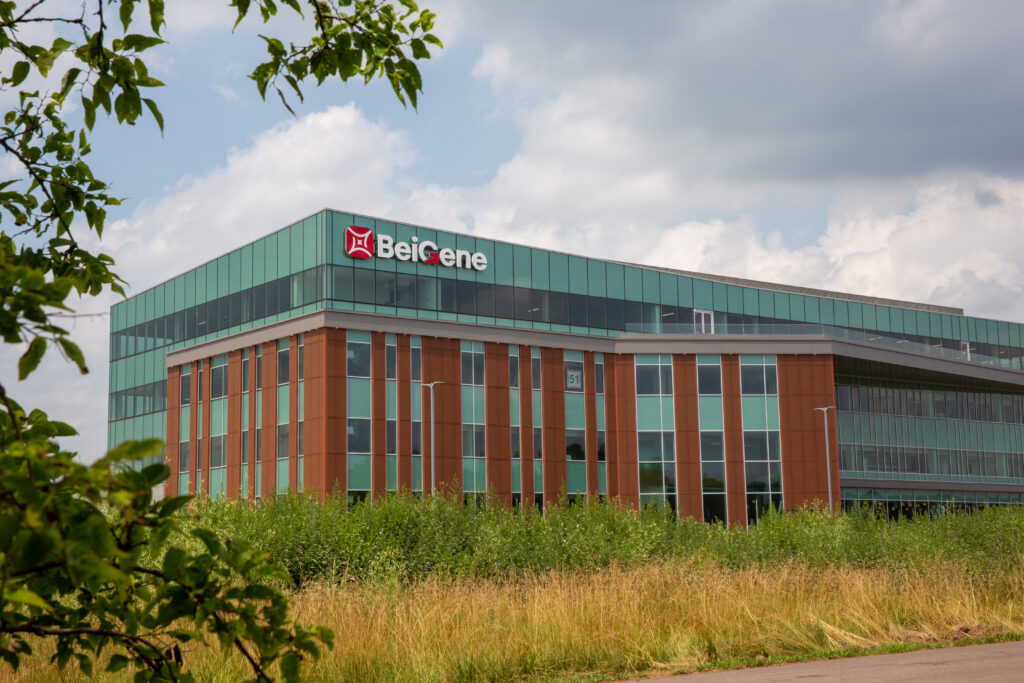
BeOne Medicines’ Flagship Biologics Manufacturing and Clinical R&D Center in the United States. Image source: BeOne Medicines official website
According to John Oyler, Co-founder, Chairman, and CEO of BeOne Medicines, the completion of the new facility at the Princeton West Innovation Campus will not only enhance the company’s production and clinical development capabilities but also further solidify BeOne Medicines’ differentiated strategy by fully leveraging its advantages in speed, efficiency, and technology. Furthermore, as New Jersey’s biopharmaceutical hub concentrates numerous talents in drug research and development and manufacturing, the establishment of this plant is expected to deepen relationships with key regional research institutions and advance BeOne Medicines’ next-generation pipeline of hematology and solid tumor drugs.
Striking While the Iron Is Hot: U.S. Factory Weathers Turmoil Over Three-Year Period
In August 2021, BeOne Medicines announced for the first time that it would launch a new project, the “Princeton West Innovation Campus,” with completion scheduled for mid-2023. Three months later, the company issued another statement indicating that construction of the initial phase was expected to be completed by late 2023 or 2024.
At that time, BeOne Medicines signed a purchase agreement to acquire a site spanning approximately 42 acres (about 170,000 square meters), with over 1 million square feet (approximately 93,000 square meters) of developable property. The site will be used to build a world-class facility comprising commercial biologics manufacturing, a clinical R&D center, and BeOne Medicines’ pharmacovigilance innovation hub. Meanwhile, BeOne Medicines plans to recruit hundreds of new employees from the local deep talent pool to advance the company’s continued growth.
Following a comprehensive survey across the United States, BeOne Medicines ultimately selected Hopewell, New Jersey, as the site for its new manufacturing and clinical R&D center, leveraging the area’s central location and its rich talent pool in pharmaceutical R&D and manufacturing.
In fact, New Jersey is the fourth smallest and most densely populated state in the United States. Located in the northwest of the New York metropolitan area, it is nicknamed the "Garden State." New Jersey has a well-developed manufacturing sector, with its pharmaceutical industry being particularly prominent, ranking first in the nation; the state accounts for 25% of all pharmaceuticals produced in the United States. More than 20 world-class pharmaceutical companies are headquartered in New Jersey, and their sales represent approximately half of the global pharmaceutical industry's total sales.
New Jersey is home to companies such as Johnson & Johnson, Sanofi, Merck, Roche, Novartis, Bayer, Bristol-Myers Squibb, and Pfizer. As early as 2012, the state’s life sciences and pharmaceutical industry contributed $34 billion to its GDP. According to data from the state’s Department of Labor, New Jersey had more than 3,000 pharmaceutical, medical device, and life sciences companies in 2013, employing 115,000 people.
Due to its proximity to New York and Boston, affordable land prices, and convenient logistics, companies establishing manufacturing facilities can benefit from tax incentives offered by the state government. As a result, New Jersey has become one of the preferred options for Chinese pharmaceutical companies setting up production sites in the United States.
Looking back at BeOne Medicines’ plan to build a manufacturing facility in the United States, it can be described as “striking while the iron is hot” against a backdrop of underlying concerns. The company’s expansion strategy between 2021 and 2022 centered on its blood cancer drug Brukinsa, which received FDA approval in 2021 for the treatment of Waldenström’s macroglobulinemia (WM). In 2022, the drug was approved in Uruguay for the treatment of mantle cell lymphoma, marginal zone lymphoma, and Waldenström’s macroglobulinemia.
It should be noted that although BeOne Medicines had already established a certain scale of commercial production operations in Guangzhou at the time, it still relied heavily on collaborations with CMOs and CDMOs for the manufacturing of therapeutic products. In March 2022, due to non-compliance with the latest regulations regarding U.S.-listed companies, BeOne Medicines, along with several other prominent Chinese pharmaceutical manufacturers, was placed on the “pre-delist list” by the U.S. Securities and Exchange Commission (SEC). This meant that BeOne Medicines faced the risk of being delisted from the stock exchange in 2024, and its stock price was adversely affected.
In April 2022, BeOne Medicines officially broke ground on its new U.S. manufacturing facility and clinical R&D center, announcing that the planned production capacity for biologics would reach up to 16,000 liters. For the following year and a half, the company provided no further updates regarding the facility.
It was not until early in the second half of 2024 that BeOne Medicines announced the completion and official launch of its $800 million facility, following three years of construction. The facility is expected to significantly enhance the company’s integrated production and R&D capabilities in the United States. By the end of 2025, BeOne Medicines will create hundreds of high-tech jobs at this site, while New Jersey’s infrastructure and upstream and downstream industrial chains will ensure smooth access to major global markets for its products.
Mass Layoffs Amid Aggressive Hiring: The Spark of Global R&D Expansion
BeOne Medicines not only “pioneered globalization” but also continues to expand and advance.
According to incomplete statistics from the overseas media outlet Fierce, foreign pharmaceutical companies carried out a total of 200 layoffs in 2023, compared with 119 layoffs in 2022, representing a year-on-year increase of 68%. The first wave of layoffs peaked in February–March, and the trend slowed after reaching a second peak in July–August.
In a year marked by widespread layoffs and pervasive pessimism, BeOne Medicines increased its headcount by 1,400 employees in early 2024 compared to the previous year. As of February 14, 2024, BeOne Medicines had 10,600 full-time employees globally, including 1,600 in the United States. In January of the prior year, the company employed a total of 9,200 people, with 1,300 working in the U.S., reflecting talent acquisition to support its new American facility.
As an increasing number of overseas-educated talents in pharmaceutical innovation return to China, the prototypes of companies in the first tier of pharmaceutical innovation have been taking shape since 2013, with BeOne Medicines emerging as a representative example.
After successfully navigating key hurdles in Australia—including securing clinical Principal Investigators (PIs), establishing trial sites, recruiting sufficient subjects, finalizing the clinical trial protocol, and managing clinical trial operations—zanubrutinib rapidly gained prominence among a cohort of active clinical PIs in the Australian medical community who had prior engagement with and recognition from the U.S. FDA. Designed specifically to address two limitations of ibrutinib—selectivity and bioavailability—with the aim of enhancing drug efficacy and safety, zanubrutinib’s Australian clinical trial protocol was swiftly developed. The first patient was enrolled within three months, and dose escalation was completed within six months. Thereby, BeOne Medicines achieved a successful foothold in Australia, completing the “zero-to-one” phase.
Over the subsequent decade, BeOne Medicines focused on scaling from “1 to 100”: driving the market launches of its self-developed drugs, zanubrutinib and tislelizumab, in multiple global markets including China, the United States, the European Union, and the United Kingdom; and through head-to-head trials against the former “blockbuster drug,” zanubrutinib demonstrated its potential as a global Best-in-Class (BIC) therapy.
According to BeOne Medicines’ 2023 annual report, zanubrutinib’s global sales surpassed the $1 billion mark for the first time, reaching $1.3 billion for the full year, a year-on-year increase of 129%, making it the first domestically developed “billion-dollar molecule.” BeOne Medicines’ operating expenses increased by 18% year on year, primarily attributable to continued investment in the promotion of zanubrutinib in the United States and Europe.
The seeds sown in Australia have allowed BeOne Medicines’ global R&D strategy to flourish worldwide. As of March 2024, BeOne Medicines’ global R&D team comprised more than 2,400 employees in China, over 700 in the Americas, more than 270 in Europe, and over 300 in other Asia-Pacific regions. In addition, the company’s new clinical research and development center in New Jersey, United States, is progressing steadily. To date, BeOne Medicines’ clinical development team of approximately 3,000 professionals has supported more than 120 independently conducted global clinical trials, enrolling over 22,000 participants across approximately 45 regions worldwide. Meanwhile, public opinion increasingly views BeOne Medicines as resembling a multinational corporation (MNC).
Next Step: Cost Reduction + Revenue Generation?
On May 10, 2024, BeOne Medicines disclosed its first-quarter 2024 report. In Q1 2024, the company reported revenue of RMB 5.359 billion, a year-on-year increase of 74.8%; net profit attributable to shareholders after deducting non-recurring gains and losses was -RMB 2.047 billion. During the reporting period, the company’s R&D expenditure amounted to RMB 3.328 billion, accounting for 62.10% of its revenue. This indicates that BeOne Medicines’ product revenue ranks among the top 15 global oncology pharmaceutical companies. Specifically, zanubrutinib generated $351 million in revenue in the United States, a year-on-year increase of 153%, and $67 million in sales in Europe, a year-on-year increase of 243%. Tislelizumab achieved sales of $145 million, representing a 26% year-on-year growth. Meanwhile, new indications for this product were approved in the European Union and the United States for NSCLC and ESCC, respectively.
Despite a divergence in market sentiment—driven by the stark contrast between robust revenue growth on the sales front and losses observed from a capital perspective, as well as patent litigation faced by BeOne Medicines—the company, as a leading domestic innovator in pharmaceuticals, is highly likely to launch its first best-in-class (BIC) product and subsequently focus on introducing first-in-class (FIC) therapies. Furthermore, with BeOne Medicines’ pipeline centered around zanubrutinib and tislelizumab, the competitive moat established through combination therapies is also promising.
Since late July 2024, the new flagship facility at the Western Innovation Campus in Hopewell, Princeton, New Jersey, USA, has officially commenced operations. This milestone enables BeOne Medicines to achieve scaled-up manufacturing, reduce costs, ensure supply chain resilience, prevent global supply disruptions, safeguard production capacity, and rapidly adapt to the latest innovative therapies. Consequently, profitability concerns raised by the investment community are now more likely to be resolved sooner.