

Shanghai University Professor's Startup Files IPO Prospectus for Next-Gen Vascularized Organ-on-a-Chip Platform, Promising 5x Faster and 70% Cheaper Drug Development
“We can integrate vascular systems into organ-on-a-chip platforms to reconstruct the tissue and organ microenvironments and their physiological functions.”Yue Tao, Deputy Research Fellow at the School of Mechatronic Engineering and Automation, Shanghai University, and Director of the Center for Micro-Nano Manipulation Technologystated in an interview.
Vascularized Organ-on-a-Chip: As the name suggests, this technology leverages microfluidics and control science to simulate the microenvironment of human capillary tissue. Since 2016, Yue Tao has focused his research on vascularized organ-on-a-chip technology. He told Chengguo Bureau, “Existing organoids and organ chips represent only tissues with low physiological complexity, unable to real-time simulate the development and physiological processes of specific human tissues and organs; thus, their efficacy is limited in areas such as drug screening and clinical testing.”
To address these challenges, Yue Tao led his research team in the independent development of a novel vascularized organ-on-a-chip.This organ-on-a-chip has received feedback from multiple enterprises, including Shanghai Biochip Co., Ltd., after trial use, indicating that it improves the efficiency of traditional new drug development by nearly fivefold and reduces R&D costs by over 70%.
Thus, we spoke with Yue Tao about the R&D process of vascularized organ-on-a-chip technology and his journey in translating this innovation into a startup.
Three Generations of Technological Iteration: Building a Realistic, Precise, and Simple Vascularized Organ-on-a-Chip
When discussing the challenges of R&D, Yue Tao summarized them into three hurdles. “The first stage is to address the difficulties in manufacturing organ-on-a-chip devices, the second stage is to overcome control challenges, and the third stage is to resolve usability issues,” said Yue Tao.
Regarding the development history of vascularized organ-on-a-chip,YueTao’s focus has always revolved around the word “practical.”Organ-on-a-chip technology is not an esoteric or inaccessible innovation; its mission is to advance drug development and clinical applications. Yue Tao has been engaged in research on vascularized organ-on-a-chip systems for nearly a decade. From his perspective, this work is driven by actual market demands. “Many companies have told us that they need an organ-on-a-chip platform that is easy to operate and highly efficient,” he added.
"Between 2016 and 2017, Yue Tao followed in the footsteps of his postdoctoral mentor and successfully developed the first generation of organ-on-a-chip technology ready for industrialization."The chip architecture of this generation is two-dimensional; this single-layer chip configuration places all components, including spaces for vascular growth and control structures, on a single plane..” Yue Tao stated that while two-dimensional chip design is functionally effective, its limited scalability and spatial constraints restrict further enhancement of its capabilities.
To overcome this limitation, Yue Tao has been dedicated to upgrading chips into three-dimensional structures since 2017. The so-called 3D construction effectively separates control modules that were originally crowded onto the same plane. Yue Tao used an analogy to describe this separation mechanism: “It is similar to the role of overpasses in traffic management, where vehicles traveling in different directions can stay in their respective lanes, significantly improving traffic efficiency,” he stated.
Three-dimensional chip design enables the independent layout of various functional modules, enhances integration density, and makes the chip’s vascular architecture more closely resemble human physiological structures.. By that time, he had returned to Shanghai University for a faculty position. He felt that although the environment had changed, his passion and confidence in this technology had not diminished.
If the first two generations of chip design were primarily aimed at addressing fundamental issues related to the chips themselves, such as vascular control and growth, then the third-generation technological upgrade is focused on solving practical application challenges. During his professional experiences in both the United States and China, Yue Tao received numerous new requirements for chip design, including the tight integration of vasculature with other functional organs and the customized design of specialized vascular structures. “These demands drove us to develop chips capable of customizing vascularized structures according to any specific requirement and seamlessly integrating them with the required functional organoids,” said Yue Tao.
Around 2021, Yue Tao began developing the third-generation chip—Capable of constructing vascularized structures in any desired morphology tailored to specific applications and problems, and integrating them with the required functional organoids.. The innovation of this generation of chips lies in their high degree of flexibility and application-oriented problem-solving capabilities, enabling the simulation of more complex physiological environments and disease states.
In terms of practical applications, Yue Tao’s team has also developed vascularized organ-on-a-chip systems targeting the liver and heart to simulate hepatic and cardiac functions, which can be used to support the simulation of drug delivery and effects.
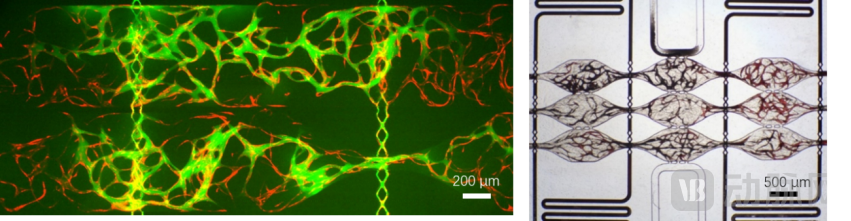 Perfusable microvascular network within a vascularized organ-on-a-chip. Image provided by the interviewee.
After three generations of technological iterations, Yue Tao finally informed VCBeat that his team had overcome the challenges in manufacturing, controlling, and applying vascularized organ-on-a-chip systems. The latest generation of organ products includes two types of vascularized organ chips and an intelligent injection platform, resulting in more realistic product structures, more precise control, and simpler operation.
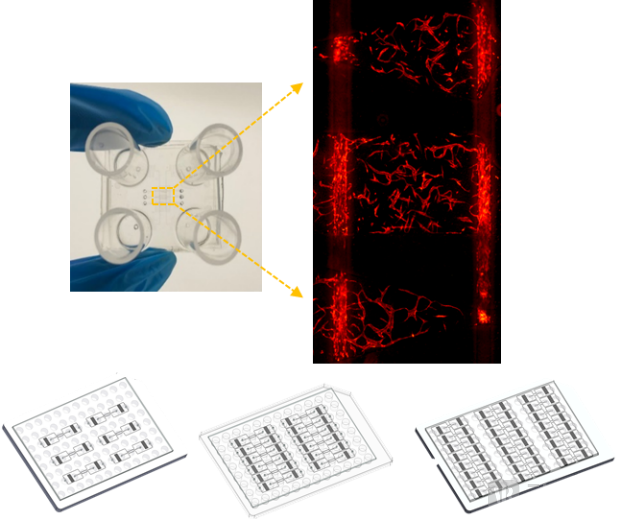
Actual Product vs. Standardized Product, Image Provided by Interviewee
Establishment of Shanghai Micro-Nano Core Innovation Biotechnology to Accelerate Industrialization Layout
In May 2024, Yue Tao and his team established Shanghai Micro-Nano Core Innovation Biotechnology.This is a startup focused on the research, development, and manufacturing of vascularized organ-on-a-chip systems, providing an unprecedentedly precise platform for drug screening, disease model construction, and personalized medicine.。
In fact, as early as 2021, Yue Tao had already considered the commercialization of his technological achievements, but the technology was not yet mature at that time. Therefore, instead of rushing for quick success, he chose to focus intently on further advancing his technical expertise and continuously breaking through technological bottlenecks. During that period, Yue Tao led his team in working day and night on research and development, addressing key technical challenges related to the structural design, cell culture, and microenvironment simulation of vascularized organ-on-a-chip systems. They relentlessly explored, experimented, failed, and tried again.
The establishment of Micro-Nano Core Innovation marked Yue Tao’s first entrepreneurial venture. Recognizing the need to build a more diverse team with rich and varied backgrounds to successfully carry out this endeavor, Yue Tao placed particular emphasis on recruiting members from different fields, possessing diverse professional expertise and extensive experience during the team-building process.
Yue Tao told VCBeat that the team is currently divided into two main parts:Part I: Core Technical Team, including university research teams with expertise in mechanics, control systems, automation, artificial intelligence, materials science, and biomedical engineering;The other part is the management and operations team., they are primarily composed of faculty members with relevant work experience at the National University Science Park of Shanghai University, possessing foundational knowledge in technology transfer, startup management, legal affairs, and finance, thereby providing a solid support for the smooth operation of the project.
Not only that, the team is also equipped withA Financial Advisor with Extensive IPO Experience, responsible for the company's financial planning, financing strategies, and the formulation of related policies.
In terms of product refinement,Yue Tao’s team is also engaging in deep reflection and strategic planning regarding product form to differentiate itself from similar offerings in the market, where Chinese organ-on-a-chip products suffer from severe homogenization.“Currently, the domestic market is dominated by imitations of foreign competitors. The promotion of innovative products is constrained by European and American policies regarding organ-on-a-chip technology. However, the most critical aspect of organ-on-a-chip technology is to demonstrate product value while lowering the barrier to entry and reducing training and educational costs for customers,” said Yue Tao.
This approach is reflected not only in the design of the chip itself but also extends to the entire product ecosystem and application scenarios, providing users with more comprehensive and efficient solutions.It is understood that Yue Tao’s team has already developed differentiated organ-on-a-chip platforms, including vascularized liver organoid chips and cardiac organ chips, with each chip capable of housing 4 to 5 million cells.. In the next phase, the team will adopt a disease-oriented approach to expand and enrich its product portfolio of vascularized organ-on-a-chip systems, developing organ chips capable of simulating various major diseases.
Once vascularized organ-on-a-chip devices are manufactured, their ultimate goal is to enable customers to culture and generate specific organs of interest on the chips for applications such as drug testing. In simple terms, the system is designed to be “user-friendly and straightforward, accessible to everyone.” Yue Tao stated, “The functionality and usability of the chips are now highly mature; our next step is to drive their commercialization.”
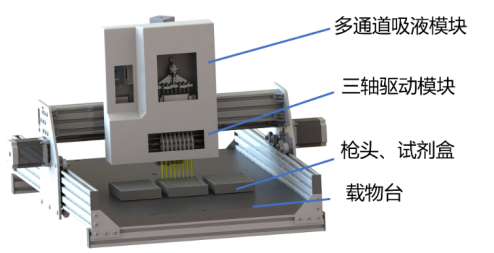
Intelligent Operation Platform, Lowering the Barrier to Use
Over one million partnerships established; financing process actively advancing
It is reported that Yue Tao’s team has established business collaborations with enterprises such as Shanghai Biochip Co., Ltd., with related technical cooperation exceeding RMB 1 million. In practical implementation,Test results from the injection instrument’s chip injection module demonstrated a 45% increase in platform injection efficiency and a 20% reduction in scrap rate. Drug testing within the chips revealed that the discrepancy between vascularized chip data and animal trial results was less than 10%. The project was also awarded the Second Prize for Scientific and Technological Invention by Shanghai Municipality.。
“This is only part of the future development trajectory for vascularized organ-on-a-chip technology,” Yue Tao told VCBeat. He outlined two primary directions for the team’s future business development: first, leveraging research funding and social capital to drive R&D and iteration, developing vascularized organ-on-a-chip solutions tailored to different diseases, while simultaneously independently developing intelligent equipment to lower the barrier to entry for using these chips; second, establishing a standardized product and quality system to build a high-barrier competitive moat. Additionally, considering the team’s interdisciplinary background centered on mechanical engineering and control systems, Yue Tao noted that their commercialization entity differs from most companies currently offering organoid model services. Instead, it will anchor itself in the blue ocean of biotechnology and manufacturing, providing standardized intelligent equipment and chip consumables, with the aim of becoming a leading enterprise in the biotechnology sector.
“We don’t wait until our products are fully perfected before seeking revenue. We are already leveraging the entrepreneurial team’s accumulated experience and technical capital to continuously generate cash flow throughout the process, thereby adapting to market demands and iterating our products,” said Yue Tao.
In the future, regardless of whether Yue Tao secures angel investment, self-finances, or obtains government fund support, he plans to generate cash flow by selling certain key submodules—such as chips with relatively simple operation—before the official commercial launch of his main product. Leveraging existing technologies, his team has incubated a variety of products, including droplet microfluidic chips and point-of-care testing devices. “Although these products are not vascularized organ-on-a-chip systems, they can be benchmarked against similar mature products on the market to generate cash flow,” said Yue Tao.
Mature projects often require substantial capital infusion.
At this stage, Yue Tao’s team has also begun to more proactively seek investment opportunities. In his interactions with investors, he does not want the project to remain merely at the conceptual level, inflating market valuation through exaggerated claims while failing to achieve genuine industrial implementation. “We progress from simple to complex, from single products to integrated systems, and gradually transition from non-standard components (i.e., products customized according to customer requirements) to standard components (i.e., mass-produced products).” At each development stage, Yue Tao and his team carefully consider how to generate revenue and how to ensure continuous product iteration and upgrades.