

Xaira Therapeutics Secures $1 Billion Seed Round, the Largest in Global Healthcare for 2024, Igniting the AI+Proteomics Sector

Xaira Therapeutics
Comprehensive Biotechnology Developer

ARCH Venture Partners
Venture Capital Firms
In the healthcare venture capital industry, financing rounds exceeding $1 billion typically occur only in the mid-to-late stages of a company’s development.
Recently, a medical innovation company emerged from stealth mode and announced securing over $1 billion in funding, marking the largest global seed round in healthcare to date in 2024 and propelling the company to unicorn status.
It is important to note that seed rounds are typically the first significant infusion of capital for startups. Given the early-stage nature of projects at this phase, average funding amounts generally range from hundreds of thousands to several million dollars. Medical seed rounds exceeding $1 billion are extremely rare, with only two such cases globally to date (the other being Altos Labs, an anti-aging company, which secured $3 billion in financing in 2022).
The company that secured over $1 billion in seed funding is named Xaira Therapeutics, which was jointly incubated in May 2023 by ARCH Venture Partners, one of the largest investment firms in the biotechnology sector, and Foresite Labs.According to its official website, Xaira Therapeutics’ core business is leveraging AI to reshape drug discovery and development, with a current focus on proteomics—the study of how proteins change in health and disease.
Closely aligned with its business direction, the company was co-founded by David Baker, Director of the Institute for Protein Design at the University of Washington and recipient of the 2021 Breakthrough Prize in Life Sciences (hailed as the “Oscars of Science”). Baker and his team have developed a novel technology capable of designing proteins never before seen in nature, including new protein candidates with therapeutic potential for intervening in human diseases.
In fact, Xaira Therapeutics’ fundraising in the “AI + protein” space is not an isolated case. According to the VCBeat Orange Database,Between January 2022 and June 2024, a period of two and a half years, this sector witnessed no fewer than 100 financing events, with total funding exceeding $6 billion., is currently one of the most capital-favored sectors in healthcare.
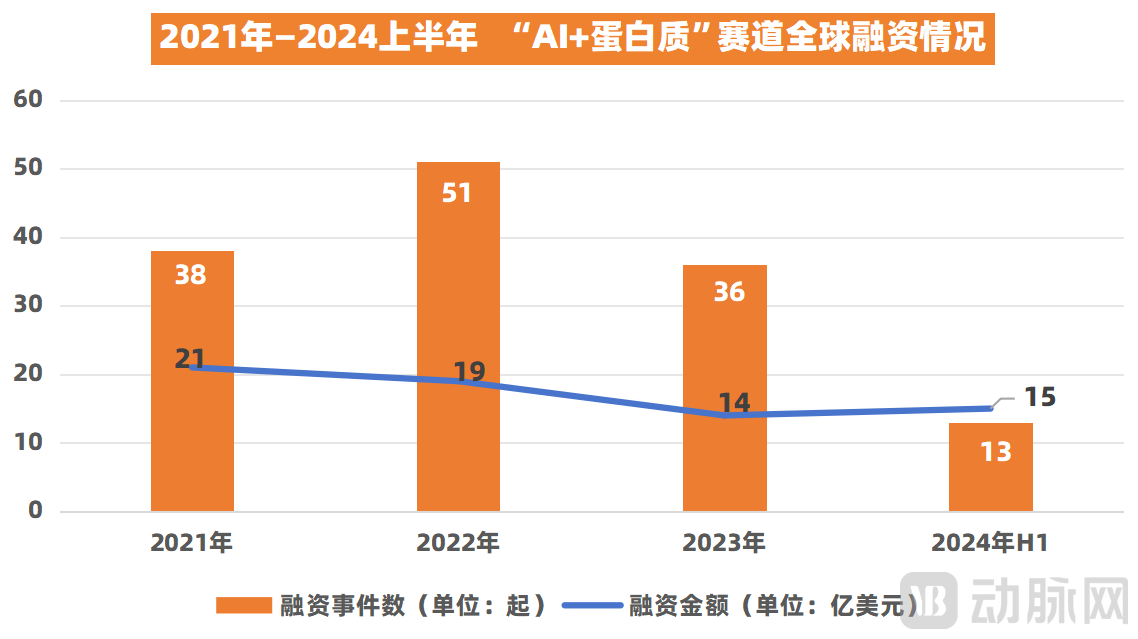
(Data source: VCBeat Orange Database)
Behind the Frequent Funding Rounds, What New Industry Narrative Is the “AI + Proteins” Sector Telling?
All-Star Lineup + Over $1 Billion in Funding,
What exactly does Xaira Therapeutics do?
“AI + Proteins” Is Becoming the Focus of the Tech Industry
The reason is that,Traditional protein research methods suffer from issues such as lengthy experimental cycles and high costs, whereas AI can accelerate the pace of protein research.: When applied to drug development, it can facilitate the discovery of new targets, shorten the R&D cycle, and reduce time costs; when applied to materials, it enables the generation of novel protein materials surpassing those found in nature, thereby creating new growth opportunities for sectors such as agriculture and food.
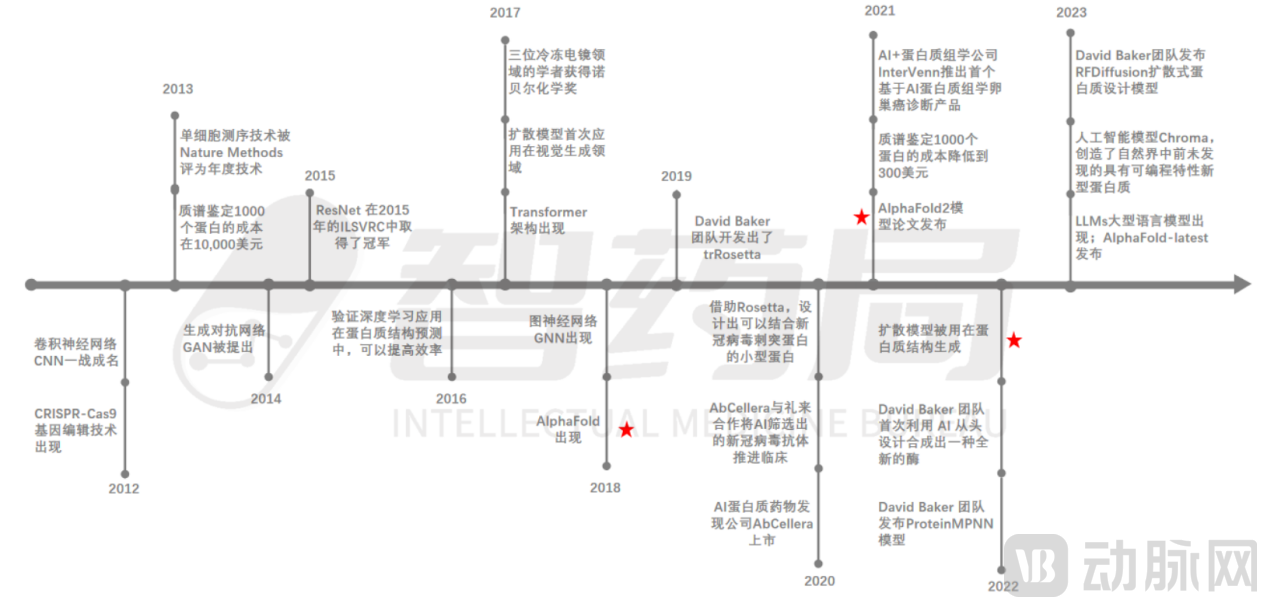
(Major Milestones in the Development of the AI + Protein Industry; Image Source: Zhiyaoju, “AI + Protein Industry Research Report”)
It is precisely within this vast landscape of possibility that the “AI + Protein” sector has embarked on a rapid expansion. However, entering this field is no easy feat: first, it requires substantial R&D funding; second, it demands a strong team.
In the former case, Xaira Therapeutics has secured over $1 billion in funding; in the latter, it boasts a robust interdisciplinary team comprising professionals with expertise in computer science, bioinformatics, data science, pharmacology, and business management. For instance, its CEO is Dr. Marc Tessier-Lavigne, who previously served as Chief Scientific Officer at Genentech and held presidential positions at both Rockefeller University and Stanford University.
More importantly, David Baker, the co-founder mentioned earlier, is a leading figure in the field of “AI + proteins.” It is reported that most of Xaira Therapeutics’ technology originates from David Baker and the Institute for Protein Design at the University of Washington, where he serves.
Therefore, to gain a deep understanding of Xaira Therapeutics, it is essential to be familiar with the research achievements of David Baker and his team. Throughout David Baker’s scientific career, he has consistently focused on protein structure prediction and protein design.
· In the field of protein structure prediction, David Baker and his team launched the Rosetta algorithm as early as 1998, gaining prominence in the 3rd Critical Assessment of Protein Structure Prediction (CASP) competition. With continuous optimization over the years, Rosetta has remained one of the most representative algorithms in protein structure prediction, facilitating the development of multiple protein-based biologics in clinical stages, several molecules under Investigational New Drug (IND) applications, and more than a dozen preclinical biologics.
· In the field of protein design, David Baker and his team launched the deep learning tool ProteinMPNN in 2022. Drawing on neural networks used in image recognition, this tool can identify amino acid sequences corresponding to specific structures, enabling more precise and rapid protein molecule design. It has reduced the time required for protein design from “months” to “seconds,” achieving a speed more than 200 times faster than the best previously available software.
It is reported that the large AI model used by Xaira Therapeutics integrates RFdiffusion, a large AI model developed by David Baker and his team. RFdiffusion is a more advanced and versatile protein design model launched by the team following ProteinMPNN.
Specifically, RFdiffusion is an innovative generative AI system built on diffusion models. Similar to text-to-image models such as Midjourney and Stable Diffusion, it can generate novel, customizable protein “backbones” (i.e., the overall structural scaffolds of proteins) and then layer sequences onto them. According to foreign media reports, this model enables on-demand design of biomolecules, holding promise to revolutionize vaccine and drug development.
However, as Xaira Therapeutics is still in its early startup phase, it has not disclosed much about its R&D progress or pipeline portfolio, making it difficult for external observers to predict its specific future moves.
But one thing is certain: with a star-studded founding team and substantial funding, Xaira Therapeutics has emerged as one of the most significant players in the “AI + protein” sector right from its inception.
The investment wave of “AI + Proteins” began in 2020.
At that time, AlphaFold, developed by the Google DeepMind team, successfully predicted the three-dimensional structures of proteins, marking the first step in using artificial intelligence for protein structure prediction. This breakthrough propelled “AI + proteins” into the mainstream spotlight, attracting numerous entrepreneurs and investment institutions to enter the field.
“This is the greatest contribution of artificial intelligence to the field of science, and one of the most important scientific breakthroughs achieved by humanity in the 21st century.” Such was the remark made by Shi Yigong, President of Westlake University, when discussing AlphaFold.
From a technical perspective,The “AI + Proteins” sector can be divided into three major directions: AI proteomics, AI protein prediction, and AI protein design., the differences are as follows:
·AI Proteomics: Proteomics is the scientific study of the composition and dynamic changes of proteins in cells, tissues, or organisms. The integration of AI with proteomics holds significant application potential in target discovery, biomarker identification, and precision medicine.
·AI Protein Prediction: Leveraging machine learning and deep learning algorithms to predict protein three-dimensional structures, folding patterns, and interactions with other molecules based on amino acid sequence information.
·AI Protein Design: Leveraging AI to design novel proteins by learning the relationship between protein sequences and functions, without direct human intervention.
Next, we will examine representative companies and their progress from three perspectives. It is important to note that both protein structure prediction and protein design revolve around the core question of “how proteins fold,” so some innovative companies have established a presence in both areas.
Currently, in the field of AI proteomics, representative innovative companies include Luomi Technology, Matchpoint, Olink, Somalogic, and Westlake Omics (listed in alphabetical order by company name).
Taking Westlake Omics as an example, the company was founded in July 2020 and primarily focuses on the development and application of multi-omics technologies centered on protein mass spectrometry. Leveraging this technology, it is advancing the development of in vitro diagnostic reagents and methods for various diseases, including thyroid nodules, Alzheimer’s disease (senile dementia), and lung cancer.
For example, in the detection of thyroid nodules, Westlake Omics has developed a novel molecular diagnostic product, “Jiapunuo,” by integrating proteomics with AI technology. This product increases the accuracy of differentiating between benign and malignant nodules to approximately 90%, thereby sparing most patients—whose nodule status was previously difficult to determine—from unnecessary surgery.
Another example is Olink, a Sweden-headquartered company that offers a proteomics-centric platform of products and services. Its most renowned offering is the Proximity Extension Assay (PEA) technology, which enables high-throughput protein analysis by running on laboratory-installed qPCR instruments and next-generation sequencers. Reportedly, PEA technology is built upon an extensive library of over 5,300 protein biomarker targets and has been utilized in approximately 1,400 scientific papers, demonstrating its strong market potential and scientific research value.
On July 10, Thermo Fisher Scientific, a global leader in scientific services, announced its acquisition of Olink for a total consideration of $3.1 billion. In a statement, Marc Casper, President and Chief Executive Officer of Thermo Fisher Scientific, remarked, “The acquisition of Olink underscores the profound impact of proteomics on advancing life sciences research and precision medicine.”
In the field of AI-based protein prediction, representative companies have emerged, including Baitu Life Sciences, DeepMind, Molecule Mind, Genesis Therapeutics, Huashen Zhiyao, Profluent Bio, DP Technology, and Tianrang (listed in alphabetical order by company name).
As a pioneer in the field of AI-based protein prediction, DeepMind released another AI model, AlphaMissense, last year, following AlphaFold. According to foreign media reports, AlphaMissense leverages protein sequence databases and variant structural contexts to identify pathogenic missense mutations (genetic mutations that may impair human protein function) and genes of unknown pathogenicity, with a predictive scope nearly 1,000 times greater than that of human experts.
Meanwhile, in May this year, DeepMind and AI drug discovery company Isomorphic Labs jointly announced the launch of AlphaFold 3, a next-generation AI biomolecular structure model. Built upon AlphaFold 2, it expands prediction capabilities from proteins to a broad range of biomolecules.
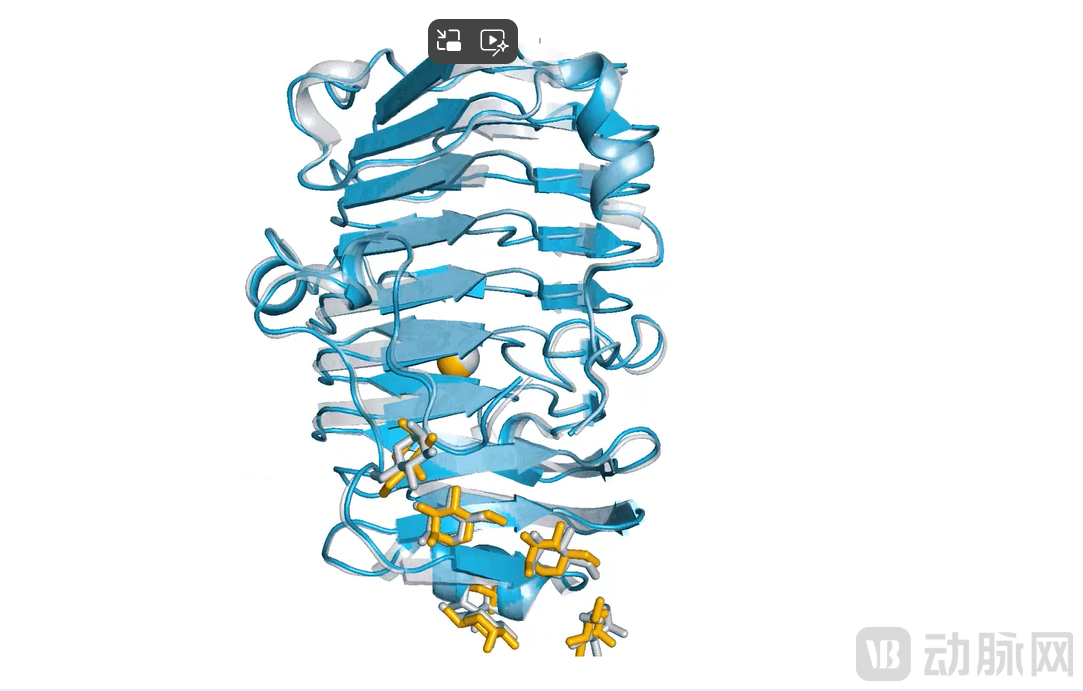
(Molecular structure predicted by AlphaFold3. Image source: DeepMind)
Tianrang, a Chinese enterprise, has launched the xCREATOR workbench. By integrating diverse AI algorithms and computing resources, it provides research institutes, enterprises, and other entities with more efficient, convenient, and user-friendly services for protein structure prediction and design. Users can perform tasks such as protein prediction and design without writing any code, and visualize and analyze the computational results. The platform is applicable to peptides, enzymes, antibodies, and various functional proteins.
With the aid of the workbench, users can obtain protein structures with near-experimental resolution accuracy within minutes. In the past, this process could take months or even years and required the use of expensive, specialized instrumentation.
In the field of AI-driven protein design, companies such as Arzeda, Cradle Bio, Generate Biomedicines, Molecule Mind, RevolKa, Tianrang Intelligence, Tianwu Technology, and Tushen Zhihe have emerged (listed in alphabetical order by company name).
Generate Biomedicines, a foreign enterprise, is one of the representative companies in this field. Incubated by Flagship Pioneering, a top-tier life sciences venture capital firm, it has developed a generative artificial intelligence model named Chroma. Built on the frameworks of Diffusion Models and Graph Neural Networks, Chroma is capable of de novo generation of high-quality, diverse, and innovative protein structures.
In terms of practical applications, Generate Biomedicines currently boasts an extensive product pipeline covering immunology, oncology, and infectious diseases.
Turning to the Chinese enterprise Molecular Heart, the company has independently developed an industrial-grade AI large model for protein generation—the NewOrigin (Darwin) large model. With tens of billions of parameters, this model has been trained on massive amounts of highly specialized and complex multimodal data, enabling it to “customize” functional proteins on demand according to industrial application requirements.
To date, Molecular Mind has extensively applied its NewOrigin large model across fields such as innovative drug development, new materials, food, chemical engineering, and agriculture. It has achieved significant breakthroughs in various high-difficulty industrial tasks, including macromolecular drug design, optimization of protein stability under extreme conditions, enzyme activity optimization, enzyme–specific substrate docking, and de novo protein design, with these advancements validated in real-world production systems.
It is not difficult to see that innovative companies have already achieved significant breakthroughs in various niche sectors and are continuing to deepen their efforts.
Going forward, driven by the entry of more enterprises and the emergence of new possibilities, the application of “AI + Proteins” in the industry will see greater progress, and the market space will continue to expand. According to MedMarket Insights,The AI protein market size reached $1.483 billion in 2023 and is projected to grow to $17.8 billion by 2031., with a compound annual growth rate of approximately 36.5%.
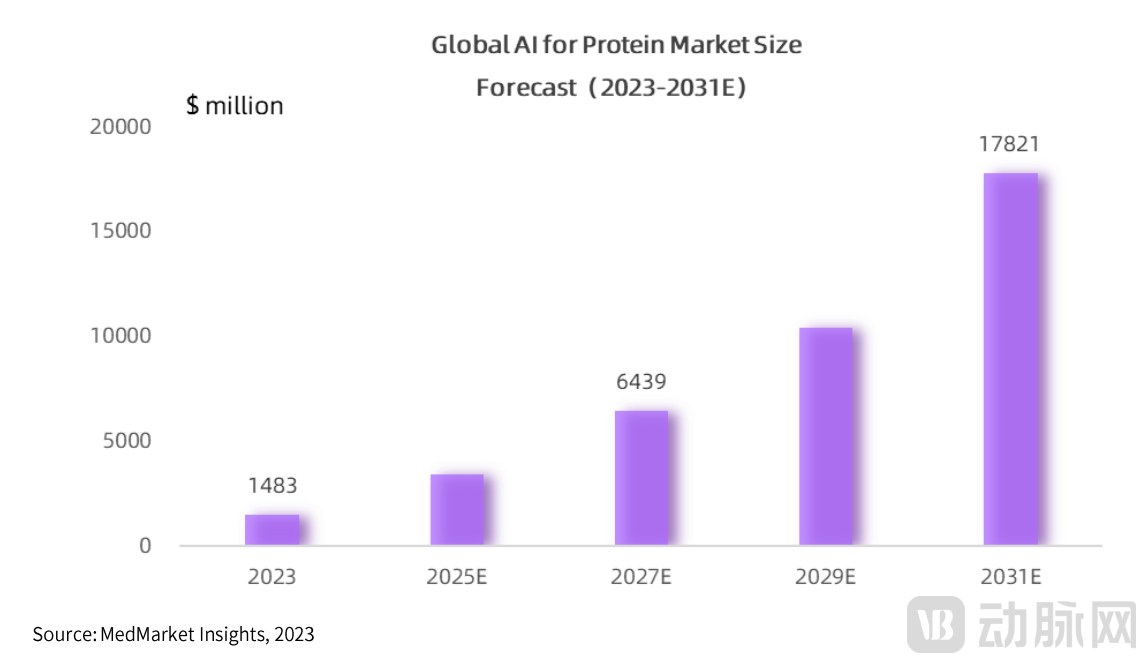
(“AI + Protein” Market Size Forecast. Image source: Zhiyaoju · “AI + Protein Industry Research Report”)
With abundant resources, fish can grow large. Within the ever-expanding realm of imagination, the “AI + Proteins” sector is poised to produce global industry giants.
The road ahead is promising, but at the same time, caution is warranted.“The AI + Protein” sector still faces challenges in practical implementation.
For instance, the “AI + Protein Research Report” points out that,Data Quality Issuesis a key limiting factor in AI applications. Due to the complexity of protein structures, substantial amounts of high-quality data are required to train and validate AI models. Currently, although public databases such as the Protein Data Bank (PDB) provide extensive structural information, these data often suffer from bias and incompleteness, which may compromise the accuracy and generalizability of AI models.
Furthermore, in an interview with Nature Biotechnology, Mohammed AlQuraishi, an assistant professor at Columbia University, stated that in the process of designing proteins with specific molecular functions and understanding how they operate within humans and other organisms,The Full Complexity of Biologywill become the rate-limiting step.
Of course, everything has two sides.Behind Challenges Lie Opportunities—As one of the most fundamental components of living organisms, protein-related applications, empowered by AI, are poised to be implemented in more specialized fields over the next few years, unlocking significant commercial potential.
Currently, industry giants such as Meta (formerly Facebook) and NVIDIA have expanded into the “AI + protein” domain, aiming to develop models for protein design by learning from vast amounts of data. As more companies enter this field, research papers on related findings are emerging in abundance and accelerating continuously, making it highly likely that the industry will achieve a major breakthrough at some point.
We believe that as industry players rise to the occasion and overcome one challenge after another, the “AI + Protein” sector will tell an even more compelling story, thereby unlocking greater possibilities for innovation in the healthcare industry.
In this process, enterprises that continuously innovate and explore will ultimately reap their rich rewards.
References:
“AI + Protein Industry Research Report” — Zhiyao Bureau