

Organovo, Pioneer of Bioprinting, Files IPO Prospectus to Enter Drug Development After Collaborations with Merck, Roche, and Johnson & Johnson

Organovo
Medical Device Provider
The development of 3D printing technology in the medical field represents a revolutionary advancement, as it not only transcends the limitations of traditional medical technologies but also brings patients unprecedented treatment options and hope.
Twenty years ago, the concept of 3D-printed organs was merely a science fiction fantasy, seemingly out of reach; today, the 3D printing of structures ranging from bones, skin, and blood vessels to complex organs such as the heart has become a reality one by one.
When discussing the development of 3D printing in the medical field, one cannot bypass a biomanufacturing company based in California, USA.OrganovoIn 2009, Organovo launched the world’s first 3D bioprinter capable of helping users fabricate biological tissues for research and development, ushering in the era of biofabrication. Over the following decade, this company, with fewer than 100 full-time employees, repeatedly redefined people’s understanding of 3D bioprinting.
“Father of Bioprinting” Leads the Founding of the World’s First Bioprinting Company
To 3D print an organ, five steps are required: modeling – bioink selection – printing – post-processing – culturing.
Modeling serves as the foundation of the entire process, requiring precise representation of the morphological and functional requirements of the target biological structures or organs to ensure the fabrication of compatible products. Bioinks are typically composed of cells, biomaterials, and growth factors; during printing, parameters such as concentration and viscosity must be carefully controlled to guarantee stability and precision throughout the process. Printing and post-processing primarily aim to enhance the stability and safety of the printed organs.
Culture is a unique step in 3D bioprinting. The printed constructs need to be placed in an incubator to provide nutrients, growth factors, oxygen, and other essentials, enabling them to simulate physiological function. They can only be put into use after subsequent tests for morphology, functionality, and biocompatibility are completed.
From an overall perspective, apart from material selection and cultivation processes, bioprinting appears no different from conventional 3D printing. In fact, the origins of bioprinting can be traced back to a standard inkjet printer.
It was Professor Thomas Boland of Clemson University who first linked life with printing.
In 2000, Professor Boland had a sudden insight while using an inkjet printer: “If I replace the ink with cells, can I also print organ tissues?” Inspired by this idea, he and his team modified a standard HP inkjet printer and completed the first-ever bioprinting experiment using bacteria as the “ink.”
Although the printed output remains an “inanimate object,” it has validated the feasibility of 3D-printed organs. With this experiment,Professor Boland proposed the concept of “cell and organ printing technology,” laying the foundation for the entry of 3D printing into the life and health sector.
Subsequently, Professor Boland’s team experimented with various cell types as bioinks for 3D printing, ultimately achieving the successful printing of living cells in 2003 and publishing the world’s first academic paper on bioprinting of living cells.This achievement marks the transition of 3D bioprinting technology from theory to practice, realizing a leap from printing non-living materials to living matter.This technology also secured the world’s first patent for cell and organ printing, earning Professor Boland the title of “Father of Bio-3D Printing.”
The emergence of bioprinting technology has caused quite a stir in the field of life sciences. Keith Murphy, who once served as Director of Bioprocess Engineering at Amgen, keenly recognized the commercial value of this “future technology.” Leveraging his business expertise, he secured licensing from Professor Boland’s team and co-founded Organovo, the world’s first bioprinting company.
Establish a viable commercialization pathway to achieve comprehensive coverage of skin, tissues, and organs.
Bolstered by Professor Boland’s technology and Keith Murphy’s business expertise, Organovo has advanced rapidly, achieving multiple “firsts” in the 3D bioprinting sector.
In 2009, Organovo manufacturedThe World's First Prototype of a Bioprinter, and was named one of the 50 Best Inventions of 2010 by TIME magazine. This breakthrough heightened public awareness of bioprinting technology and sparked considerable interest and attention from scientists and investors alike.
Building on this 3D printer, the team carried out upgrades and enhancements, ultimately creatingThe World's First Commercialized NOVOGEN MMX Bioprinter. It is reported that the NovoGen MMX bioprinter can arrange clusters of liquid human cells (bio-ink) in such a way that they re-fuse with each other to form tissues of specific shapes, thereby constituting entirely new organs.
Currently, the NOVOGEN MMX bioprinter has been on the market for over a decade and is widely used in fields such as tissue engineering, regenerative medicine, and drug development.
In addition to its technological leadership, Organovo’s commercialization strategy was also ahead of its time. In 2014, Organovo officially launched its NOVOGEN MMX bioprinter,The first commercial bio-3D-printed product, “exVive3D Human Liver Tissue.”
exVive3D is primarily used for preclinical drug development testing, capable of accurately and reproducibly simulating certain functions of the human liver, thereby providing a novel, more efficient, and accurate testing platform for drug discovery. According to Organovo, within just one year of its market launch, exVive3D secured $2 million in contracted orders, driving a 209% year-over-year increase in Organovo’s total revenue. This milestone marked a significant turning point in Organovo’s transition from laboratory research to commercialization.
The success of exVive3D has attracted a significant number of clients to Organovo, including globally leading life sciences and healthcare companies seeking collaboration. This successful commercialization path has also enabled Organovo to embark on a trajectory of continuous iteration of its 3D bioprinting products, alongside customized development partnerships with research institutions and enterprises.
In 2015, Organovo partnered with L'Oréal to 3D-bioprint human skin tissue, providing a human skin alternative for L'Oréal’s product toxicity and efficacy testing. Subsequently, Organovo collaborated with the German biomanufacturing company Merck Group to customize and print various liver and kidney tissue models for drug toxicity testing, thereby assessing the safety and efficacy of new drugs. Additionally, organizations such as the Knight Cancer Institute, the University of California, San Francisco, the Michael J. Fox Foundation, Roche, and Janssen Pharmaceuticals have all become partners of Organovo.
As of 2023, Organovo has achieved the bioprinting of various biological tissues, including liver organoids, hepatic tissue, mini-kidneys, renal tissue, transplantable kidneys, bone tissue, muscle tissue, and skin tissue.It has achieved near-complete coverage, ranging from viscera to skin and from tissues to organs.
From Experimental Models to Pipeline Development, Organovo’s Most Advanced Pipeline Has Reached Phase II Clinical Trials
Through in-depth collaborations with numerous leading enterprises and research institutions, Organovo’s bio-3D printing technology has undergone continuous iterative innovation, as primarily exemplified by the NovoGen MMX bioprinter.
First, the NOVOGEN MMX bioprinter employs syringe-based extrusion 3D bioprinting technology. Compared with conventional 3D printing techniques, it precisely deposits cells and biomaterials layer by layer onto the build platform, thereby constructing three-dimensional biological tissue models with complex structures and functions, and achieving high-precision bioprinting. This technology enables the personalized fabrication of biological tissues.
It is reported that the NOVOGEN MMX bioprinter can currently achieve printing precision at the micron level, ensuring high accuracy and consistency in the printed biological tissues.
Secondly, the current NOVOGEN MMX bioprinter supports various types of “bio-inks,” including cells, hydrogels, and polymers. This enables printed biological tissues to more closely mimic the structure and function of real human tissues when used as testing platforms for applications such as toxicity screening, thereby yielding more accurate results. Furthermore, when utilized for transplantable organs, these novel materials enhance the biocompatibility of the printed tissues and can incorporate functionalities such as tissue repair and drug delivery, thus accelerating patient recovery.
Technological advancements have also expanded Organovo’s product pipeline. After collaborating with multiple renowned pharmaceutical companies and research institutions, Organovo decided to enter the drug development arena itself—leveraging 3D bioprinting technology to recapitulate the entire process of disease onset and treatment, thereby identifying therapeutic solutions based on the fundamental mechanisms underlying disease progression.
Currently, Organovo has identified two major drug targets,Involving Gastrointestinal and Hepatic Diseases. Among them, the one progressing the fastest isTherapeutic Molecule FXR314, currently undergoing Phase 2 trials for ulcerative colitis. According to Organovo’s official website, it is a potential best-in-class FXR agonist that can be administered orally, offering high potency, safety, and tolerability, with the potential to avoid the dose-limiting toxicities observed with other FXR-targeting compounds.
Furthermore, in clinical trials, FXR314 has demonstrated potential in the treatment of metabolic diseases and oncology. It was disclosed that Organovo is also advancing research on FXR314 for the treatment of other inflammatory bowel diseases, including Crohn’s disease, as well as liver diseases such as non-alcoholic steatohepatitis (NASH) and primary biliary cholangitis.
Another drug target of Organovo has not yet been disclosed, but it has been validated in a 3D tissue model of Crohn's disease.
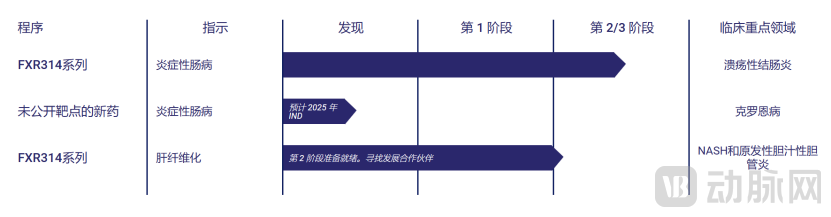 Organovo’s Drug Product Pipeline (Image source: Organovo official website)
Based on Organovo’s current drug pipeline, bio-3D printing technology offers new opportunities for identifying novel drug targets and facilitating drug development. Its precision and customization capabilities will also drive the advancement of personalized medicine.
Domestic Bioprinting Is Still in Its Infancy, with Some Companies Emerging
In 2020, Murphy, who had previously left Organovo, returned to the position of CEO. He announced to the world, “We have not used these simple bioprinted tissues in clinical trials for many years, but today we are conducting preclinical studies. In the future, Organovo will also leverage 3D bioprinting technology to pursue research into cardiac muscle patches, nerve grafts, and vascular bypasses.”
From manufacturing instruments to commercializing bioprinting products, and then to identifying drug targets, Organovo is now venturing into the field of organ transplantation. Each step not only challenges its past self but also leads the development of medical innovation.
Bioprinting has emerged as a critical tool for the future development of healthcare. Although China entered this field relatively late, in recent years it has garnered substantial attention from both policy makers and the market.
Since 2014, China has introduced multiple policies to encourage and support enterprises in strengthening the research, development, and application of bio-3D printing technology. This has sparked a boom in the domestic bio-3D printing sector, leading to the emergence of numerous Chinese bio-3D printing technology companies.
Currently, the domestic bio-3D printing market in China remains dominated by foreign companies, with Organovo, Organovo Holdings, Inc., and EnvisionTEC GmbH continuing to occupy the majority of the Chinese market. Meanwhile, local enterprises such as Hangzhou Regenovo, Sichuan Blue Light Inno, Beijing Shangpu Bio, and Guangzhou Medprin Regenerative Medicine have already demonstrated considerable potential.
Currently, the research directions of domestic bioprinting companies are mainly divided into two categories: developing technology platforms and developing biological products.
Nuope RegenerationIt is a leading enterprise in the field of biological 3D printing in China. Currently, its two leading products—biological 3D-printed bone repair scaffolds and breakthrough biological 3D-printed skin repair products—have completed preclinical studies and are about to enter clinical trials, holding promise to provide new solutions for clinical challenges in bone and skin repair.
CELLINKis a representative focused on the development of technical platforms. In 2017, Regenovo launched China’s first generation of high-throughput integrated bioprinter, “Bio-architect® X,” achieving more than 50 technological innovations and breakthroughs. One year later, it released China’s first generation of high-throughput integrated bioprinter, Bio-architect. According to publicly available information, Bio-architect can achieve a maximum printing speed of 0–190 mm per second and has currently been applied in three types of procedures: vertebral orthopedic surgery, left atrial appendage occlusion, and orbital fracture repair.
However, alongside its rapid development, China’s bio-3D printing sector still exhibits certain shortcomings.At this stage, China’s bio-3D printing industry is in the initial phase of standardization, with an incomplete standards framework. Meanwhile, mismatches between cell counting and biomaterial development, along with socio-ethical challenges, will hinder the advancement of domestic bio-3D printing technology.The road is long and arduous; China’s bioprinting technology needs more time to come to fruition.