

Baidu Health Reshapes Internet Healthcare in the Era of Large Models
At the recently concluded Baidu Health Industry Ecosystem Conference, He Mingke, Senior Vice President of Baidu Group and President of Baidu’s Healthcare Business Group, opened his speech with the latest business data, providing a comprehensive summary of Baidu’s healthcare sector deployments in recent years.
He stated in his speech that Baidu Health currently hosts more than 300,000 physicians, collaborates with over 3,000 content partner institutions, and has indexed information on more than 160,000 healthcare facilities. Leveraging these foundational assets, the company has accumulated 600 million health-related content items, served over 210 million patients, and established partnerships with more than 1,000 pharmaceutical and medical device companies.
When comparing data across the same dimensions, Baidu Health has established the largest internet hospital network, the most comprehensive health information portal, the leading medical decision-making platform, and the most extensive drug education platform in China, positioning itself ahead of all IT giants with healthcare business layouts.
Behind the Outstanding Performance, Baidu Health’s Expansion Continues.
Having established a comprehensive healthcare ecosystem centered on the three core elements of “patients, providers, and pharmaceuticals,” Baidu Health is continuously intensifying its investments in artificial intelligence, aiming to reshape a new internet healthcare system through large language models and digital-intelligence service capabilities.
To dissect the term “reshaping,” we must first deconstruct Baidu Health’s existing medical ecosystem.
The construction of Baidu Health’s ecosystem in the past can be broadly divided into two steps: First, it broke down spatial barriers between doctors and patients, connecting them via the internet; second, it introduced pharmaceutical companies, medical device manufacturers, and other institutions into the doctor-patient relationship, thereby fostering innovative development in modern medicine.
Establishing online communication channels between doctors and patients may seem easy, but it actually poses a significant test to a company’s accumulation of essential resources. Conventional internet healthcare platforms struggle to build a consolidated patient base or assemble doctors at scale, thereby failing to effectively fulfill their “connecting” role. In contrast, Baidu Health benefits from the natural patient entry point provided by its search engine, enabling it to more easily aggregate the patient population.
To help patients retrieve effective information from the vast amount of search results for symptoms and conditions, and to improve patient retention on its platform, Baidu first invested years of resources in developing high-quality science popularization content, presented through features such as the Medical Encyclopedia, health-related entries, and a Medication Assistant, thereby ensuring that the information provided by its search engine is reliable and easy to understand. Subsequently, leveraging its Internet Hospital services, Baidu contracted with a large number of physicians, enabling patients who require further consultation and services to meet their healthcare needs via online channels.
Upon completion of this step, the platform value of Baidu Health is no longer confined to providing patients with pathways for diagnosis and treatment; it further creates social value by enhancing patients’ understanding of diseases.
Mao Ji, General Manager of Pharmaceutical Marketing at Baidu’s Healthcare Business Group, stated in his speech, “A user began searching for information on ‘shingles’ on May 17 and conducted approximately 80 searches over the next four days, until May 20. Initially, she merely read basic entries about shingles; by the end, she had gained an understanding of the age distribution and contraindications associated with the disease. This indicates that through her search process, she transformed from a complete novice into an ‘expert’ on the condition, proactively taking steps to prevent its onset. This carries significant social value.”
Physicians also benefit from the platform’s more efficient allocation of medical resources. Leveraging its connectivity capabilities, Baidu Health can directly match patient demands with physicians who have available time slots, thereby increasing their income. It also helps them build reputation and establish personal brands, which is particularly advantageous for the career development of early- and mid-career physicians.
Furthermore, Baidu Health can leverage patient online data to provide solutions for the public health system. For instance, in responding to sudden public health emergencies such as Influenza A, Influenza B, and pertussis, Baidu Health can use big data to accurately predict the transmission trends of different infectious diseases across various cities. This enables governments to proactively allocate medical resources, thereby preventing healthcare system overload caused by disease outbreaks.
Revisiting the Value of Baidu Health’s Platform in Connecting Pharmaceutical and Medical Device Partners.
At the conference, He Mingke pointed out: “China has as many as 20 million patients with rare diseases, yet only about 10% of them receive effective treatment. The remaining 90% either cannot afford the prohibitive costs of therapy due to financial constraints, or must silently endure the suffering caused by their conditions because no effective medications are currently available.”
To assist patients with complex or rare diseases in dire straits, Baidu Health has integrated “pharmaceutical companies” into its existing doctor-patient ecosystem to jointly carry out “patient recruitment” for rare diseases, providing those lacking access to treatment resources with the latest therapeutic and medical device solutions. To date, Baidu Health has covered more than 7,000 relevant clinical trial enrollment projects, with the number of patients registered for enrollment exceeding 100,000.
In most healthcare scenarios, it is difficult to simultaneously enhance access to medical services (“ability to seek care”), reduce the cost of medical services (“affordability of care”), and improve the quality of medical care (“effectiveness of care”). This constitutes the “Impossible Trinity of Healthcare” model. However, this “trilemma” in the medical field is not insurmountable; through technological iteration, it is possible to achieve concurrent improvements across all three dimensions of the model.
Reviewing Baidu Health’s medical layout, its “connectivity” capability ensures service quality without increasing medical costs.
Improving the accessibility of medical services, thereby enhancing the supply capacity of the healthcare system.
However, the efficiency gains achieved through “connectivity” are realized by squeezing out the efficiency of medical resource allocation; thus, they do not increase the total supply capacity of the healthcare system and easily hit a ceiling. To break through this upper limit, companies must improve medical quality and reduce medical service
Efforts should be made in two aspects of cost.
This is precisely the crux of Baidu Health’s significant bet on AI.
In September 2023, Baidu Health unveiled the industry’s first enterprise-grade large medical language model—the Lingyi Large Model. After nearly a year of development, the model has established a three-tier technical architecture comprising Mixture of Experts (MoE), terminal components, and intelligent agents. It has been widely applied across products in science popularization content, internet hospitals, smart hospitals, intelligent diagnosis and treatment, and open platforms. At this ecosystem conference, Baidu Health further accelerated the practical implementation of this innovative technology by launching four large medical model applications and one open platform, designed to address the needs of patients, healthcare providers, and pharmaceutical companies throughout every stage of the patient care journey.

(Centered on the patient’s healthcare journey, Baidu Health’s AI applications penetrate every stage involving patients, physicians, and pharmaceuticals)
Let’s begin with the AI Health Assistant. As a vertical large language model product designed for general users, the AI Health Assistant supports multiple interaction methods, including text, images, and voice, providing users with authoritative and convenient health education information and medical consultation services, thereby addressing various challenges encountered in daily information retrieval.
Zhang Yandong, General Manager of Medical Services at Baidu’s Health Business Group, stated at the conference that users have historically struggled to accurately describe their symptoms when searching for medical information and lacked access to multimodal educational resources such as images and audio. He emphasized the need for an assistant equipped with diagnostic capabilities akin to those of a physician to help patients effectively achieve their health-related goals.
Driven by this demand, Baidu Health has developed its AI Health Assistant into a “1+N” agent matrix, with popular science Q&A as the foundation and vertical services as extensions. This system not only pinpoints user queries accurately through multi-turn dialogues but also supplements them with additional services—such as precise medical consultation guidance, interpretation of medical reports, photo-based skin condition recognition, and medication-related Q&A—thereby meeting patients’ follow-up diagnosis and treatment needs.
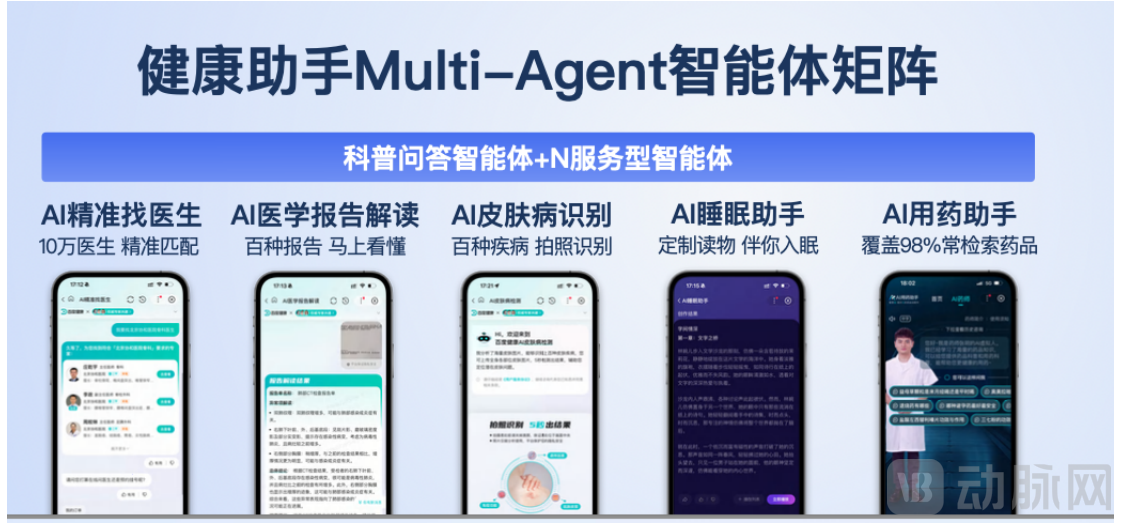 (Baidu Health Agent Family)
Revisiting the Online Healthcare Copilot. According to Zhang Yandong, Baidu Health’s online healthcare services now cover a wide range of offerings, including medical decision support, online consultations, physician appointment slot additions, and multi-location registration. The platform has collaborated with over 100 hospitals on specialized disease outpatient clinics, handling more than 2 million daily consultation requests and facilitating precise in-person appointments for over 6,000 patients per day. Given this large scale of service volume, Baidu must ensure both operational efficiency and security throughout the functioning of its internet hospital.
This is precisely where Copilot delivers value. From pre-consultation patient matching and precise triage, to intelligent responses and knowledge recommendations during consultations, and post-consultation medical quality control and dialogue content archiving, AI can provide support such as quality assurance and decision-making assistance at every stage of online healthcare, thereby helping physicians comprehensively improve efficiency in their practice within internet hospitals.
The third product, the AI-Powered Smart Outpatient Clinic, is a hospital-facing solution designed to address several critical contradictions: patients registering for incorrect or inappropriate specialties amidst strained medical resources; the mismatch between patient demand and specialist availability, where patients in need cannot secure appointments while specialists frequently complain about imprecise patient triage; the “three long waits and one short consultation” phenomenon (prolonged waiting times for registration, medication pickup, and payment, contrasted with brief consultation durations); and the burden of extensive medical documentation that physicians must manage during clinical encounters.
Currently, the “AI Smart Outpatient Clinic” has been successfully piloted at Wuhan Union Hospital for over two months, with large language models deployed in more than ten clinical departments. Supported by diverse service modules such as intelligent triage and guidance, automated appointment slot addition, and smart waiting rooms, the “AI Smart Outpatient Clinic” not only resolves various patient pain points during registration, waiting, and consultation but also helps physicians break free from inefficient doctor-patient communication, thereby maximizing their professional value.
“CDSS+LLM” is also an AI product designed for physicians, and it is closer to clinical practice than the AI-powered smart outpatient clinic.
Previous-generation NLP-enabled intelligent Clinical Decision Support Systems (CDSS) were primarily applied to assist decision-making in primary care settings and support hospital accreditation, with relatively few products deployed in specialized clinical scenarios. Now, empowered by large language models, the decision-support capabilities of CDSS have been further expanded. Baidu Health is attempting to upgrade its positioning from serving smart hospital accreditation to becoming an AI assistant for physicians in their daily work.
According to Zhang Yandong, current CDSS+LLM applications primarily target high-frequency, time-consuming clinical scenarios such as case generation, patient summarization, and intelligent Q&A. Real-world data indicates a significant increase in physician adoption rates. Currently, Baidu Health, in collaboration with hardware partners, has developed an out-of-the-box, integrated software-hardware large model appliance. This solution has been deployed in multiple Grade A tertiary hospitals, further addressing the challenges medical institutions face regarding algorithm configuration and high hardware investment costs when lacking GPU infrastructure.
Beyond applications, Baidu Health also launched the Lingyi Open Platform and a dedicated initiative to tackle the application of large medical AI models.
In the era of large language models, Baidu Health is committed to providing partners with medical service APIs and a free quota of 10 million tokens on the Lingyi Open Platform. It also offers free co-development support for 20 standardized scenarios, jointly exploring smart hospital services, enterprise operational efficiency improvement, post-diagnosis patient management, high-quality science popularization content creation, and the upgrading of internet-based diagnosis and treatment, ultimately promoting AI inclusivity and reshaping an AI-empowered healthcare service system.
From its initial focus on “establishing a foothold in primary care and strengthening grassroots services” to its current presence in “Grade 3A hospitals, integrating the entire patient–provider–pharmaceutical workflow,” Baidu Health has achieved a leap in AI application scenarios over six years, tangibly transforming certain operational logics of the healthcare system through its technological capabilities.
However, Baidu Health still has a long way to go. Although the ecosystem closed loop is beginning to take shape, the number of hospitals covered by the closed loop and the variety of ecosystem partners participating in it (such as pharmacies and insurance institutions) still need to be improved.
Baidu Health executives did not provide a clear answer regarding the blueprint for its “patient-pharmaceutical-medical” industrial ecosystem. Only He Mingke, in the conclusion of his speech, discussed the driving force behind Baidu Health’s commitment to building a healthcare ecosystem.
He said, “The Three-Body Problem states, ‘Endow time with civilization, rather than endowing civilization with time.’ Here, I have adapted it to: ‘Endow time with health, rather than endowing health with time.’ Our hope is that our lives and our years are meaningful, healthy, and happy, rather than merely extending a number.”