

Biocytogen Inks $406.5M Deal for First-in-Class B7H3/PTK7 Bispecific ADC with IDEAYA

Biocytogen
Antibody Drug Developer
IDEAYA Biosciences
Targeted Therapy Drug Developer
July 31,Biocytogen Pharmaceuticals (Beijing) Co., Ltd. (“Biocytogen,” stock code: 02315.HK) announced that it has entered into an option and license agreement with IDEAYA Biosciences (“IDEAYA,” Nasdaq: IDYA) for a B7H3/PTK7 bispecific ADC program with first-in-class potential, under which the total potential transaction value could reach $406.5 million (approximately RMB 2.93 billion).。
In accordance with the terms of the agreement,Biocytogen will grant IDEAYA Biosciences an exclusive global option to license a potential first-in-class B7H3/PTK7 topoisomerase inhibitor payload bispecific antibody-drug conjugate (BsADC) program. Upon exercise of the option by IDEAYA, Biocytogen will receive an upfront payment and will be entitled to option exercise fees, development and regulatory milestone payments, commercialization milestone payments, and single-digit royalties on net sales.. The total potential transaction value amounts to $406.5 million, including $100 million in clinical development and regulatory milestone payments.
Biocytogen is an international biotechnology company driven by innovative technologies for new drug development. Based on gene-editing technology, the company utilizes its proprietary genetically engineered RenMice® (RenMab®, RenLite®, RenNano®, RenTCR-mimicTM) platform, for the discovery of fully human therapeutic monoclonal antibodies, bispecific/multispecific antibodies, bispecific antibody-drug conjugates (ADCs), nanobodies, and TCR-like antibodies. Currently, Biocytogen is conducting large-scale drug development targeting more than 1,000 potentially druggable targets (“Thousand Mice, Ten Thousand Antibodies”TMPlan”), and has established a library of over 400,000 fully human antibody sequences for global collaboration.
As of December 31, 2023, Biocytogen had signed 103 drug co-development, licensing, or transfer agreements, and reached collaborations with enterprises, including multiple multinational corporations (MNCs), for the licensed development of 47 target projects on its RenMice® platform; additionally, several clinical-stage antibody molecules have been out-licensed.
The centerpiece of this transaction is a BsADC program featuring B7-H3/PTK7 targeting and a topoisomerase I inhibitor as the payload, a novel anticancer drug recently launched by Biocytogen.
B7-H3 and PTK7 are two tumor-associated antigens found to be co-expressed in various types of solid tumors, including lung cancer, colorectal cancer, and head and neck cancer. They are also closely associated with tumor invasion, metastasis, and poor prognosis, making them promising new anti-cancer targets that have garnered significant attention in recent years. Currently, inhibitors targeting B7-H3/PTK7, including antibodies, antibody-drug conjugates (ADCs), and radioimmunotherapy, represent a novel class of anti-tumor agents. Several investigational drugs targeting B7-H3/PTK7 have already demonstrated preliminary clinical efficacy.
By targeting these specific antigens, Biocytogen is developing this B7H3/PTK7 inhibitor using its proprietary topoisomerase inhibition technology. Topoisomerases are key enzymes within cells responsible for DNA replication, repair, and unwinding; inhibiting their activity can effectively block tumor cell proliferation. Leveraging its proprietary topoisomerase I linker-payload, Biocytogen enables this drug to precisely bind to the surface of B7H3 and PTK7, thereby maximizing target specificity and drug potency.
Previously, IDEAYA disclosed detailed structural information on its B7H3/PTK7-targeted bispecific antibody-drug conjugate (BsADC) program at an investor conference.
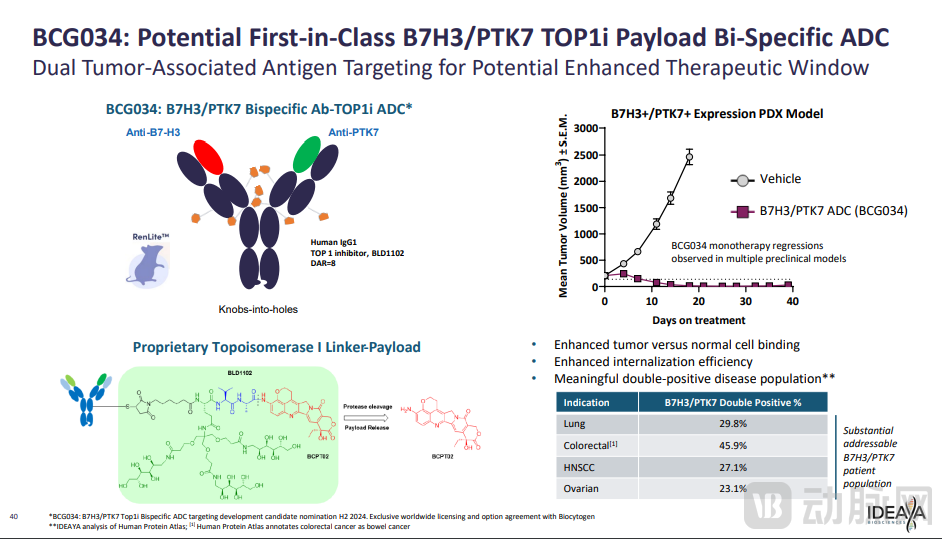 Image source: IDEAYA official website
The press release pointed out that,Based on preclinical data, the potential “first-in-class” B7H3/PTK7 topoisomerase inhibitor payload BsADC program has the potential to be developed as a monotherapy and may be used in combination with IDEAYA’s multiple DNA damage repair (DDR) therapies, including the PARG inhibitor IDE161.Among them, IDEAYA Biosciences is expected to complete the nomination plan for candidate drugs in its B7H3/PTK7-targeted BsADC development project in the second half of 2024.
IDEAYA Biosciences is an oncology precision medicine company dedicated to discovering and developing targeted therapies for patient populations identified through molecular diagnostics. Since its establishment in 2015, IDEAYA has attracted investment from prominent firms such as 5AM Ventures, Roche Venture Fund, Google Ventures (GV), and WuXi AppTec. The company successfully completed its initial public offering (IPO) in 2021, raising over $300 million.
IDEAYA’s approach integrates the discovery and validation of translational biomarkers with drug development to identify patient populations most likely to benefit from its targeted therapies. IDEAYA is applying its research and drug discovery capabilities to emerging precision medicine targets such as synthetic lethality (SL).
Leveraging the principles of synthetic lethality (SL) and tumor DNA damage, IDEAYA has established a fully integrated SL platform that enables a comprehensive suite of research operations, including the discovery of synthetic lethal targets and biomarkers, drug discovery, functional genomics and pharmacological validation, translational research, and opportunity expansion. With this platform, IDEAYA has currently developed multiple pipelines in development.
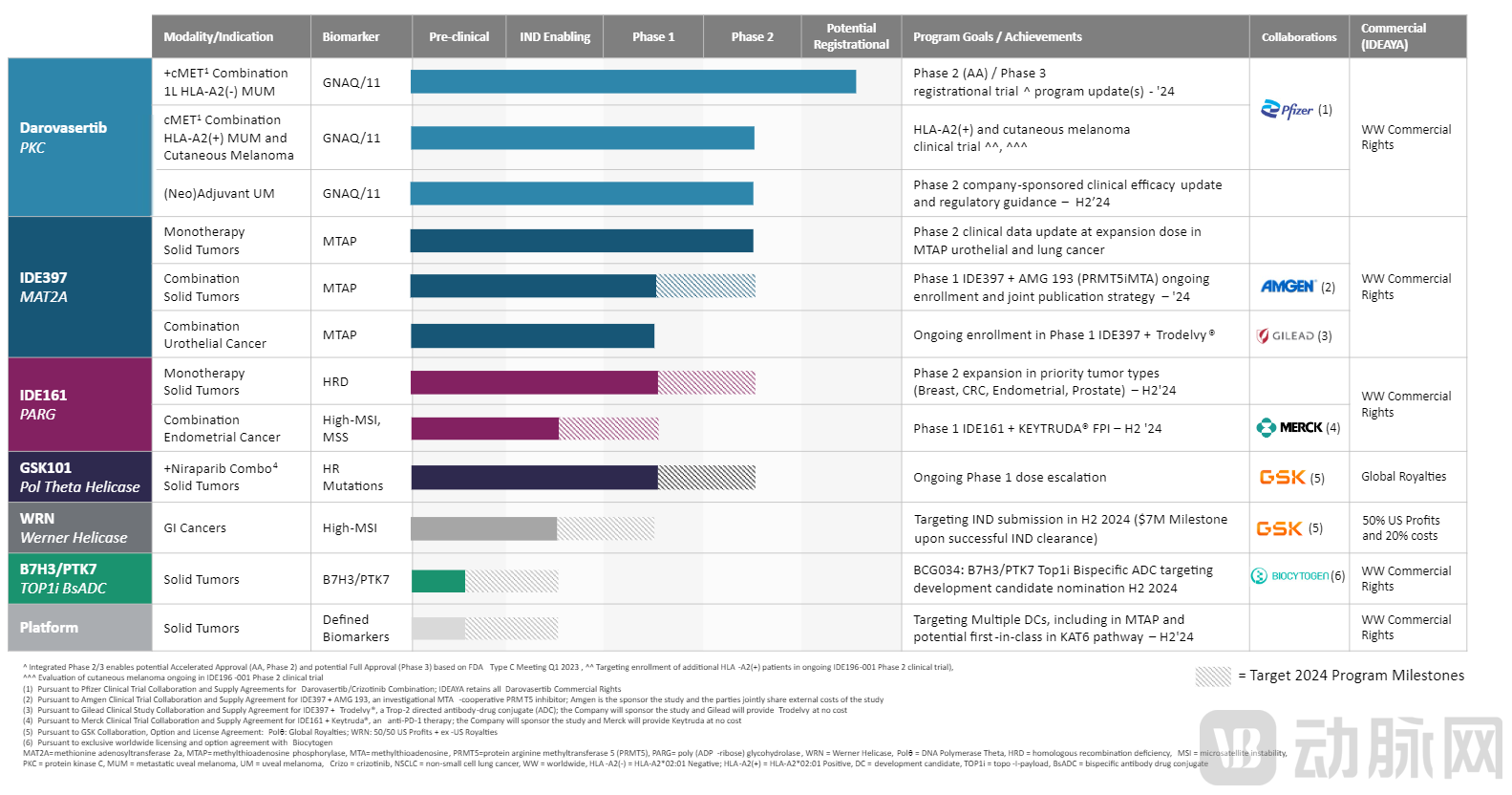 Image source: IDEAYA official website
Among them,IDE161 is a selective PARG inhibitor for the treatment of adult patients with advanced or metastatic hormone receptor-positive (HR+) cancer. Its preclinical studies demonstrated that monotherapy with IDE161 induced tumor regression in PARP inhibitor-refractory HRD models. Owing to its favorable efficacy, IDEAYA Biosciences was granted Fast Track designation by the FDA. The FDA has also designated IDEAYA for the treatment of patients with breast and ovarian cancers harboring BRCA1/2 mutations.
IDEAYA Biosciences specifically pointed out,IDE161 is a candidate drug that can synergize well with ADCs.IDEAYA Biosciences Chairman and CEO Yujiro S. Hata stated at a Goldman Sachs event in June, “While IDE161 has demonstrated promising efficacy as a monotherapy in diseases such as endometrial cancer and colorectal cancer, combination therapies will unlock additional indications.”
To this end,IDEAYA has been seeking molecules to pair with IDE161, and antibody-drug conjugates (ADCs) bearing a topoisomerase I inhibitor payload will be its top choice.. Previously released data from IDEAYA showed that in preclinical lung cancer models, the combination of a topoisomerase I inhibitor payload and IDE161 elicited a stronger response than either molecule used alone.
In the press release, Yujiro S. Hata stated, “The promising first-in-class B7H3/PTK7-topoisomerase inhibitor payload bispecific antibody-drug conjugate (BsADC) program has the potential to be developed as a monotherapy for multiple types of solid tumors and to advance IDEAYA’s broader corporate strategy of enabling autonomous, rational combinations of first-in-class agents at the intersection of ADCs and small-molecule DNA damage response (DDR) therapies, thereby delivering greater benefits to patients.”
Since 2024, the market for domestically produced ADC drugs has continued the strong momentum seen in 2023. Chinese pharmaceutical companies have frequently licensed out their next-generation ADC drugs or entered into collaborations with overseas pharmaceutical firms, reflecting sustained enthusiasm for global expansion as an increasing number of ADC products enter the global market.According to incomplete statistics, as of press time, there have been a cumulative total of 12 BD transactions involving domestically produced ADCs since 2024, with the total transaction amount reaching nearly $7.6 billion (approximately RMB 54.96 billion).。
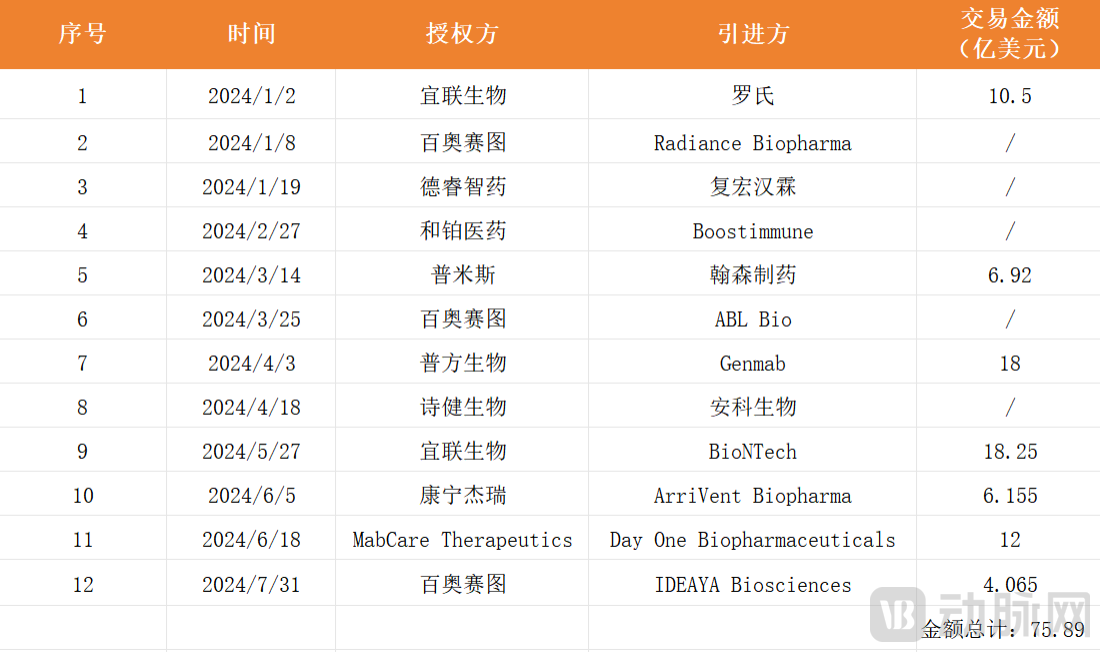 Source: Compiled from public data; graphic by VCBeat New Medicine
As a novel therapeutic modality, antibody-drug conjugates (ADCs) offer significant advantages over monoclonal antibodies, bispecific antibodies, and chemotherapy, further expanding and deepening the scope of targeted therapy applications. Particularly in the field of oncology, ADC development continues to grow steadily, ushering in a new era of targeted treatment.
Amid the global surge in antibody-drug conjugate (ADC) development, Chinese innovative pharmaceutical companies have delivered standout performances. According to the PatSnap New Drug Intelligence Database, more than 1,000 ADC clinical trials are being conducted in China, involving over 100 pharmaceutical companies, establishing China as a leading hub for ADC innovation. Leveraging robust platform technologies and a rich pipeline of candidate drugs, domestically produced ADCs have garnered strong interest from overseas pharmaceutical companies, which have been actively acquiring these assets.
Furthermore,Among Chinese-made ADCs that have successfully expanded overseas, bispecific antibody-drug conjugates (BsADCs), as an emerging technological direction, are particularly gaining traction.. The transaction between Biocytogen and IDEAYA also focuses on bispecific antibody-drug conjugates (ADCs). This is because bispecific ADCs offer several advantages over monoclonal ADCs; with two antigen-binding sites, they can enhance tumor cell killing by binding to both tumor cells and immune cells. Furthermore, by targeting two different cellular epitope antigens, they can reduce off-target side effects, while the dual targets can block two distinct signaling pathways, thereby enhancing cytotoxicity and overcoming drug resistance.
In the field of bispecific antibody-drug conjugates (ADCs), Baili Tianheng has also achieved a record-breaking major business development (BD) deal. On December 11, 2023, Baili Tianheng entered into an $8.4 billion collaboration with Bristol Myers Squibb (BMS) for its HER3/EGFR bispecific ADC product, BL-B01D1. This transaction set a new record for the highest upfront payment in the overseas licensing of innovative Chinese drugs.
From the global distribution of bispecific antibody-drug conjugate (BsADC) pipelines under development, BsADCs represent a key therapeutic area where Chinese pharmaceutical companies may hold an advantage over their overseas counterparts. Data from the Insight database shows that as of May 2024, only 16 BsADCs had entered clinical stages globally, with the majority being developed by Chinese pharmaceutical companies, including Baili Tianheng, Alphamab Oncology, Chia Tai Tianqing, and Innovent Biologics.
Among them, Baili Tianheng’s BL-B01D1 is leading in development progress, with six Phase III clinical trials and nearly ten Phase II trials currently registered and initiated, targeting multiple cancer types including nasopharyngeal carcinoma, breast cancer, esophageal squamous cell carcinoma, and non-small cell lung cancer. Bristol Myers Squibb (BMS) estimates that BL-B01D1 may be launched in the United States in 2028, potentially becoming the first approved bispecific antibody-drug conjugate (ADC) worldwide. Additionally, in May 2024, Alphamab Oncology initiated a Phase III clinical trial of JSKN003 for HER2-low breast cancer. Previously, Alphamab Oncology reported positive clinical results, demonstrating a superior safety profile and comparable efficacy to trastuzumab deruxtecan (DS-8201a).
Currently, multinational corporation (MNC) giants are facing numerous challenges, including the expiration of patents on core products, intensifying competition from generic drugs, and bottlenecks in pipeline growth. There is an urgent need to expand their product pipelines to sustain performance growth, accumulate R&D technological advantages through acquisitions or collaborations, enhance R&D capabilities, and identify promising drug candidates, thereby reserving resources for future development. MNCs are also increasingly signaling their willingness to collaborate. Recently, Reuters reported that employees of Sanofi and Bristol Myers Squibb (BMS) revealed that both companies are actively seeking merger and acquisition opportunities in China.
As one of the hottest tracks in innovative drug development, antibody-drug conjugates (ADCs) have attracted numerous Chinese pharmaceutical companies, ushering in a period of robust growth. With an increasing number of transactions being finalized, the global community is once again recognizing the potential and market value of ADC drugs from Chinese pharma. It is believed that more differentiated ADC products will enter the global market in the future.