

Digital Therapeutics Set for Breakthrough in 2024: 26 Funding Rounds and Domestic Leaders Preparing IPOs

BrainAurora
Cognitive Rehabilitation Cloud Platform Provider

Sword Health
Digital Remote Physical Therapy Service Provider
Digital Therapeutics Sector Sees a Wave of Good News.
This July, BrainAurora’s overseas listing filing was registered with the China Securities Regulatory Commission (CSRC), marking another step toward becoming “China’s first digital therapeutics stock.” Earlier, in early June this year, Sword Health, a digital therapeutics company specializing in musculoskeletal rehabilitation, announced the completion of approximately $130 million in financing. This brings Sword Health’s total fundraising to $340 million, with a company valuation reaching $3 billion, firmly establishing it as a new unicorn in the digital therapeutics sector.
From an industry-wide perspective, although the downward trend in global healthcare investment and financing continued in the first half of 2024 (H1), the "Analysis Report on Global Healthcare Investment and Financing in H1 2024" pointed out that a total of 1,197 primary market investment deals were completed globally in the healthcare sector during the first half of 2024, with cumulative financing reaching $30.7 billion. Compared to the same period in 2023, despite a decline in the number of transactions, the average financing amount saw a significant counter-trend increase of 29.97%.
Globally, the digital health sector saw 317 financing rounds, totaling $4.6 billion, marking a year-on-year recovery in data. Even within China, digital health remains the sector attracting the most capital investment. In the first half of 2024, there were 272 financing deals in China’s digital health sector, with seed and angel rounds leading all sub-segments at 61 transactions. A significant number of innovative digital health enterprises continue to emerge and capture investor attention.
Focusing on the digital therapeutics sector, a total of 26 financing rounds were completed globally in 2024. These included previously mentioned companies such as Sword Health. In China, enterprises engaged in the research and development of digital therapeutics for autism, including Shanghai Qianqiu Intelligent Technology Co., Ltd., have also successively secured funding.
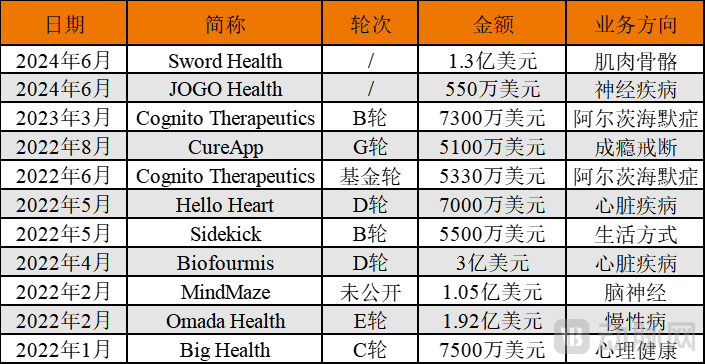
Investment and Financing Activities of Selected Overseas Companies in the Digital Therapeutics Sector (Incomplete Statistics)
The digital therapeutics sector is showing strong growth momentum. VCBeat has also observed that,The digital therapeutics sector is advancing beyond clinical value creation toward commercial viability—increasingly diverse stakeholders are entering the field and refining their strategic positioning, implementation scenarios are emerging one by one, numerous digital therapeutics companies are experiencing new growth, and the payer reimbursement loop is further taking shape.
To better explore the future development direction of digital therapeutics and even digital health,The 2024 Digital Therapeutics Conference, the first global conference in China centered on the full-chain ecosystem of digital therapeutics and digital health, will be held from August 30 to August 31 in Hainan Province, the “Global Digital Therapeutics Innovation Island.”The conference will focus on international frontier trends in digital health, clinical department scenario case studies, and the integration and synergy of the industrial chain ecosystem. By leveraging diverse formats—including selections for innovative international products and technologies, collection of clinical scenario needs, matchmaking for ecosystem collaboration demands, summits on cutting-edge themes, and roadshows for early-stage projects—it aims to build a comprehensive communication and matchmaking platform for the entire digital health industry chain.
Registration for the conference is now open. We cordially invite you to join us in exploring the future of digital health.
Scan the QR Code to Register for the 2024 Digital Therapeutics Conference
Change is happening.
Traditionally, conventional disease interventions have encompassed pharmaceuticals, medical devices, services, and other modalities. Among these, clinical services are delivered by physicians based on their professional knowledge and experience, yet they face challenges such as variability in quality, lack of replicability, and limited per-capita efficiency. Digital therapeutics (DTx) have digitized these clinical services. With the emergence of DTx, its scope has expanded across prevention, treatment, and rehabilitation, giving rise to concepts such as digital vaccines, digital drugs, and digital medical orders.
An increasing number of industry practitioners have undoubtedly recognized the value of digital therapeutics (DTx). The roles involved are becoming increasingly diverse, gradually covering every segment of the healthcare sector. As participants proactively engage in building the DTx ecosystem, they have further accelerated its rapid development—
From the perspective of pharmaceutical and medical device companies, integration with digital therapeutics undoubtedly helps enhance patient adherence. Timely data feedback can further provide real-world data to support drug R&D and evaluation, as well as enable precision marketing.
Taking pharmaceutical companies as an example, multinational giants such as AstraZeneca, Bristol-Myers Squibb, and Novartis have all launched explorations into digital therapeutics in the field of oncology. Recently, Sanofi has partnered with DarioHealth on digital therapeutics to complement its drug offerings, thereby collecting data to provide higher-quality services to patients. In the medical device sector, one standout product is continuous glucose monitoring (CGM). Some CGM manufacturers are also collaborating with the Diabefly-Pro digital therapeutic platform to provide lifestyle, nutritional, and behavioral guidance for patients with type 2 diabetes, facilitating better blood glucose control.
From the perspective of pharmaceutical service providers and healthcare delivery organizations, the integration of digital therapeutics not only enhances patient adherence but also serves as an effective channel for patient engagement.
For instance, CVS Health, a leading U.S. pharmacy chain, has partnered with Big Health, which offers two digital therapeutics products—Sleepio for insomnia and Daylight for anxiety. Healthcare providers are also accelerating the integration of digital therapeutics, particularly private hospitals, aiming to further break down the physical barriers of hospital care through such integration. For example, numerous hospitals are currently collaborating with Weimai. By linking electronic medical records from public hospitals with real-world post-discharge data from its “Weimai Comprehensive Management” service system, Weimai leverages integrated in-hospital and out-of-hospital data to provide patients with digital therapeutics that cover full-cycle disease management.
Large health platforms with a substantial user base leverage digital therapeutics to integrate and connect their ecosystems, thereby further unlocking platform value.
Jin Enlin of JD Health has pointed out, “JD Health does not view digital therapeutics merely as a standalone product or tool; instead, it connects software with hardware and physical products with services to form a complete AIoT ecosystem. Leveraging its end-to-end pharmaceutical supply chain capabilities and an integrated online-offline medical service model, JD Health connects various stakeholders within the ecosystem to jointly serve users’ health needs.”
Beyond the vertical health sector, consumer electronics manufacturers are also joining the ecosystem, leveraging health features and even professional digital therapeutics to attract their user base.
For instance, a large number of hardware manufacturers, such as those producing smart bands and watches, as well as home mattress manufacturers, are increasingly aligning with digital therapeutics. By integrating health-related features and even rapidly expanding into medical monitoring, these manufacturers collaborate with digital therapeutics to provide professional medical services, thereby further enhancing product recognition. For example, the OPPO Watch ECG incorporates routine health monitoring functions such as heart rate monitoring, sleep tracking, menstrual cycle management, sedentary reminders, and breathing exercises for stress relief. Meanwhile, the Huawei Band 8 supports professional services provided by Huawei’s ecosystem partners for users with chronic insomnia, such as Cognitive Behavioral Therapy for Insomnia (CBT-I) digital therapeutics.
The increasing diversification of participants in the digital therapeutics (DTx) sector is becoming a major trend. How can these diverse stakeholders further refine their positioning to integrate with digital therapeutics? At the 2024 Digital Therapeutics Conference, we cordially invite you to join us in exploring innovation and integration in digital therapeutics.
Regulatory authorities are gradually increasing their acceptance of digital therapeutics.
Data shows that as of October 2023, a total of 85 “digital therapeutics” products had obtained medical device registration certificates in China. These products primarily cover areas such as neurology/psychiatry, vision, rehabilitation, respiratory care, and endocrinology. Internationally, according to incomplete statistics, the U.S. FDA approved 49 software-based medical devices meeting the definition of “digital therapeutics” between 2017 and 2023. In Germany, as of August 2, 2023, a total of 181 applications had been submitted through the fast-track approval process, with 48 apps approved for inclusion in the directory. The relevant products are predominantly focused on mental health disorders.
As can be seen, if the early development challenges in the digital therapeutics field stemmed from a lack of standardization and insufficient recognition by clinical experts, then with the successive approvals of digital therapeutics products, the issue facing digital therapeutics companies has become: how to achieve commercial implementation.
Currently, a large number of enterprises are implementing practical applications across various disease areas, with several highly representative case studies already emerging:
For example, Xinjing Technology provides digital therapeutics products to C-end patients with sleep disorders in medical institutions and charges fees; Shixin provides visual function correction systems to H-end medical institutions; Peking University Medical Brain Health provides rehabilitation digital therapeutics to B-end children's rehabilitation institutions; Saiwengsi provides digital therapeutics for addiction treatment to G-end drug rehabilitation centers, with its business covering more than 70 drug rehabilitation centers in 18 provinces across China; Shukang has signed a cooperation agreement with BlueCross, one of the largest health insurance companies in the United States, successfully entering the insurance payment list for patient treatment and implementing it.
In Hainan, a frontier for digital therapeutics, the implementation of these therapies is even more pronounced.
As a key initiative of Hainan Province’s health commission, the province is implementing the “2+3” Health Service Package across its jurisdiction, targeting five diseases that severely impact the health of Hainan residents: hypertension, diabetes, tuberculosis, severe mental disorders, and hepatitis. Digital therapeutics offered by Shanghai Zhizhong Medical Technology Co., Ltd., Suzhou Yiduoyun Information Technology Co., Ltd., Tianjin Weiyi Digital Hospital Co., Ltd., and Yidu Cloud (Hainan) Technology Co., Ltd. were all selected for the diabetes component of Hainan Province’s 2023 “2+3” Health Service Package. Driven by digital therapeutics, this initiative addresses prominent challenges such as the limited clinical capacity of primary care physicians and poor patient adherence.
The corresponding results are also significant. For instance, in Baoting Li and Miao Autonomous County, as of July 26 this year, there were 4,909 diabetes patients under management. The target attainment rates were 29.1% for glycated hemoglobin (HbA1c), 40.5% for fasting blood glucose, 40.2% for random blood glucose, and 37.9% for blood pressure among diabetic patients. The rate of simultaneous attainment of both blood glucose and blood pressure targets was 19.3%. Through digital diabetes management, comprehensive coverage of standardized patient care has been achieved.
Digital therapeutics have undoubtedly significantly enhanced the efficiency of chronic disease management, including for conditions such as diabetes, and improved patient health indicators. Meanwhile, they have transformed the traditional landscape where doctor-patient interactions were confined to offline settings, thereby further improving the accessibility of patient services.
What further explorations can be made in the practical implementation of disease-specific scenarios? What breakthroughs and innovations can be achieved in both in-hospital and out-of-hospital settings? You are cordially invited to attend the 2024 Digital Therapeutics Conference to jointly discuss innovative application scenarios for digital therapeutics.
In the digital therapeutics ecosystem, payers play a particularly important role.
From the U.S. perspective, the scope of payment coverage is continuing to expand.In April 2020, the U.S. Food and Drug Administration (FDA) issued emergency authorization guidelines for digital therapeutics used to treat mental health conditions, accelerating the approval and market launch of digital therapeutic products. Subsequently, reimbursement policies were further aligned. By the end of 2021, the Centers for Medicare & Medicaid Services (CMS) added a new Level II Healthcare Common Procedure Coding System (HCPCS) code for “FDA-authorized prescription digital therapeutics,” enabling payers to more easily cover these digital therapeutic products.
And inOn July 10 of this year, the Centers for Medicare & Medicaid Services (CMS) proposed Current Procedural Terminology (CPT) payment codes for certain digital therapeutics products (specifically those for treating specific mental health conditions) for the first time in its latest proposed 2025 Physician Fee Schedule (PFS).Historically, HCPCS codes applied to Medicare and Medicaid, whereas current CPT codes apply to all payers, thereby further facilitating the expansion of reimbursement coverage for digital therapeutics.
From the perspective of China, as the country’s healthcare system is currently dominated by public medical insurance, commercial health insurance, which is still in its early stages, continues to rely primarily on the National Reimbursement Drug List as its main reference.Digital therapeutics are currently not reimbursable through insurance claims; instead, they exist as ancillary value-added services. Furthermore, commercial insurers tend to prioritize conditions such as cancer, with few insurers focusing on age-related cognitive disorders—a domain where digital therapeutics excel and which affects a large population.
However, we also see that Hainan is leading the development and transformation in the field of digital therapeutics.On October 11, 2022, Hainan Province issued the “Several Measures for Accelerating the Development of the Digital Therapeutics Industry in Hainan Province” (also known as the “Hainan 21 Articles” due to its 21 specific measures). This policy outlines detailed provisions for developing the digital therapeutics industry in Hainan, with a plan to transform the province into a global innovation hub, a cluster for innovative resources, and an industrial highland for digital therapeutics within two to three years. It further proposes establishing digital therapeutics as a “new engine” for the high-quality development of Hainan’s health industry. Among these measures is the encouragement of exploring diverse payment models.
Hainan’s 21 Measures point out that product innovation in “digital therapeutics + commercial insurance” will be explored, including pilot initiatives in the Boao Lecheng International Medical Tourism Pilot Zone to incorporate digital therapeutics as health management services for special drug insurance, and developing an upgraded version of Hainan’s Huimin Bao (inclusive supplementary medical insurance). Furthermore, it encourages the inclusion of digital therapeutics in the technical specifications and fee schedules for medical services, while exploring price formation mechanisms and medical insurance payment models for digital therapeutics. In addition, Hainan plans to further explore the application of digital therapeutics in medical cost control and health management, and to identify effective models for integrating digital therapeutics with diagnosis-related group (DRG) payment systems.
Clearly, Hainan is increasingly becoming a hub for innovative practices in digital therapeutics in China. As Hainan further promotes the development of the digital therapeutics industry and the broader digital health sector, it is poised to share more successful practical experiences and emerge as a central node for the release of digital health policies, the establishment of consensus, the leadership in public awareness, and the aggregation of resources.
In Hainan, we witness the future unfolding together. Registration for the 2024 Digital Therapeutics Conference is now open—we cordially invite you to join us in shaping the future of digital health.
Scan the QR Code to Register for the 2024 Digital Therapeutics Conference