

Tempo Therapeutics Files for IPO to Advance Its Proprietary MAP Scaffold Platform in Regenerative Medicine

Tempo Therapeutics
Developer of Synthetic Biomaterials
March 19, 2024,Tempo Therapeutics Successfully Secures $12 Million in Series A Financing. The round was co-led by renowned investment firm Galaxy-Sirius Partners and healthcare giant Johnson & Johnson Innovation (JJI).。
Tempo Therapeutics is an innovative biomaterials company focused on leveraging its cutting-edge Microporous Annealed Particle (MAP) technology platform to develop a series of novel synthetic biomaterials. These materials demonstrate significant potential in surgical reconstruction and regenerative medicine, progressively transforming the landscape of medical technology.
As a revolutionary injectable porous material, the MAP scaffold is composed of precisely engineered microgel units that form a structurally stable network via an in vivo annealing process. Its cell-scale microporous architecture provides an ideal environment for cell migration and integration with host tissue, thereby effectively enhancing biocompatibility and facilitating tissue repair.
UC Professor’s Startup Achieves Microporosity and Injectability of MAP Materials
In 2014, Donald Griffin, a professor in the Department of Chemical and Biomolecular Engineering at the University of California, Los Angeles (UCLA), joined forces with Dr. Westbrook Weaver, who brings extensive experience in executive management and life sciences R&D, to co-found Tempo Therapeutics.
 Executive Team, from the company's official website
Among them, Donald Griffin brings over 14 years of extensive research background and teaching experience, focusing on advancing the clinical application of cell-free and cell-based therapies by optimizing hydrogel-tissue integration. He ingeniously combines microscale geometric control with modern chemical techniques to design innovative biomaterials.
Dr. Westbrook Weaver brings over seven years of executive management experience and 15 years of research and development experience in the life sciences. According to Westbrook, he first met Donald on the biomedical engineering soccer team at the University of California, Los Angeles (UCLA). At that time, Donald Griffin was focused on tissue engineering, while Westbrook was dedicated to microfluidics. Although these two fields are typically distinct within biomedical engineering, their convergence gave rise to an innovative technology—the Microporous Annealed Particle (MAP) core technology—which laid the foundation for the establishment of Tempo Therapeutics.
In 2015, the two researchers published a paper titled “Accelerated wound healing by injectable microporous gel scaffolds assembled from annealed building blocks” in Nature Materials.An injectable, interconnected microporous gel scaffold assembled from annealed microgel building blocks, whose chemical and physical properties can be tailored via microfluidic fabrication。
Research data indicate that, in vitro, cells incorporated during scaffold formation proliferate within 48 hours and establish an extensive three-dimensional network. In vivo, the scaffolds promote cell migration, enabling rapid skin tissue regeneration and structural organization within five days. The combination of microporosity and injectability of these annealed hydrogel scaffolds offers a novel approach for in vivo tissue regeneration and formation.
It is reported that Tempo Therapeutics is leveraging MAP technology to reconfigure traditional hydrogel polymers into highly porous, flowable scaffolds, enabling immediate tissue ingrowth and integration, effectively preventing foreign body reactions, and promoting regenerative immune responses along with the rapid formation of vascularized tissue volume.
Establishing Five Product Pipelines with a Special Focus on the Regenerative Market
The MAP scaffold platform, leveraging its capacity for rapid integration with host tissue and low immunogenicity, has been demonstrated to deliver superior outcomes across multiple regenerative medicine applications, including accelerated dermal wound healing, treatment of stroke cavities, revascularization, mesenchymal stem cell delivery, tissue expansion therapy, and repair of glottic insufficiency.
Tempo Therapeutics is also actively leveraging its proprietary novel MAP technology to develop a series of cutting-edge products in tissue engineering and regenerative medicine.To date, the company has established five product pipelines, covering 11 application scenarios ranging from complex surgical wound repair to medical aesthetics, cartilage regeneration, and vaccine development.
Among them, Tempo Therapeutics focuses particularly on the regenerative market. According to data from Precedence Research, the global regenerative medicine market was valued at $20.04 billion in 2021 and is projected to reach approximately $125.54 billion by 2030, with a compound annual growth rate (CAGR) of 16.2% from 2022 to 2030. TT101-Biosurgery, the fastest-growing product pipeline under Tempo Therapeutics, has entered the clinical trial phase.
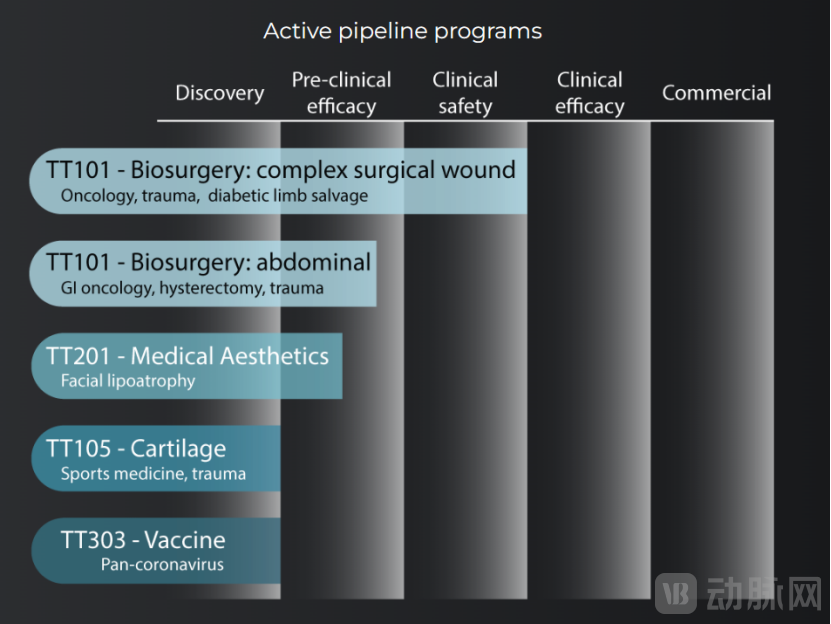
Company Product Pipeline, sourced from the company's official website
TT101-Biosurgery is specifically designed to address the challenges of tissue healing associated with complex surgical wounds and post-implantation of medical devices. Cell migration is a critical step in wound healing and tissue regeneration; however, traditional hemostatic agents often exhibit limited efficacy due to their tendency to impede cell migration. By leveraging an innovative microporous gel system, TT101-Biosurgery optimizes the tissue-device interface, thereby creating an ideal environment for cell migration and tissue regeneration.。
According to disclosures by Tempo Therapeutics, after the porcine wound bed was completely filled with a meticulously designed microporous gel, histological cross-sectional examination revealed that the microporous gel fully occupied the wound bed and underwent nearly complete degradation within five days post-treatment. In pathological scoring of tissue fibrosis, wounds treated with the microporous scaffold exhibited reduced alignment and density of collagen fiber bundles, indicating that the tissue architecture more closely resembled non-fibrotic scar tissue.
Notably, a 38-day comparative study demonstrated that, compared with non-porous flowable hydrogels (which share the same chemical composition as the Oasis® SIS matrix but lack a microporous structure), microporous gel injections achieved nearly complete tissue integration at the injection site, with no detectable inflammation or presence of multinucleated giant cells (MNGCs), indicating their superior biocompatibility and tissue integration capabilities. Furthermore, non-fibrous tissue featuring large vascular walls and reticular dermal structures formed at the injection site, further underscoring the advantages of microporous gels in promoting intradermal tissue regeneration.
Donald R. Griffin publicly stated, “Slowing the degradation rate of MAP scaffolds can prevent pore closure and provide additional support during tissue growth, thereby improving tissue quality.” Technologically modified hydrogels can be used to promote faster and more natural wound healing, and may even aid in vaccine development. Currently, Tempo Therapeutics is also developing combination drug delivery, allogeneic cell implantation, and next-generation vaccine technologies.
Raised $12 million to advance pipeline into clinical trials
With the Series A funding, Tempo Therapeutics will enter clinical trials for MAP technology-based surgical scaffolds for the first time. As the sole developer of MAP technology-based tissue scaffolds, Tempo Therapeutics is poised to achieve key development milestones by establishing the safety and efficacy of its two flagship products:TT101-Biosurgery: Complex surgical wounds for the exposure of bone, tendon, or fascia; TT101-Biosurgery: Abdominal for reinforcement of fascial incision sites.
“Tempo Therapeutics is at the forefront of transforming medical outcomes through genuine breakthroughs in regenerative medicine technology. We immediately recognized a revolutionary, disruptive technology combined with significant market opportunities,” said Marty Sands of Galaxy-Sirius Partners, which led this financing round. “Tempo Therapeutics possesses a proprietary platform technology that can significantly improve medical outcomes for a wide range of surgical procedures.”
In recent years, hydrogels, as a unique class of smart materials, have demonstrated broad application prospects in agriculture, medicine, industry, and other fields, owing to their distinctive structural properties and responsiveness to environmental stimuli. Driven by technological advancements and innovation, novel hydrogels with new structures and properties continue to emerge, providing robust technical support for the transformation and upgrading of various industries.
Currently,Although no innovative cases of hydrogel materials based on MAP technology have been disclosed in China, the development of the hydrogel industry in the Chinese market has also been quite remarkable.According to data from Gongyan Wang, the market size of hydrogels in China experienced significant growth over the ten-year period from 2012 to 2022, rising from RMB 2.28 billion to RMB 6.28 billion, with a compound annual growth rate (CAGR) of 10.66%.
Major domestic players in China’s hydrogel market include Changchun Jiyuan Biotechnology, Zhuhai Guojia New Materials, and Huizhou Huayang Medical Devices. Notably, Huanuo Biotechnology has emerged as a dark horse by leveraging its proprietary technology for the design and preparation of supramolecular non-covalent cross-linked colloidal network hydrogels to develop self-healing hydrogel materials. These materials offer advantages such as safe and non-toxic raw materials, high mechanical strength, ease of fabrication, injectability, printability, moldability, and biodegradability/absorbability.