

Pow.Bio Unveils AI-Driven Continuous Fermentation Platform, Cutting Production Costs by 40–70% and Boosting Efficiency 5–10x

Pow.Bio
Intelligent Fermentation Service Provider
Biological fermentation has long been a crucial means by which humans harness microorganisms to convert raw materials into valuable substances. From ancient winemaking to modern antibiotic production, fermentation technology plays a pivotal role in numerous sectors, including pharmaceuticals, food, and chemicals. However, with the rapid advancement of synthetic biology, traditional fermentation techniques are facing challenges such as low efficiency and high costs. Many companies both in China and abroad are leveraging biological fermentation technology as an entry point, aiming to address the challenges currently confronting traditional fermentation methods.
Against this backdrop, Pow.Bio, a U.S.-based biological fermentation services company, has emerged as a beacon of hope for the biomanufacturing sector with its revolutionary intelligent continuous fermentation technology. Co-founded in 2019 by Dr. Ouwei Wang and Shannon Hall, and headquartered in Berkeley, California, Pow.Bio is a startup dedicated to achieving sustainable biomanufacturing through biological fermentation technologies.
As global demand for sustainable and eco-friendly products continues to grow, Pow.Bio’s technological solutions have become increasingly vital. The company has successfully raised $9.5 million in its Series A financing round, led by Re:Food and Thia Ventures. This funding will be used to expand operations at its demonstration plant in Alameda, California, further advancing the commercial application of its intelligent continuous fermentation platform.
Continuous Fermentation Technology: Efficient, Stable, and Cost-Effective, Addressing the Pain Points of Traditional Fermentation Technology
Pow.Bio is dedicated to empowering biomanufacturing with continuous fermentation technology, aiming to address the many pain points associated with traditional fermentation techniques.
Traditional batch fermentation, as a mature production method, once held a prominent position in industrial manufacturing. However, with technological advancements and rising market demands, this process now faces a series of challenges.
First, the production efficiency of batch fermentation is relatively low, as each production cycle requires interruption for equipment cleaning and re-inoculation, which limits the continuous operational capacity of the equipment. Furthermore, frequent manual intervention and cleaning processes increase production costs and also elevate the risk of microbial contamination.
Secondly, batch fermentation poses challenges in product consistency, as minor variations in fermentation conditions between batches can lead to fluctuations in the quality and performance of the final product. Such inconsistency may undermine the product’s competitiveness in the market. Meanwhile, batch fermentation is difficult to scale up for large-scale production; its cyclical nature limits the ability to respond rapidly to market changes, particularly during periods of high demand.
Furthermore, batch fermentation processes exhibit high energy consumption, as equipment requires heating and cooling before and after each production run; these temperature fluctuations lead to energy waste. Moreover, controlling substrate and product concentrations is challenging, which may adversely affect microbial metabolic activity and production efficiency.
In terms of technological upgrades, the relatively low levels of automation and intelligence in batch fermentation limit its application potential in modern industrial production. Limitations in data acquisition and analysis also constrain a deeper understanding and optimization of the fermentation process. Regarding strain performance validation, batch fermentation is inefficient and fails to meet the demand for rapid performance verification in the era of synthetic biology.
Batch fermentation also poses environmental concerns. Frequent cleaning and sterilization processes generate chemical waste, placing stress on the environment.
To address these challenges, industrial production is gradually transitioning to continuous or semi-continuous fermentation technologies to achieve more efficient and cost-effective production processes while reducing environmental impact.
High-Efficiency Continuous Fermentation Technology Enables Continuous Microbial Growth and Metabolite Production Through Automated Control. This technology offers multiple advantages, including improved production efficiency and stability, reduced production costs, enhanced product purity and equipment utilization, as well as lower energy consumption and environmental impact.It also helps address issues related to substrate and product concentration control, optimize the study of microbial physiological and biochemical characteristics, and cope with challenges posed by market volatility and significant variations in product properties.
More notably,Continuous fermentation technology enables flexible adjustment of production processes, rapid response to market changes and variations in product demand, while simultaneously driving the digitalization and intelligent automation of fermentation processes.This provides solutions for high-throughput screening and strain construction in the era of synthetic biology, meeting the needs for performance validation and process development of high-performance strains.
Pow.BioInnovative Continuous Fermentation Platform Reduces Production Costs40%# Improved Production Efficiency5to10Times
Continuous fermentation technology holds immense potential, but it also faces challenges such as complex equipment and control systems, difficult operational control, and stringent requirements for aseptic operations. With technological advancements, these challenges are gradually being overcome. Many companies are dedicated to improving modern fermentation techniques and process control, effectively reducing the risks of strain variation and contamination, thereby fully realizing the potential of continuous fermentation technology in industrial applications.
Pow.Bio is one such company. Dr. Shannon Hall, the company’s CEO, pioneered a fermentation technology that addresses capacity constraints in biomanufacturing. Its core competitive advantage lies in its ability to sustain high-performance continuous fermentation processes for hundreds of hours.Addressing challenges in fermentation technology and scaled-up production, Pow.Bio holds a distinct perspective: they believe that larger-capacity bioreactors do not drive progress in the field of biomanufacturing; rather, intelligent, modern, and efficient bioreactors are the key to enhancing production efficiency and unlocking economic viability.
“The lack of available capacity for commercial-scale precision fermentation is a critical issue that the biomanufacturing sector must address today,” said Dr. Ouwei Wang, CTO of Pow.Bio. “It is an undeniable fact that synthetic biology companies have not yet been able to produce biomaterials at competitive prices capable of replacing traditional petrochemical- or animal-derived products. Until we can manufacture biomaterials at costs comparable to or lower than those of these conventional alternatives, only high-cost biologics will be able to secure a foothold in the commercial market. What we should truly pursue is economic viability, and achieving this goal requires advancements in biomanufacturing technology.”
Pow.Bio’s mission is to change this status quo by enabling precision fermentation companies to deploy continuous rather than batch production processes. This approach, combined with AI-controlled software, accelerates process optimization and drives autonomous operations.
Pow.Bio’s technological core lies in the integration of its AI-controlled automated fermentation software, SOFe, with innovative hardware systems.This technology not only enhances production efficiency but also significantly reduces production costs, enabling efficient and continuous fermentation processes. This allows biomanufactured products to compete with traditional ones in terms of cost, paving the way for the commercialization of synthetic biology products.
By simulating the continuity of industrial production lines, Pow.Bio’s intelligent continuous fermentation technology addresses the efficiency and cost challenges inherent in traditional batch fermentation processes. The application of this technology is poised to play a significant role in multiple fields, including alternative protein production and synthetic biology product development, thereby driving the growth of the bioeconomy.
According to reports, Pow.Bio’s innovative technology combines continuous fermentation with advanced AI control methods to achieve the long-term maintenance of ultra-high microbial productivity. This breakthrough significantly reduces costs while enhancing biomanufacturing capacity by several orders of magnitude.Compared with traditional batch fermentation, Pow.Bio can increase the productivity of the same raw materials by 5 to 10 times, significantly improving the efficiency of system operation, reducing the need for facilities and storage tanks, thereby lowering capital and operating costs.
Shannon Hall emphasized that Pow.Bio can provide customers with techno-economic models for fine chemicals and food proteins, clearly demonstrating the capital requirements and unit costs of continuous production methods. For instance, for fine chemicals with an annual demand of 10,000 metric tons, the capital expenditure for traditional batch fermentation may range from $150 million to $180 million, with a unit cost of approximately $3.50. In contrast, the Pow.Bio platform can produce the same quantity at a cost of $40 million, reducing the unit cost to under $2, thereby highlighting the significant cost-effectiveness advantages of Pow.Bio’s technology.
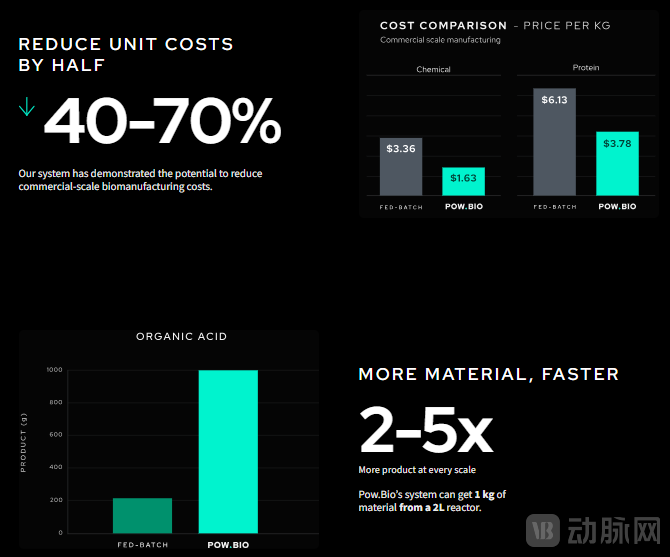
Of course, continuous fermentation processes also present certain challenges, with the most significant issues being contamination and strain mutation. In the face of this challenge,Pow.Bio addresses these challenges by developing a two-chamber system. This system separates the microbial growth phase from the production phase, effectively reducing the risk of contamination and preventing strain mutation.In the growth bioreactor, microorganisms are allowed to proliferate without producing the target product; in the production chamber, microbial growth is halted by limiting nutrients, thereby redirecting cellular resources toward production. This innovative process design not only enhances system adaptability and stability but also underscores Pow.Bio’s core strength in process innovation, rather than mere hardware manufacturing.
Ouwei Wang emphasized that Pow.Bio’s process can theoretically support indefinite precision fermentation. However, in practice, to accommodate scheduling and ensure operational convenience, the company typically sets the run cycle at three to four weeks, approximately 21 days or 500 hours. This cycle has proven sufficient to meet production demands. According to the techno-economic analysis conducted by Pow.Bio, significant productivity gains are achieved once the system operates for more than 500 hours.
Revenue generation achieved, fundamentally transforming the economics of precision fermentation
Currently, as a “fermentation-as-a-service” company, Pow.Bio focuses on providing customized solutions to the biomanufacturing industry using its intelligent fermentation technology. Ouwei Wang pointed out that the company primarily researches bacteria and yeast to produce high-value organic acids, food proteins, and other ingredients.Pow.Bio’s services include helping clients validate strains, optimize processes, and produce materials for regulatory and market testing, with the aim of leveraging its continuous fermentation technology to enable efficient production for its clients.
Shannon Hall noted that the company’s future business model may include technology licensing or establishing joint ventures, depending on partner companies’ visions regarding manufacturing ownership. Currently, Pow.Bio has begun generating revenue by addressing diverse customer needs, which may include selecting optimal strains, improving production efficiency, or directly manufacturing specific quantities of products.
Pow.Bio’s service advantage lies in its continuous fermentation system, which enables rapid production of prototype products. Due to the inherent characteristics of the system, it generates abundant data that help customers achieve real-time improvements and design high-efficiency strains. This service model not only accelerates the product development process but also brings innovative solutions to the biomanufacturing industry.
According to Shannon Hall,Pow.Bio’s fermentation technology achieves a significant boost in productivity by mimicking efficient assembly-line processes, while ensuring product quality and consistency and avoiding contamination and performance instability.This technological advancement is a significant profit driver for the company’s partners, as it can substantially reduce manufacturing costs, thereby increasing profit margins.
For partners seeking to launch new products through price-reduction strategies, Pow.Bio’s platform not only offers a cost-effective manufacturing solution but may also be the only viable option for achieving market objectives in certain cases. Leveraging Pow.Bio’s technology, partners can optimize their cost structures and enhance market competitiveness while maintaining product quality.
Following the completion of its Series A financing, Pow.Bio will expand the construction of its demonstration facility in Alameda, California, aiming to transition from gram-scale experiments to the production of hundreds of kilograms of finished products using a novel dual-chamber fermentation system. “Our primary objective is to establish a 1,000-liter demonstration platform to achieve the high-efficiency output we have demonstrated at the 30-liter and 300-liter scales,” said Shannon Hall. The facility is scheduled to become operational in 2024, accelerating Pow.Bio’s commercial-scale deployment.