

Thyme Care Files for IPO Following $95M Series C Funding and 20% Reduction in Acute Care Expenditures Through Value-Based Oncology Solutions
Thyme Care
Provider of Tumor Nursing Management Solutions
In early 2024, the International Agency for Research on Cancer (IARC) of the World Health Organization pointed out in its report “Global cancer burden growing, amidst mounting need for services” that approximately one in five people worldwide will develop cancer during their lifetime. As the cancer burden continues to intensify, the field of cancer treatment is facing challenges such as rising treatment costs, fragmented care services, and significant heterogeneity in patient conditions.
In this context, the steadily rising costs of cancer care have led to the widespread acceptance and adoption of oncology care services based on the Value-Based Care (VBC) model. Thyme Care, a provider of oncology care management solutions, leverages its innovative hybrid collaborative care model, along with an intelligent technology platform and data analytics tools, to seamlessly integrate navigation care teams, healthcare institutions, and patients. This approach delivers comprehensive, personalized guidance and support throughout the entire cancer treatment journey, thereby improving patient experience and treatment outcomes while reducing healthcare costs.
In July 2024, Thyme Care announced the completion of a $95 million Series C financing round.The funding comes from a $55 million equity financing round jointly provided by Concord Health Partners, CVS Health Ventures, Town Hall Ventures, a16z Bio + Health, AlleyCorp, Echo Health Ventures, Frist Cressey Ventures, and Foresite Capital; as well as a $40 million debt financing facility provided by Banc of California.
This financing marks Thyme Care’s second funding round in less than a year. In late 2023, Thyme Care completed a $60 million Series B financing; this Series C round will also be the company’s final public fundraising before its initial public offering (IPO). According to statistics, Thyme Care has raised a total of $178 million in financing.
Cancer Care NavigationIt is not a novel or unvalidated concept.
Oncology Nurse Navigation SystemThe oncology nurse navigation system pairs cancer patients with oncology nurse navigators (ONNs). As the executors of patient navigation, ONNs possess specialized oncology knowledge and provide personalized assistance to patients, their families, and caregivers. They can schedule medical appointments, remind patients about potential medication side effects, and even help them connect with professional counseling resources. This approach not only improves the quality of patient care but also underscores the importance of delivering personalized support in cancer care.
Among the many oncology care navigation systems, Thyme Care’s success lies in its respect for and reinforcement of human connection and compassion, as this emotional support is irreplaceable by technology and tools for cancer patients.
Thyme Care combines the expertise of its care navigation teams with modern advanced technologies, leveraging automated processes to identify when and where patients need assistance and ensuring that human support is provided at critical moments. This integration not only simplifies the complex and fragmented healthcare system, reduces care barriers for patients who have long lacked support, and improves the quality and responsiveness of care, but also optimizes the allocation and utilization of medical resources, enabling oncology care navigation services to reach a broader patient population.
Specifically, Thyme Box, the intelligent care management software developed by Thyme Care, provides patients with data-driven, 24/7 professional nursing guidance throughout their cancer journey. It also offers more than 100 evidence-based oncology care plans tailored to each patient’s specific disease and condition.
For example, the “Emergency Department Discharge Transition Care” program is triggered when a patient is discharged from the emergency department. With support from Thyme Care, the navigation care team promptly establishes contact with the patient to confirm follow-up medical appointments and daily medication schedules, and helps the patient understand and adhere to the professional discharge instructions provided by their physician.

Thyme Care Medical Guidance
During the management process, if a member reports symptoms of nausea and vomiting via the Thyme Box, the navigation care team is immediately notified. Subsequently, they proactively contact the patient to conduct a comprehensive health assessment and provide professional health guidance. When necessary, the care team also assists in arranging consultations with oncologists to ensure that patients receive timely and comprehensive medical support.
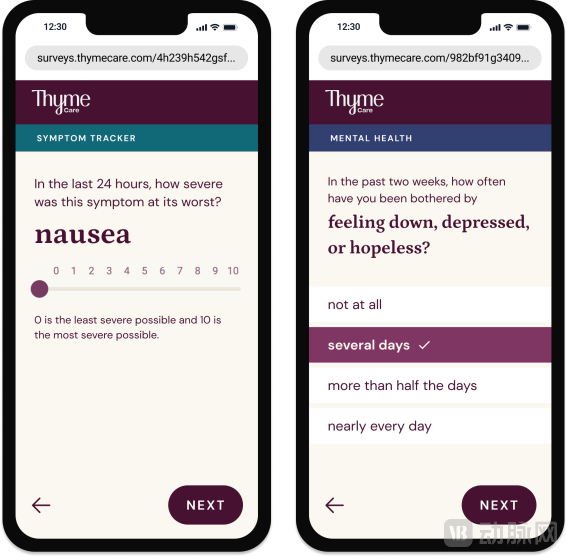
Thyme Care Mobile Patient Interface
Such timely response and personalized care not only reduce the risk of disease incidents but also correspondingly lower treatment costs.It is reported that Thyme Care currently provides cancer patients in 31 U.S. states with support including care navigation services, technology and data analytics, and therapeutic interventions. With the help of these interventions, the total monthly cost of care per cancer member was reduced by $594, acute care expenditures decreased by approximately 20%, and the incidence of emergency department visits and hospitalizations dropped by 30%.
For healthcare institutions and nursing staff, high-intensity workloads and sustained physical and mental burdens not only adversely affect their mental health but also compromise the quality of care. Furthermore, in traditional oncology care models, nurses’ workloads are often unevenly distributed.
For example, a nurse may have an extremely busy schedule for four days of the week, while being relatively free on the remaining day. How can digital twin models and technical platform support help nurses optimize their work schedules and assist hospitals in effectively allocating human resources? This is one of the primary problems that Thyme Box aims to address.
Leveraging intelligent technology and data insights, Thyme Box assumes the burdensome tasks of management and coordination for navigation care teams. Once patients subscribe to become members, the navigation care team can rapidly collect background information, manage comorbidities, and establish close collaboration with the patients’ primary care physicians through this platform. In the event of critical conditions, patients are promptly triaged to primary healthcare institutions, ensuring continuity of care.
In daily care operations, the platform can automatically dispatch tasks to the appropriate nursing staff at the correct times, alleviating their “cognitive burden” associated with work scheduling and automatically coordinating with other team members. This design does not render nursing care mechanical; rather, it enables the nursing team to devote more attention to direct communication with patients, thereby enhancing the overall efficiency and quality of care.
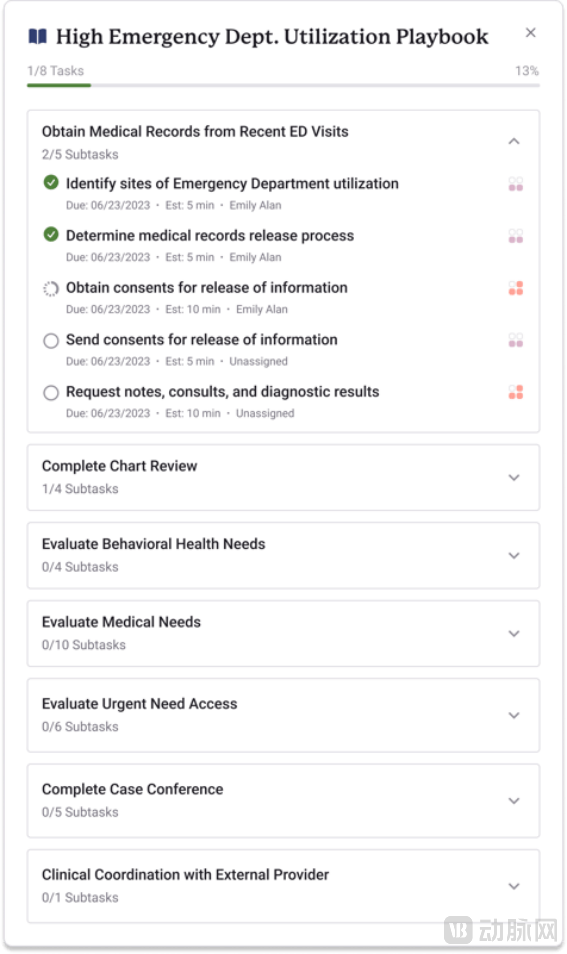
Thyme Care Navigation Care Team Provider Interface
Furthermore, Thyme Care automatically prioritizes tasks based on assessment criteria such as the severity of members’ conditions, enabling care teams to shift from reactive responses to proactive interventions and ensuring the timeliness of key activities such as symptom assessments and non-clinical needs screenings.
More importantly, by combining software analysis with human guidance, Thyme CareA Comprehensive and Effective Oncology Management SolutionIt enables the rapid provision of appropriate care to patients, along with continuous, targeted, evidence-based nursing interventions. On one hand, the system offers comprehensive support to patients outside the hospital setting, reducing the incidence of unexpected events such as emergency department visits; on the other hand, it alleviates the burden of cumbersome patient education tasks, allowing healthcare professionals to focus entirely on specialized treatment and thereby improving the quality of medical services.
Despite having received multiple rounds of recognition from capital markets, Thyme Care is in fact a young company founded in 2020. The company’s ability to achieve such success is inseparable from the profound backgrounds of its founding team.
Robin Shah, Founder and CEO of Thyme CareA graduate of the University of Washington’s Biomedical Engineering program, Robin Shah is the son of an oncologist. After completing his undergraduate studies in 2007, he received a job offer from the U.S. Food and Drug Administration (FDA). However, during a conversation with his father, he learned that his father’s clinic was facing closure due to being squeezed out by competing hospitals, despite providing high-quality cancer care closer to patients’ homes. Motivated by this, Robin Shah sought to help his father establish a new, patient-centered approach to cancer care.
In 2017, Robin Shah co-founded OneOncology, a company in the cancer care sector, which was later acquired for $2.1 billion. In 2020, Robin Shah founded Thyme Care.
Bobby Green, Co-founder, Chief Medical Officer, and President of Thyme CareHolding an M.D. from Duke University, he has served as an oncologist at major hospitals, including the Helen & Harry Gray Cancer Center, since 1993. Prior to co-founding Thyme Care, he was the Chief Medical Officer of Flatiron Health, an oncology data management company that was later acquired by Roche.
Following the completion of its Series C financing, Robin Shah stated, “This funding will significantly drive the expansion of our business. Currently, Thyme Care manages over $500 million in medical expenditures through risk-sharing contracts, a figure expected to triple within the next year. Moreover, over the past six months, Thyme Care has successfully doubled its partner network, delivering high-quality, value-based care services to more patients, while also enhancing the company’s market prospects and economic returns.”
Health economists define “value-based care” as “healthcare with the highest cost-effectiveness.” In the future, Thyme Care will continue to deepen its expertise in this field.“Value-Based Oncology Care”, namely, to provide more comprehensive and timely oncology care services at a lower cost. By integrating clinical expertise with advanced technologies, optimizing resource allocation, and improving care efficiency, we ensure that patients receive personalized, high-quality medical services, while also promoting cost-effectiveness and maximizing value across the entire healthcare industry.