

China Resources Sanjiu to Acquire 28% Stake in Tasly for RMB 6.212 Billion, Becoming Controlling Shareholder

CR SANJIU
Pharmaceutical R&D, Production, Sales, and Related Health Service Provider
On August 4, 2024, Tasly Pharmaceutical (600535) announced in an evening filing that its controlling shareholder, Tasly Group, and its parties acting in concert intended to transfer shares to CR SANJIU for a consideration of RMB 6.212 billion. Upon completion of the transaction, the company’s controlling shareholder will change to CR SANJIU, and the actual controller will change to China Resources. In a separate announcement on the same day, the company stated that, upon its application to the Shanghai Stock Exchange, its shares would resume trading at the market opening on August 5, 2024.
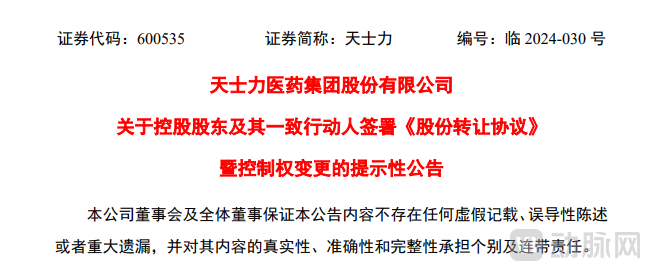
Image source: Tasly Pharmaceutical announcement
According to Tasly Pharmaceutical’s announcement on the evening of August 4, its controlling shareholder, Tasly Group, and parties acting in concert—Tianjin Heyue, Tianjin Kangshunke, Tianjin Hongxun, Tianjin Tongming, Tianjin Shunqi, and Tianjin Shanzhen—have entered into a Share Transfer Agreement with CR SANJIU. Under the terms of the agreement, Tasly Pharmaceutical Group and its parties acting in concert will transfer a 28% equity stake to CR SANJIU for a consideration of RMB 6.212 billion, and waive the voting rights attached to an additional 5% equity stake (with the remaining voting rights not exceeding 12.5008%). Simultaneously, a 5% equity stake will be transferred to China Reform Holdings Corporation Ltd. (Guoxin Investment) for a consideration of RMB 1.109 billion. The total transaction amount stands at RMB 7.321 billion, involving an aggregate transfer of 33% of the shares, resulting in CR SANJIU becoming the new controlling shareholder.
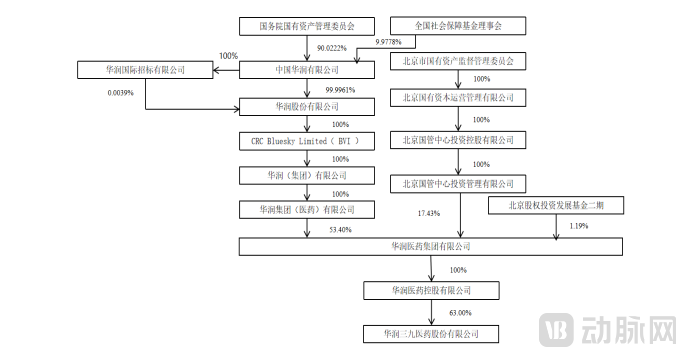
CR SANJIU Shareholding Structure, Image Source: Tasly Pharmaceutical Announcement
The announcement further stated that the transaction gives rise to horizontal competition. Upon completion of the transaction, Tasly Pharmaceutical’s pharmaceutical retail chain business will compete horizontally with the retail chain operations of China Resources Pharmaceutical, a subsidiary of China Resources; additionally, Tasly Pharmaceutical’s production of eszopiclone tablets will compete horizontally with the zopiclone tablets manufactured by CR SANJIU, which is controlled by China Resources.
To safeguard the interests of the Company and its shareholders, CR SANJIU, its controlling shareholder China Resources Pharmaceutical Holdings, and its actual controller China Resources have issued the Letter of Commitment on Avoiding Horizontal Competition. Within five years following the completion of this transaction, they shall resolve the existing horizontal competition between the committing parties and their controlled subsidiaries and Tasly Pharmaceutical and its controlled subsidiaries through statutory procedures, including but not limited to custody, asset (equity) transfers, and business integration.
Previously, Tasly Pharmaceutical applied for a trading suspension effective from the market open on August 1 due to plans for share transfer. On the last trading day before the suspension (July 31), the company’s latest closing price was RMB 14.08 per share, representing a significant increase of 6.18%.
“Tasly Pharmaceutical Model”
Tasly Group was established in May 1994 and has a history of 20 years. Driven by scientific research achievements, Tasly has spurred the rise of an entire industry, gradually built a modern quality standard system for traditional Chinese medicine (TCM), and formed a cluster of major brands. Some view Tasly’s development history as a microcosm of China’s private economy, even referring to it as a “model case.”
In 1994, the predecessor of Tasly Group Co., Ltd.—Tianjin Tianshili United Pharmaceutical Company—was established, successfully completed the pilot production scale-up of its new product, “Compound Danshen Dripping Pills,” and subsequently launched the high-quality product on the market. In 1997, “Compound Danshen Dripping Pills” became the first traditional Chinese medicine to receive FDA approval for an Investigational New Drug (IND) application. In March 1998, with the approval of the Beijing Military Region, the Beijing Military Region (division-level) Pharmaceutical Group was formed with Tasly as its core, and Yan Xijun was appointed as General Manager of the group. In December of the same year, the central government decided that military-owned enterprises would be decoupled from the military and transferred to local administration. In September 1999, upon approval by the municipal party committee and municipal government, Tasly underwent comprehensive restructuring, and Tasly Group was formally established, with Tasly Pharmaceutical Group Co., Ltd. as its core enterprise.
In the course of its subsequent development, Tasly Pharmaceutical, building on its specialization and refinement in modern traditional Chinese medicine (TCM), gradually expanded into biologics, chemical pharmaceuticals, and specialized medical services. On the basis of establishing a life safety industrial sector with pharmaceuticals as its core domain, the company has progressively entered the life health industry sectors, including health supplements, health foods, cosmetics, safe drinking water, and bio-fermented Pu'er tea.
In 2006, Tasly Pharmaceutical began to advance its comprehensive internationalization and build an innovation-driven enterprise. Based on the deliberations at Tasly’s First Science and Technology Development Seminar, the company reformed the management system of its scientific research framework, innovated its management models, and adjusted its research projects. Regarding its overseas expansion strategy, Tasly primarily targeted East Asia and Southeast Asia, where traditional medicines are widely used, as well as Africa, where medical resources are scarce. As Compound Danshen Dripping Pills, a modern traditional Chinese medicine (TCM) formulation, became the first compound TCM product globally to successfully complete large-scale, Phase III, randomized, double-blind, multicenter clinical trials under the U.S. FDA’s international standards, Tasly leveraged this achievement—validated by the international modern medical evaluation system—to establish an international marketing system. In specific regional markets, the company built channels for TCM enterprises and products to go global, finding it more appropriate to enter these markets with prescription drugs and health supplements. This approach was driven by the fact that these countries or regions have a history of using traditional medicines, exhibit high acceptance of natural remedies, have low per capita healthcare coverage, and show strong receptivity to natural drugs that are “simple, convenient, effective, and affordable.”
In 2014, Yan Kaijing succeeded his father, Yan Xijun, as Chairman of Tasly Pharmaceutical, a position he has held for ten years. Unlike his predecessor, who had a background in pharmacy, Yan Kaijing brings extensive experience in finance and investment. Upon taking the helm at Tasly, he promptly reformed the company’s investment strategy, shifting the focus to the “4D” sectors: Diagnostics, Devices, Drugs, and Digital Health.
At the 2018 “Grand Health Industry Investment Ecosystem Innovation Conference,” Yan Kaijing stated that Tasly Capital, under the company’s umbrella, managed five RMB funds and three USD funds, with a total scale exceeding RMB 10 billion.
First Loss in 21 Years Since Listing and Return to Profitability
In 2021, the share price of I-Mab Biopharma, in which the Company had invested, rose significantly, with its market capitalization exceeding USD 7 billion at its peak. This also drove a substantial increase in the Company’s 2021 financial performance, with net profit reaching a record high since its listing. However, as the biopharmaceutical sector cooled down, the share prices of listed companies within the industry began to decline, thereby affecting Tasly Pharmaceutical’s net profit level. In 2022, the Company recorded its first loss since its listing.
In May 2023, Tasly Pharmaceutical disclosed its 2022 annual report, revealing a year-on-year decline of 110.87% in net profit attributable to shareholders of the parent company, with a loss of RMB 257 million. Marking its first annual loss since going public, Tasly has repeatedly stumbled in the field of innovative drugs. Behind its R&D investment, which exceeds that of its peers, lies a heavy reliance on core single products.
This reflects Tasly Pharmaceutical’s strategic approach to innovative drug development. In the field of innovative drugs, Tasly prefers external equity investments. According to its 2022 annual report, four of the five listed companies in which Tasly held investments were innovative pharmaceutical enterprises. In addition to I-Mab Biopharma and CARsgen Therapeutics, these included Pharn and Yongtai Biologics (06978.HK). I-Mab Biopharma went public in 2020, focusing on oncology immunotherapy and autoimmune diseases. Tasly invested in I-Mab through its Series B and C financing rounds, with cumulative investments exceeding RMB 200 million. CARsgen Therapeutics listed on the capital market in 2021 and is primarily engaged in the discovery of innovative CAR-T cell therapies. Tasly’s investment cost in CARsgen amounted to RMB 65 million. However, at that time, neither I-Mab Biopharma nor CARsgen Therapeutics had any commercialized products, and both remained unprofitable.
To turn the tide, Tasly Pharmaceutical made every effort to expand its product market and intensify sales efforts in 2023. Meanwhile, the company’s R&D pipeline advanced efficiently, comprising 98 products in development, including 41 Class 1 innovative drugs; among these, 36 were in clinical trials, with 26 in Phase II or III clinical stages.
In 2023, Tasly Pharmaceutical turned a profit in terms of net profit attributable to shareholders, representing a year-on-year increase of more than fivefold. Specifically, in 2023, Tasly Pharmaceutical achieved operating revenue of approximately RMB 8.674 billion, a year-on-year increase of 0.42%; the corresponding net profit attributable to shareholders was approximately RMB 1.071 billion, a year-on-year increase of 505.34%; and the net profit after deducting non-recurring gains and losses was approximately RMB 1.181 billion, a year-on-year increase of 60.11%.
However, the reason Tasly Pharmaceutical’s 2023 performance appeared impressive was primarily due to the notably weak performance in 2022, which served as a low baseline. Viewed over a longer timeframe, Tasly Pharmaceutical had not yet returned to its historical peak performance levels in 2023: From 2015 to 2021, the company’s operating revenues were approximately RMB 13.23 billion, RMB 13.95 billion, RMB 16.09 billion, RMB 17.99 billion, RMB 19.0 billion, RMB 13.58 billion, and RMB 7.952 billion, respectively; the corresponding net profits attributable to shareholders were approximately RMB 1.479 billion, RMB 1.176 billion, RMB 1.377 billion, RMB 1.545 billion, RMB 1.001 billion, RMB 1.126 billion, and RMB 2.359 billion, respectively.
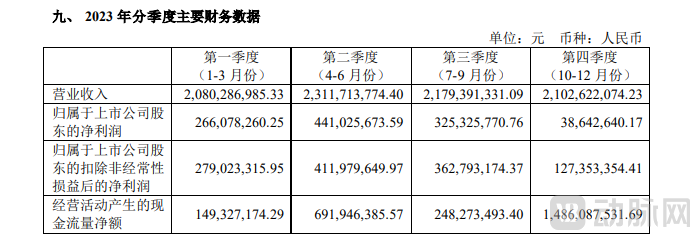
Tasly Pharmaceutical's Key Financial Data for 2023
Financial data shows that in 2023, Tasly Pharmaceutical’s revenue was derived from its pharmaceutical manufacturing and pharmaceutical commercial segments. The pharmaceutical manufacturing segment generated operating revenue of approximately RMB 7.421 billion, accounting for 85.56% of the total, representing a year-on-year increase of 3.22%. The pharmaceutical commercial segment generated operating revenue of approximately RMB 1.215 billion, accounting for 14.01%, reflecting a year-on-year decrease of 14.21%. Tasly Pharmaceutical had also planned to continue divesting certain pharmaceutical commercial assets, but these efforts ultimately did not come to fruition.
In the pharmaceutical industry, Tasly Pharmaceutical’s primary focus is on traditional Chinese medicine (TCM). In 2023, revenue from its TCM business amounted to approximately RMB 5.971 billion, representing a year-on-year increase of 6.62%. By contrast, revenues from chemical preparations, chemical active pharmaceutical ingredients (APIs), and biological products declined by 5.3%, 19.67%, and 23.47%, respectively.
On April 26, 2024, Tasly Pharmaceutical released its first-quarter 2024 performance report, signaling a potential resurgence toward its historical revenue milestones. During the reporting period, the company achieved a total operating income of RMB 2.049 billion, representing a year-on-year decrease of 1.73%, while net profit reached RMB 295 million, a year-on-year increase of 11.58%. The basic earnings per share amounted to RMB 0.20.
Expanding the Network in the Traditional Chinese Medicine Market
Tasly Pharmaceutical’s core business is currently divided into three major segments: modern traditional Chinese medicine (TCM), chemical drugs, and biological drugs. With modern TCM as the core and chemical and biological drugs as the two supporting pillars, these three segments develop synergistically, focusing on therapeutic areas such as cardiovascular and cerebrovascular diseases, digestive and metabolic disorders, and oncology. Due to negative factors including channel inventory cycle adjustments, setbacks in internationalization, drag from pharmaceutical commercial operations, pressure from national medical insurance negotiations and centralized procurement, and impairment losses on external investments, Tasly’s performance has experienced significant volatility in recent years. Since 2022, the company has gradually cleared its risks, marking the end of a period of deep adjustment and the beginning of a bottoming-out and rebound in performance. However, given that chemical and biological drugs are struggling to assume a leading role, Tasly still relies heavily on its legacy product, Compound Danshen Dripping Pills, to sustain revenue.
According to Tasly Pharmaceutical’s 2023 annual report, the Chinese government has placed greater emphasis on traditional Chinese medicine (TCM) in 2023, with multiple favorable policies gradually being clarified or implemented. On February 10, 2023, the General Office of the State Council issued the Implementation Plan for Major Projects to Promote the Revitalization and Development of Traditional Chinese Medicine, marking a significant milestone in TCM policy. In the same month, the National Medical Products Administration officially released the Special Provisions on the Registration and Administration of Traditional Chinese Medicines. The implementation of these provisions will further strengthen guidance on TCM research and development, offer strong practical operability, and accelerate the market launch of new TCM drugs.
Meanwhile, China Resources Pharmaceutical, a recognized leader in the traditional Chinese medicine sector that built its foundation through mergers and acquisitions, has shown no signs of slowing down its acquisition spree.
According to data compiled by the Qianzhan Industry Research Institute, two traditional Chinese medicine (TCM) enterprises, Baiyunshan and Yunnan Baiyao, reported annual revenues exceeding RMB 20 billion. Among them, Baiyunshan ranked at the top with an annual revenue surpassing RMB 60 billion. Companies with revenues between RMB 10 billion and RMB 20 billion, including CR SANJIU, Tongrentang, Buchang Pharma, and Taiji Group, constitute the first tier of the market. Enterprises with revenues ranging from RMB 5 billion to RMB 10 billion include Pien Tze Huang, Jichuan Pharmaceutical, and Xinbang Pharmaceutical.
Tasly Pharmaceutical’s market positioning is more akin to that of a manufacturer of proprietary Chinese medicines, and it ranks among China’s top 30 in this sector. For CR SANJIU, which has pursued aggressive expansion through frequent mergers and acquisitions, the synergistic integration with Tasly in areas such as branding, product portfolio, distribution channels, terminal networks, and management systems will help further consolidate its position in the first tier of key markets.
Currently, the market concentration of China's traditional Chinese medicine (TCM) industry is relatively low, yet it exhibits certain distinctive characteristics. In summary, although the market concentration in China's TCM sector remains low, leading enterprises have secured a competitive advantage by leveraging their substantial revenue scales and extensive market presence. Meanwhile, with strengthened government support for the TCM industry and rising consumer health awareness, the sector is poised for further growth opportunities.