

Melei Weiyeh's Netrod® Xingdai™ RDN System Receives NMPA Approval, Ushering in a Minimally Invasive Era for Hypertension Treatment

Brattea
Developer of Interventional Devices for Hypertension
Palpitations, agitation, insomnia, coronary heart disease, heart failure, cerebral hemorrhage, cerebral infarction, renal atrophy and renal insufficiency, fundus hemorrhage, and even blindness... Hypertension gradually damages multiple organ systems throughout the body. It is not only an independent disease but also a major risk factor for cardiovascular and cerebrovascular diseases. Over the past two decades, the prevalence of hypertension in China has nearly doubled, and cardiovascular and cerebrovascular diseases caused by hypertension have become the leading cause of death.
Given the severe hazards of hypertension, timely detection and effective blood pressure control are crucial. Traditional hypertension treatment relies solely on lifestyle interventions and pharmacotherapy, yet most patients exhibit poor adherence and fail to achieve target blood pressure levels.
How to Control the Target Achievement Rate of Hypertension? A Problem That Has Plagued the Medical Community for Years. RDN (Percutaneous Renal Artery Radiofrequency Ablation) offers new hope to hypertensive patients worldwide.
On August 6, Chinese domestic medical technology innovation enterprisesIndependently developed by Shanghai BRATTEA Medical Technology Co., Ltd.Netrod® StarBand™Reticular Renal Artery Radiofrequency Ablation System (Including Disposable Reticular Renal Artery Radiofrequency Ablation Catheter and Renal Artery Radiofrequency Ablation Device) Approved by the National Medical Products Administration (NMPA) approved for market launch(NMPA Registration No.20243011385, National Medical Device Registration No. 20243011387), for the adjunctive treatment of patients with refractory hypertension or those intolerant to antihypertensive medications,RDNThis groundbreaking innovative procedure will bring a brand-new treatment option to patients with hypertension!
The sympathetic nervous system plays a crucial role in blood pressure regulation, and excessive sympathetic activation is one of the key pathogenic mechanisms of hypertension. By reducing renal sympathetic nerve activity, it is possible to decrease renin release from the kidneys, reduce sodium reabsorption, lower blood volume and vascular resistance, thereby effectively lowering blood pressure. Renal denervation (RDN) is a percutaneous renal artery interventional therapy developed based on this theory. It utilizes specialized catheters to deliver radiofrequency energy to the sympathetic nerves surrounding the renal arteries, ablating the sympathetic nerve fibers around the renal arteries, blocking neural signal transmission, thus reducing the overactivity of the sympathetic nervous system and achieving a blood pressure-lowering effect.
With the deepening understanding of chronic disease mechanisms in basic medical research and advancements in biomedical engineering technologies, interventional therapy for chronic diseases—particularly renal denervation (RDN) for hypertension—has emerged as a new focal point for clinical innovation and R&D in the cardiovascular field, following decades of evidence-based medical exploration and continuous iterative device development. Netrod®The StarBand™ system is a prime example of the latest generation of RDN devices, utilizing Netrod®StarBand™ System for RDNSurgical treatment for hypertension is characterized by a favorable safety profile, 24-hour blood pressure control, improved patient adherence, and a short learning curve:
In terms of safety,As a minimally invasive interventional therapymethod, RDN does not involve permanent implantation, is minimally invasive, has relatively minor side effects, and noSystemic adverse reactions allow for rapid patient recovery. Extensive research data demonstrate that renal denervation (RDN) therapy is safe and effective, with sustained blood pressure-lowering effects. In recent years, RDN therapy has been included in clinical guidelines and consensus recommendations both domestically and internationally, further corroborating the safety and efficacy of this innovative treatment.
In terms of antihypertensive efficacy,From 24-hour Arterialambulatory blood pressure monitoring, RDN provides round-the-clock blood pressure-lowering effects and is not influenced by patient behavior. InBlood pressure can be continuously controlled in surgical patients during the night and early morning, when cardiovascular risk is typically highest.
Patient compliance,Addressing the challenges of patient adherence, both pharmacological therapy and lifestyle interventions are first-line recommendations for hypertension management, butIssues with medication adherence exist. Extensive research on medication adherence indicates that only approximately 50% of patients fully comply with prescribed regimens within one year, while 20% do not take any medication at all. Renal denervation (RDN) offers an effective alternative therapy, effectively addressing the challenges of medication adherence in patients with hypertension.
On the Learning Curve,Using Netrod®The StarBand™ system is easy to operate for RDN procedures, with a relatively short learning curve, facilitating physician adoption and enabling more patients to benefit from the technology sooner.
It can be said that Netrod, as a technical solution for the treatment of hypertension with original Chinese devices,®The StarBand™ system comprehensively addresses multiple pain points in the clinical management of hypertension, paving the way for a revolutionary new treatment option for patients.
The true clinical application of renal denervation (RDN) therapy hinges on the regulatory approval of RDN systems both domestically and internationally. Previously, the U.S. Food and Drug Administration (FDA) and China’s National Medical Products Administration (NMPA) each approved two RDN devices developed by multinational corporations. On August 6, the Netrod® Xingdai™ System became one of the first batch of RDN products to receive a Class III medical device registration certificate from the NMPA, signaling that indigenous Chinese RDN products are poised for imminent clinical use.
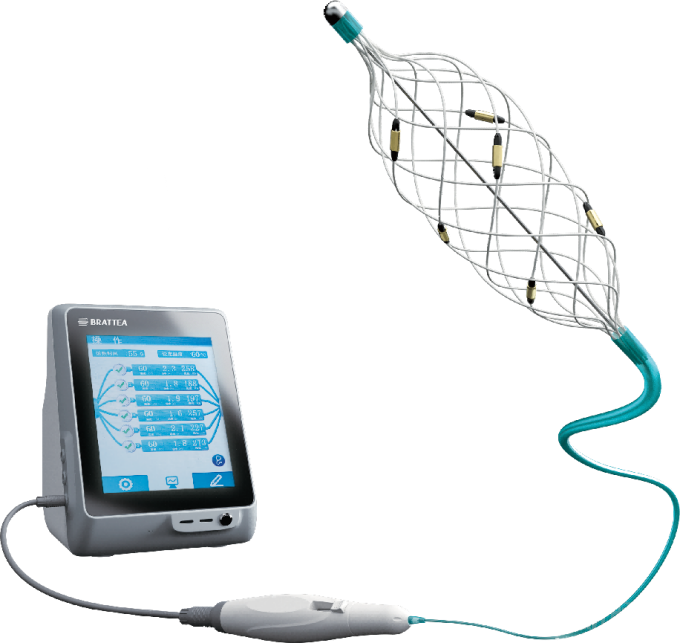
▲ China’s Original Netrod®StellarBand™ System
Netrod®The StarBand™ System consists of a renal artery radiofrequency ablation generator (including the main unit, footswitch, main unit connection cable, neutral electrode connection cable, and power cord) and a single-use mesh renal artery radiofrequency ablation catheter. These components are used in conjunction to perform percutaneous renal artery radiofrequency ablation for sympathetic denervation of the renal arteries.
Among them, BRATTEA independently developed and owns the intellectual property rights to Netrod.®The StarBand™ single-use mesh renal artery radiofrequency ablation catheter features six electrodes arranged in a spiral pattern, effectively enhancing ablation efficiency. Its basket-like design ensures uninterrupted blood flow during ablation, representing an innovation unique both domestically and internationally. This mesh structure provides robust support with stent-like radial force, ensuring stable and consistent apposition to the vessel wall throughout the procedure. The adjustable diameter design allows the catheter to accommodate vessels of varying morphologies with diameters ranging from 3 to 12 mm, achieving full-quadrant contact with the vessel wall. The six ablation electrodes on the catheter are distributed in a spiral configuration, reducing dispersion between electrodes and thereby forming a continuous ablation energy field, which further shortens procedural time.
Netrod®The StarBand™ Renal Artery Radiofrequency Ablation System employs temperature and impedance measurement along with feedback control algorithms to monitor vascular ablation in real time, providing protective alerts. In the event of excessive temperature or impedance, the system automatically terminates ablation on the affected channel and alerts the operator, thereby enhancing the safety profile of renal denervation (RDN) procedures. Its user-friendly interface, combining a touchscreen, physical buttons, and a footswitch, facilitates diverse initiation methods, streamlining intraoperative workflows for medical staff and supporting the learning and adoption of the technique. Furthermore, the system independently monitors catheter wall apposition across its six ablation channels and executes tailored ablation strategies to ensure efficacy. A 120-second sustained thermal ablation protocol optimizes the duration of effective nerve injury, ensuring extensive ablation around the vessel wall.
During renal denervation (RDN), a catheter is used to deliver high-frequency radiofrequency current to heat the vessels in the renal artery region, causing cellular dehydration, desiccation, contraction, and eventual necrosis. This process damages local sympathetic nerves, inhibits neurotransmitter release, thereby reducing excessive sympathetic nervous system activity and achieving blood pressure reduction.
As an original Chinese, world-leading innovative technology, Netrod®The StarBand™ system not only demonstrates the enhancement of China’s R&D capabilities, but also provides a reference pathway for other innovative technologies in the industry to transition from concept to market launch.
Innovation Never Stops,Minimally Invasive Interventions Make the Cure of Chronic Diseases Possible
Netrod®The potential of the Xingdai™ System does not stop atTreatment of Refractory Hypertension and Drug-Intolerant Hypertensionor the Chinese market. Initially, the inclusion criteria for patients undergoing renal denervation (RDN) were relatively strict, limited to those with resistant hypertension, defined as patients whose blood pressure remained uncontrolled despite treatment with ≥3 different classes of antihypertensive medications (including diuretics). Internationally, attempts have also been made to include a small number of patients with renovascular hypertension in RDN trials. Subsequently, the indications for RDN have been further expanded. According to the 2023 ESH Guidelines for the Management of Arterial Hypertension, in addition to patients with resistant hypertension, RDN may be considered as an option for blood pressure control in hypertensive patients whose blood pressure is not effectively controlled due to poor treatment adherence, significant blood pressure variability, or intolerance to multiple classes of antihypertensive drugs, as well as in patients unwilling to commit to lifelong pharmacological therapy, provided they express a preference for RDN during shared decision-making with their physicians. The Chinese Expert Scientific Statement on Percutaneous Renal Denervation for the Treatment of Hypertension also provides similar recommendations for the application of RDN. In the future, with close collaboration among multidisciplinary teams,The indications for RDN are expected to be further expanded to include patients with comorbid heart failure, arrhythmias, or acute cerebrovascular events, potentially offering greater long-term benefits for those with cardiac, cerebral, and renal complications.
From a market strategy perspective, BRATTEA has carefully planned its global layout since its inception, with the commercialization process in the Chinese marketUpon its launch, the Netrod® StarBand™ system also entered the international stageEmerging Prominence:
● In 2020, Netrod®The StarBand™ system has successfully obtained EU CE certification and has maintained compliance with this high-standard certification framework for four consecutive years, demonstrating international recognition of its technology and quality. Meanwhile, Netrod, designed for renal artery radiofrequency ablation therapy®Clinical exploration of the Xingdai™ System in Europe and other regions is now on the agenda, signaling broader market application prospects.
● In 2021, the Netrod® StarBand™ System achieved another milestone by receiving FDA Breakthrough Device Designation, becoming the first and currently only domestically produced radiofrequency renal denervation (RDN) product to receive this distinction, marking a significant breakthrough for Chinese innovative medical technologies in the international high-end market.
Around Netrod®With the StarBand™ System, BRATTEA has established a robust patent barrier, securing nearly 100 invention patents and methodological protections worldwide, thereby laying a solid foundation for continuous product innovation and market expansion. Looking ahead, the company will further deepen its global strategy, committed to expanding the reach of the Netrod® StarBand™ System to more countries and regions, bringing significant benefits to hypertension patients worldwide.
BRATTEA continues to expand and optimize its energy platforms, incorporating active energy technologies with tissue-selective specificity such as radiofrequency (RF), ultrasound (US), and pulsed field ablation (PFA), while further penetrating into the management of various chronic diseases including diabetes, chronic obstructive pulmonary disease (COPD), and heart failure. By leveraging minimally invasive techniques to address the limitations of pharmacological therapies—such as inability to achieve a cure, suboptimal efficacy, or poor patient compliance—BRATTEA aims to improve treatment target attainment rates and reduce mortality and disability rates.
Over the past few decades, China’s medical device industry has achieved a leap from scratch to strength, transforming from reliance on imports to independent innovation and ultimately to global export, now securing its place as a key player in the global medical device sector. As a pioneer in this movement, BRATTEA, with its Netrod®The StarBand™ System ushers in a new era in hypertension treatment, showcasing the excellence and immense potential of “Made in China.” On the journey of medical innovation, every step is fraught with challenges—from precise pipeline planning to breakthroughs in key technologies, and from product launch to commercialization—each requiring careful strategy and relentless pursuit of perfection. In this era, there is a growing call for more Chinese domestic enterprises to step forward, scale the heights of technological innovation, seize opportunities for future development, and lead global trends in healthcare.