

Sanzyme Announces $1.2 Billion Strategic Collaboration with BioNTech to Advance 3D-Printed Oral RNA Therapeutics

BioNTech
Developer of Novel Biologics
Recently, Triastek, a global leader in 3D-printed pharmaceuticals (hereinafter referred to as “Triastek”), announced that it has entered into a research collaboration and platform technology licensing agreement with BioNTech SE (hereinafter referred to as “BioNTech”), a next-generation immunotherapy company dedicated to pioneering treatments for cancer and other serious diseases. The two parties will jointly develop oral RNA therapeutics based on 3D-printed drug technology.
Under the terms of the agreement, Triastek will receive a $10 million upfront payment and is eligible to receive milestone payments totaling over $1.2 billion for product development, regulatory approval, and commercialization, as well as potential tiered sales royalties in the future.
Notably, this collaboration marks a breakthrough for China’s pharmaceutical industry, representing the first international cooperation on a technical platform in the history of Chinese pharmaceutical formulations. In the emerging field of 3D-printed drugs, Triastek’s 3D printing technology, developed through years of dedicated research, has gained industry recognition, making this partnership a landmark event. Looking ahead, 3D-printed drugs hold immense opportunities.
Collaboration is premised on mutual benefit and empowerment. Dr. Cheng Senping, Founder and CEO of Triastek, stated, “We were identified by our partners, and together we explored new technological directions. The prerequisite was their belief that our technology platform could help them address their challenges.”
Drug delivery has long been one of the key bottlenecks constraining the development of RNA therapeutics. 3D-printed drug technology can assist BioNTech in designing innovative oral formulations by optimizing the delivery of RNA drugs across the gastrointestinal mucosa, reducing their degradation in the gastrointestinal tract, and targeting them to the optimal absorption sites within the gastrointestinal system.
Compared with traditional pharmaceutical formulation technologies, 3D printing technology for drugs can significantly enhance the efficiency of product development and manufacturing through digital dosage form design and intelligent production, thereby reducing costs and improving effectiveness. Meanwhile, novel drug dosage forms with three-dimensional structures enable programmed, precise controlled release while improving the accuracy of drug delivery. In other words, 3D-printed drugs can create unique external and internal structures for pharmaceutical formulations, such as multi-layer tablets and multi-chamber designs, thereby optimizing the delivery of innovative RNA therapeutics.
The $10 million upfront payment and milestone payments totaling over $1.2 billion further underscore the highly cutting-edge nature of this exploratory collaboration.
Generally, the pricing of upfront payments in collaborations depends on the project’s stage; the later the stage, the lower the risk borne by the partner, and consequently, the higher the payment amount. Currently, 3D-printed pharmaceuticals represent an emerging frontier industry without a mature, commercially viable business model, with all aspects still under exploration. Dr. Cheng Senping also stated, “We are the first company to implement a business model in this industry. This collaboration with BioNTech marks our entry into the field of 3D-printed oral RNA therapeutics, which is at a very early stage.”
In fact, external observers have maintained a wait-and-see attitude toward whether 3D-printed drugs can replace traditional pharmaceutical manufacturing for large-scale application. Triastec also aims to validate its technology and gain industry recognition through collaborations with various partners.
In addition to BioNTech, Triastek has successively entered into collaborations with multiple multinational and domestic pharmaceutical companies over the past two years, marking a new stage in the development of 3D-printed drug technology.
As an innovative technology, 3D-printed pharmaceuticals represent uncharted territory. To successfully implement such projects, it is essential not only to validate technical feasibility but also to secure regulatory approval and demonstrate the technology’s value to industry stakeholders. Only then can commercial collaborations be fostered, paving the way for the emergence of a new industry.
To successfully navigate this path, Triad Therapeutics has established a three-phase corporate development strategy: a technology development phase, a product development and business expansion phase, and a globalization phase.
Since its establishment in 2015, Triastek has adopted an intellectual property-driven strategy, pioneering the Melt Extrusion Deposition (MED®) 3D printing process for pharmaceuticals. Building on this foundation, the company has developed formulation technologies such as MED combined with Micro-Injection Molding (MED&MIM) and MED combined with Semi-Solid Extrusion (MED&SSE). Furthermore, Triastek has established five 3D micro-structured drug delivery platforms for modified release, solubility enhancement, colon targeting, gastric retention, and oral peptide delivery, while advancing multiple pipelines of 3D-printed pharmaceutical products.
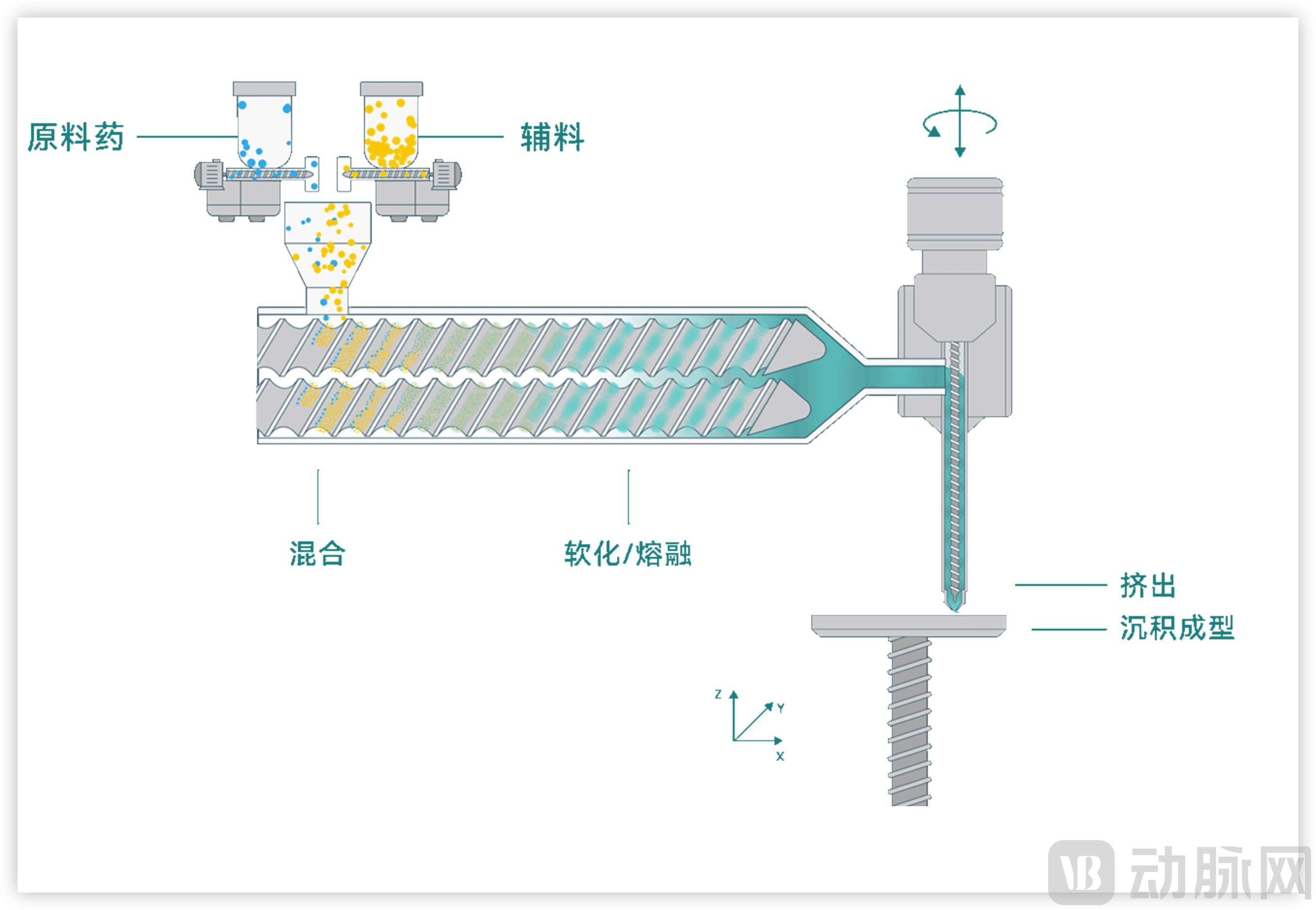
Schematic Diagram of Fused Deposition Modeling (FDM) 3D Printing Process, Source: Company Official Website
Today, Triastek has established a GMP-compliant digital manufacturing center for 3D-printed pharmaceuticals. Its first commercial-scale production line has an annual capacity ranging from 75 million to 300 million tablets, ranking it first globally in the field of 3D-printed drug manufacturing.
As R&D capabilities and production capacity continue to mature, how can the industry be made to recognize the value of 3D-printed drugs, thereby enabling the company to advance to its next stage of development?
Triastek chose to independently develop its pharmaceutical products, with its first product, T19, receiving Investigational New Drug (IND) approval from the U.S. FDA in 2021. In 2022, Triastek announced that T19 had received IND approval for clinical trials from China’s National Medical Products Administration (NMPA), becoming the first 3D-printed drug product approved for clinical use in China. This marks a milestone event representing the “zero-to-one” breakthrough for 3D-printed drug products in China and signifies an innovative technological advancement in the country’s pharmaceutical formulation industry.
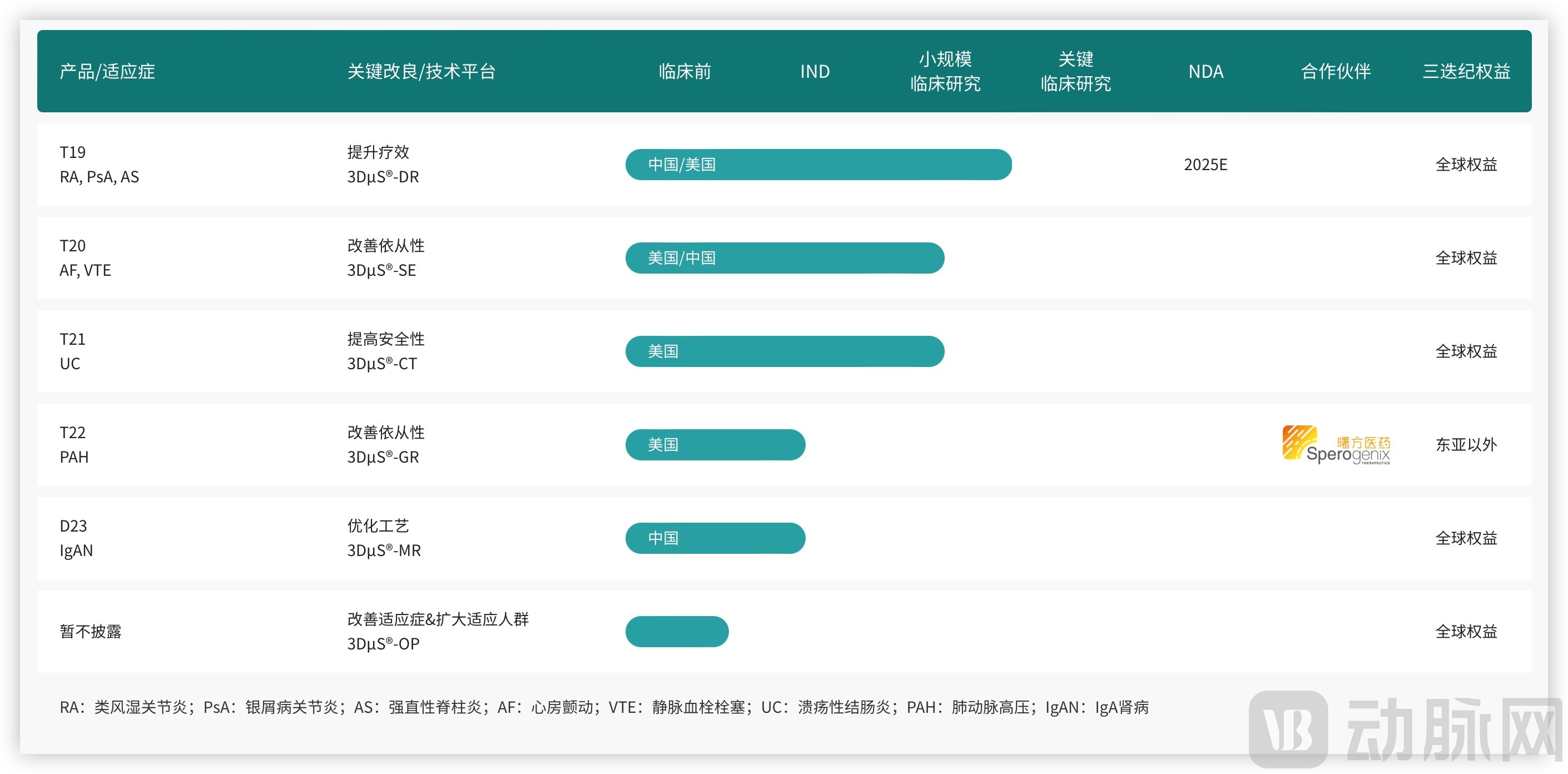
San Die Ji’s In-House Drug Product Pipeline, Image Source: Company Official Website
According to the official website, Triastek currently has multiple self-developed 3D-printed drug product pipelines, with indications including RA (rheumatoid arthritis), PsA (psoriatic arthritis), AS (ankylosing spondylitis), AF (atrial fibrillation), VTE (venous thromboembolism), UC (ulcerative colitis), PAH (pulmonary arterial hypertension), and IgAN (IgA nephropathy).
Currently, Triastek has secured seven Investigational New Drug (IND) approvals in China and the United States for five of its products, ranking first globally in the number of 3D-printed pharmaceutical products. Although there are numerous companies in this industry, few have achieved industrialization of 3D-printed drug technology and committed capital to advance clinical development, as Triastek has.
Nevertheless, Dr. Cheng Senping did not shy away from acknowledging the initial hesitation and inner conflict surrounding his decision to pursue independent research and development.
For emerging technologies, the most direct way to validate them is by developing products. However, product development entails high costs and places greater demands on a company’s capabilities. The competencies required to focus on building a technology platform are fundamentally different from those needed for product development.
Ultimately, what sealed Dr. Cheng Senping’s resolve was not only his confidence in his own technology but also his global commercial vision.
During the in-house development process, not only can the company’s deep technical capabilities be demonstrated, but the various data accumulated throughout product development also serve as the foundation for its corresponding technology platforms. These platforms, in turn, enable the creation of additional customer products, laying a solid groundwork for the comprehensive commercialization of 3D-printed drug technologies.
“The entire industry is still in its nascent stage, characterized by a heavy reliance on the exploratory efforts of pioneering companies. In the absence of a mature ecosystem, many tasks must be undertaken by these pioneers, which presents significant challenges,” said Dr. Cheng Senping. “For an industry to thrive, division of labor is essential; this is particularly true for 3D-printed pharmaceuticals, which constitute a multidisciplinary systems engineering endeavor. Without a mature industry ecosystem or support from upstream and downstream partners, we have no choice but to handle everything ourselves.”
Empowered by this courage to confront challenges head-on, Triastek has partnered with global pharmaceutical giants such as Merck, Eli Lilly and Company, and Boehringer Ingelheim in recent years. This latest collaboration with BioNTech further lays a solid foundation for the next phase of its globalization strategy.
3D-printed drug technology holds broad prospects for future development, with tablets, capsules, implants, small molecules, peptides, and other formulations poised to become the next frontiers for commercial expansion.
Constrained by drawbacks such as the high complexity of formulation processes, trial-and-error development approaches, and intricate distributed production workflows, traditionally manufactured pharmaceuticals often suffer from pain points including imprecise drug release, prolonged development cycles, and uncontrollable quality. In contrast, 3D printing technology enables precise design and control of the three-dimensional structure of tablets, offering innovative approaches to drug delivery, development, and manufacturing.
Through successful collaboration cases with multiple pharmaceutical companies, 3D Matrix has fully validated its MED®, the feasibility and versatility of the three technical systems—MED&MIM and MED&SSE—and the five 3D microstructured drug delivery technology platforms. Going forward, Triastek will actively expand external collaborations through a new business model that runs its pharmaceutical operations and technology platform segments in parallel.
Taking the pharmaceutical business segment as an example, based on an analysis of production line operational data from the past two years, 3D Matrix discovered that commercial-scale MED®The 3D printing production line ensures that products meet stringent quality control standards, maintaining high quality for every single tablet produced. Given these advantages, how can they be fully leveraged? Triastek plans to utilize innovative technologies to create a new generic drug brand, ensuring that generics manufactured through such advanced techniques are of high quality and cost-controllable.
“Given the high level of certainty, we have initiated numerous projects and planned substantial investment. In the area of generic drugs, we aim to establish a new type of generic drug brand,” said Dr. Cheng Senping. Regarding product selection, she stated, “We will develop a portfolio of drugs eligible for volume-based procurement (VBP) that are not yet included in VBP programs, with the hope of qualifying for the next round of VBP by the time our products go on market.”
In the future, these generic drug products will not only be sold through self-operated channels in the Chinese market but will also expand globally through out-licensing.
The technology platform segment serves as the hub for Triastek’s collaborations with global pharmaceutical companies, providing end-to-end technical solutions that span drug product design, development, manufacturing, and commercial supply, thereby facilitating the coordinated advancement of innovative products from R&D to market launch. Dr. Cheng Senping stated, “As a pioneer of new technologies, we are delighted to witness the widespread adoption and development of innovative technologies within the pharmaceutical industry.”
Regarding Triastek’s future commercialization direction, Dr. Cheng Senping believes that the 3D-printed drug industry is still in its nascent stage. Currently, Triastek has established collaborations with multiple multinational pharmaceutical companies, pharmaceutical excipient manufacturers, and digital technology providers to jointly promote the application of 3D printing technology in the pharmaceutical field.
This has enabled Triastek to build a more diversified business portfolio, allowing the company to provide end-to-end industry services spanning early-stage R&D, mid-stage development, and subsequent manufacturing. The combination of different business models can also generate stable revenue for the company across short-, medium-, and long-term horizons.
“If there is no ecosystem, we will create one,” explained Dr. Cheng Senping. In her view, the commercialization “map” for 3D-printed drugs has already taken shape.
Compared with traditional pharmaceutical manufacturing, 3D-printed drug technology, which possesses inherent digital attributes, aligns with the industry’s trend toward digital and intelligent development and adheres to patient-centric principles.
In June this year, the World Economic Forum announced its 2024 Technology Pioneers list. Triastek was successfully selected, thanks to its leading position and continuous innovation capabilities in the field of 3D-printed pharmaceuticals, reflecting the World Economic Forum’s authoritative recognition of its sustained innovation. This also highlights Triastek’s determination, as a leader in 3D-printed drugs, to iterate the underlying manufacturing processes of pharmaceutical production and propel the pharmaceutical industry into the era of intelligent drug manufacturing.
As 3D Matrix advances toward its vision of becoming “the most globally influential intelligent pharmaceutical company,” the role played by its investors behind the scenes cannot be overlooked.
According to data from VCBeat, Triastek has completed seven rounds of financing, ranging from the angel round to the Pre-C round, since its inception, with a total amount exceeding RMB 800 million. Investors include well-known institutions and individuals such as Tasly Group, Morningside Venture Capital, Volcanic Stone Investment, Daotong Investment, Yunqi Partners, Mr. Zheng Xiaodong, Matrix Partners China, CPE Yuanfeng, Shanghai Science and Technology Innovation Fund, QinZhi Capital, Guoxin Investment, and Gaomai United Family Office.
Thanks to the steadfast support of investors, Triastek has independently completed in-house R&D on equipment, materials, and drug dosage forms, thereby retaining core technologies in-house and laying a solid foundation for the rapid commercialization and global expansion strategy.
Today, Triastek holds 238 patent applications in areas such as innovative dosage form structural design, proprietary pharmaceutical processes and equipment technologies, and digital drug development methodologies. Its core patents are strategically deployed across 12 countries and regions, including China, the United States, and Europe, making it one of the institutions with the most comprehensive patent portfolio and the highest number of patent applications in the global field of 3D-printed pharmaceuticals.
As the evening lights begin to glow, colorful specks of light illuminate the city of Nanjing.
A gentle breeze stirs, and the water shimmers with rippling light. Tour boats glide slowly along the Qinhuai River, as buildings on both banks gradually draw nearer and then recede into the hazy moonlight, as if history itself is ebbing and flowing. The past successes of 3Dij are now behind us. As the helmsman of 3Dij, Dr. Cheng Senping is charting an ambitious vision for the next phase of the company’s global strategy.