

Who's Struggling in AI Drug Discovery? Recursion and Exscientia Merge Amid Industry Shakeout

Recursion
Clinical-stage biopharmaceutical R&D company

Exscientia
Developer of Artificial Intelligence (AI)-Driven Drug Discovery Technology
The first wave of AI drug discovery companies has begun to consolidate.
On August 8, two leading AI-driven drug discovery companies, Recursion and Exscientia, announced that they had entered into a definitive merger agreement. Recursion, an AI pharmaceutical company strongly backed by NVIDIA, is dedicated to building large-scale generative AI models for biological molecules to industrialize drug discovery. Exscientia, by contrast, is a more “traditional” AI drug discovery company that leverages high-precision data for drug screening, design, and development.
Reportedly, Recursion will acquire Exscientia in an all-stock transaction valued at $688 million, marking the largest merger and acquisition deal in the AI-driven drug discovery sector to date, with completion expected in early 2025.
Recursion and Exscientia are often compared in terms of their strategic approaches and operational models; for instance, Exscientia’s pipeline focuses on a few key disease areas, whereas Recursion boasts an extensive portfolio spanning multiple therapeutic fields.
Yet the reality is that neither of these two representative AI drug discovery companies has fulfilled the initial expectations for AI-driven drug development. Exscientia had aspired to “become the first company to automate drug design,” while Recursion set a goal to treat 100 monogenic diseases by 2025.
Exscientia, in particular, has experienced significant turbulence over the past year: last October, the company streamlined its pipeline and announced the termination of the Phase I/II study of its investigational cancer drug EXS-21546; this February, its CEO was removed from office, and in May, it announced another round of layoffs affecting 25% of its workforce.
“Recursion and Exscientia have yet to deliver compelling clinical data readouts; their merger appears more like a defensive move to weather the storm,” said an investor.
Besides Recursion and Exscientia, another AI drug discovery pioneer, BenevolentAI, is also facing difficult times. Earlier this year, BenevolentAI announced that its lead drug candidate failed to outperform placebo in a Phase IIa clinical trial for atopic dermatitis. This result led to the termination of the drug’s development, a sharp drop in its stock price, and large-scale layoffs.
BenevolentAI also announced the closure of its U.S. offices, while on the same day, Xaira Therapeutics, regarded as a next-generation AI-driven pharmaceutical company, disclosed a $1 billion seed funding round. Xaira focuses on proteomics and leverages AI to reshape drug discovery and development.
The merger between Recursion and Exscientia signals a seismic shift in the AI-driven drug discovery sector. The previous generation of AI drug discovery companies has yet to deliver definitive results, but capital markets have lost patience and are pivoting toward more promising new entrants. Amidst significant advancements in AI technology in recent years, competition among the next generation of AI-driven drug discovery firms is becoming increasingly complex.
Why Has the AI Drug Discovery Landscape Undergone a Paradigm Shift?
David Baker, co-founder of Xaira, stated that a decade ago, there was no evidence to suggest that AI could transform the critical stages of drug discovery. In other words, when the first wave of AI-driven pharmaceutical companies emerged, AI remained largely an emerging technological concept. In the pharmaceutical industry, which relies heavily on scientific expertise and accumulated knowledge, there was neither sufficient computational power nor adequate data to fully realize AI’s potential.In the face of data scarcity, early AI-driven pharmaceutical companies attempted to rely on data-driven approaches to accelerate drug discovery, which sometimes resulted in compounds that were similar to known drugs or replicated previously failed candidates, leading to a period of disappointment in the field of AI-enabled drug development.
But today, ten years later, things are vastly different.
Advances in techniques such as X-ray crystallography, nuclear magnetic resonance (NMR), and cryo-electron microscopy have significantly accelerated the rate of protein structure determination, leading to an exponential growth in the number of structures deposited in the Protein Data Bank;
Large models have achieved breakthrough progress in tasks such as protein structure prediction and drug–target interaction prediction;
The development of GPUs and dedicated AI chips has significantly enhanced the capacity to process large-scale data, while cloud computing provides flexible and scalable computational resources, making it possible to handle massive volumes of biological data...
Riding the wave of technological leaps, a new generation of AI-driven pharmaceutical companies is adjusting its strategy, aiming to address the more fundamental challenge of drug target selection through “AI + proteins.” Traditional drug development has largely relied on known natural protein structures, which limits the number of druggable targets. In contrast, de novo protein design can open pathways for therapeutics targeting previously “undruggable” sites, while enhancing the specificity of generated proteins for their intended targets, thereby reducing the time and cost associated with identifying and developing clinical candidates.
“Proteins are the molecular machines that drive biology. They are the targets of the vast majority of drugs,” said Don Kirkpatrick, Vice President at Xaira. “They will ultimately become the biomarkers we track, and in many cases, we will use them to understand when a molecule is working.”
Several of the hottest next-generation AI drug discovery companies on the market today, including Generate:Biomedicines, Isomorphic Labs, Xaira Therapeutics, and EvolutionaryScale, are making rapid strides in the field of “AI + proteins.”
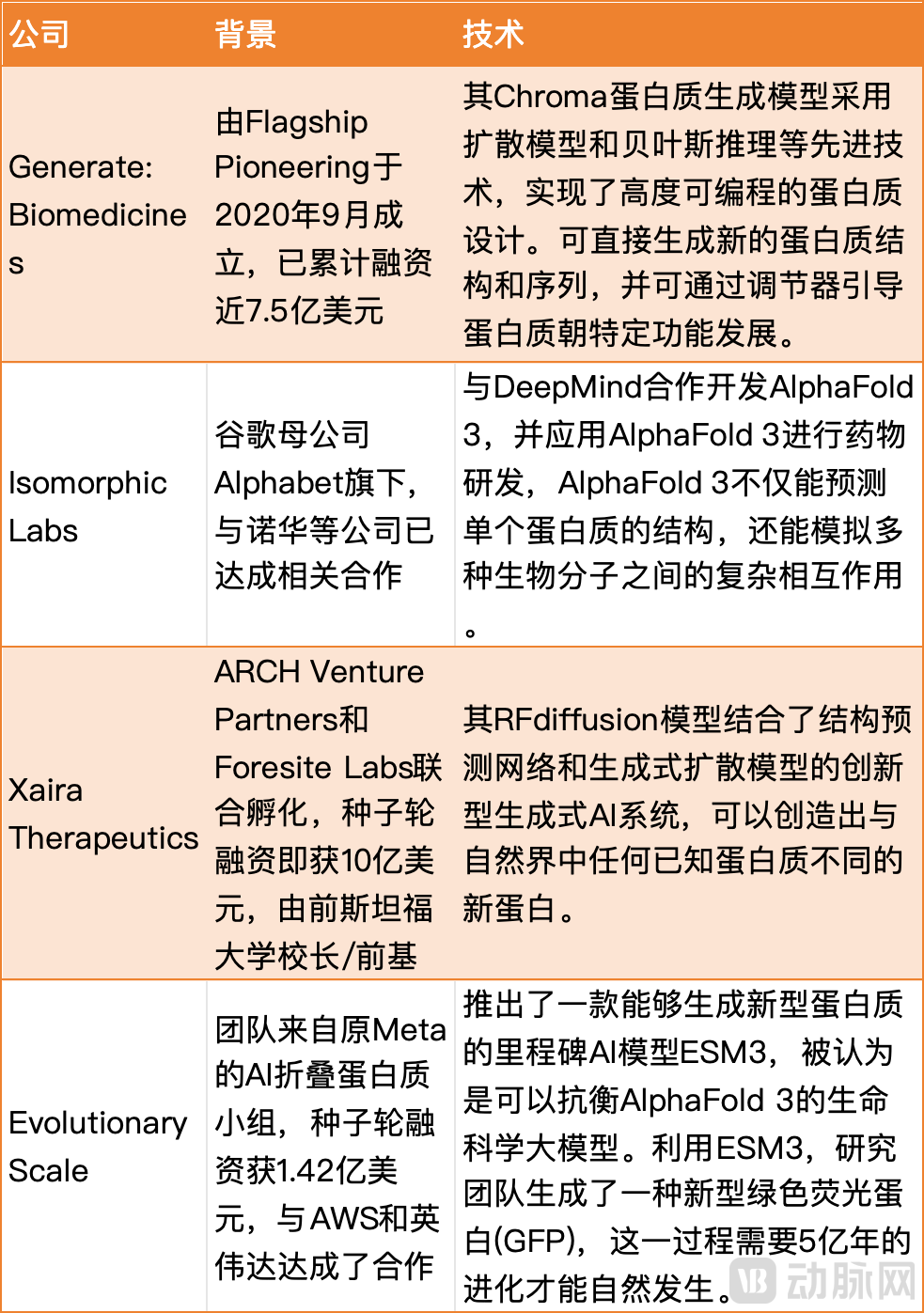
According to MedMarket Insights, the global market size for AI-driven protein solutions reached $1.483 billion in 2023 and is projected to grow to $17.8 billion by 2031, representing a compound annual growth rate (CAGR) of approximately 36.5%.
However, the barriers to entry for carving out a share of this increasingly enticing market are rising. Beneath the allure of rapid technological iteration lie prohibitive training costs. It is evident that these companies have not only secured early-stage financing on a scale far exceeding that of typical biopharmaceutical startups, but their substantial R&D expenditures and long investment horizons also necessitate backing from industry giants and prestigious institutions, while their teams boast truly stellar credentials.
It is worth noting that among the first generation of AI-driven drug discovery companies, Exscientia raised just over $100 million in funding during the nearly decade-long period from its founding in 2012 to 2020. During its first four years of operation, the company secured only negligible amounts through small-scale financing or research grants. Meanwhile, Chris Gibson, the founder of Recursion, was still pursuing his PhD when he established the company.
It is now exceedingly difficult to launch “small and beautiful” AI-driven drug discovery startups. Backed by substantial financial resources, the new generation of AI pharmaceutical companies has once again become the focus of high market expectations, with stakeholders hoping they will realize the vision that the first wave of AI drug discovery companies failed to achieve a decade ago.But to put it more bluntly, these new companies have already left the first wave of AI drug discovery firms high and dry.
Will China keep up in this round?
In fact, it is not just “AI + protein”; broadly defined AI drug discovery companies in North America are securing financing with increasing frequency. In the first half of 2024, several AI drug discovery companies raised over $100 million in funding.
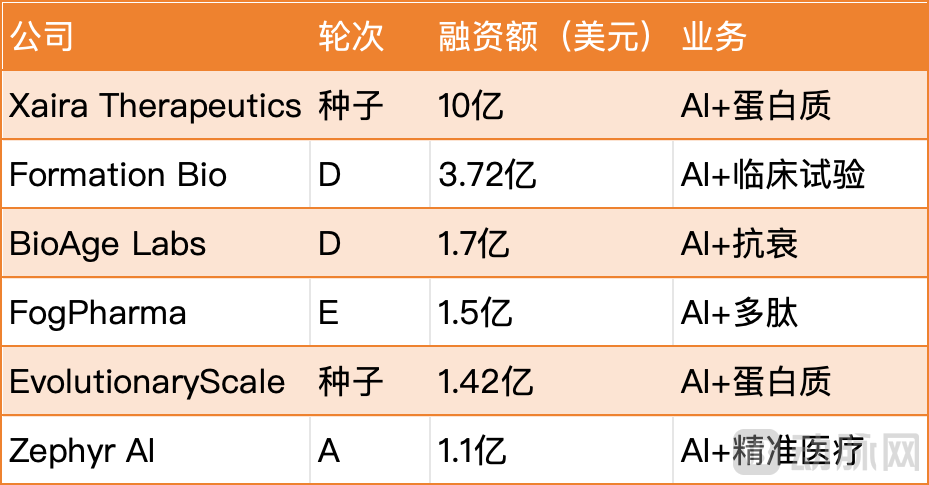
AI Drug Discovery Companies That Raised Over $100 Million in Financing in the First Half of 2024
Beyond “AI + proteins,” the intersection of AI and biopharmaceuticals is yielding more diverse and sophisticated applications.
For example, Formation Bio provides pharmaceutical companies with clinical trial technology tools and streamlines clinical trial processes through AI automation. By leveraging customized large language models to handle tasks such as medical writing and protocol development, Formation Bio can significantly enhance efficiency; for instance, its AI can generate adverse event reports within minutes. Its ultimate goal is to develop AI models capable of predicting toxicity, tolerability, and efficacy.
For another example, FogPharma’s Helicon platform combines highly diverse and tunable stable helical peptides with customized computational physics and AI, encompassing target assessment, high-throughput screening, data analysis, structure prediction, and optimization. This enables the discovery and development of potential peptide drugs against a vast array of intracellular targets that were previously considered undruggable, with particular strengths in handling large-scale data and optimizing complex molecular structures.
However, the domestic market does not appear to be following this wave of AI biotechnology.
In the first half of 2024, disclosed financing in China’s AI-driven drug discovery sector totaled less than RMB 2 billion. Market investors showed a greater preference for early-stage and smaller projects, with only four deals exceeding RMB 100 million during this period—a significant decline from the 13 such deals recorded in the first half of 2022.
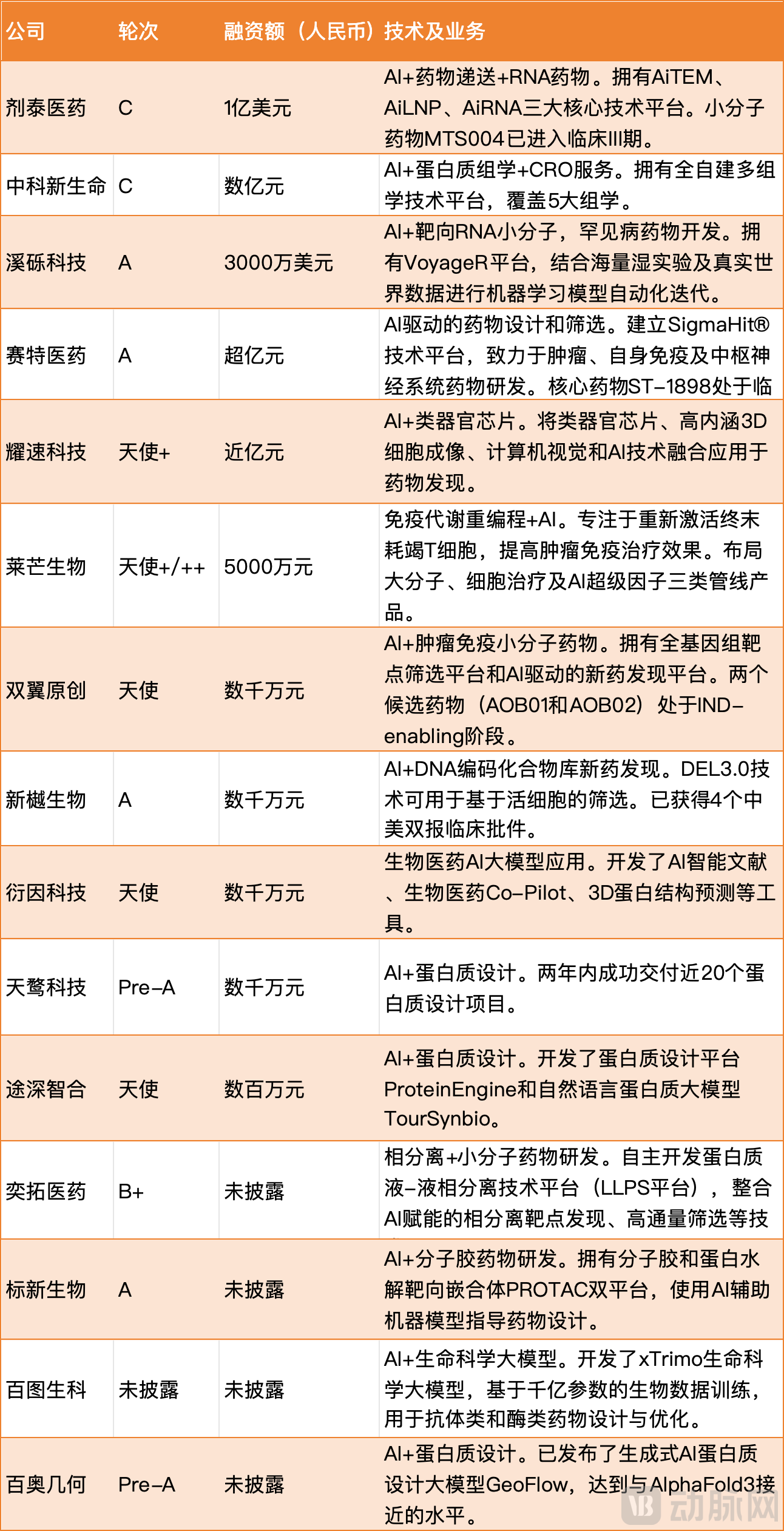
Domestic AI Drug Discovery Companies That Secured Financing in the First Half of 2024, Compiled from Public Sources
From a business model perspective, newly funded AI drug discovery companies in China also exhibit significant differences from their North American counterparts.
Overall, AI-driven drug discovery in China is currently concentrated in areas such as protein structure prediction, protein function prediction, protein design, RNA structure prediction, RNA design, target discovery, and the generation and optimization of small-molecule ligands. This has led to severe homogeneous competition, making it difficult to raise unit prices. Industry insiders have pointed out that quotes for large-molecule optimization and design projects are merely RMB 300,000 to 400,000.
Certainly, there are also companies in China at the forefront of technological competition.
For instance, BioMap has developed “xTrimo,” the world’s first and largest multimodal pre-trained model for life sciences, to address the most complex challenges in the field. Meanwhile, Biologix AI has released GeoFlow, its latest generative AI large model for protein design, which can simultaneously perform two critical tasks: predicting the structure of antigen-antibody complexes and designing antibodies.
Drawing on the development of emerging “AI + protein” companies in North America, AI-driven drug discovery firms pursuing more disruptive innovations require sustained and substantial capital support. In the biopharmaceutical financing market, it is not easy to secure additional funding for cutting-edge AI-based drug development. A significant disparity in momentum has emerged between China and the United States in the fields of “AI + biopharmaceuticals” and “AI + life sciences.”
Ultimately, AI-driven drug discovery must be judged by its tangible outcomes. Despite significant advancements in AI technology in recent years, bottlenecks inherent to actual drug development—such as the need for sufficient experimental data, protracted clinical trial cycles, and regulatory requirements—continue to constrain the full realization of AI’s potential. Even the most cutting-edge AI pharmaceutical companies do not claim that AI can completely replace traditional experimental processes; rather, they are committed to making these processes more efficient and increasing the probability of success.
“The bottleneck in pharmaceutical development remains in clinical trials.“Expectations for AI-driven drug discovery companies in the clinical stage still hinge on their ability to consistently demonstrate positive data,” said a relevant investor.
AI-driven drug discovery companies with proprietary R&D pipelines continue to be highly favored. For instance, Insilico Medicine just announced this week that its pan-TEAD inhibitor, ISM6331, received Investigational New Drug (IND) clearance from the U.S. FDA in July for the treatment of mesothelioma, bringing the total number of its innovative molecules approved for clinical trials to nine.
In any case, in the rapidly evolving intersection of biopharmaceuticals and AI—where technologies and achievements are advancing at a breathtaking pace—transformation is the only path to survival.As NVIDIA CEO Jensen Huang stated: “Every company’s natural state is on the brink of extinction; either innovate continuously or go bankrupt within 30 days.”