

TrialNet Launches Innovative 'Internet + AI' Patient Recruitment Model Amid Digital Transformation of Clinical Trials
Patient recruitment is one of the most critical components of clinical research. In the vast majority of cases, this process spans months or even years. Research data indicate that over 80% of clinical trials fail to complete patient enrollment within the scheduled timeframe. Consequently, breaking free from the constraints of traditional recruitment models and adopting more innovative, efficient, stable, and compliant approaches to patient recruitment has become an imperative consideration for all sponsors.
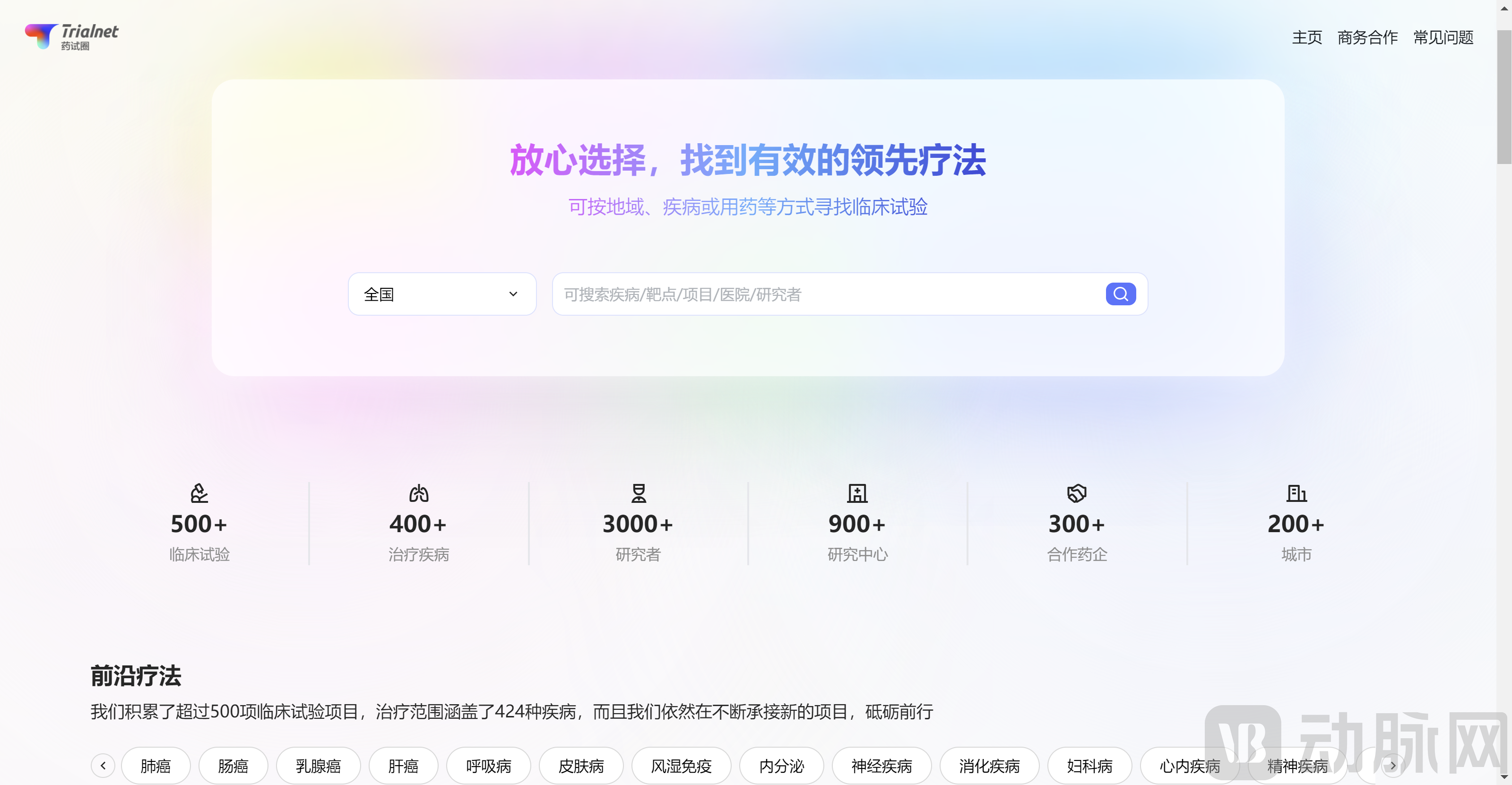
Yao Shi Quan (www.trialnet.cn) is expected to provide a novel solution to this challenge.
Compared to the inherent limitations of traditional recruitment models—such as geographic constraints, limited channels, and difficulties in communication—YaoShiQuan leverages an internet-based platform to implement an “Internet + AI” recruitment strategy. This approach effectively expands the recruitment scope, enabling potential patients to access trial information via online channels. It facilitates an integrated collaborative workflow that includes information review, screening, online informed consent, voluntary registration, upload of assessment materials, and review by Clinical Research Coordinators (CRCs). This innovative model not only provides sponsors with access to a broader pool of patient resources but also significantly enhances recruitment efficiency and compliance, ensuring real-time transparency and visibility of recruitment progress.
Recently, we interviewed Ms. Ma Fan, Director of Subject Recruitment for R&D at Shengfang Pharmaceutical, to discuss this innovative model. Our in-depth conversation covered a detailed exposition of the “Internet + AI” recruitment approach, the deep integration of AI technologies, and the significant value it delivers to sponsors.
The following are the main points of the interview:
1Why Conduct “Internet + AI” Recruitment?
Ma Fan: Traditional recruitment refers to the practice where recruitment specialists conduct subject enrollment within the geographic vicinity of the clinical trial sites. Taking a late-stage liver cancer project as an example, if patients with advanced hepatocellular carcinoma need to be recruited, the conventional approach involves dispatching staff to the medical oncology departments of hospitals for promotional activities. These activities may include placing roll-up banners and posters, or sharing information via social media platforms such as WeChat Moments. Interested patients can register with the recruitment specialist, who then compiles the patients’ medical histories and conducts preliminary screening based on the protocol criteria (in some large companies, this screening task is delegated to medical specialists). Patients who meet the eligibility criteria are subsequently referred to the investigational department for face-to-face consultation with the investigator physician, where they undergo informed consent signing, examinations, and drug administration. The recruitment process is considered complete once drug administration is initiated.
2What capabilities are required to excel in recruitment?
Ma Fan: Traditional patient recruitment places high demands on practitioners. Although the barrier to entry is low, the role requires a broad knowledge base, involves substantial repetitive tasks, and frequently entails handling unexpected situations, thus demanding strong comprehensive professional capabilities.
First, from the perspective of medical and pharmaceutical knowledge, recruitment for anticancer drugs alone involves hundreds of disease types and their corresponding pharmacological mechanisms. For most people, acquiring a comprehensive foundational understanding of this knowledge requires at least five years of accumulated experience. And this pertains solely to the medical domain.
Furthermore, there are regulatory requirements, such as the Good Clinical Practice (GCP) for Drug Clinical Trials, the Measures for the Administration of Medical Advertisements, and the Declaration of Helsinki. As a practitioner, you cannot disregard these; you must demonstrate professional competence and avoid engaging in unethical manipulations or making irresponsible statements.
Furthermore, participation requirements vary across projects; research site procedures and screening timelines are also subject to dynamic updates. Recruitment staff must maintain close collaboration with external vendor teams and stay fully informed of these changes to ensure effective communication and coordination. Failure to do so may misalign participant expectations—either lowering or raising them—leading to scheduling chaos and potential disputes.
Finally, the vast majority of participants hold biases toward clinical trials, viewing themselves as “guinea pigs” or harboring unrealistic expectations about drug efficacy; therefore, recruiters must provide an objective and clear explanation of the background of the clinical study from the outset.
These are all hard skills that can be acquired through training.
As professionals, practitioners must also possess soft skills. Many trial participants are patients with heightened sensitivity. In the event of unexpected situations, qualified practitioners must know how to communicate and coordinate in a compliant and efficient manner to resolve issues while safeguarding the rights and interests of all parties involved.
3How does the “Internet + AI” recruitment model pioneered by Yaoshiquan differ from traditional recruitment models?
Ma Fan: The processes are quite different, and the tools used also vary.
Traditional recruitment still relies on WeChat, posters, Excel spreadsheets, and PDF documents to recruit and manage study participants. For practitioners, this involves substantial repetitive work; information details are easily overlooked during cross-enterprise communication and collaboration, and participant data is difficult to trace or hand over when staff turnover occurs. For participants, questions related to the project cannot be answered promptly. From a management and reporting perspective, consolidating project status and conducting reviews require significant labor hours, leading to wasted resources, reduced work efficiency, and a poor user experience.
All operations within the Drug Trial Circle are managed through a fully digitalized system, with AI providing substantial assistance across many tasks.
For instance, when subjects register for clinical trials online, our system automatically guides them to submit their medical history. AI instantly analyzes the documents uploaded via photos and provides feedback on whether the subject matches the eligibility criteria for the trial. As a result, subjects pass the “intelligent matching” process and gain a preliminary understanding of the projects they are eligible for before staff contact them. This significantly enhances communication efficiency and saves considerable time.
For patients who register via traditional internet channels, the process begins with a phone call during which staff must first introduce their company to establish initial trust. They then add the potential subject on WeChat to collect their medical history. After organizing this information, staff search the project database for suitable clinical trials and provide the subject with a preliminary overview of the matched projects. This entire workflow suffers from low conversion rates and compromises the subject’s experience.
In addition to scenarios where participants self-enroll, we have also applied AI in project reporting, document management, and collaborative work. This has significantly reduced repetitive tasks. Thanks to these tool upgrades, our team members can handle a broader range of work scenarios, accelerating their professional growth. Meanwhile, our partners experience reduced workloads, improved collaboration efficiency, smoother project management, and an enhanced participant experience.
4“YaoShiQuan” actually only began subject recruitment around 2022, by which time there were already a cohort of industry leaders with approximately ten years of presence. It is widely believed that the period of most rapid industry growth was from 2014 to 2019, and achieving significant growth in recruitment has become challenging in the current landscape. However, your enrollment data has been growing very rapidly. How have you achieved this?
Ma Fan: Yes, the data growth of Yaoshiquan in recent years has been very rapid, exceeding many people's expectations.
I entered the subject recruitment industry in 2022. Although market leaders already existed at that time, recruitment remained a primary bottleneck hindering the progress of clinical trials. Many projects had to open additional sites, suffer delays, or even be abandoned midway due to recruitment difficulties, resulting in resource loss and waste. Consequently, many drugs failed to reach the market for patient use. Believing that we could do better, we decided to take on this challenge.
Although 2014–2019 was a period of rapid growth and high profitability under the traditional model, this growth was driven by initial market development from scratch. With the business model remaining unchanged for years, many small companies began adopting the same approach to recruit participants, leading to severe hypercompetition within the industry. Therefore, from the outset, we had no intention of employing a mass-recruitment strategy to capture market share.
We have been addressing the industry’s persistent challenges through technological and process optimization. We have invested significant effort in developing the Yaoshiquan Subject Recruitment System, which integrates a range of AI technologies, including disease knowledge graphs, optical character recognition (OCR), and large language models (LLMs).
● During the clinical trial enrollment process, if general cancer patients lack physician assistance and struggle to understand hospital records or clinical study protocols, we leverage AI to help them compile medical histories and identify suitable trials, presenting the results in an easily understandable format. For example: “Patient Zhang San has a 60% match with Trial A, located 456 km from the center, and a 100% match with Trial B, only 2 km away.” This approach ensures clarity and empowers patients to make informed, autonomous decisions.
● During sponsor reporting sessions, our Project Managers (PMs) no longer need to spend time compiling data, creating tables, sending report emails, or calculating costs. The system’s Business Intelligence (BI) capabilities can automatically generate various visual reports, analytical charts, and pricing schedules, while automated bots can deliver updates and send project progress reports.
These applications genuinely deliver convenience and delight to users, thereby driving rapid growth in our business performance. We have seen a substantial volume of patient registrations; for instance, in the case of psoriasis, daily new registrations exceed 100. After using our app, enrolled patients gain a preliminary understanding of clinical trials and make informed choices, which significantly boosts their willingness to participate. Moreover, many competitors relying on traditional recruitment methods are eager to collaborate with us, specifically to leverage our AI system. The recruitment speed for subjects with chronic diseases and tumors has far exceeded client expectations.
Beyond this, we are also exploring applications in a wider range of scenarios. The rapidly evolving landscape of large language models (LLMs) continues to deliver many surprises, and we are closely following these developments while gradually implementing them in practice. In the near future, we will launch even more intelligent products and services.
In the future, as technology iterates and AI lowers cognitive barriers, an increasing number of ordinary people will be able to understand clinical research, overcome biases, and participate in clinical trials. This represents the market growth area we value most.
5Could you please introduce your team and the scale of your business?
Ma Fan: Currently, our team consists of two parts: Product & R&D and Operations. The Operations team has six members, responsible for undertaking and delivering subject projects, managing subject follow-ups, etc. The Product & R&D team, comprising approximately ten members, is in charge of product design, development, and launch. Additionally, we have numerous bots handling tasks such as follow-ups, reporting, medical matching, and Q&A.
To date, we have undertaken more than 900 subject recruitment projects, with approximately 100 subjects completing enrollment each month.
6Do you think traditional recruitment models may be replaced by AI-powered intelligent recruitment in the future?
Ma Fan: The workflow for subject recruitment is lengthy. While AI cannot yet replace tasks involving patient services and humanistic care, teams that fail to adeptly leverage new tools may be gradually eliminated from the market within three to five years due to intensifying competition and sluggish growth.
7Data security and patient privacy protection have been issues of significant concern in recent years. How does YaoShiQuan address these challenges?
Ma Fan: YaoShiQuan has always placed a high priority on compliance. In this regard, we have obtained numerous certifications and established a comprehensive system for data security and patient privacy protection.
● When patients register, they are required to sign a privacy authorization agreement with the platform, consenting to the use of their personal medical data for project screening and matching in all clinical studies conducted on the platform.
● Upon receiving patient data, the platform encrypts personally identifiable information entered during registration. Additionally, AI automatically redacts privacy-sensitive elements in photographic materials, such as names, national ID numbers, and phone numbers, ensuring that software users cannot view patients’ personal information when accessing their records.
● In China, the widely accepted regulations regarding patient data ownership stipulate that data related to intellectual achievements, such as diagnosis and treatment outcomes, are jointly owned by hospitals and individual patients, while laboratory test results belong solely to the individual patient (as per the "Administrative Specifications for the Application of Electronic Medical Records (Trial)"). If a patient voluntarily photographs and uploads their disease-related information to a platform for participation in clinical research and provides appropriate authorization, the process is considered compliant, provided that the platform ensures data security and privacy protection, and the scope of use remains within the agreed-upon limits.
● Yaoshiquan has obtained international and national certifications, including ISO/IEC 27001 Information Security Management System, China’s Classified Protection of Cybersecurity Level 3, the General Data Protection Regulation (GDPR), and the Health Insurance Portability and Accountability Act (HIPAA). These certifications not only demonstrate our professionalism but also underscore our commitment to data security and privacy protection.
This concludes the interview regarding YaoShiQuan’s intelligent patient recruitment services.
Amidst the transformation of clinical trial subject recruitment driven by the digital wave, the exploration of a new “Internet + AI” recruitment model initiated by Yaoshi Quan has revealed alternative possibilities and opportunities for the implementation of new technologies in the field of clinical research. It is foreseeable that future AI technologies will achieve qualitative leaps in precision, adaptability, and intelligence. From disease prediction and diagnostic assistance in healthcare to intelligent driving and traffic flow optimization in transportation; from quality inspection and process automation in industrial production to smart home solutions and personalized services in daily life, the application scope of AI technology is vast, injecting new momentum into social development and bringing unprecedented convenience and innovation to people’s lives.
Drug Trial Circle looks forward to collaborating with all stakeholders in the industry, continuously leveraging AI technology to support the development of innovative drugs in China.