

Shijiazhuang Pharma's CAR-T Therapy SYS6020 Granted IND Approval for Refractory Systemic Lupus Erythematosus

CSPC
Innovative Drug Research and Development, Manufacturer
Recently, according to the public notice on the official website of the Center for Drug Evaluation (CDE) under China’s National Medical Products Administration, CSPC’s CAR-T product, SYS6020 Cell Injection, developed by its subsidiary CSPC Zhongqi Pharmaceutical Technology (Shijiazhuang) Co., Ltd. (hereinafter referred to as “CSPC”), has been approved for clinical trials. It is intended for the treatment of refractory active systemic lupus erythematosus (SLE).
This approval marks a significant achievement for CSPC in the field of cell therapy. It is reported that no CAR-T therapy has been approved globally for the treatment of systemic lupus erythematosus (SLE). SYS6020 Cell Injection, which targets the BCMA antigen, is expected to provide a new, lower-cost treatment option for SLE patients.
Specifically recognizes the BCMA antigen, with favorable safety and efficacy.
SYS6020 is an mRNA-LNP-based chimeric antigen receptor (CAR)-T cell injection, and it is also the first mRNA-LNP-based CAR-T cell therapy candidate globally approved for clinical trials.
By expressing a chimeric antigen receptor (CAR) that specifically recognizes the BCMA antigen, this product binds to BCMA on the surface of mature B lymphocytes and plasma cells, thereby targeting and eliminating these immune cells, reducing elevated autoantibody levels, and achieving therapeutic efficacy. It represents a novel, safe, and effective potential treatment option for patients with systemic lupus erythematosus (SLE).
Compared with traditional CAR-T products, SYS6020 offers the advantages of high cell viability, high CAR-positive rate, no risk of tumorigenesis caused by genomic integration, and low incidence of side effects such as cytokine release syndrome (CRS).
Preclinical studies have demonstrated that this product can significantly kill BCMA antigen-positive myeloma cells and exhibits a favorable safety profile. In terms of cost, the use of LNP-transfected T cells can reduce the high expenses associated with lentiviral vectors, thereby alleviating the financial burden on patients.
SYS6020 is also the first cell therapy product under development in CSPC’s portfolio. In late June of this year, SYS6020 cell injection received its first clinical trial approval in China, with plans to develop it for the treatment of relapsed or refractory multiple myeloma (MM). Preclinical studies have shown that it can significantly kill BCMA antigen-positive myeloma cells and exhibits a favorable safety and efficacy profile. At that time, CSPC announced that, in addition to the indication for multiple myeloma, SYS6020 also holds potential for treating autoimmune diseases such as systemic lupus erythematosus and myasthenia gravis.
The approval of this clinical trial for the SLE indication marks another significant achievement in CSPC’s strategic layout in the cell therapy field, laying a solid foundation for the development of other cell therapy products, such as in vivo-generated CAR-T.
Traditional Therapies Have Severe Side Effects, While CAR-T Therapy Achieves Precision Targeting
Systemic lupus erythematosus (SLE) is a complex, chronic, systemic autoimmune disease in which the body's immune system attacks its own tissues, with a complex pathogenesis. According to the "Chinese Guidelines for the Diagnosis and Treatment of Lupus Nephritis," the incidence of SLE in China ranges from 30.13 to 70.41 per 100,000 people, corresponding to an estimated patient population of 422,000 to 986,000.
This disease is difficult to cure and requires long-term medication, but traditional treatment methods are prone to causing side effects. Data from the Chinese Systemic Lupus Erythematosus Research Alliance (CSTAR) shows that 84.13% of SLE patients in China are undergoing glucocorticoid therapy, with some patients receiving excessively high doses for maintenance treatment, leading to an increased incidence of adverse reactions as the dosage rises.
Biologics are emerging therapies that have transformed the treatment paradigm for systemic lupus erythematosus (SLE) in recent years. By interfering with signaling pathways of the immune system, they suppress abnormal immune responses and reduce autoimmune attacks on self-tissues. Additionally, they modulate specific immune cells, such as T cells and B cells, to mitigate their detrimental effects on bodily tissues. Biologics have reduced the dependence of SLE patients on corticosteroids; however, only three drugs have currently been approved for marketing worldwide: belimumab, telitacicept, and anifrolumab.
In recent years, CAR-T cell therapy has demonstrated remarkable efficacy in refractory systemic lupus erythematosus, bringing a ray of hope to this challenging field.
Compared with conventional therapies, CAR-T therapy offers distinct advantages. First, a key pathogenic mechanism of systemic lupus erythematosus (SLE) is the “rogue” behavior of B cells, which misidentify self-components as “foreign invaders,” thereby triggering immune responses and producing autoantibodies against host tissues, leading to multi-organ damage. Consequently, eliminating these “rogue” B cells and the antibodies they produce represents a major therapeutic direction in SLE management. CAR-T therapy achieves precise targeting by genetically engineering T cells ex vivo to express proteins that specifically recognize “rogue” B cells, followed by reinfusion of the modified T cells to clear these aberrant B cells. In contrast to the non-selective action of conventional treatments, the precision targeting of CAR-T therapy constitutes its greatest advantage.
Secondly, the types of antibodies secreted by B cells reconstituted after CAR-T therapy differ significantly from those present before treatment, indicating that the depletion of autoreactive B cells plays a broader role in immune remodeling. Furthermore, while biologics require repeated infusions to achieve sustained blockade of relevant signaling pathways, CAR-T therapy enables continuous and profound depletion of target B cells with a single infusion. This is an advantage unattainable with conventional therapies or biologics.
Moreover, systemic lupus erythematosus (SLE) is a more straightforward target for CAR-T cell therapy than B-cell malignancies. In the treatment of B-cell malignancies, due to tumor antigen heterogeneity, it is necessary to manufacture and assemble different types of CAR-T cells targeting distinct antigens; therefore, the selection of CAR-T targets constitutes a key focus and challenge in their clinical application.
Currently, most clinical studies in the treatment of systemic lupus erythematosus (SLE) are designed to target CD19 with CAR-T therapy. By combining T cell-based therapies with pre-treatment lymphodepletion regimens, dysfunctional B cells can be successfully eliminated and the immune system rebuilt, thereby achieving effective control of SLE.
In terms of dosage and side effects, cytokine release syndrome (CRS) and immune effector cell-associated neurotoxicity syndrome (ICANS) are common adverse events associated with CAR-T therapy. Since the number of target B cells in patients with systemic lupus erythematosus (SLE) is significantly lower than that in patients with tumors, the risk of CRS induced by CAR-T therapy is reduced. On the other hand, the lower B-cell burden decreases the required dose of infused CAR-T cells, thereby limiting unnecessary CAR-T cell toxicity and reducing the incidence of immune effector cell-associated neurotoxicity syndrome.
Therefore, compared with cancer patients, SLE patients receiving CAR-T therapy will have better safety due to the smaller proportion of targeted cells. However, larger-scale studies and longer-term follow-up are still needed to confirm its long-term safety.
Multiple pharmaceutical companies in China and abroad have entered the field, with most pipelines still in early-stage clinical trials.
CAR-T Therapy Offers New Directions for Treating Systemic Lupus Erythematosus, But Why Has It Not Yet Been Widely Adopted in Clinical Practice for SLE? The Long-Term Efficacy and Safety of CAR-T Therapy Require Further Investigation, and Its Feasibility Needs Additional Validation.
Currently, CAR-T therapy is limited to small-sample clinical studies. To achieve true clinical application, larger-scale clinical trials are required to confirm the efficacy and safety of CAR-T therapy. Meanwhile, although CAR-T therapy theoretically enables precise clearance of B cells and restoration of B-cell function, thereby effectively controlling SLE activity, there is currently no relevant data on its long-term effectiveness.
Furthermore, although current small-sample clinical studies have confirmed that CAR-T cell therapy for autoimmune diseases has an excellent overall safety profile, with some patients experiencing only mild cytokine release syndrome (CRS), long-term safety requires extended follow-up and further validation. It remains unclear whether systemic lupus erythematosus (SLE) patients treated with CAR-T therapy face an increased risk of associated malignancies and infections during long-term follow-up, or whether their overall life expectancy can be prolonged.
Currently, multiple cell therapy companies both domestically and internationally have actively established R&D pipelines for CAR-T drugs to treat autoimmune diseases such as systemic lupus erythematosus (SLE), including Jiute Biotech’s relmacabtagene autoleucel injection and Gracell Biotechnologies’ CD19/BCMA dual-target CAR-T.
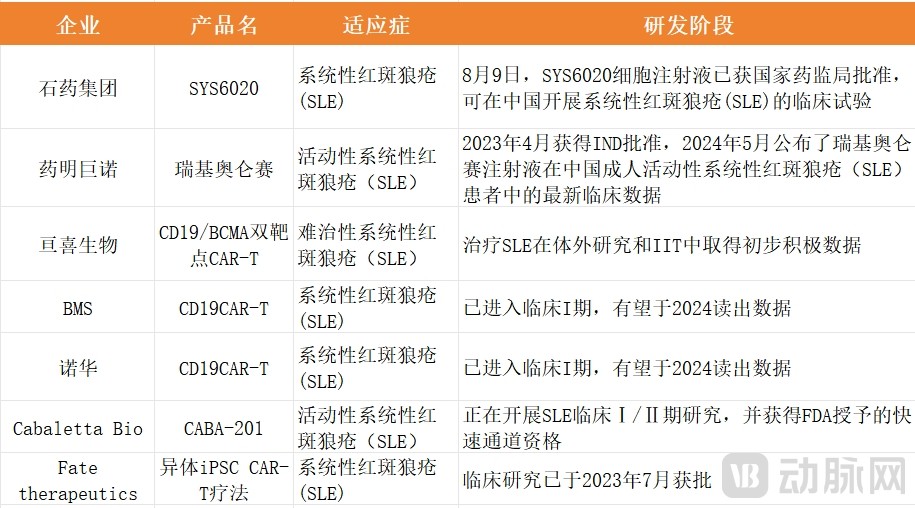 CAR-T R&D Pipelines for the Treatment of Autoimmune Diseases Such as SLE: Domestic and International Landscape (Incomplete Statistics)
According to incomplete statistics, among the seven CAR-T drug candidates currently in development worldwide for the treatment of systemic lupus erythematosus (SLE), three have entered clinical trials. The most advanced is Cabaletta Bio’s CABA-201, which is undergoing Phase I/II clinical studies in SLE and has been granted Fast Track designation by the U.S. Food and Drug Administration (FDA).
Among these, there are numerous CAR-T product pipelines under development in China for the treatment of SLE; however, the vast majority remain in investigator-initiated trials (IITs), with only a handful having advanced to registrational clinical development.
In the future, whether CAR-T therapy for lupus erythematosus will succeed remains to be determined by further clinical data. We look forward to favorable outcomes from these clinical trials, which would help establish CAR-T as a safer, more effective, and truly clinically viable treatment option for patients with systemic lupus erythematosus (SLE).
References:
CAR-T Therapy for Lupus? Doctor: No Data Yet on Long-Term Efficacy and Safety—The Paper
Multiple Pharmaceutical Companies Are Positioning CAR-T Therapy for Lupus, but Widespread Adoption Will Take Time — People's Daily Health Client