

Domestic Endoscopes Surge as Olympus Scrambles to Respond

Olympus
Precision Machinery and Instrumentation R&D, Production, and Sales
The endoscopy market is truly undergoing a seismic shift!
In the domestic endoscopy sector, a surge in sales, technological breakthroughs, new product launches, and increased investment and financing have converged. Under these multiple factors, Chinese endoscopy companies have finally achieved phased results in the first half of 2024 for the long-advocated goal of “domestic substitution.”
In contrast, the market share of overseas giants such as Olympus in China’s endoscopy market has continued to decline. As shown in Olympus’s previously released 2024 financial report: during the reporting period, factors such as product recalls due to issues, anti-corruption campaigns in the pharmaceutical and medical sectors, and delays in bidding and procurement activities affected performance,Its sales in China decreased by 10% year-on-year.。
Olympus Is Truly Feeling the Pressure. To address challenges such as the rise of domestic Chinese brands and policy support for the procurement of locally produced equipment, Olympus has built a new endoscope components factory in Suzhou, launched new products including single-use ureteroscopes, endoscopic ultrasound systems, and AI-assisted diagnostic systems, and announced in late July its continued investment in the Chinese market.
With the rise of domestically produced endoscopes on one hand and Olympus’s continued investment in the Chinese market on the other, it is foreseeable that domestic endoscope manufacturers and overseas giants such as Olympus will engage in a smokeless war within the domestic market. From multiple perspectives,Domestic Endoscopes Are Experiencing an Unstoppable Surge。
For a long time, China’s endoscopy market has been monopolized by overseas companies, with global giants such as Olympus, Pentax, and Karl Storz consistently accounting for approximately 90% of the market share.
However, in the first half of 2024, the market share of domestically produced endoscopes increased significantly, showing a trend of overtaking imported brands. According to bidding and tendering data, the five major overseas giants—Olympus, Fujifilm, Karl Storz, Hoya, and Stryker—collectively accounted for approximately 60% of China’s endoscope market, a substantial decline from their previous 90% share. Meanwhile, domestic companies such as Aohua Endoscopy, Mindray Medical, Sonoscape Medical, OptoMedic, and Shixin Medical have all entered the top ten in sales rankings, collectively capturing around 15% of the market.
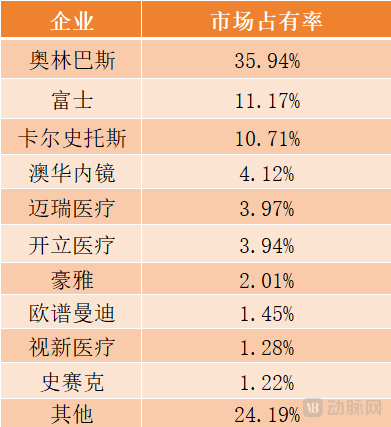
(2024 H1 China Endoscope Market Landscape, Data Source: Zhongcheng Medical Devices)
Among them, Aohua Endoscopy’s 2024 semi-annual performance forecast indicates that the company’s revenue for the first half of the year is expected to range from RMB 345 million to RMB 357 million, representing a year-on-year increase of 19.55% to 23.74%. The revenue growth was primarily driven by the company’s intensified product promotion, product upgrades and iterations, expanded coverage across hospitals of all tiers, and enhanced brand influence.
In fact, Aohua Endoscopy has experienced ultra-high-speed growth since last year: in 2023, its revenue reached RMB 678 million, a year-on-year increase of 52.29%. Meanwhile, Aohua Endoscopy successfully entered the high-end endoscope market, leading to a significant surge in profit margins, as evidenced by its 361.42% year-on-year growth in net profit excluding non-recurring items in 2023.
It is not just Aohua Endoscopy; listed companies such as Sonoscape Medical, Mindray Medical, Micro-Tech (Nanjing), and Angios are also highly competitive. For instance, Sonoscape Medical recorded RMB 850 million in revenue from endoscopes and endoscopic therapeutic instruments in 2023, a year-on-year increase of 39.02%; Mindray Medical’s rigid endoscopy systems rose to the third-largest market share in China; Micro-Tech (Nanjing) generated RMB 2.02 billion in revenue from endoscopic consumables, up 26.36% year on year; and Angios, a leading enterprise in the digestive endoscopy field, achieved RMB 508 million in revenue, representing a 37.09% year-on-year growth.
Furthermore, innovative companies in the endoscopy sector have successfully entered the market. For instance, OptoMedic’s 4K optical 3D fluorescence laparoscopic system has seen steady growth in orders since its launch in August 2023; Bosun Medical’s endoscopy system has been deployed in nearly 800 hospitals across China, and in 2024, the company made a significant move by launching an integrated endoscopic diagnosis and treatment solution featuring 3D, 4K, and fluorescence capabilities.Deep Expertise in the Ultra-Fine Endoscopy FieldAfter 24 years in the femtosecond medical sector, the company once achieved nearly RMB 100 million in sales for a single product. It has now completed the development of a prototype for a disposable ultra-thin endoscope and is set to launch its next-generation product on the market.
Notably, domestic innovative enterprises have also achieved significant breakthroughs in emerging markets such as single-use endoscopes, confocal laser endomicroscopy, and endoscopic ultrasound.
Disposable Endoscope Market: Disposable Flexible Ureteroscopes Lead in Large-Scale Adoption. It is reported that in 2023, domestic sales of disposable flexible ureteroscopes in China reached approximately 150,000 units. Among them, Chinese manufacturers such as Ruipai Medical, Hongji Medical, and Happy Factory have all achieved mass sales, with some companies holding a dominant position in multiple provinces across China and ranking among the top in terms of market share.
Furthermore, the industry predicts that disposable endoscopes will experience explosive growth in 2024, with scaled adoption extending beyond urology to other clinical departments.
Confocal Laser Endomicroscopy Market: Since commercializing its confocal laser endomicroscopy system in 2022, Jingwei Shida has deployed the technology in more than 200 high-level hospitals, including Wuhan Tongji Hospital, Beijing Friendship Hospital, Shanghai Changhai Hospital, and West China Hospital of Sichuan University. It is understood that confocal laser endomicroscopy offers micron-level resolution and optical sectioning capabilities. Due to the significant technical challenges and high barriers to entry, only a few companies worldwide currently master this technology. Jingwei Shida has obtained the first medical device registration certificate for confocal laser endomicroscopy in China and the second globally, and continues to iterate and upgrade its products.
The endoscopic ultrasound market was long monopolized by foreign companies such as Olympus, Fujifilm, and Hoya. However, Chinese enterprises have not only broken this monopoly but also successfully risen to the forefront of the market. According to data from Yizhuang Shusheng, Sonoscape Medical ranked third in endoscopic ultrasound sales volume in the first half of 2024, with domestic companies such as Angmed Medical and Lepu Zhiying following closely behind.
Nowadays, Chinese enterprises have broken through barriers in many niche fields such as flexible endoscopes, rigid endoscopes, single-use endoscopes, confocal laser endomicroscopy, and endoscopic ultrasound, achieving a certain degree of domestic substitution. With policy support, product promotion, and technological iteration, domestically produced endoscopes will further seize market share and increase the rate of localization.
In the first half of 2024, the global investment and financing market remained on a downward trend. However, investment and financing activities in China’s endoscopy sector showed no signs of decline.
According to incomplete statistics, in the first half of 2024, endoscopy companies such as Ruipai Medical, Lingmou Medical, Hongji Medical, Cosmedent, DPM, Jingwei Shida, Zhuowai Medical, Jiyuan Medical, Xingchenhai Medical, Yingshu Life, and Tuge Medical all completed new rounds of financing, with some even securing two consecutive rounds. Notably, despite a slowdown in investment and financing activities in 2023, more than 20 domestic endoscopy companies still successfully raised funds.
As industry uncertainty becomes increasingly pronounced, investors are turning their attention to projects with greater certainty. Endoscopy is one of the sectors collectively favored by domestic investors in China.
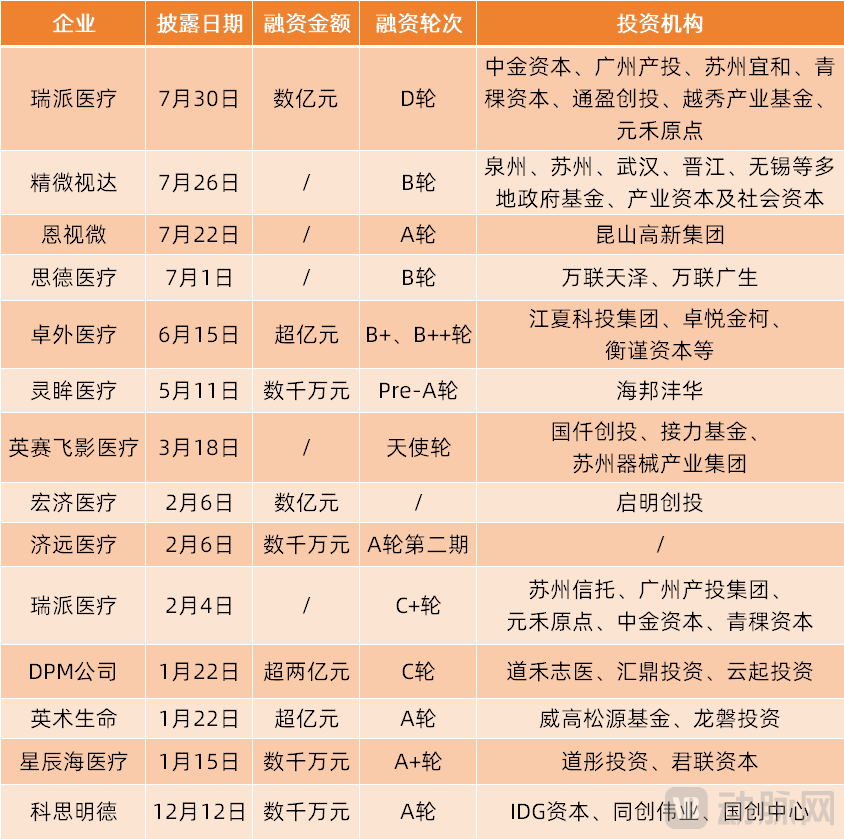
(Financing Activities of Endoscopy Companies in the First Half of 2024, Incomplete Statistics)
Why Are Investors Collectively Betting on Endoscopes During the Downturn in the Capital Market?From these funded enterprises, we have observed a set of common characteristics.。
First, technological breakthroughs, launching globally pioneering and leading innovative products.For example, Insfeiying Medical, which has secured financing, has launched diagnostic and therapeutic solutions with portable and mobile advantages, such as wireless endoscopes and wireless ultrasound devices. Among these, the smart wireless endoscope reduces the size of the traditional image processing host to one-twentieth of its original volume, transforming it into a handheld device free from cable constraints. Meanwhile, leveraging ultra-low-latency wireless image transmission technology and ISP tuning techniques, the product achieves latency levels and image clarity comparable to those of traditional wired endoscopy systems at both 4K and 1080P resolutions.
For another example, Side Medical has launched a capsule endoscopy system (GICE-1000), an AI cloud platform, and an image reading software system. Reportedly, the GICE-1000 is the world’s first smartphone-based capsule gastroscope that requires no host unit or wearable devices and supports large-scale deployment across multiple scenarios. The system operates via a mobile app: after swallowing the capsule, users change their body positions to guide the capsule along a preset gastrointestinal tract path. The camera continuously captures digital images of the stomach at a rate of three frames per second, with real-time display on the smartphone. Each examination takes approximately 20 minutes. Upon completion, the images are automatically uploaded to the intelligent image reading system, which generates an examination report and sends it to the user’s phone.
Professor Luo Xiaobei from the Department of Gastroenterology at Nanfang Hospital stated, “Through rigorous comparative analysis of clinical trial data, the diagnostic concordance rate between Side Medical’s smartphone-based capsule gastroscope and electronic gastroscopy reached 99.4%. This indicates minimal difference compared with electronic gastroscopy, demonstrating its safety and efficacy, and it can basically meet clinical needs.”
In addition, other companies that do not currently require financing have also launched numerous globally leading innovative products. For instance, OptoMedic has introduced the world’s first 4K dual-fluorescence endoscopic camera system. This system is designed for fluorescence navigation supporting the separate or combined use of indocyanine green (ICG) and methylene blue (MB), enabling personalized multi-fluorescence angiography. ICG contrast agents help fluorescence endoscopes identify tumors, assess wounds, and recognize anatomical structures such as bile ducts and blood vessels, while MB is widely used in fluorescence imaging-guided surgeries. The 4K dual-fluorescence endoscopic camera system combining ICG and MB is expected to play a significant role in clinical practice.
Second, break through key milestones to complete commercial validation or achieve successful commercialization.. For example, after the clinical benefits of single-use endoscopes were fully demonstrated, domestic manufacturers of single-use endoscopes successfully achieved commercialization.In March 2024, Jiyuan Medical signed a partnership agreement with a U.S.-based minimally invasive surgical device company to promote the sales and marketing of its ARMI single-use electronic hysteroscope in the U.S. market. In the same month, New Guangwei Medical announced an expanded strategic collaboration with Boston Scientific to jointly develop endoscopic products and promote them globally. In May, Ruipai Medical entered into a strategic partnership with Cook Medical, a global leader in urology, to jointly promote Ruipai Medical’s single-use ureteroscopes in the North American market.
Driven by the innovation, feasibility, and initial commercialization of single-use endoscopes, companies in this sector—including Ruipai Medical, Enshiwei, Hongji Medical, Xingchenhai Medical, Zhuowai Medical, Yingshu Life, and Jiyuan Medical—all completed new rounds of financing in the first half of the year.
In addition, endoscopy companies such as Lingmou Medical and Jingwei Shida have also initiated commercialization. For instance, after Lingmou Medical’s full-high-definition electronic endoscopy system and other products received regulatory approval, the company held its inaugural installation ceremony in July 2024. According to reports, feedback from clinical trials indicated that Lingmou Medical’s endoscopes demonstrated excellent performance in terms of patient comfort during examination, procedure duration, and diagnostic accuracy. Meanwhile, Jingwei Shida invested RMB 100 million in June 2024 to build a manufacturing center in Changzhou after validating market demand. Upon completion, this facility will serve as Jingwei Shida’s national-scale production center for confocal laser endomicroscopy systems and is expected to become operational by the end of 2024.
Third, the product possesses differentiated advantages and has gained market recognition or favor.Compared with the 4K endoscopes and fluorescence endoscopes commonly available on the market, endoscopy companies such as Bosheng Medical, Zhuowai Medical, and DPM have launched endoscopic systems that integrate 4K, 3D, and fluorescence capabilities.
Taking Zhuowai Medical’s UNICORN multimodal endoscopic imaging system as an example, this system integrates 4K, 3D, and fluorescence functionalities into a single camera control unit. It supports both optical and electronic endoscope imaging, delivering 4K ultra-high-definition resolution, 3D imaging in multiple formats, and NIR/ICG fluorescence visualization, thereby earning widespread market recognition.
Zhuowai Medical’s other product, the “All-in-One Electronic Laparoscopy System,” has also gained market favor and was included in the Shanghai Innovative Product Recommendation Catalog for two consecutive years. Reportedly, this product integrates the functions of traditional endoscopic systems—including rigid optical endoscopes, cameras, light guides, main units, and light sources—into a single unit, requiring only connection to a medical monitor for imaging. Compared with other products on the market, the All-in-One Electronic Laparoscopy System offers advantages such as compact size, ease of operation, ultra-low power consumption, and active anti-fogging capabilities.
Overall, against the backdrop of domestic substitution, Chinese endoscope brands are accelerating their development by leveraging advantages in product differentiation, cost, performance, marketing, and policy support, thereby capturing market share previously held by overseas companies. It is likely this very trend that has prompted investors to flock collectively to the endoscopy sector.
Today, the landscape of China’s endoscopy market has undergone significant changes, with domestic brands rising rapidly. This trend has also attracted major players from other sectors in China to cross over and enter the endoscopy market.
In April 2024, OFILM, a leading optical technology company, stated in its annual report that it would continue to strengthen R&D for products in new fields, strategically expand its optoelectronic business into industrial and medical sectors as well as VR/AR, and drive these emerging areas to become significant contributors to the company’s future growth.
To date, O-film has made progress in the field of endoscopy. Its medical endoscope products have achieved industry-leading miniaturization and waterproofing. The capsule endoscope product effectively eliminates common ghost imaging artifacts by precisely adjusting the distance between the capsule shell and the lens.
It is understood that O-Film Tech has been deeply engaged in the optical and optoelectronic industry for over two decades, accumulating substantial expertise in optical lenses and optical imaging technologies. As optical lenses are one of the core components of endoscopes, and optical technology serves as a foundational core technology for high-performance endoscopes, O-Film Tech, with its mastery of optical lenses and optical technologies, is well-positioned to leverage its upstream technological advantages to innovate lower-cost, higher-quality endoscopic products, potentially bringing notable advancements to the industry.
Not only O-film Tech, but Hisense Medical also received approval for its first 4K fluorescence endoscope in June 2024, officially entering the high-end medical endoscopy market. Previously, Hisense Medical primarily focused on products and solutions such as color Doppler ultrasound equipment, medical display devices, and smart operating rooms. With the approval of its endoscope product, it will form a complete minimally invasive surgical solution alongside Hisense Medical’s existing integrated smart operating room solutions and endoscopic displays. Leveraging its channel advantages, Hisense Medical is poised to drive rapid volume growth for its endoscope products.
In addition, Laimei Pharmaceutical, a company listed on the ChiNext board, received approval in March 2024 for two endoscopic products: an electronic endoscope image processor and a single-use electronic bronchial imaging catheter. Reportedly, Laimei Pharmaceutical’s main products are chemical drugs, covering specialized therapeutic areas, anti-infectives, and other categories.
Earlier, Pumen Technology entered the endoscopy field by acquiring Zhixin Biology. Zhixin Biology’s product portfolio includes video laryngoscopes, electronic endoscope image processors, and single-use electronic ureterorenoscopes. Following the acquisition, Zhixin Biology’s endoscopic products were fully integrated into Pumen Technology’s treatment and rehabilitation product line, creating synergy and complementarity with its existing products, domestic and international distribution channels, and customer base.
These tech giants entering the market possess advantages in either capital, distribution channels, or technology. Their entry may further fuel the already booming endoscopy market.
In addition to the entry of industry giants, China’s endoscopy sector is exhibiting another trend: domestically produced endoscopes are accelerating their global expansion and making inroads into the international market.
For example, Tiansong Medical’s endoscopic products have begun to be exported to leading manufacturers of minimally invasive surgical instruments in countries such as Japan, Germany, and the United States; Ruipai Medical’s single-use endoscopic products are now sold in more than 40 countries and regions across Europe, the Middle East, North America, South America, and Southeast Asia; Xingchenhai Medical’s recent roadshows have reached the United States, Germany, Singapore, Turkey, Japan, South Korea, and other locations...
Overall, as domestic companies break through technical barriers and successfully enter the market, the rise of Chinese-made endoscopes has become unstoppable. Today, Chinese-made endoscopes are accelerating their expansion into overseas markets. From multiple perspectives, including policy, capital, product development, and commercialization progress, it is expected that Chinese-made endoscopes will experience a significant surge in the short term, capturing a larger share of the market.