

The Potential Phase-out of Allograft Bone: Who Will Lead the Future of Bone Repair Materials?
Recently ExposedThe “Illegal Sale of Human Remains Case” undoubtedly serves as yet another testament to the dangers of unchecked capital. According to public reports, the company involved illegally purchased human remains for the production of products such as “allogeneic bone.”
Allogeneic bone is a bone defect repair material used to treat bone defects that exceed the self-healing capacity of bone. In China, there are more than 6 million patients with bone defects or functional impairments each year, resulting in substantial treatment demand.
It is reported that repair materials for the treatment of bone defects can be categorized into three major types: autologous bone, natural bone repair materials, and synthetic bone repair materials. In recent years, natural bone repair materials have accounted for two-thirds of the market share in China’s orthopedic bone defect repair materials industry. Among these, allogeneic bone constitutes over 90% of the natural bone repair materials segment.
This means that allogeneic bone accounts for approximately 55% of the market share in China's entire bone defect repair materials market.。
In terms of origin, allogeneic bone refers to bone tissue harvested from deceased donors or amputated limbs. Public reports indicate that such bone tissue is primarily sourced from rigorously screened donors or retrieved from living individuals (e.g., during certain amputation procedures).
It should be noted that public awareness of medical donation (such as blood and organ donation) has historically been low in China. Compared with European and American countries, the culture of body and organ donation has not yet become fully widespread in China. As of May this year, the cumulative number of posthumous body and organ donations by Chinese citizens has exceeded 50,000 cases—a figure that the United States can achieve in just two years.
Meanwhile, bone tissue obtained through procedures such as amputation is also scarce in China. Some physicians have stated, “In China, a large amount of bone from surgeries that could be processed into allogeneic bone grafts is discarded as medical waste. This is because establishing a ‘bone bank’ in hospitals requires navigating complex regulatory processes, imposes cumbersome additional labor on individuals, and entails significant risks, making it a thankless and arduous endeavor.” Moreover, the number of bone banks in China remains limited.
Apart from this, the remaining bone tissue is derived from other sources.
Why does allogeneic bone dominate in clinical practice? Are there any viable alternatives? Can we directly undermine the financial incentives for industry participants from a capital perspective, making illicit trafficking unprofitable and thereby minimizing such incidents?
Bone defect refers to the disruption of the structural integrity of bone. A variety of conditions, including tumors, trauma, necrosis, and congenital malformations, can lead to the development of large-volume bone defects.
For large-volume bone defects (diameter greater than 8 mm), bone tissue cannot heal spontaneously. Clinically, bone grafting is the primary method for treating bone defects. However, the bone repair materials used in bone grafting have long remained a global challenge.
In 1668, xenogeneic bone of animal origin was used for bone transplantation. Although animal-derived bone tissue exhibits good osteoconductivity, it carries risks such as immune rejection, disease transmission, delayed healing, and infection. Currently, relevant companies can eliminate immunogenicity through methods such as high-temperature calcination; however, this also reduces biodegradability, resulting in a low proportion of clinical applications.
In 1820, autologous bone was first used for bone transplantation.Autologous Bone: Bone Tissue Harvested from the Patient Themselves, exhibits excellent biocompatibility, superior osteoconductivity, and osteoinductivity, and has been widely used since the early 20th century.Currently the "gold standard" in clinical applications。
According to statistical data from the Southern Medical Economics Institute, the clinical usage rate of autologous bone in China was approximately 62% in 2017 and has shown a continuous downward trend. In the United States, which boasts more advanced medical technology, the clinical usage rate of autologous bone was 45.51% in 2017, also exhibiting a declining trend.
The application of autologous bone has continued to decline. On one hand, autologous bone itself has limitations: its supply is constrained by the patient’s own skeletal reserves, which may sometimes be insufficient to meet the demands of bone grafting; harvesting autologous bone requires an additional surgical procedure, leading to extra blood loss and trauma for the patient, thereby increasing the difficulty and complexity of the surgery; and there is a risk of complications at the bone harvest site. On the other hand, this trend is driven by the development of bone repair materials.Rapid Clinical Application of Natural and Synthetic Bone Graft Materials。
According to the prospectus of Aojing Medical, natural bone repair materials accounted for two-thirds of the market share in China’s orthopedic bone defect repair materials industry in 2018. Natural bone repair materials are mainly categorized into allogeneic bone, xenogeneic bone, and demineralized bone matrix.

Compared with autologous bone, allogeneic bone has a more abundant source and retains the natural structure, shape, and strength of bone, thereby promoting new bone growth. Based on these advantages, allogeneic bone has become an effective alternative to autologous bone, accounting for over 90% of clinical applications among natural bone repair materials in 2018.
However, the sourcing of allogeneic bone has always been associated with legal and ethical concerns. Demineralized bone matrix (DBM), derived from allogeneic bone, is a bone repair material composed of collagen, non-collagenous proteins, growth factors, trace amounts of calcium phosphate, and cellular debris. Similar to allogeneic bone, this product faces limited availability as well as legal and ethical issues. Furthermore, DBM presents additional challenges, including poor mechanical strength, significant batch-to-batch variability in quality, and a high risk of immune rejection.
In addition to natural bone repair materials represented by allogeneic bone,Artificial bone repair materials are also developing rapidly.. Based on material properties, artificial bone repair materials can be classified into metallic materials, inorganic non-metallic materials, polymeric materials, composite materials, tissue engineering materials, and others.
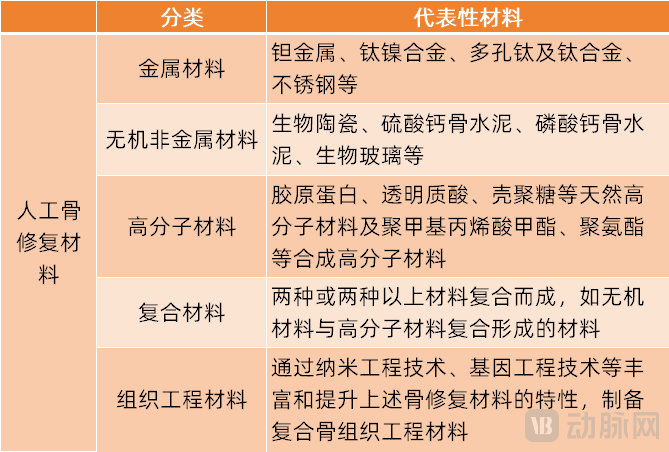
Since the 1950s, artificial bone repair materials have gradually attracted clinical attention, and have experienced rapid development since the 1980s. It is reported that after this period, the biomimetic degree of artificial bone repair materials has gradually increased, with a wider variety of materials emerging, such as metallic materials including porous titanium and titanium alloys, titanium-nickel alloys, and tantalum; inorganic non-metallic materials such as bioceramics, calcium sulfate bone cement, and bioactive glass; polymeric materials such as collagen, hyaluronic acid, and chitosan; as well as composite materials and tissue engineering materials.
As the technological sophistication and clinical efficacy of synthetic bone graft materials continue to improve, their share in clinical applications has been steadily rising. In 2018, synthetic bone graft materials accounted for approximately one-third of the market share in China’s orthopedic bone defect repair materials industry. Key players include domestic companies such as Allgens Medical, Ruibang Biological, Jiuyuan Gene, Guona Technology, and Bio-Lu Biological, as well as international companies such as Biomet, Wright Medical, and Johnson & Johnson.
Although the artificial bone repair material industry is advancing rapidly, no bone repair material capable of replacing autologous bone in terms of clinical efficacy has yet emerged on the market. For instance, metallic materials may cause toxic side effects, wear down surrounding tissues, and exhibit poor plasticity; inorganic non-metallic materials typically suffer from inadequate mechanical strength, unsuitability for load-bearing sites, and unfavorable conditions for new bone growth.
Overall,At present, allogeneic bone remains the most widely used material for repairing orthopedic bone defects.On the one hand, allogeneic bone grafts demonstrate clinical efficacy comparable to that of autologous bone, have a long history of clinical application (since 1880), and have established certain usage patterns among physicians. On the other hand, no synthetic bone repair materials with efficacy rivaling that of autologous bone have emerged in the market, and foreign companies whose product portfolios are primarily composed of synthetic bone repair materials have made limited investments in marketing and clinical education, failing to attain a dominant position in the industry.
The only silver lining is that in recent years, the emergence of polymer materials, composite materials, and tissue engineering materials has made it possible to develop synthetic bone graft substitutes comparable to autologous bone. Furthermore, as natural bone repair materials such as allogeneic bone face increasing challenges related to supply sources, the adoption of synthetic bone repair materials is likely to accelerate.
As evidenced by the above analysis, although autologous bone remains the gold standard, its limited supply fails to meet market demand. Natural bone repair materials, represented by allogeneic bone, demonstrate favorable clinical efficacy but are constrained by limited sources and legal and ethical concerns. In contrast, artificial bone repair materials are poised to replace both autologous and allogeneic bone, driven by technological breakthroughs and rapid development.
The industry also anticipates that, with the continuous expansion of the market size for bone defect repair materials in orthopedics and the sustained increase in clinical application demand, the market share of artificial bone repair materials is expected to rise further.
The industry's confidence in synthetic bone repair materials stems primarily from breakthroughs and advancements in polymer materials, composite materials, and tissue engineering materials.
Polymeric materials are derived from a wide range of sources, including natural polymers such as collagen, hyaluronic acid, and chitosan, as well as synthetic polymers such as polymethyl methacrylate and polyurethane.
In recent years, the rapid development of medical polymer materials has driven innovation in a variety of medical devices, such as polymeric heart valves, absorbable sutures, and biodegradable stents.
In the field of bone repair, polymer materials have also been rapidly adopted. For instance, owing to the favorable biocompatibility, osteoconductivity, and tunable physicochemical and mechanical properties of medical-grade polymers, their use in the manufacture of orthopedic implants has led to varying degrees of optimization in key performance metrics such as mechanical strength, fatigue resistance, and biocompatibility.
Taking the polymer material PEEK as an example, Jusheng Medical received approval in 2022 for China’s first medical-grade implantable PEEK material. It is reported that Jusheng Medical has developed a PEEK cranial repair system based on this material. Compared with traditional cranial reconstruction materials, PEEK-based cranial repair is associated with fewer complications and superior aesthetic outcomes. Furthermore, leveraging CT or MRI scan data, neurosurgeons can utilize CAD/CAM systems to design patient-specific implants, thereby producing PEEK implants that precisely match the patient’s cranial anatomy.
Currently, Jusheng Medical is continuously developing new PEEK material implant products in the field of bone repair, with applications expanding from craniofacial reconstruction to skeletal repair across all extremities.
In addition, in 2023, the Ministry of Industry and Information Technology and the National Medical Products Administration jointly launched the “Open Competition” initiative to tackle key challenges in biomedical materials innovation, designating medical polymer materials as one of the three priority areas for breakthroughs.
According to the published “List of Selected Entities for the ‘Open Competition’ Initiative on Innovation in Biomedical Materials (First Batch),” a total of 20 entities (universities or enterprises) have undertaken challenges related to medical polymer materials, including Beijing University of Chemical Technology, Winner Medical, Nilun Chemistry, Aimet, Hua’an Biology, Kehui Medical, Linsheng Polymers, and Huarkang.
Among these, Linsheng Polymer has taken the lead in carrying out the project “Research, Development, and Industrialization of Medical-Grade Polyetheretherketone (PEEK) Materials and Related Endoscopic and Orthopedic Implantable Tubes and Rods.” To date, Linsheng Polymer’s developed products—including single-lumen tubes, multi-lumen tubes, and specialty material tubes of various sizes—have been widely used in implantable and interventional devices across departments such as orthopedics, cardiology, radiology, and anesthesiology.
Composite materials are formed by combining two or more distinct materials, typically referring to composites of inorganic materials and polymeric materials. Compared with single-component materials, composite materials exhibit superior properties in terms of microstructure, biodegradability, and bioactivity.
At this stage, multiple domestic enterprises, including Weida Biotechnology, Lixin Science, and Bai'ao Regeneration, have achieved breakthroughs in composite materials and applied them to the field of bone repair.
For example, on August 1, 2024, the first domestically developed cotton-like absorbable composite artificial bone by Weida Biotechnology was approved for market launch. This productComposed of medical-grade organic polymers and calcium phosphate salts., forming white, flexible, fibrous aggregates with a cotton-like appearance, and offering advantages such as high plasticity, superior mechanical strength, high porosity, and biodegradability.
Previously, Lixin Science’s moldable absorbable bone repair material (absorbable regenerated bone) received U.S. FDA approval for market launch in February 2023.
It is understood that the absorbable regenerative bone utilizes “Polylactic Acid (PLA) + Hydroxyapatite (HA)"Material combination. Polylactic acid (PLA) exhibits strong hydrophobicity, but its osteogenic performance is suboptimal, and its acidic degradation products are prone to inducing aseptic inflammation in vivo. Hydroxyapatite (HA), on the other hand, demonstrates excellent biocompatibility and osteoconductivity, releasing calcium ions during degradation to promote bone tissue regeneration; however, it suffers from poor mechanical properties and low osteoinductive efficiency."
Lixin Science has developed a composite material with moderate stiffness by combining these two materials, reducing the carboxyl group content formed after material degradation to control environmental acidity. Furthermore, through ultra-dispersion technology, fine hydroxyapatite particles are uniformly dispersed within the polylactic acid matrix. This not only efficiently neutralizes acidic substances but also enables the sustained release of calcium ions during hydroxyapatite degradation, ultimately maintaining a relatively balanced calcium ion concentration in the surrounding tissue fluid, which is conducive to osteogenesis.
BioRegen has also launched a bone repair product made from composite materials—China’s first xenogeneic bovine-derived and hyaluronic acid bone grafting material. It is reported that BioRegen combined hyaluronic acid with bovine-derived bone particles to develop a bone grafting material with superior properties. This material retains the favorable bone structure of bovine-derived bone particles while leveraging the bioactivity of hyaluronic acid to enhance biocompatibility and bone regeneration efficacy, stimulate the expression of osteogenic factors, and impart higher hydrophilicity, thereby significantly promoting early osteogenesis. Additionally, hyaluronic acid offers benefits such as promoting wound healing and providing anti-inflammatory effects.
Tissue engineering is an emerging discipline that combines cell biology and materials science to construct tissues or organs in vitro or in vivo.
According to the International Union of Societies for Biomaterials Science and Engineering, tissue engineering is defined as: the use of cells, biomaterials, and appropriate molecular or physical factors, alone or in combination, to repair or replace tissues in order to improve clinical outcomes.
The core elements of tissue engineering are primarily scaffold materials, seed cells, and growth factors. It is understood that advancements in composite materials and nanotechnology have provided ideal scaffold materials for the development of tissue engineering constructs. By combining seed cells and growth factors—bioactive substances capable of inducing and promoting bone tissue repair—with these ideal scaffolds, it is expected to yield artificial bone repair materials with clinical efficacy comparable to that of autologous bone.
It is worth noting that among the three key elements of tissue engineering, seed cells are subject to considerable policy restrictions in clinical applications, while growth factors have encountered certain issues in clinical use abroad. Therefore, the focus of research and development for artificial bone repair materials will be on the continuous optimization of scaffold materials and the in-depth advancement of bone tissue engineering.
At present, companies such as Allgens Medical, Fuxiang Medical, Huamai Medical, and Susheng Biotech have launched artificial bone repair materials made from tissue-engineered materials.
For example, the biomimetic mineralized collagen bone repair material independently developed by Allgens Medical utilizes in vitro biomimetic mineralization technology to achieve an ordered arrangement of type I collagen and hydroxyapatite. This process creates a synthetic bone repair material whose composition and microstructure closely resemble those of natural human bone. The material exhibits excellent osteoconductivity and guided bone regeneration capabilities, with extremely low immunogenicity, no toxic side effects, and a high safety profile. Furthermore, the material is fully degradable after implantation, with a degradation rate that matches the rate of new bone regeneration.
Nuopu Regenerative has also launched China’s first fully independently developed bio-3D-printed regenerative bone graft. In addition to innovative enterprises, research institutions such as universities and hospitals are also driving the development of orthopedic tissue engineering materials. For example, in February 2024, Shanghai Ninth People’s Hospital, affiliated with Shanghai Jiao Tong University School of Medicine, disclosed a patent for an orthopedic tissue engineering material: “Preparation Method and Application of Strontium-Doped Calcium Silicate and Silk Fibroin Composite Materials.” This patent utilizes “strontium-doped calcium silicate and silk fibroin composite materials” as a scaffold structure, holding promise for providing more ideal scaffold materials for bone repair tissue engineering.
Overall, although no artificial bone repair materials currently available on the market match the efficacy of autologous bone, rapid advancements in polymer materials, composite materials, and tissue engineering technologies are expected to gradually bring the efficacy of artificial bone repair materials close to, or even on par with, that of autologous bone. Furthermore, their clinical risks and complication rates will be lower than those of allogeneic bone, ultimately enabling them to replace both autologous and allogeneic bone grafts.