

Feimiao Medical Files for IPO: A Pioneer in Ultra-Thin Endoscopy with 24 Years of Expertise and $100M Product Success
Driven by rising healthcare demands, the widespread adoption of minimally invasive surgery, and continuous advancements in optics, imaging, and image processing technologies, the medical endoscope market is experiencing expanded growth opportunities.
According to data from Huajing Industry Research Institute, the global market size for medical endoscopes reached $20.3 billion in 2020. With increasing global penetration rates, the market is projected to reach $28.6 billion by 2025. Compared with the global growth rates of other medical devices, endoscopy remains a high-growth sector worldwide.
In this fiercely competitive industry, the niche segment of ultra-thin endoscopes remains a blue ocean. In clinical practice, there is an urgent need for ultra-thin endoscope products to empower diagnostic and therapeutic procedures in narrow body cavities, as well as to support clinical research and medical education. However, due to high technical barriers, significant R&D challenges, and long development cycles, many companies have been deterred from entering this field.
To effectively fill the long-standing market gap in the field of ultra-fine endoscopes,Shaanxi Femto Medical Equipment Co., Ltd. (hereinafter referred to as “Femto Medical”) has been deeply engaged in the research and development and production of ultra-fine endoscope products.. The company’s flagship products include medical endoscopes, sterile medical consumables, and optical electronic devices for both medical and civilian applications. Its endoscope product line primarily focuses on ultra-thin medical endoscopes, specialized medical endoscopes, and single-use medical consumables designed for use with endoscopes. The company has achieved multiple technological breakthroughs.
Femto Medical originated from the “Medical Electronics Division” of Femto Optoelectronics Technology (Xi’an) Co., Ltd., a company incubated by the Xi’an Institute of Optics and Precision Mechanics of the Chinese Academy of Sciences. In October 2016, the “Medical Electronics Division” was restructured into an independent limited liability company through resource optimization. Leveraging over two decades of extensive experience in the medical device industry, along with technical expertise in optics, electronics, and mechanical design, Femto Medical has vigorously developed the research and development, manufacturing, and sales of optoelectronic medical devices, achieving remarkable success particularly in the field of ultra-thin medical endoscopes.

Exterior View of Femto Medical
Currently, the development and application of conventional medical endoscopes have entered a relatively mature stage, with a stable market landscape. However, for narrow human body cavities such as the Eustachian tube, dental root canals, and lacrimal ducts, applicable endoscopic products are scarce, particularly ultra-thin endoscopes with diameters below 0.8 mm. This scarcity results in a lack of effective methods for imaging examinations of these small cavities, leading to a degree of blindness in clinical diagnosis and treatment. Physicians struggle to obtain rapid, accurate, and intuitive assessment feedback on examination and treatment outcomes, which consequently compromises therapeutic efficacy, increases diagnosis and treatment time and costs, and causes significant patient discomfort.
From the demand side, the need for ultra-thin endoscopes in clinical diagnosis and treatment is self-evident. However, from the supply side, existing products on the market fall far short of meeting this unmet demand. This is primarily because the design and manufacturing of ultra-thin endoscopes are significantly more challenging than those of conventional endoscopes, and most conventional endoscope manufacturers lack the capability to design and produce them. “In particular, the machining and assembly processes for extremely miniature optical lenses are exceptionally difficult to master. This has made many endoscope companies very cautious about their R&D investments in this field,” introduced Li Xiaogang, the company’s general manager. “Overall,Ultra-thin endoscopes belong to an underdeveloped niche market. While clinical demand is substantial and pain points are clearly defined, resources capable of delivering effective solutions remain severely scarce. Consequently, the potential market size is enormous.。”
Recognizing the unmet clinical needs and significant market potential in the field of ultra-thin endoscopes, the “Medical Electronics Division” of Femto Optoelectronic Technology (Xi’an) Co., Ltd., the predecessor of Femto Medical, began the research, development, and production of ultra-thin endoscope products in 2000. It successfully commercialized two products: an endoscopic abortion suction system and a transvaginal pubic bone visualization puncture endoscope. Among them,The former sold nearly 800 units, generating sales revenue of nearly RMB 100 million.To date, the Femto team has been deeply engaged in the field of ultra-fine endoscopes for 24 years, with a significant first-mover advantage.
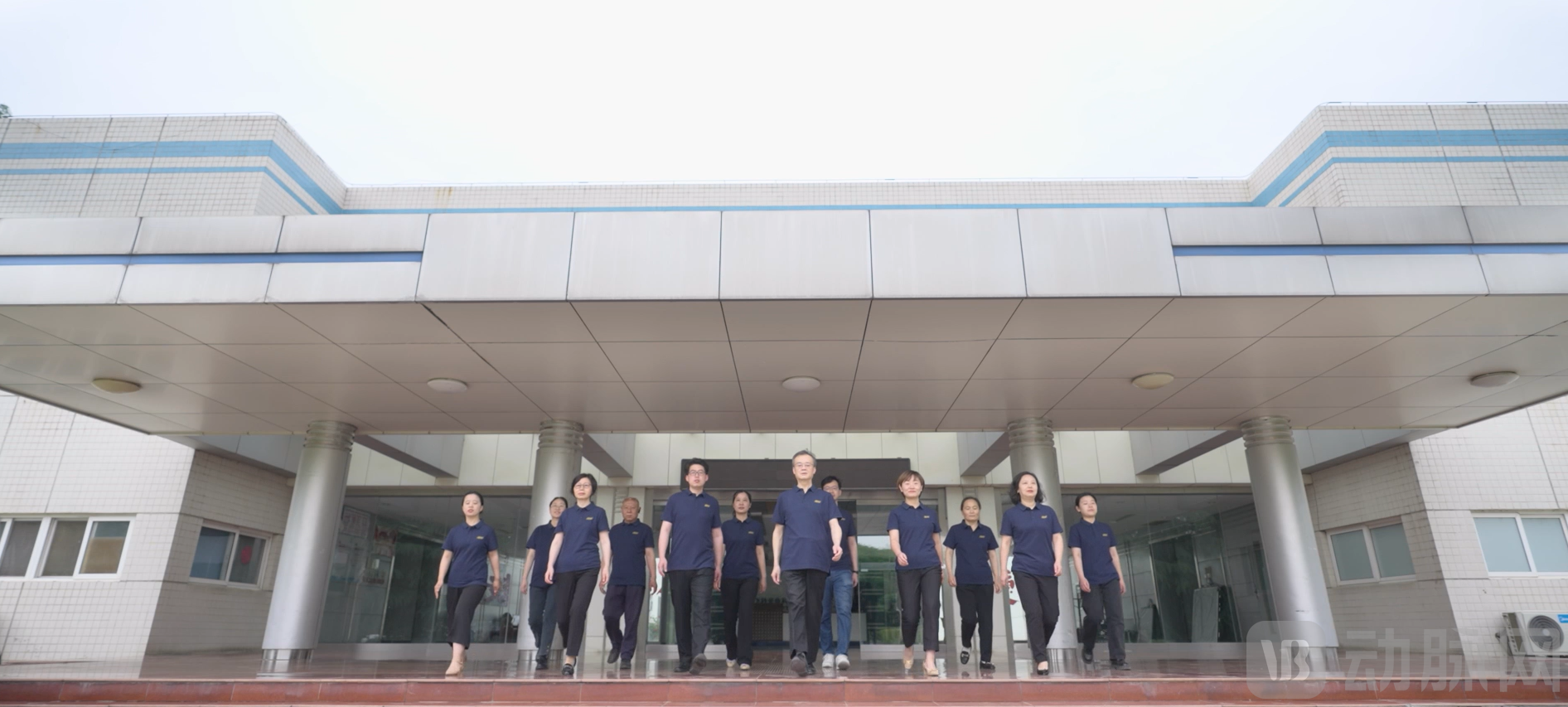
Femto Medical has teams for R&D, registration, production, and sales.
In addition, Femto Medical participated in a sub-project of the National Key R&D Program, led by the Xi’an Institute of Optics and Precision Mechanics of the Chinese Academy of Sciences, titled “High-Performance Fiber Optic Products and Key Preparation Technologies for Industrialization.” The project completed its acceptance review in 2021. Femto Medical was responsible for researching the performance of drawn optical fibers developed by the Institute and studying their application technologies in ultra-thin endoscopes. By overcoming technical challenges, the company resolved mass-production difficulties for high-numerical-aperture, high-resolution imaging lenses and secured priority usage rights and exclusive procurement rights for core components of ultra-thin endoscopes. “This has provided us with significant advantages in core device technology for the future research, development, and production of single-use ultra-thin endoscopes,” added Li Xiaogang.
Shaanxi Femto Medical Equipment Co.,Ltd. boasts a comprehensive team spanning R&D, marketing, regulatory registration, production, sales, and after-sales service, enabling independent product research and design, technological breakthroughs, and manufacturing. Notably, the specialized equipment and testing instruments required for the production of ultra-fine endoscopes are also independently developed by the team. The development of such equipment is highly challenging and remains rare in the market.
Furthermore, Femto Medical has been invited by numerous prestigious Chinese universities, including Shanghai Jiao Tong University and Xi’an Jiaotong University, as well as renowned research institutes such as the Shenzhen Institutes of Advanced Technology, Chinese Academy of Sciences, and the Qingdao Industrial Technology Research Institute, to participate in applications for National Key R&D Programs and National Natural Science Foundation projects, and to engage in the research and development of multiple scientific endoscopy projects.
Currently, the ultra-fine endoscope objective lenses produced by the vast majority of manufacturers employ gradient-index (GRIN) imaging lenses. While this design features a simple structure and relatively convenient assembly, it suffers from poor edge resolution, cannot correct chromatic aberration, and is difficult to achieve high-resolution imaging. In contrast, another configuration is the classic stacked lens group imaging objective. Ultra-fine endoscopes utilizing this type of lens offer superior image quality and can eliminate chromatic aberration; however, they present greater challenges in manufacturing and assembly, resulting in slightly higher costs.
Currently, Femto Medical has fully mastered the two aforementioned structural solutions. According to Li Xiaogang,Femto Medical is the first company in the industry capable of researching, developing, and manufacturing ultra-fine endoscopes using both of the aforementioned structures., which is also the company's unique advantage that distinguishes it from other manufacturers of ultra-thin endoscopes.
According to Li Xiaogang, due to the high technical difficulty in the design, processing, and assembly of classical stacked lens groups, most companies, constrained by manufacturing limitations, predominantly adopt gradient-index (GRIN) imaging lenses. These components are mostly sourced from foreign giants, resulting in relatively high prices and an insignificant cost advantage. However,Femto Optoelectronic Technology (Xi'an) Co., Ltd., the holding company of Femto Medical, is the largest domestic supplier of gradient-index lenses and one of only three companies worldwide currently capable of producing gradient-index imaging lenses, providing supply chain advantages for Femto Medical’s ultra-thin endoscope production.
Compared with gradient-index (GRIN) imaging lenses, stacked submillimeter-class conventional lens objective assemblies present a higher barrier to entry. Due to their diminutive design dimensions (diameter <1 mm), submillimeter optical lenses cannot be fixtured for machining, rendering traditional lens design expertise and manufacturing methods ineffective. This necessitates that endoscope manufacturers develop specialized designs for submillimeter optical lenses by integrating existing processing techniques, addressing parameters such as the curvature-to-diameter ratio, edge-to-center thickness ratio, curvature extension allowance, aperture stop etching, zero-gap positioning, and material selection. Built upon over two decades of accumulation,Femto Medical has overcome the aforementioned technical challenges, and its designed sub-millimeter optical lenses are manufacturable, reproducible, and suitable for mass production.
Meanwhile, the assembly of submillimeter imaging objectives is a highly demanding “precision task” that rigorously tests manufacturing craftsmanship—these optical lenses are actually smaller than granules of white sugar, and the process requires the precise alignment and assembly of three to four lens elements, making the technical difficulty self-evident. To address this bottleneck,Femto Medical has designed dedicated assembly fixtures and mastered the assembly technology for micro-lenses., such as the core-extraction and axis-retraction method, the double-layer bilateral advancement method, and the lens edge stray light elimination method, enable large-scale and stable production, achieving high-quality imaging that is unattainable with gradient-index imaging lenses.
To couple sub-millimeter optical lenses with image fiber bundles and achieve high-quality image transmission performance through process calibration, specialized alignment and adjustment fixtures are required. To this end, Femto Medical has designed an image fiber optic aligner. According to Li Xiaogang, no similar equipment currently exists in the market for optical production devices. In terms of quality inspection, there is no off-the-shelf equipment available for the quality testing of sub-millimeter optical lenses.The company has also designed a complete set of optical parameter testing equipment and instruments to ensure the stability and consistency of quality during production.
Currently, during balloon dilation of the Eustachian tube, the balloon catheter itself is not visible as it enters the Eustachian tube, necessitating the use of a sinus endoscope. This procedure requires either two-handed operation by a single physician or coordinated manipulation by two clinicians, with both instruments kept in sync. This makes the procedure technically challenging and may adversely affect clinical outcomes. Furthermore, in patients with nasal stenosis or anatomical variations of the nasal cavity, it is difficult to advance both instruments simultaneously. Due to the relatively large diameter of the sinus endoscope and the inability of the catheter to bend, there are certain blind spots in the visual field. If the balloon fails to align accurately with the ostium of the Eustachian tube, it may result in patient injury or balloon damage. Moreover, existing devices cannot provide a detailed assessment of Eustachian tube patency after the procedure is completed.
Leveraging its ultra-thin endoscope technology, Femto Medical has delivered innovative solutions with two products: the Eustachian tube balloon dilation endoscope and the endoscopic balloon dilation catheter. The company has replaced the guidewire in the balloon catheter with an endoscope,Developed the world’s first eustachian tube balloon dilation device that integrates a balloon and an endoscope into a single unit, eliminating the need for sinus endoscopy throughout the procedure. Currently, both products have received marketing approval.
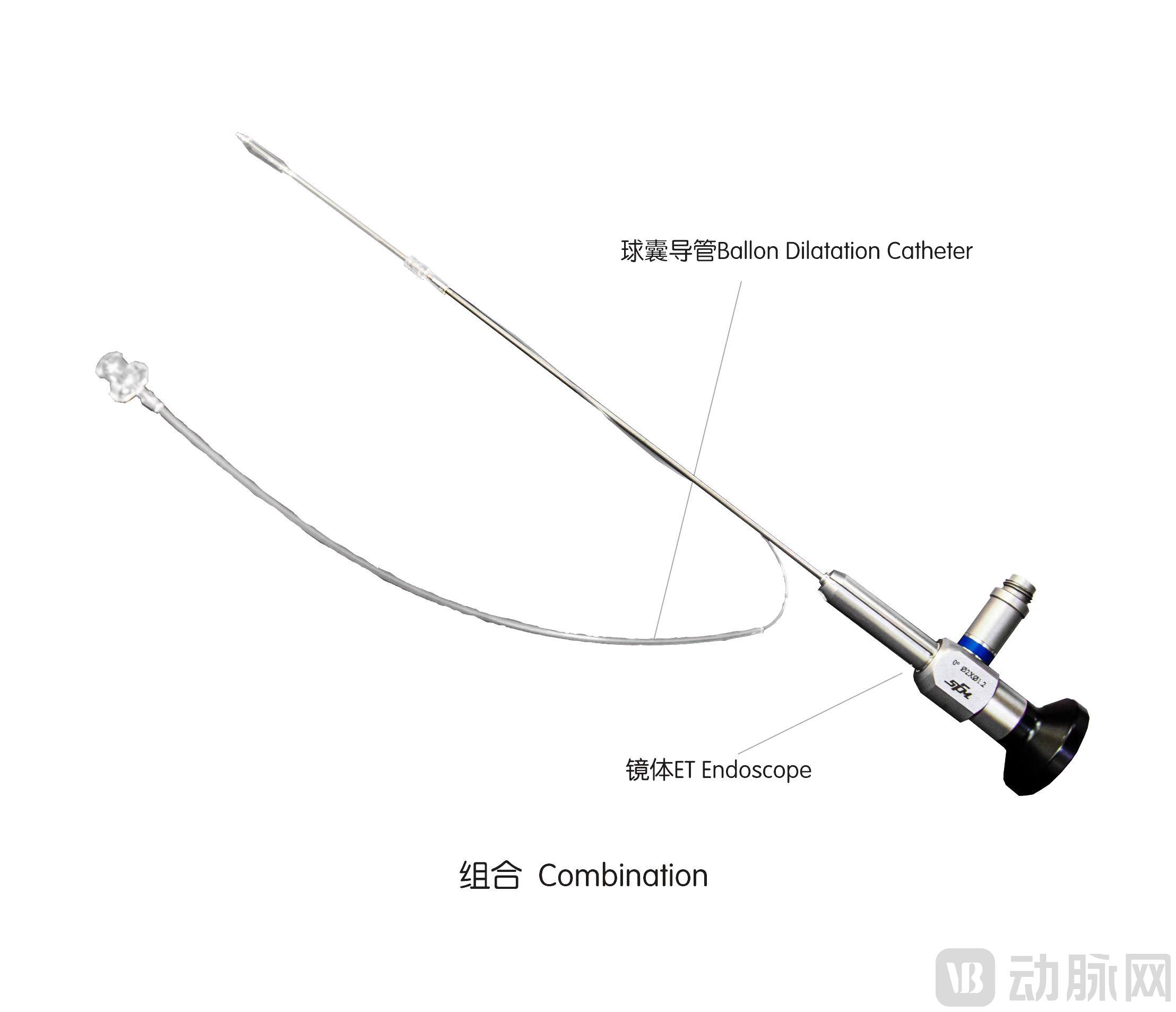
Combined View of Eustachian Tube Balloon Dilation Endoscope and Balloon Dilation Catheter
Overall, Femto Medical's evidence-based innovative medical devices offer the following advantages:
First, Femto Medical integrates the balloon with the endoscope, enabling single-handed operation by physicians and eliminating the need for a sinuscope during surgery, thereby enhancing operational convenience;
Second, the balloon is wrapped around the lens end of the endoscope, ensuring accurate delivery of the balloon into the lumen of the Eustachian tube, thereby enhancing visibility and placement accuracy. According to Li Xiaogang, since its clinical application, there has never been a single case of balloon damage caused by inaccurate delivery.
Third, Femto Medical’s endoscope can access the Eustachian tube to enable detailed visualization of its internal condition—a capability that is difficult to achieve with traditional endoscopic products;
Fourth, with traditional instruments, the success of the surgery can only be assessed through other biological indicators after the procedure is completed and the patient has left the operating room. Shaanxi Femto Medical’s devices enable physicians to immediately observe the patency of the Eustachian tube orifice via endoscopy once the procedure is finished and the instrument is withdrawn from the orifice. If the orifice remains closed, immediate secondary dilation can be performed, thereby reducing the rate of repeat surgeries in patients.
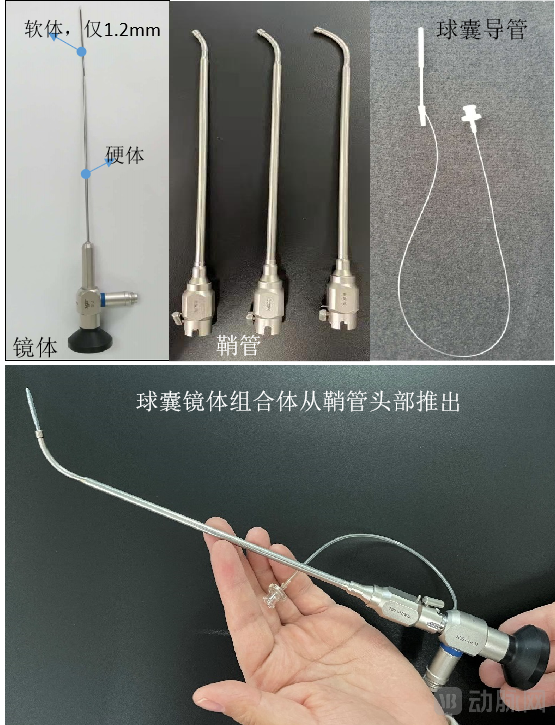
Endoscope for Balloon Dilation of the Eustachian Tube and Balloon Dilation Catheter
Building on these two commercially available products, the company is currently developing an endoscope for middle ear examination and treatment, which will enable functions such as examination, treatment, drug delivery, irrigation, and drainage of the middle ear. In addition, Femto Medical is continuously expanding its product portfolio with ultra-thin endoscope technology as its core. The company has completed the development of a prototype for a disposable ultra-thin endoscope, while other ultra-thin endoscope products, such as salpingoscopes and periodontal endoscopes, are in the research and development stage.
Currently, Femto Medical is preparing for a new round of financing. The funds raised are intended to advance the R&D of otic endoscopes for middle ear examination and treatment, expand production lines, and enlarge its talent pool. Regarding future plans, in the short term, Femto Medical will focus on promoting its launched products and aims to obtain registration certificates for its otic endoscopes for middle ear examination and treatment within three years. In the medium term, the company plans to develop two to three new ultra-thin endoscope products and bring them to market within five years, contingent upon achieving robust revenue or securing additional investment. Meanwhile, the company may enter the R&D and manufacturing of conventional endoscopes to supplement its product portfolio in the endoscopy field and explore overseas markets.
“In the long run, we aim to establish Femto Medical as a leading enterprise in the fields of ultra-thin medical endoscopes and specialized medical endoscopes, becoming a pioneer and leader in this sector,” said Li Xiaogang. He expressed his hope that, under the leadership of Femto Medical, a market landscape will emerge in which electronic endoscopes, rigid endoscopes, and ultra-thin endoscopes develop side by side, complement each other, and mutually enhance one another, thereby making greater contributions to original innovation in China’s medical device industry.