

Deray Photonuclear Advances Domestic Substitution of Medical Isotopes with Self-Developed High-Power Electron Linear Accelerator
Currently, radiopharmaceuticals are undoubtedly the “hot favorite” in the field of innovative drugs, attracting significant attention and favor from both the industry and capital markets. In particular, since 2024, the investment, financing, and trading markets for radiopharmaceuticals have exhibited a particularly vibrant momentum.
According to incomplete statistics from VCBeat, as of 2024, a total of 12 companies in the nuclear medicine sector have secured financing globally, with the total amount exceeding RMB 6.8 billion. Furthermore, global collaborations and transactions in nuclear medicine continue to flourish; since the beginning of 2024, nine major deals have been announced, with a potential total value exceeding USD 10 billion.
However, the development of radiopharmaceuticals has not been without obstacles. While investment, financing, and trading in the radiopharmaceutical sector are booming, challenges such as the global shortage of medical isotopes and an incomplete drug distribution supply chain persist. Among these, the insufficient production capacity of medical isotopes has long been regarded as the primary bottleneck to the industrialization of radiopharmaceuticals. Accelerating the mass production of medical isotopes has thus become one of the key factors in overcoming the barriers to the commercial application of radiopharmaceuticals.
Derui Guanghe (Shenzhen) Technology Co., Ltd. (hereinafter referred to as “Derui Guanghe”) is an innovative enterprise dedicated to the independent research and development of high-current electron accelerators for the production of medical isotopes, thereby providing radiopharmaceutical raw materials to radiopharmaceutical companies, hospitals, and research institutions.。
To date, Derui Guanghe has overcome key technical challenges associated with “high-energy electron accelerators,” completed technical validation of the 40 MeV/40 kW high-current electron linear accelerator, and secured patent protection for its core technologies. Currently,The company is advancing the construction of its first 40 MeV/40 kW high-current electron linear accelerator.
Medical isotopes are one of the most critical raw materials for radiopharmaceuticals. Currently, they are primarily produced through three methods: nuclear reactors, particle accelerators, and isotope generators. Among these, reactor irradiation is the most important method for obtaining medical isotopes, accounting for more than 80% of their production, including commonly used medical isotopes.99Mo/9999mTc, I-131, Sr-89, Lu-177, Y-90, C-14, etc.
It is worth noting that medical isotope reactors are currently highly concentrated, with a large number located in Europe and North America. Reactors in these regions account for over 90% of the global supply. In China, there are currently five reactors available for the production and preparation of medical isotopes. However, due to various constraints, domestically produced iodine-131 and strontium-89 meet only 20% of domestic demand, while lutetium-177 meets merely 5%. Other commonly used reactor-produced medical isotopes rely heavily on imports, resulting in low stability of the industrial chain.
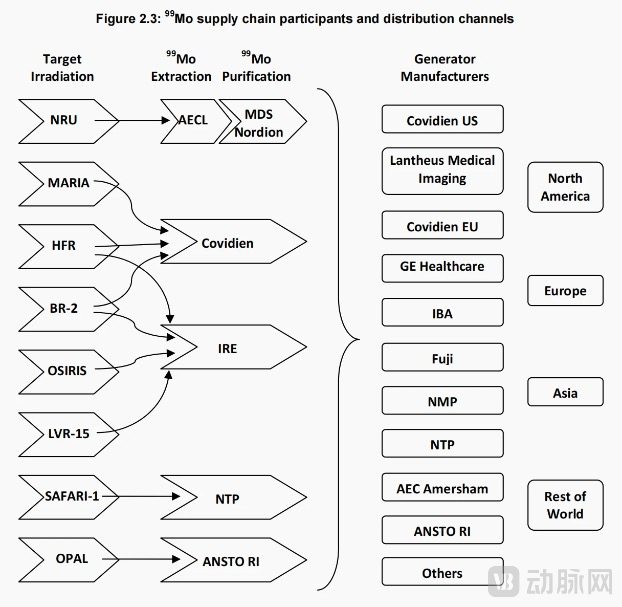
99Mo Supply Chain Participants and Distribution Channels | Image source: Derui Guanghe
Meanwhile, most of the reactors currently producing medical isotopes internationally have been in operation for over 40 years, and multiple active reactors are expected to be shut down by 2030. At that time, there will be a significant capacity gap in the global supply of medical isotopes, accelerating the onset of a worldwide shortage of radionuclides. In this context, accelerators have become a key technology to overcome the shortage of medical isotopes, thanks to their advantages such as low cost, minimal wear and tear, and stable supply.
Li Yutu, COO and Co-founder of Derui Guanghe, stated, “Compared to reactors, accelerators offer certain advantages in terms of commercialization. However, the majority of accelerators currently used for medical isotope production in China still rely on imports.”Thus, to reverse this situation, Li Yutu joined forces with Professor Huang Yongsheng and his team to co-found Derui Guanghe in June 2024.
Currently, Derui Guanghe has assembled a core team with 20 years of R&D and engineering experience, boasting globally leading acceleration technology. Team members hail from Tsinghua University, Sun Yat-sen University, the Institute of High Energy Physics (IHEP) of the Chinese Academy of Sciences, the Shanghai Institute of Applied Physics (SINAP) of the Chinese Academy of Sciences, Wuhan University, and Northwestern Polytechnical University, among others. They have led or participated in more than 80% of high-energy linear accelerator projects in China.
Importantly,The company’s core team is led by Professor Huang Yongsheng. A graduate of the Department of Engineering Physics at Tsinghua University, Professor Huang currently serves as Deputy Dean of the School of Physics at Sun Yat-sen University. He is a renowned expert in particle physics, nuclear physics, and plasma physics, and the designer of the world’s first gamma-gamma collider.。
Under the leadership of Professor Huang Yongsheng and driven by his team, Derui Guanghe has overcome the technical challenges associated with producing medical isotopes using electron accelerators and is accelerating the construction of its first 40 MeV/40 kW high-current electron linear accelerator.
Among them, the technical principle of the high-current electron accelerator independently developed by Derui Guanghe is:High-energy electrons are generated by a high-current, high-energy electron accelerator; these electrons bombard a conversion target to produce gamma rays, which then irradiate an isotope target material to induce photonuclear reactions, thereby producing medical isotopes.。
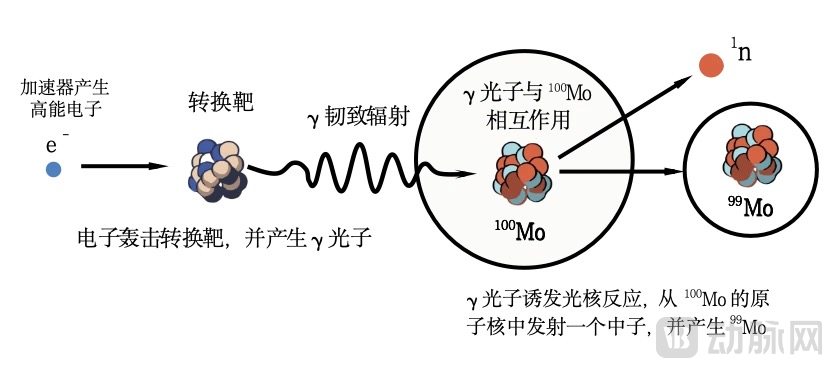
Image source: Derui Guanghe
The production of medical isotopes using accelerators requires overcoming three major technical challenges—target materials, separation and purification, and the accelerator itself.
for the production of the medical isotope molybdenum-99 (99Mo) as an example. Regarding target materials, in the field of nuclear medicine, highly enriched molybdenum-98 and molybdenum-100 isotopes are precursor nuclides for the production of the radioisotope molybdenum-99. Therefore, the accelerator-based production of molybdenum-99 requires substantial amounts of molybdenum-100 as target material. Subsequently, high-energy electrons are generated by an accelerator and directed onto a converter target to produce gamma rays. These gamma rays then irradiate the molybdenum-100, inducing the ¹⁰⁰Mo(γ,n) photonuclear reaction, thereby producing molybdenum-99.
Previously, China relied heavily on imports for molybdenum isotope materials. However, in 2023, the Institute of Nuclear Physics and Chemistry under China National Nuclear Corporation (CNNC) successfully produced kilogram-scale quantities of molybdenum-100 isotopes with 99% enrichment through independent R&D, ending the country’s long-standing complete dependence on imported molybdenum isotopes. “This also means that the subsequent supply of molybdenum-100 will not be an issue for Derui Guanghe,” said Li Yutu.
In terms of separation and purification, the traditional method for producing molybdenum-99 employs enriched uranium, initiating the reaction through the fission of uranium-235. However, this fission process generates a mixture of radionuclides with diverse properties, whose differing chemical and physical characteristics make the separation and purification of molybdenum-99 highly challenging.
In response, Derui Guanghe’s accelerator produces molybdenum-99 (Mo-99) via photoneuclear reactions using the stable isotope molybdenum-100 (Mo-100). During this process, the probability of generating other radionuclides is lower than that associated with traditional nuclear reaction methods. This is because bombarding specific target nuclei with gamma rays of particular energies may concomitantly produce some radionuclides with shorter half-lives and weaker radioactivity. However, their quantities are relatively small, and their radiological impact diminishes significantly after a certain period of decay. Consequently, the separation and purification of Mo-99 become relatively simpler.
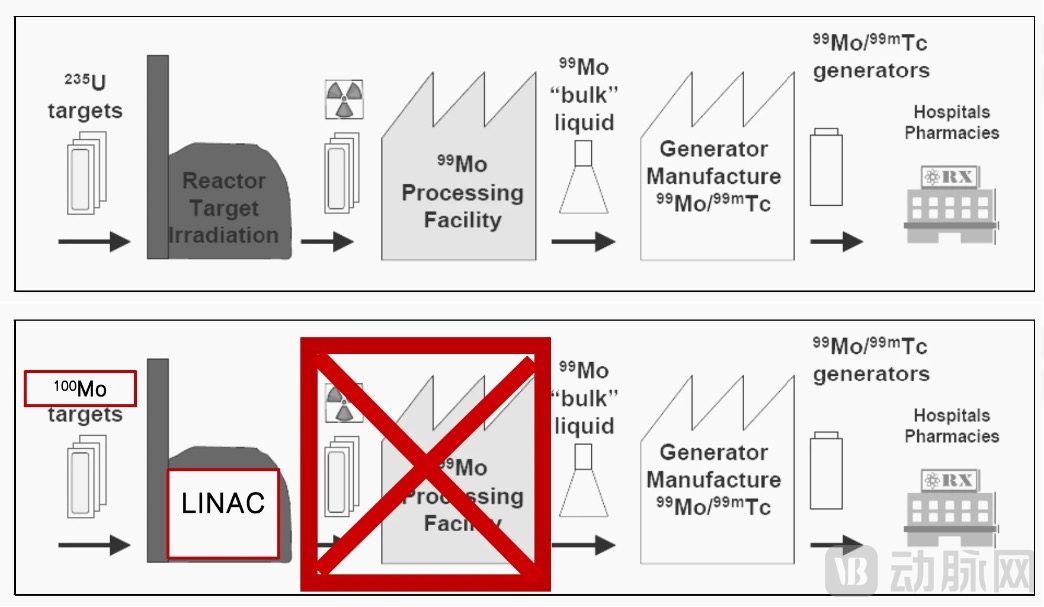
Image source: Derui Guanghe
Finally, regarding the core technologies of accelerators. It is important to note that radionuclide production imposes numerous stringent requirements on accelerators. First, in terms of energy, the accelerator must achieve specific high-energy levels to induce the required nuclear reactions. Second, the beam current intensity requirements are also high. A powerful and stable beam current can enhance reaction efficiency and yield, thereby enabling the production of a greater variety of target radionuclides per unit time.
In this regard, Li Yutu also stated, “Accelerators for radionuclide production must deliver both ‘high energy’ and ‘high current’: the electron beam energy should reach 40 MeV, and the average beam current should achieve 1 mA. Moreover, construction costs must be kept under control; otherwise, commercial-scale production of such accelerators will be difficult to realize.”
Regarding this point,Derui Guanghe has achieved breakthroughs in key technologies for “high-energy electron accelerators” and completed technical validation for a 40 MeV/40 kW high-current electron linear accelerator. The company is currently advancing the design and construction of its first high-energy electron accelerator.。
Despite being established for only over two months, Derui Guanghe is accelerating its progress toward achieving “Accelerator-Driven Subcritical Systems Replace Reactors, Establishing a New Paradigm for Medical Isotope Production"the pace of development goals."
Currently,Derui Guanghe is accelerating the manufacturing of its first high-current electron linear accelerator for the production of medical isotopes.Upon completion, it will become China’s first commercial high-energy, high-current electron accelerator, and the company is poised to become the nation’s first producer of accelerator-produced isotopes to achieve “commercial mass production.”
Meanwhile,Derui Guanghe is advancing the construction and commissioning of its first molybdenum-99 production line. In this process, Derui Guanghe is actively seeking collaborations with innovative pharmaceutical companies in the fields of molybdenum-technetium radiopharmaceuticals and radiopharmaceutical drug conjugates (RDCs) to jointly promote the development of radionuclide production facilities.。
The Medium- and Long-Term Development Plan for Medical Isotopes (2021–2035) states that by 2025, breakthroughs should be achieved in a number of key core technologies for the development of medical isotopes, and one to two dedicated production reactors for medical isotopes should be constructed in due course according to market demand, so as to achieve stable and independent supply of commonly used medical isotopes; by 2035, on the basis of fully safeguarding the health needs of the Chinese people, we will actively promote the global expansion of medical isotopes and contribute to building a global community of health for all.
Li Yutu stated, “With the completion and commissioning of Derui Guanghe’s first accelerator, it will not only accelerate the reversal of China’s long-standing reliance on imported medical isotopes but also significantly reduce their production costs. Furthermore, as this production system adopts a ‘uranium-free (enriched uranium) and reactor-free’ technological route, it offers advantages such as low overall capital cost, simple separation processes, no nuclear waste, and environmental friendliness, representing a disruptive radioactive medical isotope production technology capable of replacing nuclear reactors.”
In the future, building on its molybdenum-99 production line, Derui Guanghe will further expand the scope of medical isotope production. By collaborating with global partners and leveraging high-current electron linear accelerators, the company will jointly establish additional production lines for other nuclides, thereby enabling the production of various medical isotopes such as 67Cu, 47Sc, 225Ac, and 212Pb. On the basis of achieving domestic substitution for commonly used medical isotopes, Derui Guanghe will actively expand its product portfolio and overseas markets, ultimately promoting the steady development of the radiopharmaceutical industry.
Currently, Derui Guanghe is launching a new round of financing.。Meanwhile, Derui Guanghe is actively expanding its team and looks forward to welcoming elite professionals from the radiopharmaceutical and radionuclide industries.