

MagForce Bio Files for IPO After Securing Over RMB 100 Million in Orders Within First Year as an Enzyme Engineering Services Leader
Amidst the wave of biotechnological innovation, enzyme engineering has emerged as an unstoppable force, driving the industry forward. This momentum has not only expanded the boundaries of biocatalysis applications but also charted a new course for green chemistry and sustainable production. With the rise of synthetic biology, enzyme engineering has become a bridge connecting fundamental research with industrial applications, bringing revolutionary changes to multiple fields, including biopharmaceuticals, in vitro diagnostics, and medical aesthetics.
Molefuture, a company established just one year ago, has rapidly emerged as a prominent player in the industry with its cutting-edge enzyme engineering technology.As a supplier specializing in customized enzyme engineering solutions, Molefuture leverages the profound technical expertise of its parent company, Yeasen Biotechnology, to provide one-stop services through continuous technological innovation, meeting application demands across diverse fields such as biopharmaceuticals and synthetic biology.
The establishment of Molefuture tells a story of the perfect integration of technological innovation and industrial application. Founded by a team of experts passionate about biotechnology, the company possesses profound expertise in enzyme catalysis and directed enzyme evolution, dedicated to transforming cutting-edge scientific achievements into practical industrial solutions. With its professionalism and innovative capabilities in enzyme engineering, Molefuture is leading the industry toward a more efficient and environmentally sustainable future.

Committed to Becoming a Leader in Enzyme Engineering Services, Securing Over RMB 10 Million in Orders Within One Year of Establishment
In 2023, Molefuture was established as a wholly-owned subsidiary of Yeasen Biotechnology. Dr. Liu Xiang, founder and CEO of Molefuture, led the company’s team into the synthetic biology sector, embarking on an entrepreneurial journey with enzyme engineering technology as its entry point.
Liu Xiang, a scholar deeply engaged in the fields of enzyme catalysis and directed enzyme evolution, was jointly trained by East China University of Science and Technology and the California Institute of Technology. She studied under Professor Xu Jianhe, a Chang Jiang Scholar Distinguished Professor appointed by the Ministry of Education, and Professor Frances H. Arnold, the 2018 Nobel Laureate in Chemistry. Her academic pursuits have not only flourished in the laboratory but also yielded significant achievements in industry.
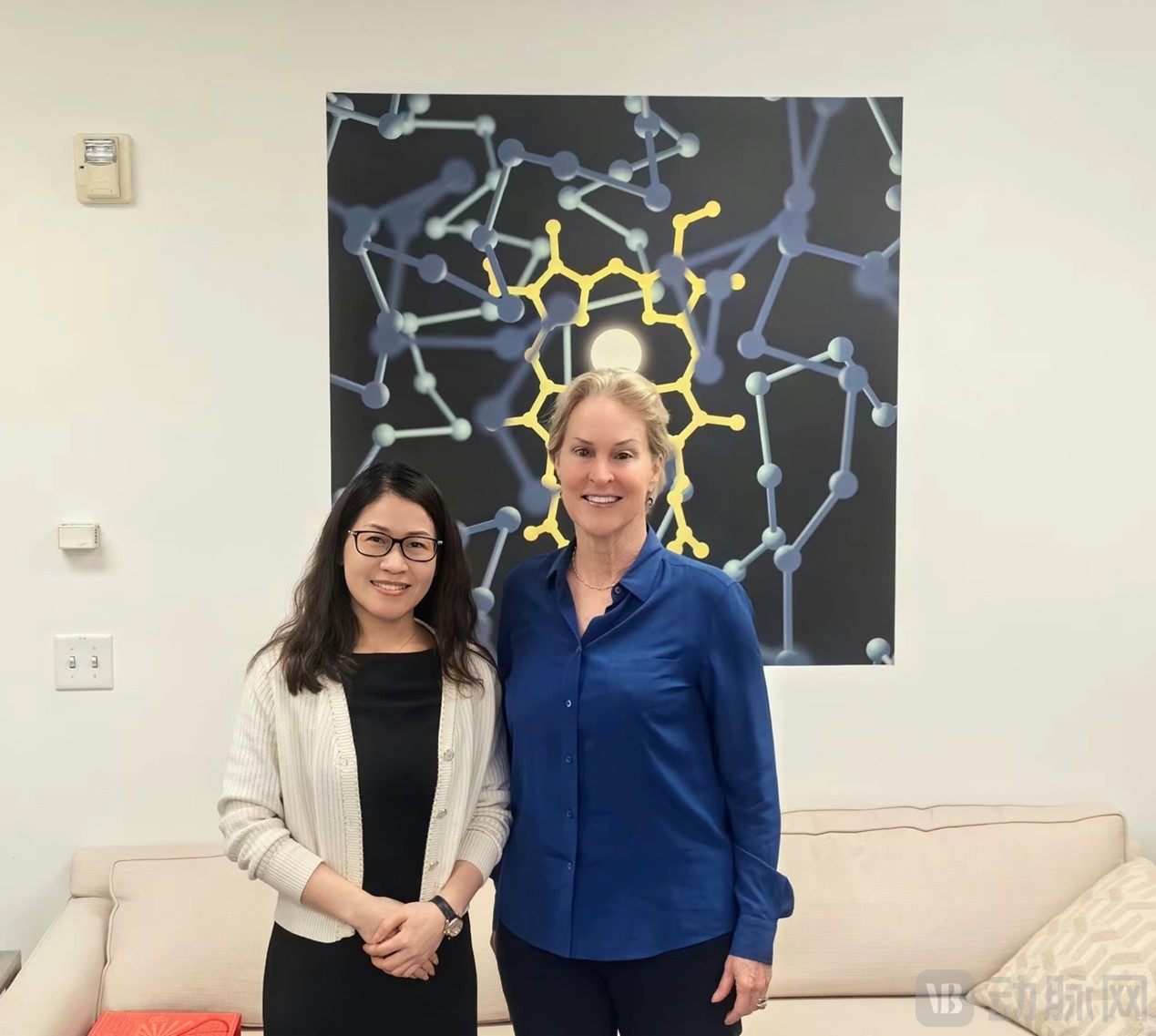
Photo of Dr. Xiang Liu (left) and Professor Frances H. Arnold (right)
Taken on June 14, 2024, at Professor Arnold’s office
After earning her Ph.D., Liu joined the industry directly. She has worked for multinational corporations such as DSM and Wilmar, dedicating over a decade to the enzyme sector and related industries. She possesses extensive experience in research and development as well as industrialization across various enzyme categories, including catalytic enzymes for API intermediates, food enzymes, lipid enzymes, research-grade enzymes, diagnostic enzymes, and biopharmaceutical enzymes. She has profound expertise in enzyme molecular engineering, process development, large-scale manufacturing, and applications.
In 2021, Liu Xiang joined Yeasen Biotechnology, a leading domestic enterprise in tool enzymes, during a pivotal period of vigorous development in the biotechnology sector.At this company, which is dedicated to import substitution and focuses on the field of tool enzymes, she led her team in building an enzyme engineering platform—ZymeEditor—from the ground up. Comprising nearly 30 professionals, the platform concentrates on the development of molecular enzymes and tool enzymes, and has established capabilities in directed evolution, high-throughput screening, and semi-rational design to meet diverse demands for enzyme engineering. This has made significant contributions to strengthening Yeasen’s independent intellectual property rights and advancing upstream enzyme development.
In fact, the “ZymeEditor” platform was initially designed to provide customized services exclusively for its parent company. However, the recent surge in synthetic biology has led Liu Xiang to realize that his team, leveraging their deep expertise in industrial and catalytic enzymes as well as their comprehensive technical and service capabilities in the industrial application of enzymes, is fully equipped to make significant strides in this rapidly evolving field.
In terms of team background, Molefuture has assembled an elite group with outstanding credentials. Its core members have previously worked at international enzyme giants such as Dupont and DSM. These valuable experiences have laid a solid industry foundation for them, demonstrating profound expertise in the full-chain development of industrial and catalytic enzymes, covering every stage from the innovative source of upstream genetic engineering of enzyme molecules to the successful industrialization of final products.
According to Liu Xiang,Molefuture is capable not only of serving specific types of enzymes but also of engineering multiple properties of most enzymes based on its underlying technology platform.“Last year, we began offering our services externally, quickly attracting numerous client inquiries and securing enzyme engineering solution orders worth over RMB 10 million within just one year of establishment, which has significantly boosted our confidence.”Liu Xiang noted, “Currently, there are few companies like Molefuture that provide professional enzyme engineering services. We are one of the few companies in China specializing in enzyme engineering, serving both the healthcare industry and the broader biomanufacturing sector. Molefuture has a clear positioning: to become a leader in the field of enzyme engineering services and provide comprehensive solutions for our customers.”
Establishing six core technology platforms to provide solutions ranging from enzyme directed evolution toGMPTurnkey Customized Solutions for Industrial-Scale Production
Although enzyme preparations have demonstrated commercial value in specific fields, many other application areas remain constrained by technical challenges and high development costs. Developing new enzymes or engineering existing ones is a complex and lengthy process that requires substantial investments of both human and financial resources.
Furthermore, patent protection and market access barriers also limit the widespread application of enzyme preparations. Industrial-scale production imposes stringent requirements on enzyme activity and stability, which current enzyme engineering initiatives often struggle to meet. While scientific research may achieve breakthroughs in creating novel enzymes from scratch, the true challenge lies in commercializing these research outcomes to bridge the gap between laboratory discoveries and manufacturing lines.
If these challenges remain unaddressed, they will constrain the development of the entire industry. This situation underscores the urgent demand within the sector for professional enzyme engineering services. Drawing on a profound understanding of these challenges and years of practical experience in both scientific research and industry, Molefuture has developed its own solutions.
Leveraging Yeasen Biotechnology,Molefuture currently has six major technology platforms: ZymeEditorTMInnovative Enzyme Evolution Platform, Multi-Host High-Efficiency Expression Platform, Fermentation Process Development Platform, Purification Process Development Platform, UCF·ME®Ultra-clean enzyme production platform, and enzyme analysis and quality control platform.Leveraging these six core technology platforms, Molefuture offers comprehensive custom solutions encompassing enzyme directed evolution, novel enzyme development, enzymatic process optimization, and GMP-compliant large-scale manufacturing. These services are designed to meet the application demands of enzymes in fields such as in vitro diagnostics, biopharmaceuticals, medical aesthetics, pharmaceutical intermediates, and functional ingredients.
Among them,ZymeEditorTMThe innovative enzyme evolution platform is Molefuture’s core technology platform, built by integrating directed evolution with rational design.The platform currently features five core enzyme engineering technologies: fluorescence-activated microdroplet sorting, microplate screening, phage-assisted continuous evolution (PACE), compartmentalized self-replication (CSR), and computer-aided rational design. By integrating these five technologies for iterative screening, the success rate of enzyme engineering can be significantly enhanced, thereby meeting diverse requirements for activity, stability, selectivity, and tolerance across various enzyme classes.
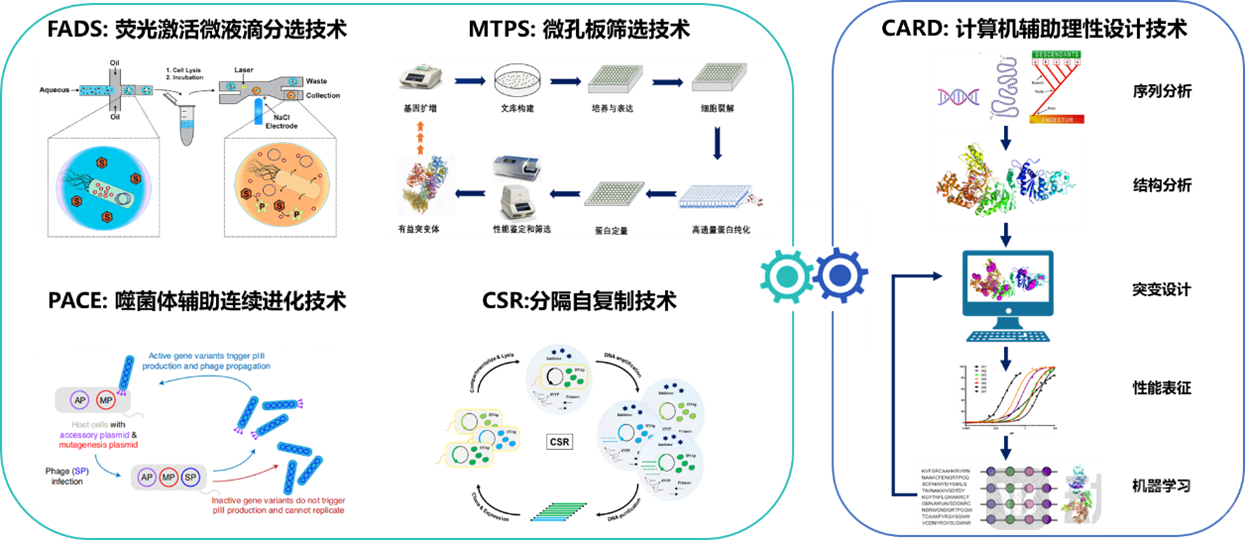
Molefuture’s Five Core Enzyme Engineering Technologies
These five core enzyme engineering technologies not only enable the provision of services tailored to diverse customer needs, but also have accumulated differentiated advantages and competitiveness for Molefuture’s development within the industry.
Molefuture integrates AI technology into the field of enzyme molecular design, achieving a seamless combination of dry and wet lab experiments. By leveraging the breadth of high-throughput screening and the depth of rational design, along with the intelligent predictions of machine learning and the precise insights of big data analytics, the company can efficiently identify target mutants. This approach significantly accelerates the enzyme engineering process and markedly improves success rates. This innovative model enables Molefuture to flexibly address diverse enzyme engineering needs across various application scenarios, providing customers with more efficient and precise solutions.
In addition to providing enzyme engineering services, Molefuture offers clients comprehensive technical solutions spanning molecular design, fermentation, purification, and enzymatic catalysis. The company provides CRO and CDMO services, as well as integrated technology packages tailored to client needs, thereby accelerating product development and industrialization.
Dr. Liu Xiang also highlighted a more critical point: “Enzyme engineering requires profound technical expertise and extensive accumulated experience, presenting a very high barrier to entry. Molefuture pursues a high degree of innovation and originality in protein design, not merely content with optimizing existing technologies, but committed to source innovation to drive technological advancement in the industry.”
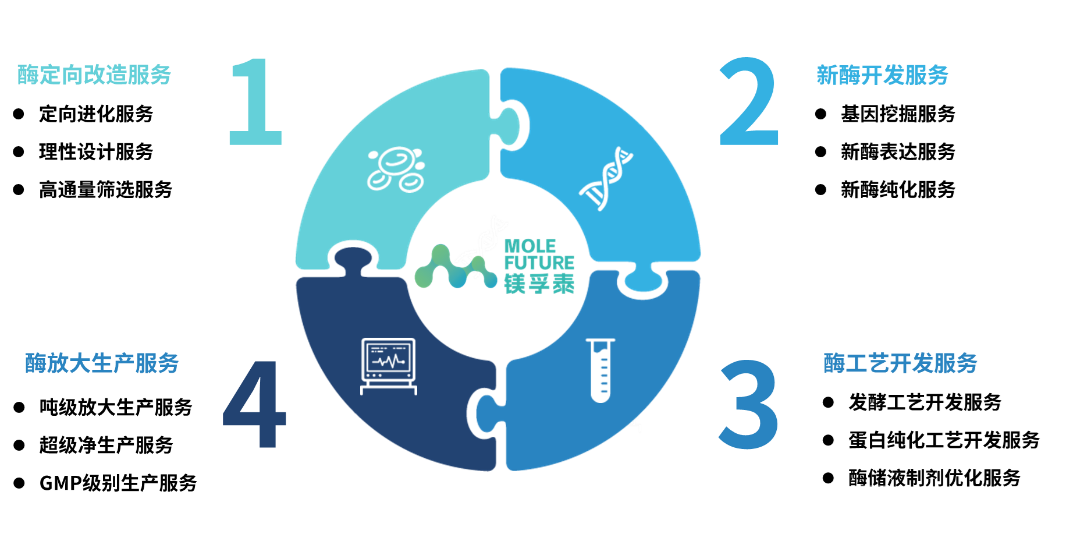
Molefuture Bio-Enzyme Engineering Service Scope
Focusing on the biopharmaceutical and biomanufacturing sectors, with greater emphasis on platform technology iteration in the future
Currently, Molefuture focuses on two major sectors: biopharmaceuticals and biomanufacturing, providing customized enzyme engineering and development services.In the biopharmaceutical sector, the company is dedicated to developing enzymes related to mRNA vaccines, gene editing, base editing, and small nucleic acid drugs. By collaborating with downstream partners, it develops enzyme proteins with independent intellectual property rights. Meanwhile, Molefuture is actively exploring the biomanufacturing industry, including DNA synthesis and sequencing, and partnering with biomanufacturing companies to develop novel enzymes that meet the demands of metabolic engineering and biocatalysis.
However, Liu Xiang noted that the company’s services will not be limited to specific fields but will cover all industries requiring enzyme applications. From food and animal feed to textiles, Molefuture can provide customized enzyme solutions tailored to customer needs, including enhancing enzyme performance, acid and alkali resistance, substrate specificity, selectivity, and inhibitor tolerance. The company is also committed to helping the chemical industry transition from chemical methods to more environmentally friendly enzymatic processes, offering comprehensive solutions that encompass the full suite of technologies—from enzyme design to fermentation, purification, and enzymatic catalysis—to accelerate customers’ product R&D and industrialization.
Looking ahead, although Molefuture has been in operation for only one year, it is actively discussing and planning its future strategic development. Since its inception, the company has remained committed to technological iteration and innovation. In addition to continuing to provide enzyme engineering services, Molefuture will accelerate the exploration of AI applications in biotechnology. Meanwhile, Molefuture will also offer broader services in the field of synthetic biology, including strain screening and engineering, with the aim of becoming a comprehensive, platform-based company that empowers the industry.
The field of synthetic biology currently holds immense potential, yet there is no shortage of homogeneous enterprises in China, and intellectual property protection for certain technologies remains imperfect. Addressing the current landscape characterized by both fervor and intense competition, Liu Xiang stated, “Molefuture was established at the height of the synthetic biology boom. Although the industry currently faces numerous challenges, we view these as opportunities for growth. Intensified competition necessitates greater innovation. We believe that through our own technological advancements, Molefuture will drive breakthrough progress for the entire industry.”