

JD Health Resembles a 'Super Comprehensive Hospital' as It Files for IPO

JD Health
Internet Medical and Health Service Platform Provider
Yesterday, JD Health released its 2024 interim performance report. In the first half of the year, JD Health achieved revenue of RMB 28.34 billion and an adjusted net profit of RMB 2.64 billion, representing a year-on-year increase of 8.5%.
As the first quarter of 2023 was still in the peak period of the COVID-19 pandemic, JD Health achieved better-than-expected performance growth at that time. Excluding the impact of the pandemic, JD Health has been maintaining steady growth.
Meanwhile, JD Health’s net profit margin in the first half of the year reached 9.3%, hitting a new high for any half-year period since the company’s listing. For the year ended June 30, 2024, JD Health’s active user base totaled 181 million.
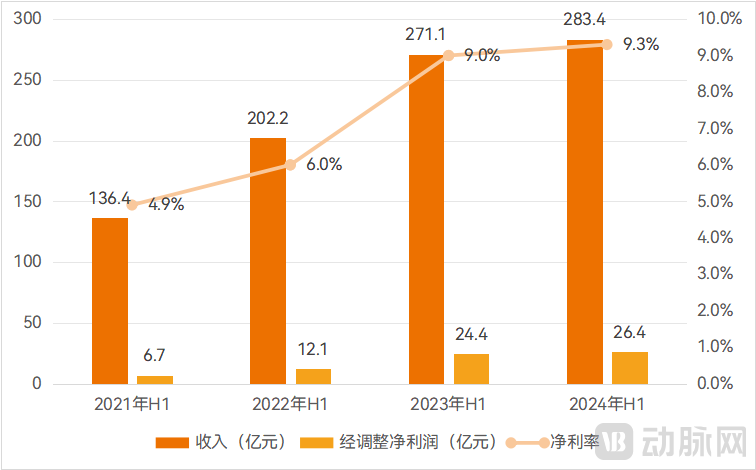
JD Health’s Interim Performance Growth; Data Source: Company Financial Reports
A review of business developments since 2024 reveals that JD Health has continuously enhanced the breadth and depth of its services across the entire healthcare workflow—encompassing medical consultation, testing, pharmaceuticals, and medical insurance. This integration creates opportunities for paid conversion at every stage, contributing to the improvement in profitability.
From the perspective of the healthcare service system, JD Health is increasingly exhibiting the characteristics of a comprehensive hospital, building upon its existing service offerings and capabilities.
In the first half of 2024, JD Health continued to strengthen the development of key specialized disciplines in internet healthcare. Among these initiatives, its Dermatology Hospital established four departments and 49 expert studios, cumulatively serving over 15 million patients, with a cross-departmental follow-up consultation rate exceeding 20%. Meanwhile, its Psychological Service Center was upgraded into China’s first online mental health service platform powered by large language models.
In recent years, the “center-based” care delivery model has been increasingly adopted by traditional large-scale brick-and-mortar hospitals. This patient-centered approach configures medical resources according to diagnostic and therapeutic needs for specific diseases and co-locates these resources within a single area. Meanwhile, care centers establish multidisciplinary collaboration mechanisms, whereby physicians from relevant specialties jointly develop treatment plans based on patients’ clinical conditions. Under this model, patients simply need to select the appropriate disease-specific care center when seeking medical attention, eliminating the need to determine which department to visit; instead, physicians, equipment, and other services are organized around the patient and their condition.
A comparison reveals that JD Health’s intensive development of its dermatology hospitals and psychological service centers follows the same logic as the “center-based” clinical model employed by offline hospitals.
For example, JD Health’s Dermatology Hospital has registered more than 5,000 physicians, including nearly 3,000 specialists from Grade A tertiary hospitals. It covers four secondary outpatient specialties, such as hair disorders and pediatric dermatology, and has launched 49 single-disease expert studios to provide targeted solutions for 17 types of complex and refractory skin conditions. Overall, the Dermatology Hospital meets patients’ personalized needs for “on-demand consultations for minor ailments,” “chronic disease management,” “early warning for serious conditions,” and “access to specialists for complex and refractory cases.”
JD Health’s Mental Health Service Center has established a multidisciplinary diagnostic and treatment model integrating “physicians, medication, and psychological counseling.” This framework enables efficient coordination and referral for psychiatric diagnosis and treatment, psychological counseling services, or combined consultations. Additionally, the center has carefully developed a suite of convenient and efficient online psychological assessment tools to provide detailed and precise evidence for subsequent interventions by professional counselors or physicians.
In 2024, the Psychological Service Center also launched an AI psychological companion product called “ChatHeal Universe,” established a Service Quality Management Committee, and released standardized clinical pathways, leveraging technology and institutional frameworks to reinforce the center’s multidisciplinary diagnosis and treatment model.
Historically, the spatial layout of most brick-and-mortar hospitals was organized according to traditional departmental divisions. In recent years, an increasing number of hospitals have incorporated the spatial requirements of the “center-based” care model into their planning from the outset during renovation and expansion projects. The “center-based” care model has become a significant trend in hospital service innovation.
Meanwhile, refined management of disease-specific specialties is a crucial pathway for the development of hospital departments. By establishing corresponding diagnosis and treatment centers focused on existing advantageous disciplines or emerging specialty areas, hospitals can not only better serve patients but also more precisely integrate cutting-edge technologies, thereby continuously enhancing their medical technical capabilities.
Driven by the continuous development of specialized disciplines, as of June 30, 2024, the average daily volume of online consultations at JD Health Internet Hospital exceeded 480,000, with dermatology and psychology emerging as its leading specialties. These interim achievements further validate the value of specialized services in internet healthcare.
In the future, dermatology and psychology can continue to be refined as key focus areas and serve as models to guide the expansion of other specialty strengths; the aggregation of multiple leading specialties will enhance the overall capability of internet healthcare services.
Laboratory and diagnostic tests are an indispensable part of the medical consultation process. For a long time, internet-based medical services were incomplete due to the difficulty in conducting such tests.
At the end of 2023, JD Health launched its at-home rapid testing service to address the peak incidence of respiratory viral and bacterial infections. Covering core areas in cities such as Beijing, Shanghai, Guangzhou, Shenzhen, and Chengdu, this service provided significant assistance to users coping with the infection surge. Subsequently, JD Health accelerated the expansion of its rapid testing portfolio, which now includes items such as PCR testing for pertussis, a triple-panel test for hand, foot, and mouth disease, and a 16-pathogen panel for respiratory viruses and bacteria. All these services utilize oral and nasal swab sampling, allowing users to complete the tests at home without the need for professional assistance.
The aforementioned services require close collaboration with third-party testing institutions, and the pilot implementation of home-based rapid testing has laid the foundation for JD Health to enhance its laboratory testing services.
In 2024, JD Health Internet Hospital launched the “Online Laboratory Test Requisition Service,” initially covering 70 blood draw items., covering conditions such as upper respiratory tract infections, diabetes assessment, thyroid dysfunction, hyperuricemia/gout, and hyperlipidemia, with service coverage extending to areas within Beijing’s Fifth Ring Road and selected parts of the Sixth Ring Road.
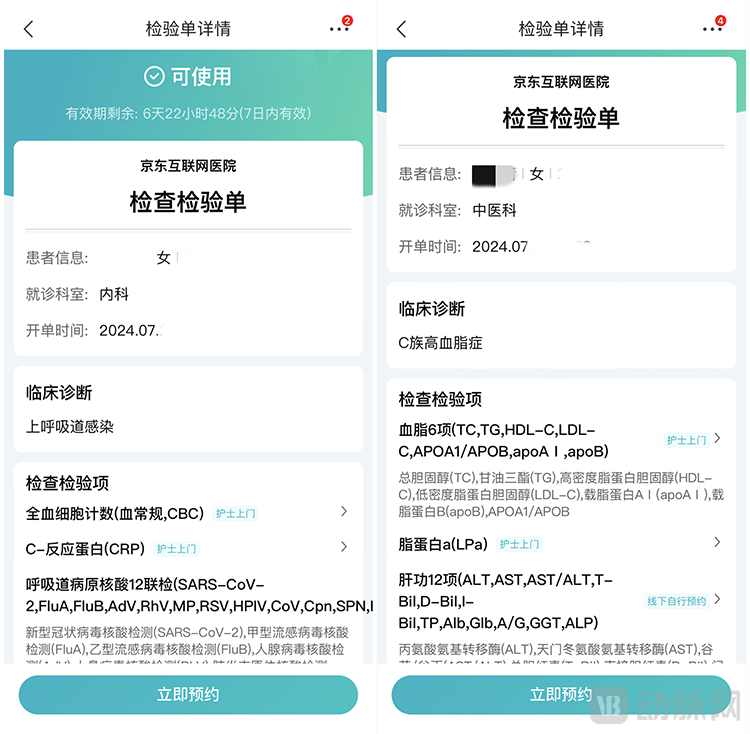
JD Health Internet Hospital - Test and Examination Order Page
Specifically, after a user initiates a medical consultation, the physician may order laboratory tests based on the patient’s condition. Once the user schedules the tests online, a licensed nurse will visit the patient’s home to collect blood or other samples in accordance with the appointment details, and these samples will be sent to a third-party medical laboratory for analysis. Users can access their test results online within 3–4 hours, enabling physicians to provide more precise diagnoses and treatment recommendations based on the findings.
In a survey on internet hospitals conducted by VCBeat’s Eggshell Research Institute, most physicians believed that patients’ failure to provide or upload necessary medical records would compromise the quality of care. They emphasized the need for internet hospitals to strengthen integration with third-party laboratory and diagnostic services to improve the availability of patient data.
Therefore, the “seamless” integration of the testing process provides JD Health with greater assurance in balancing the efficiency and quality of its internet-based medical services.In the future, JD Health will further expand its at-home service scenarios, including services such as in-home nursing and home-based care.
For brick-and-mortar hospitals, the online ordering and appointment scheduling function for laboratory and imaging tests provided by their affiliated internet hospitals has become one of the most heavily utilized services. This is primarily because the traditional offline process for such tests is cumbersome; although online access to test reports is becoming increasingly prevalent, patients still inevitably need to visit outpatient clinics in person to consult with physicians for test requisitions and then wait in line. However, even with the implementation of online test ordering and appointment scheduling, patients are still required to visit the hospital in person to undergo the actual laboratory and imaging procedures.
As an internet healthcare platform, JD Health is accelerating the integration of offline medical testing services, enabling patients to complete a closed-loop “consultation–testing–medication” service at home. It has truly established an integrated online-offline service system. Its ability to solve practical problems and its professional service capabilities are increasingly comparable to those of a high-quality general hospital, and it is rapidly evolving into a “super general hospital” that transcends traditional definitions.
If JD Health is regarded as a “super general hospital,” it also operates an all-category, omni-channel “super pharmacy.”
In terms of self-operated business, JD Health has further expanded its cooperation with upstream pharmaceutical companies. Since 2024, JD Health has launched the online debut of several new and specialized drugs, including Shenyang Xingqi Pharmaceutical’s 0.01% atropine sulfate eye drops for myopia control, Sanofi’s lipid-lowering drug Leqvio (inclisiran), and GenSci’s anorexia treatment Meishiya. Meanwhile, its offline DTP (Direct-to-Patient) pharmacies dispensed the first dose of Leqembi, a targeted therapy for Alzheimer’s disease, through China’s out-of-hospital channels.
JD Health has also engaged in deep collaboration with medical device enterprises, launching a health and elderly care channel in 2024 that offers 30,000 brands and thousands of subcategories of age-friendly products online, while establishing two self-operated hearing centers offline.
Platform-wise, the number of new and active third-party merchants grew rapidly; as of June 30, 2024, the platform hosted 80,000 merchants, representing a year-on-year increase of over 100%.
The integrated development of self-operated and platform-based businesses has enabled JD Health to offer users a more comprehensive and cutting-edge selection of medications and other medical health products.Taking dermatological conditions as an example, JD Health currently offers more than 3,000 prescription medications and non-pharmaceutical products for skin care, catering to the needs of various skin concerns.
JD Health also provides users with medication purchasing methods that better suit their actual needs.In 2024, JD Health’s instant retail business achieved breakthrough growth, with the “JD Medicine Express Delivery” brand and service upgraded to accelerate delivery to“Average 28 minutes, fastest 9 minutes”delivery, better meeting users’ urgent medication needs; as of June 30, 2024, the service covered more than 490 cities, with over 150,000 partner pharmacies.
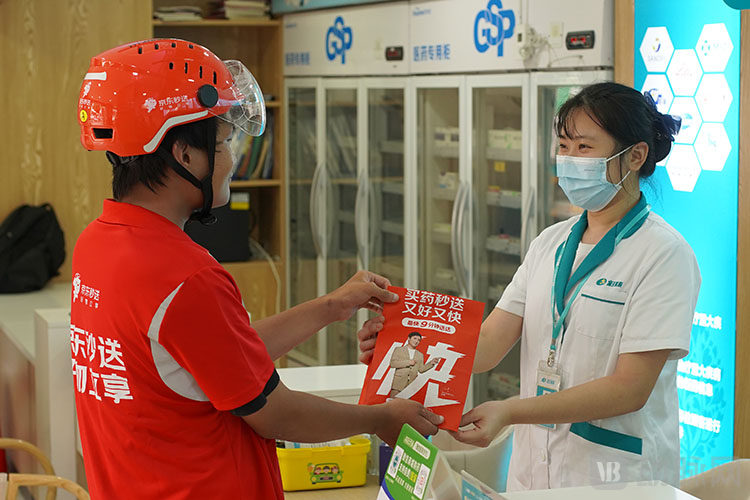
JD Health Upgrades Delivery Speed for Its Instant Retail Business
Notably, JD Medicine’s instant delivery service has launched online medical insurance payment capabilities in Beijing, Shanghai, Guangzhou, Shenzhen, and Dongguan. Financial reports indicate that in May 2024, JD Health pioneered a pilot program for personal medical insurance account payments in Beijing, enabling local insured residents to achieve real-time medical insurance settlement for online O2O orders. As of June 30, 2024, more than 350 designated retail pharmacies covered by medical insurance had been integrated into the platform. With its service network covering all administrative districts in Beijing, JD Health has become the platform with the largest number of connected stores, the widest user coverage, and the fastest delivery times in the Beijing region.
It is a common perception and habit among the general public that medical expenses for in-person hospital visits can be reimbursed through medical insurance.
Since 2019, the National Healthcare Security Administration has repeatedly spearheaded the issuance of policies regarding insurance reimbursement for internet-based medical services. Documents released by the State Council concerning medical services and health consumption have also frequently proposed incorporating “Internet+” medical services into the national health insurance scheme. Notably, the COVID-19 pandemic prevention and control efforts in 2020 significantly accelerated this process.
However, medical insurance coverage has historically been limited to internet hospitals affiliated with physical hospitals, or to certain internet healthcare companies that leveraged the medical insurance credentials of their self-operated hospitals to enable insurance reimbursement for online services. For the majority of internet healthcare platforms, medical insurance payment has not been genuinely implemented.
Currently, leveraging the opportunity presented by the opening of medical insurance payments for O2O medication purchases, internet healthcare platforms with existing O2O operations have proactively integrated with pharmacies covered by medical insurance. Although most regions currently only support payments from personal accounts, this represents a significant step forward for both platforms and users in terms of service offerings and the convenience of accessing medical care and purchasing medications. More importantly, as pilot programs for medical insurance payments for O2O medication purchases are rolled out in various regions, the inclusion of internet healthcare services under medical insurance payment schemes is also being accelerated.
The characterization of JD Health as increasingly resembling a “super general hospital” does not imply that this is its actual strategic objective. Rather, it stems from the company’s provision of closed-loop services spanning multiple medical specialties across diagnosis, testing, pharmaceuticals, and medical insurance reimbursement. This approach imbues its internet-based healthcare offerings with stronger professional medical attributes, challenging the industry perception that digital health platforms are only suited for consultations and lightweight triage. Furthermore, its service content and workflows align more closely with public expectations of a large-scale general hospital.
Compared with traditional general hospitals, JD Health differentiates itself by cross-regionally integrating medical resources across China to serve users nationwide, which is arguably the greatest advantage of internet healthcare platforms.
In addition, JD Health leverages its “Jingyi Qianxun” large language model as the underlying technology to provide end-to-end service support across medical care, diagnostics, pharmaceuticals, and health insurance.
Targeting mass-market users, JD Health launched its intelligent health assistant product, “Kangkang,” at the “2024 JD Cloud Summit.”
“Kangkang” is positioned to become a “smart doctor” by users’ sides, offering free services. It not only answers users’ health queries anytime but also provides precise and efficient links to medical resources, thereby achieving comprehensive coverage of services including health consultations, online medical consultations, finding doctors and hospitals, interpreting medical examination reports, rapid medication delivery, home testing, and scheduling medical check-ups.
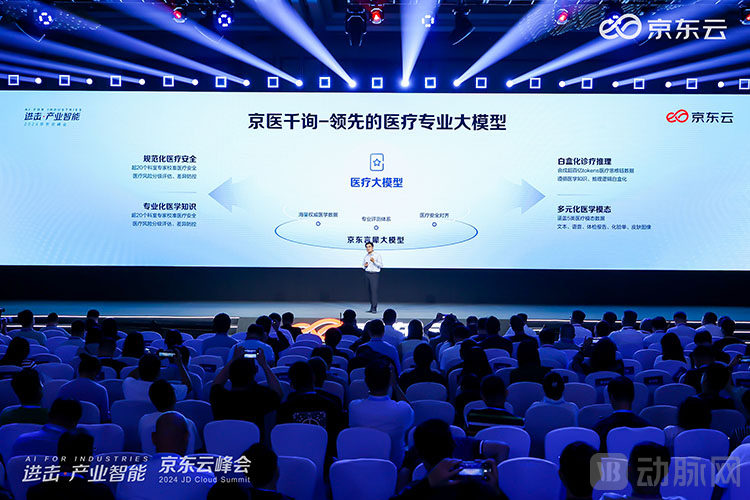
JD Health Launches Diversified Products Based on the “Jingyi Qianxun” Large Language Model
Targeting physicians and specialists, JD Health continues to enhance its intelligent physician assistant based on “Jingyi Qianxun,” upgrading intelligent diagnostic support tools to improve the efficiency and accuracy of online clinical consultations. Meanwhile, it is prioritizing the development of the “Jingyi Qianxun” Expert Service Agent, helping specialists break free from routine, low-value, and procedural tasks, thereby allowing them to focus their energy on more critical work.
For example, JD Health Dermatology Hospital has implemented end-to-end AI tools, including a series of pre-consultation AI assessment tools and an intelligent physician assistant covering the entire diagnosis and treatment workflow, to continuously optimize the patient-provider experience. Its Psychological Service Center has launched multimodal auxiliary diagnostic tools to help improve the quality and efficiency of psychological counseling and online consultations. The digital therapeutic product “Sleep Monitoring Data Processing Software” facilitates comprehensive monitoring of sleep physiological indicators throughout the entire cycle, providing precise reference data for physicians’ clinical decision-making and psychologists’ consultations.
Of course, while internet healthcare platforms offer numerous advantages over brick-and-mortar hospitals and can gradually supplement the elements of offline services, it is undeniable that in the treatment of complex and critical conditions, as well as in major examinations and surgeries, internet healthcare must be fully complementary to offline care, jointly forming an innovative medical service system.
JD Health is no exception. While continuously refining its own service model, JD Health has engaged in deep collaboration with physical medical institutions to explore an innovative system for online-offline and intra-hospital/extra-hospital coordination. For instance, JD Health has entered into a strategic partnership with the First Affiliated Hospital of Wenzhou Medical University, leveraging a diversified product portfolio powered by large language models to reshape patient care pathways and jointly build “Smart Services for the Future Hospital.”
Financial reports indicate that JD Health will continue to strengthen the closed-loop ecosystem of “retail pharmacy + healthcare services.” In other words, internet healthcare services across the domains of medical consultation, diagnostics, pharmaceuticals, and medical insurance will be continuously expanded and deepened, helping to drive the entire industry forward by a significant margin. Over time, JD Health’s leading value within the internet healthcare sector, as well as the innovative value of internet healthcare within the broader medical service system, will become increasingly prominent.