

Ansa Biotechnologies Files IPO Prospectus: Pioneering Enzymatic DNA Synthesis to Unlock the Future of Synthetic Biology
Ansa Biotechnologies
DNA Synthesis Technology Developer
Synthetic biology, hailed as the third biotechnology revolution, is driving industry transformation in next-generation biomanufacturing and the future bioeconomy with its disruptive innovative power.
According to McKinsey’s forecasts, the economic value of synthetic biology and biomanufacturing will reach $100 billion by 2025, with 60% of material products in future global economic activities being producible through biotechnology. Between 2030 and 2040, synthetic biology technologies are projected to generate annual direct economic benefits of $2 trillion to $4 trillion globally.
At the heart of this $4 trillion economic benefit lies the synthesis and engineering of DNA.Synthetic DNA provides key core raw materials for basic research and applications in synthetic biology. However, current DNA synthesis faces two major challenges—length limitations and complex structures—which restrict the efficient synthesis of longer, sequence-specific DNA. Long DNA fragments are a critical factor driving higher-level biological engineering design.
Ansa Biotechnologies (“Ansa”), a pioneer in next-generation DNA synthesis, has taken the lead in solving the challenge of long-read DNA synthesis.
March 2023,Ansa Announces Successful De Novo Synthesis of a 1,005-Base DNA Sequence. According to the press release, this is currently the longest DNA oligonucleotide synthesized in a single run worldwide.. The synthesized 1,005-base-pair DNA sequence contains key components of AAV viral vectors for developing gene therapies and features complex, stable secondary structures with high GC content. Its structural and sequence characteristics pose significant challenges to traditional chemical synthesis methods that rely on assembling short oligonucleotides.In this synthesized sequence set, 28% of the sequences were completely correct. This indicates that the average yield per step during the synthesis process was approximately 99.9%.。
Dr. Daniel Lin Arlow, Chief Scientific Officer and Co-founder of Ansa Biotechnologies, stated at the time, “The next frontier in oligonucleotide synthesis is the direct synthesis of gene-length sequences. The synthesis of DNA strands 1,005 bases in length represents a significant milestone in this field.”
Ansa, founded in 2018 and headquartered in California, USA, was co-founded by two experts in the field of DNA synthesis, Daniel Lin-Arlow and Sebastian Palluk. Currently,Ansa is dedicated to building fast and reliable DNA synthesis services to accelerate synthetic biology research.。
Ansa’s core technology is a novel enzyme-based DNA synthesis method., which was jointly developed by Daniel Lin-Arlow and Sebastian Palluk.
As Chief Scientific Officer and Co-founder of Ansa, Daniel Lin-Arlow has accumulated over a decade of research experience in the field of DNA synthesis. During his undergraduate studies, he developed computational tools for analyzing gene expression regulation at the Vamsi Mootha Laboratory, affiliated with MIT and the Broad Institute of Harvard and MIT. During his doctoral studies, he researched and developed novel technologies for de novo DNA synthesis in the Jay Keasling Laboratory. To date, his papers published in journals such as Nature, Science, and Cell have been cited more than 8,000 times, and he is a co-inventor on multiple patents.
Sebastian Palluk currently serves as Chief Technology Officer and Co-Founder of Ansa Biotechnologies. He holds a Master’s degree in Biomolecular Engineering from the Technical University of Darmstadt in Germany, where his master’s thesis focused on computational studies of the compatibility of terminal deoxynucleotidyl transferase (TdT) with reversible terminator deoxynucleoside triphosphates (RTdNTPs) for de novo DNA synthesis. In 2015, Sebastian Palluk pursued his doctoral studies at the Joint BioEnergy Institute of Lawrence Berkeley National Laboratory.
During his doctoral studies, Sebastian Palluk collaborated with Daniel Lin-Arlow to develop the first TdT-based enzymatic synthesis method, publishing their findings in *Nature Biotechnology*.1This paper also became the foundation for the birth of Ansa.
In February 2024, Ansa also attracted Jason Gammack, a seasoned executive with over 30 years of experience in the life sciences industry, to join as Chief Executive Officer. Mr. Gammack’s appointment will accelerate Ansa’s efforts to complete its “Early access” program for complex synthetic genes and gene fragments, while preparing the company for the launch of comprehensive commercial services.
Leveraging team strengths and technical expertise,Ansa has garnered significant favor from the capital markets. Over the past four years, the company has completed six rounds of financing, raising a total of $83.4 million (approximately RMB 598 million). Investors include 15 prominent institutions and corporations, such as RA Capital, Horizons Ventures, and Fifty Years.。
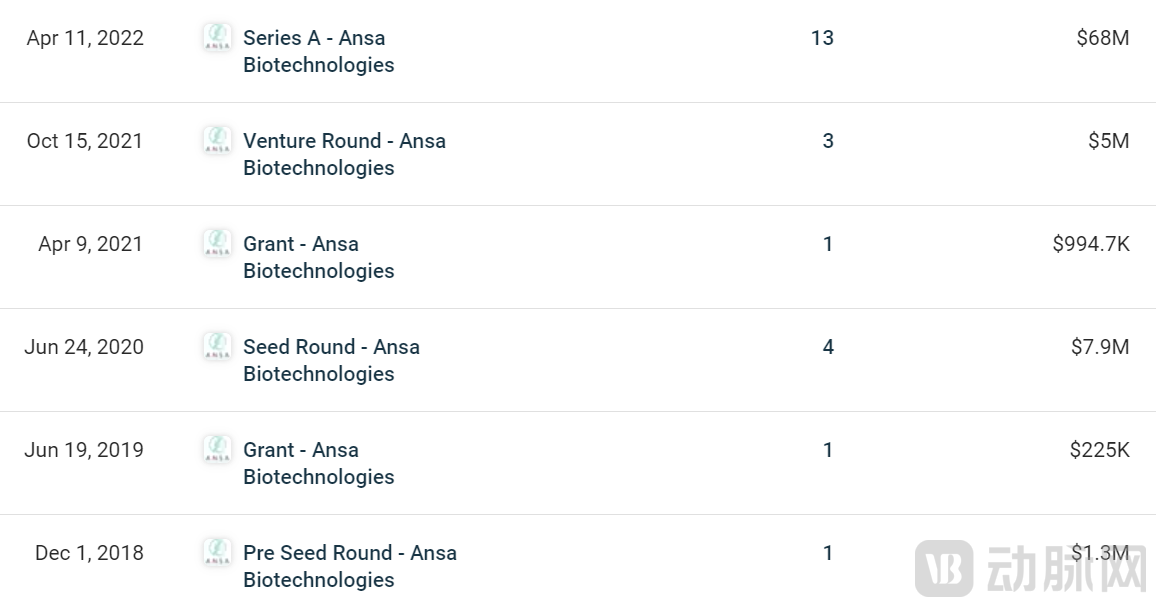 Ansa’s Funding History | Image Source: Crunchbase Website
Enzymatic DNA Synthesis Technology is a biotechnology that utilizes enzymatic catalysis to synthesize DNA molecules.. Compared with traditional chemical synthesis techniques, it offers significant advantages in multiple aspects such as synthesis length, efficiency, and cost, and is regarded as the next-generation technology capable of driving a transformation in DNA synthesis.
During the process of synthesizing DNA sequences using this technology, DNA polymerase plays a crucial role. DNA polymerase uses DNA as a template to sequentially link deoxynucleotides, thereby forming new DNA strands. It possesses the catalytic activity to form phosphodiester bonds between deoxynucleotides, thus enabling DNA synthesis.
Typically, polymerases extend primers using a DNA template. However,TdT is a specialized DNA polymerase. It exhibits template-independent rapid polymerization activity, enabling long-chain DNA synthesis using only single-stranded DNA without the need for denaturation, annealing, or extension steps during the entire catalytic process.. Furthermore, TdT exhibits low substrate selectivity and demonstrates rapid catalytic rates for all deoxyribonucleoside triphosphates (dNTPs); any dNTP, ribonucleoside triphosphate (rNTP), or modified nucleoside triphosphate analog can serve as its substrate.
However, natural TdT can only randomly add new dNTPs to the ends of DNA strands and cannot precisely control the strand synthesis process, making it difficult to meet the practical requirements of artificial DNA synthesis.
In response, Ansa has developed a unique enzymatic DNA synthesis technology.This technology utilizes a conjugate known as “TdT-dNTP.” It is an enzymatic reagent capable of rapidly and controllably adding single nucleotides to DNA sequences.It is prepared by tethering individual dNTP molecules to TdT, which can extend a DNA sequence by one base using the linked dNTP.
Specifically, the DNA synthesis process of this technology:
First, expose the DNA primers attached to a solid support to the TdT-dNTP conjugate of the first desired base to incorporate it into the primer sequence;
Second, the conjugate extends the primer using its tethered dNTP and remains covalently linked to the 3' end, thereby preventing further primer extension by other conjugates;
Third, wash away excess conjugates with reagents and cleave the linker to release TdT from the primer, thereby enabling subsequent extension;
Fourth, the process is repeated multiple times using conjugate sequences to ultimately synthesize the desired DNA sequence.
Notably, Ansa’s dNTP conjugates can incorporate a new base every 10–20 seconds. This means that the 1,005-base DNA sequence previously synthesized by Ansa can be completed in under six hours.
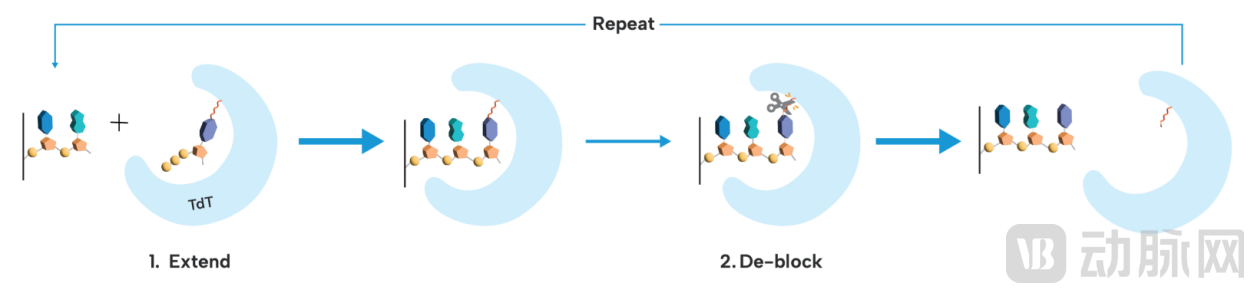
The Operational Process of Ansa's Enzymatic DNA Synthesis Technology. Image Source: Ansa Official Website
Ansa stated,This technology has previously enabled the direct synthesis of DNA sequences exceeding 1,000 bases in length without assembly. To date, Ansa is capable of directly synthesizing DNA sequences up to 600 base pairs (bp) in length without assembly.。
According to its official website, Ansa’s enzymatic DNA synthesis technology offers three key advantages over other DNA synthesis technologies: first, it enables the rapid synthesis of long and complex DNA sequences; second, the synthesis process is entirely enzymatic and causes no damage to the DNA; and third, it features a streamlined workflow optimized for speed and reliability.
Leveraging its proprietary enzymatic DNA synthesis technology, Ansa has developed a series of highly multiplexed, customized instruments. These instruments synthesize DNA using its TdT-dNTP conjugates. Furthermore, the DNA synthesis process is coordinated and controlled by bespoke informatics software to ensure that all synthesized DNA sequences undergo biosafety screening in accordance with industry standards, thereby guaranteeing the reliability of the quality of the synthesized products.
Currently, Ansa offers fully sequenced synthetic cloned genes and DNA fragments with complex structural and sequence features. Its DNA synthesis technology serves multiple industries, including healthcare and pharmaceuticals, biological research, food and agriculture, and industrial biotechnology.
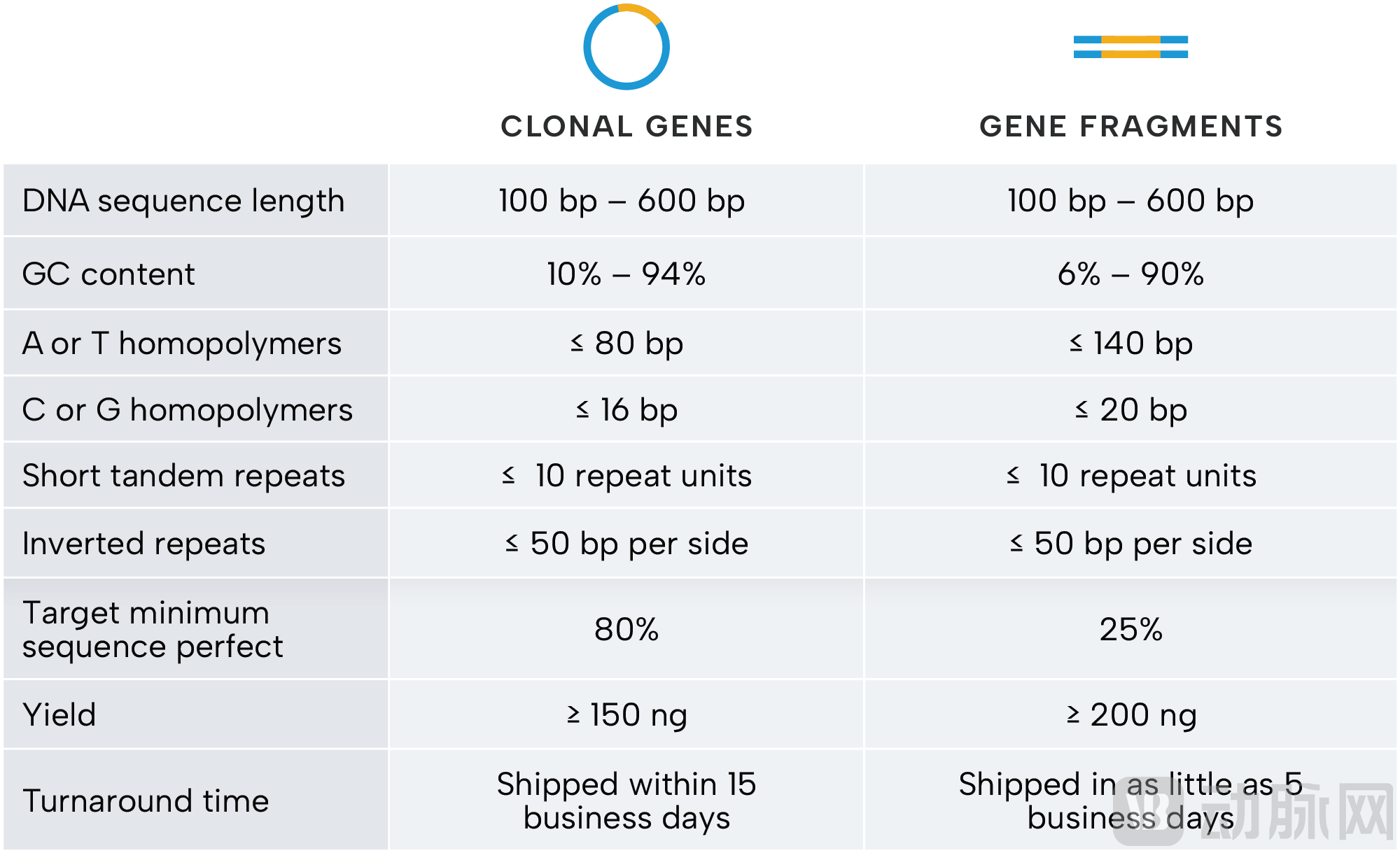 Ansa Product Types. Source: Ansa Official Website
In April 2023, after successfully synthesizing a 1,005-base-pair DNA sequence de novo, Ansa announced the launch of an Early Access Program for cloned synthetic genes to help researchers obtain difficult-to-synthesize DNA sequences. One month later, Ansa delivered promoter sequences with high GC and AT content to its first customer, Enoda.
In May 2024, Ansa Biotechnologies announced again the expansion of its Early Access Program for complex DNA synthesis services to accelerate innovation in healthcare, life sciences research, and numerous other industries underpinned by DNA synthesis technologies.
In July 2024, building on two early access programs for its synthetic DNA products, Ansa officially announced the commercial launch of its cloned synthetic DNA and synthetic DNA fragments.。
In a press release, Ansa CEO Jason Gammack stated, “With the launch of this product, we look forward to empowering more scientists to unleash their creativity, which will further drive groundbreaking advances in healthcare, life sciences research, and other industries.”
However, it is worth noting that Ansa’s enzymatic DNA synthesis technology is not flawless. Returning to the specific process of this enzymatic DNA synthesis technology,In the third step of synthesis, reagents are required to wash away excess conjugates from the product and cleave the linker. However, upon cleavage of the linker, chemical residues or scars remain on the nucleobase.. This means that, from a molecular perspective, the final synthesized DNA product is not a pure DNA molecule, which may also affect the downstream applications of DNA synthesis products.
To address this issue, Daniel Lin-Arlow and his colleagues developed a modified linker design to limit or avoid the formation of chemical scars during synthesis. Specifically, Ansa Biotechnologies employs electrochemical oxidation on microelectrode arrays to cleave the conjugates, thereby minimizing scar size. However, this is not a perfect solution, as it does not completely eliminate scars. Furthermore, if the electrochemical cleavage conditions are not carefully controlled, the relatively narrow difference in oxidation potential between the 3'-hydroxyl group and guanosine residues in the growing oligonucleotides may lead to oxidative damage.2。
However, despite certain limitations in Ansa’s enzymatic DNA synthesis technology solution, it is undeniable that this technology has broken through the bottlenecks of traditional DNA synthesis methods, bringing new opportunities to the field of synthetic biology. It enables the synthesis of longer and more complex DNA sequences, providing more efficient DNA synthesis tools for fields such as gene editing and drug development. Furthermore, the advancement of this technology is expected to reduce the cost of DNA synthesis, improve synthesis efficiency, and accelerate the development of numerous sectors supported by DNA synthesis technologies.
Currently, Ansa is optimizing and improving enzymatic DNA synthesis technology to further enhance the rationality of adapter design, thereby minimizing the formation of chemical scars and reducing the risk of oxidative damage. Meanwhile, Ansa is strengthening its control and research on electrochemical cleavage conditions, striving to identify optimal parameter settings to ensure the stability and reliability of the synthesis process.
Daniel Lin-Arlow, Chief Scientific Officer and Co-Founder of Ansa Biotechnologies, also stated, “Our R&D team is working to enhance the performance of our synthesis platform, with the aim of delivering superior DNA synthesis products to our customers. Notably, in 2024, Ansa expects to launch DNA constructs measuring thousands of bases in length.”
References:
1. Palluk S, Arlow DH, de Rond T, Barthel S, Kang JS, Bector R, Baghdassarian HM, Truong AN, Kim PW, Singh AK, Hillson NJ, Keasling JD. De novo DNA synthesis using polymerase-nucleotide conjugates. Nat Biotechnol. 2018 Aug;36(7):645-650. doi: 10.1038/nbt.4173. Epub 2018 Jun 18. PMID: 29912208.
2. Spatially Selective Electrochemical Cleavage of a Polymerase-Nucleotide Conjugate.Jake A. Smith, Bichlien H. Nguyen, Rob Carlson, Jeffrey G. Bertram, Sebastian Palluk, Daniel H. Arlow, and Karin Strauss.ACS Synthetic Biology 2023 12 (6), 1716-1726.