

Cresco Spine Submits IPO Prospectus for SDS™: A Breakthrough Dynamic Implant System Enabling 3D Spinal Correction and Natural Growth Without Invasive Lengthening

Cresco Spine
Developer of Surgical Treatment Devices for Scoliosis
Early-Onset Scoliosis (EOS) is a three-dimensional (3D) curvature of the spine and trunk caused by various etiologies, predominantly affecting children aged 9 years or younger. As a life-threatening condition with complex underlying diagnostics, EOS can deteriorate significantly during growth if left untreated, leading to impaired cardiopulmonary development, progressive thoracic insufficiency, respiratory failure, and even death.
The incidence of complications during the treatment of this disease is high, often necessitating multiple surgeries or other clinical interventions in early childhood. Furthermore, patients require repeated hospital visits for monitoring, which further exacerbates the disease burden on these young children and their parents, ultimately resulting in substantial medical costs.
Recognizing the aforementioned pain points in the field of early-onset scoliosis (EOS), Cresco Spine has entered the market. Established in 2021 as a subsidiary of the University Medical Center Utrecht in the Netherlands, the company is dedicated to developing novel surgical spinal therapies to improve the standard of care for scoliosis and has created an innovative dynamic implant solution for scoliosis.
When cast or bracing treatment fails to control the progression of early-onset scoliosis, implantation of growth-friendly systems is an effective therapeutic option. Some of these implants reduce deformity through passive sliding guidance. More commonly, implants that are repeatedly lengthened as the spine grows are used, such as Traditional Growing Rods (TGR), Vertically Expandable Prosthetic Titanium Rib (VEPTR), or Magnetically Controlled Growing Rods (MCGR).
Although these technologies have significantly improved the clinical management of early-onset spinal deformities, certain limitations remain. For instance, traditional growing rods and vertically expandable titanium rib prostheses require periodic surgical distractions, imposing a substantial burden on patients, families, and healthcare systems; furthermore, repeated exposure to anesthesia may adversely affect neurodevelopment in children.
Magnetic Controlled Growing Rods (MCGR) were developed specifically to overcome this limitation, allowing for distraction via an external magnet. However, MCGR is associated with a high rate of implant-related complications, with approximately 30–50% of patients requiring revision surgery within two years. Furthermore, concerns regarding metal debris have led to the temporary suspension of its CE marking, and international guidelines now recommend restricting the implantation of MCGR. Additionally, although MCGR eliminates the need for surgical lengthening, it necessitates more frequent outpatient visits than Traditional Growing Rods (TGR), imposing significant time and financial burdens on patients and their families.
Furthermore, magnetically controlled growing rods (MCGRs) are relatively rigid and difficult to match the spinal contour, particularly in the sagittal plane. Meanwhile, because the spine is immobilized and unloaded, this may lead to implant failure, stress shielding, and spinal stiffness. During repeated lengthening procedures, the device is subject to the “law of diminishing returns,” meaning that the benefit gained from each subsequent lengthening surgery tends to decrease.
Overall, these traditional systems share a common drawback: they cannot dynamically adapt to or stimulate spinal growth, nor can they further reduce the number of affected spinal segments. This limitation arises because many traditional implants are designed with fixed lengths and can only be adjusted through external forces. Their lengthening is intermittent rather than continuous, preventing them from actively accommodating the natural growth and changes of the spine. Consequently, they fail to respond in real time to spinal growth demands or provide sustained corrective forces during spinal development, thereby limiting the efficacy of correction.
Meanwhile, some implants frequently undergo spontaneous fusion, which may lead to the crankshaft phenomenon and loss of spinal growth; implant-related device failures are also common.
To address the aforementioned challenges,Cresco Spine has developed a novel dynamic growth-friendly implant—the Spring Distraction System™ (hereinafter referred to as SDS™)—which provides active, continuous spinal distraction through the use of one or more compression springs around a standard sliding rod, thereby stimulating spinal growth and further correction.
SDS™ is indicated for patients with early-onset scoliosis (EOS) who are skeletally immature and present with single or double curves progressing beyond 45°. It provides initial three-dimensional correction of the spine in both the coronal and sagittal planes, while allowing for distraction concurrent with spinal growth. SDS™ permits continued natural spinal growth during the correction process, which is particularly critical for patients whose skeletal development is not yet complete.
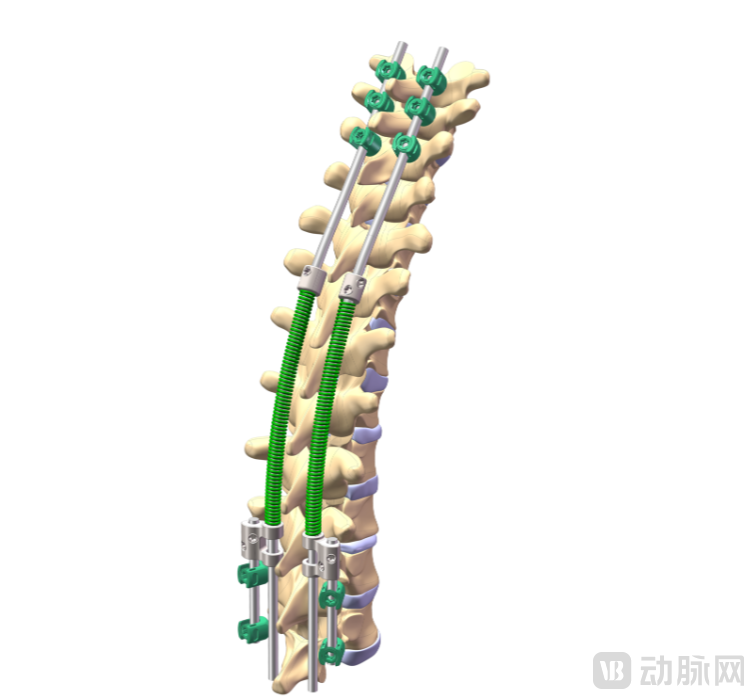
Spring Distraction System™
The SDS™ system utilizes titanium alloy pedicle screws to fixate cobalt-chromium rods, offering high strength and corrosion resistance. The rods, available in diameters of 4.5 mm or 5.0 mm, are not rigidly fixed but can slide through oversized parallel connectors at their proximal anchor points. This design allows the system to adapt to varying anatomical structures and surgical requirements, ensuring optimal implant positioning and outcomes. Due to the sliding connection at the proximal anchors, the SDS system exhibits relative flexibility. Theoretically, compared with static rods, this more dynamic system is less prone to fatigue failure, a benefit that has been demonstrated through finite element modeling.
Additionally, the connector is lined with polyethylene material, providing a smooth surface that allows the rod to slide smoothly, helping to reduce friction and thereby significantly reducing particles generated by wear, avoiding immune cell reactions that these particles may trigger.
The SDS™ system comprises traction springs positioned around standard rods. A single spring can deliver a maximum force of 75 Newtons and extend by 34 millimeters. Implanting bilateral SDS™ springs doubles this force to 150 Newtons. Implanting two springs in series doubles the working length to 68 millimeters while maintaining the same force. The SDS™ compression coil springs are available in various lengths and strengths, allowing for continuous traction and adjustment during surgery to achieve optimal correction.
By employing spring-based traction forces within the physiological range for dynamic correction, this system effectively shares the load. Consequently, it is less susceptible to damage from hardware overload, vertebral stress shielding, or screw and rod breakage under pressure, thereby minimizing harm to both the hardware and bone while maintaining stability.
From the perspective of implantation method, the connecting rods (including springs and support rods) can be implanted via a minimally invasive approach, thereby minimizing damage to soft tissues and reducing the length of skin incisions. Furthermore, the continuous dynamic sliding traction mechanism provided by the pre-tensioned spring system functions not only intraoperatively but also postoperatively, further correcting spinal curvature across multiple planes.
SDS™ can be used in conjunction with standardized pedicle screw systems. This allows the system to be seamlessly integrated into existing surgical and treatment workflows without the need for complex adjustments or modifications, thereby enabling physicians and medical teams to utilize the system more conveniently, improving work efficiency and therapeutic outcomes.
SDS™ does not require additional manual, magnetic, or other more invasive lengthening interventions after surgery. This reduces the number of surgeries and anesthesia administrations, as well as associated collateral damage, while improving the convenience and efficacy of treatment.Furthermore, the posterior placement of the SDS™ avoids traumatic invasive procedures in the thoracic cavity, thereby preventing long-term complications and interference with thoracic growth, ensuring the natural development of the pediatric thorax.
To date, the use of first-generation SDS™ implants has accumulated over five years of clinical experience and is supported by peer-reviewed literature.
A study conducted by Justin Lemans and colleagues in 2021 compared the SDS™️ system with MCGR. The results showed that both systems were similar in terms of spinal curvature correction (approximately 50%) and complication rates (MCGR: 0.35 events per patient per year; SDS™️: 0.33 events per patient per year). However,Implant growth with SDS™️ was significantly faster, approaching the physiological spinal growth rate of 10.1 mm/year, compared to 6.3 mm/year in MCGR patients.
Building on this foundation, Cresco Spine has improved its first-generation product. On one hand, it adopts a larger rod diameter of up to 5.5 mm; on the other hand, it features a more stable sliding mechanism, replacing the single-Domino sliding mechanism with a dual-Domino sliding mechanism.
A 2022 study by Casper Tabeling et al. evaluated the clinical effectiveness of the second-generation SDS™️. The updated SDS™️ demonstrated a significant reduction in the probabilities of serious adverse events (SAEs) and unplanned returns to the operating room (UPRORs), with the incidence rate decreasing from 0.33 per patient per year to 0.10 per patient per year. This indicates thatCompared with the widely used MCGR, SDS™️ has a threefold reduction in complication rate.Patients reported higher health-related quality of life (HRQoL) scores, indicating greater overall satisfaction with and acceptance of the implant. Through these improvements, the safety and efficacy of SDS™️ in the treatment of scoliosis have been further enhanced.
On May 2, 2023, Cresco Spine announced thatIts innovative spring-based traction system, SDS™️, has received the U.S. FDA’s Breakthrough Device Designation.This certification affirms the significant clinical application potential of the SDSTM Spinal System, potentially offering younger patients with early-onset scoliosis more effective and affordable treatment options.
In the Humanitarian Exemption Trial conducted at Orthopedie UMC Utrecht, 140 patients treated with SDS™️ achieved excellent clinical outcomes in terms of physical function and quality of life metrics. Moving forward, Cresco Spine will continue to drive technological advancements and commercial deployment of SDS™️, striving to improve treatment options for children and adolescents with severe spinal deformities and establishing a new standard of care for pediatric spinal deformity surgery based on dynamic implants.