

Flo Health Files for IPO as First Unicorn in Women's Health Tech Emerges from Niche to Mainstream

Flo Health
Provider of Women's Health Applications
The Once-Niche Female Health Management Sector Is Staging a Comeback!
Recently, Flo Health, a women’s health management company founded in 2016, announced that it had secured $200 million in Series C financing. The investment was led by General Atlantic, a well-known private equity firm with $14 billion in assets under management.
Following this round of financing, Flo Health’s valuation has reached $1 billion, making it the first unicorn in the sector and boosting industry confidence.
It is worth noting that the female health management sector experienced a wave of capital enthusiasm in recent years, with companies such as Pivotal Ventures and Maven Clinic abroad, and Meiyou and Dayima in China, securing substantial financing. However, after some time, the visibility of these companies gradually diminished; some faced stalled follow-on funding or repeated unsuccessful attempts at initial public offerings (IPOs), indicating significant challenges confronting the industry.
In this context, what new narrative has enabled Flo Health to secure substantial financing?
Furthermore, VCBeat has also observed that in recent years, a steady stream of startups have entered the female health management sector, including international companies such as FemTec Health, Tia, Oova, Ava Women, and Teal Health, as well as domestic players like Yisheng Jiankang, Weixin Medical, Pinjia Health, Enshiwei, and Minglan Shijia.
What New Industry Trends Are Revealed by the Continuous Entry of Companies?
Next, this article will attempt to answer the aforementioned questions.
When it comes to Flo Health’s business model, it is actually very similar to that of China’s Meiyou and Dayima.
In its early startup phase, Flo Health offered users an AI-powered software solution for precise menstrual cycle prediction. Users could track over 50 parameters—including menstrual cycles, physical activity, hydration levels, contraceptive methods, mood, and pain—enabling the platform to leverage data science and AI technologies to deliver tailored solutions, personalized content, and services.
In its subsequent development, Flo Health was not content with merely tracking and predicting menstrual cycles; instead, it continuously expanded its services to cover the entire female life course, from menarche through pregnancy and perimenopause to menopause.
Based on the app interface, Flo Health currently comprises three main sections: menstrual cycle tracking and prediction, ovulation tracking, and pregnancy management and tracking. The specific features are as follows:
· Menstrual Cycle Tracking and Prediction: This section is designed to help users better understand their menstrual health. To this end, Flo Health offers features for recording and predicting menstrual cycles, along with reminders related to hormonal changes.
· Ovulation Tracking: This section primarily uses AI to predict users' ovulation timing based on data such as menstrual cycles, provides guidance related to ovulation and fertility, and offers health knowledge relevant to preconception care.
· Pregnancy Management and Tracking: This section enables users to access essential pregnancy-related knowledge via Flo Health upon confirming their pregnancy, providing personalized recommendations to help them navigate the prenatal and postpartum periods more effectively.
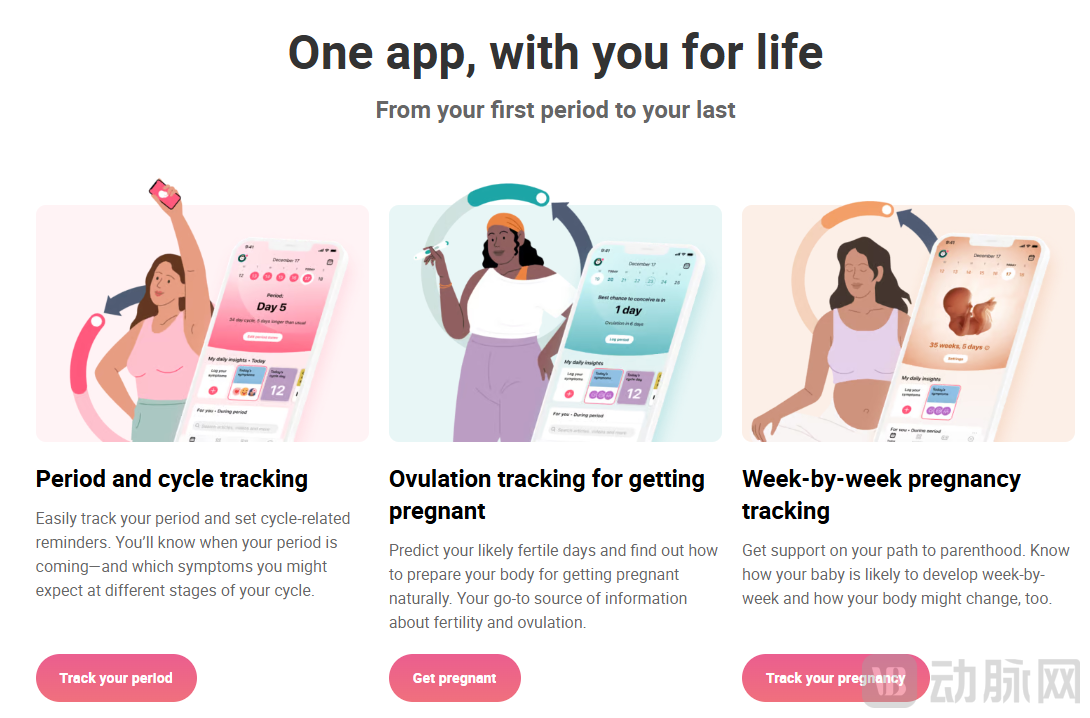
▲“One App, Lifelong Care”—An Introduction to Flo Health’s Features
Image source: Company website
To fulfill the aforementioned functions, it is essential to ensure the professionalism of health-related knowledge. In this regard, the Flo Health website states that it currently has more than 120 physicians and health experts who provide or review relevant content.
It is worth noting that, in consideration of users’ sensitivity to privacy, Flo Health has also specificallyThe platform has established an online anonymous discussion community., enabling users to confidently focus on the women's health topics they are interested in and share authentic experiences, thereby helping more people. Meanwhile, Flo Health launched in 2023“Flo for Partners” service enables users to share their menstrual cycles with their partners, learn more about women's health knowledge together, so that partners can better care for each other.
In terms of its business model, Flo Health has not broken away from the traditional monetization strategies of community- or utility-based apps. Its core strategy is to aggregate a massive base of highly targeted users, generating revenue either by charging B-side vendors for advertising on the platform, by collecting fees from C-side users through subscriptions or membership services, or by directly engaging in e-commerce. Flo Health has chosen the latter two approaches.
First, Flo Health has achieved remarkable success in aggregating a large base of highly targeted users. According to the company, as of June this year, the platform had reached one-quarter of women in the United States, with 70 million monthly active users. Approximately 50% of these users are from the United States, while the other half are primarily distributed across the United Kingdom and the European Union.
Furthermore,In terms of commercial monetization, subscription services are Flo Health’s core business., primarily offering users new features beyond the free versions such as the “Symptom Checker” and “Health Assistant.” The platform currently has nearly 5 million paid subscribers. In terms of subscription pricing, Flo Health is relatively affordable; for example, in China, the monthly subscription costs approximately RMB 43, while the annual subscription is priced at RMB 216.
Flo Health has seen strong revenue growth in the past two years, driven by its large base of paying users:Revenue grew by 220% from $35 million in 2022 to $112 million in 2023., with projected 2024 revenue exceeding $200 million and a growth rate maintained above 50%.
Driven by strong profitability expectations, Flo Health has attracted investor interest, securing $200 million in Series C financing and joining the ranks of unicorns. Following this round, Flo Health will continue to expand its user base, particularly increasing penetration among perimenopausal and menopausal women, while enhancing its AI capabilities.
“The She Economy” has been a hot topic in the business community in recent years.
According to the latest census data, China has approximately 500 million female consumers aged 20–60. As the primary drivers of consumption, women have propelled the “She Economy”—a market dominated by female spending—past the RMB 10 trillion mark. In particular, heightened health awareness has led to sustained growth in women’s healthcare expenditures, giving rise to a vast market for women’s health management.
But a large body of water does not necessarily mean big fish.Currently, there are no women’s health management companies with a market capitalization of RMB 10 billion in the market. According to a vice president of investment at a U.S.-dollar fund who previously spoke to VCBeat, menstrual cycle management and similar areas represent relatively mature segments within the women’s health sector; however, they constitute only a small fraction of the broader market, leaving substantial untapped potential in the field of women’s health.
How can companies in this sector unlock greater market potential? According to exchanges between VCBeat and industry experts, the key lies in transitioning from single-point solutions to comprehensive health management across women’s entire life cycles. Flo Health, which recently achieved unicorn status, is a prime example of this approach.
In this regard, VCBeat has provided a broad categorization of women’s lifecycle health management, broadly summarized into five stages: infancy and childhood, adolescence, adulthood (including pregnancy and childbirth), menopause, and old age.
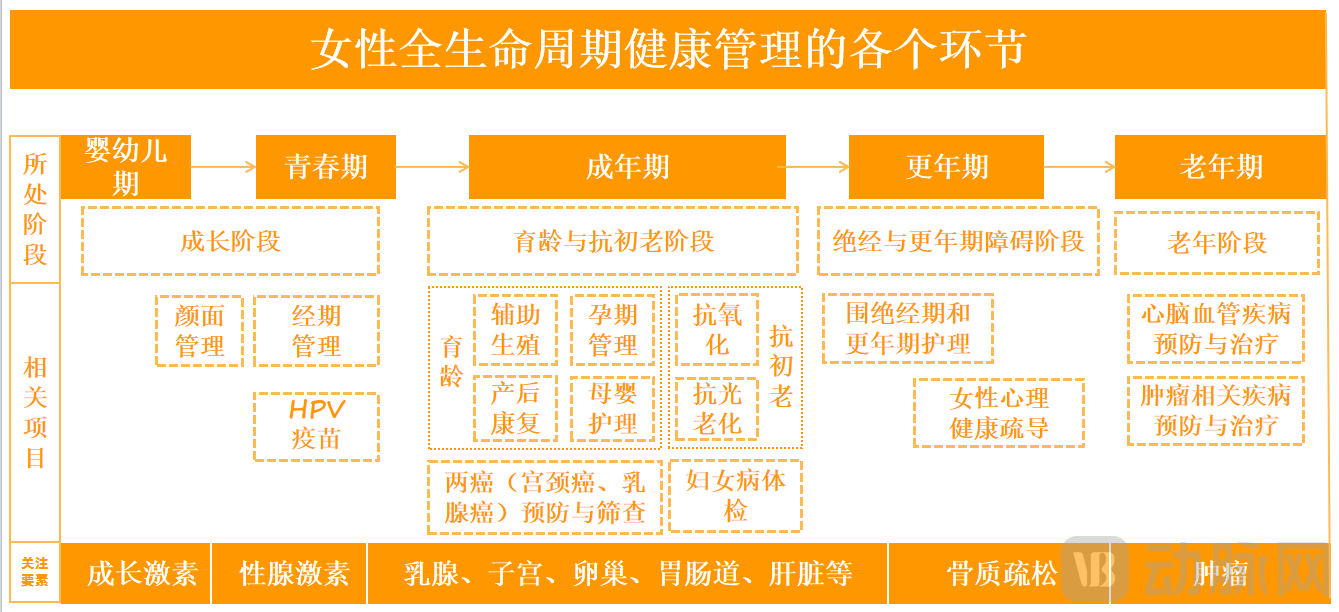
▲ Schematic Diagram of Health Management Across the Entire Female Life Cycle | Graphic by VCBeat
Specifically, from infancy and childhood through adolescence, pregnancy, childbirth, menopause, and into old age, women face significant psychological and physiological challenges due to hormonal fluctuations. These challenges include a range of issues such as menstrual disorders, pelvic floor dysfunction, infertility, sterility, and depression. During these stages, women need to maintain and care for their physical and mental well-being. Consequently, the concept of “whole-life-cycle health management” is gaining increasing attention among women.
“However, the challenge lies in the fact that it remains difficult for a company to implement full-chain health management at present. First, the extended time span makes it easy for services to fall behind; second, the heavy cost burden makes it difficult to establish a viable business model,” a senior healthcare investor told VCBeat.
Therefore, in recent years, innovative enterprises emerging within the industry have predominantly based their strategic path selection on their own corporate endowments, starting from their core competencies and then appropriately expanding into corresponding business areas aligned with the various stages of women’s development.In other words, steps can be taken, but they will not be overly ambitious.
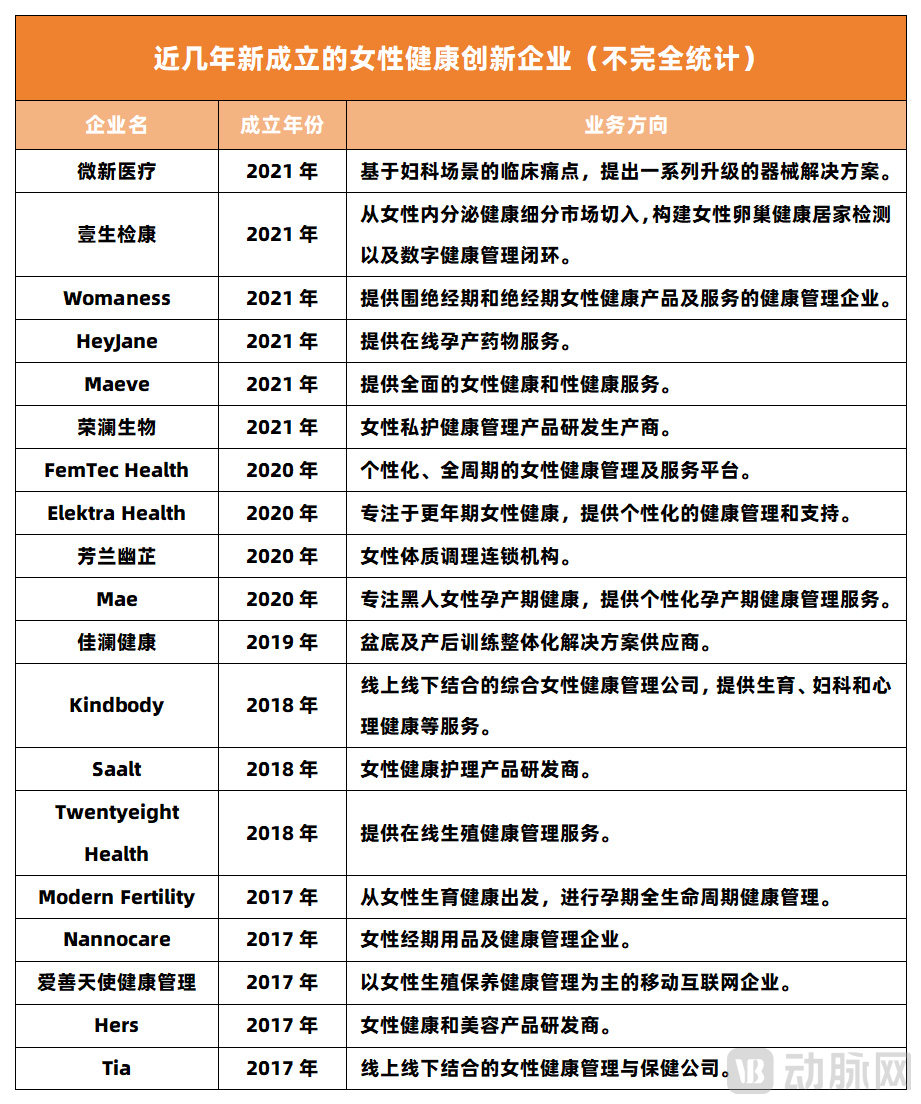
▲ Data source: Tianyancha and public information; graphic by VCBeat
Among these enterprises, VCBeat broadly categorizes them into three types.
The first approach adopts an internet platform mindset, using niche scenarios such as menstrual cycle management as entry points to build a service system for women’s whole-life-cycle health management.Companies in this sector include the aforementioned Flo Health, as well as FemTec Health, Tia, FitTime, Dayima, and Meiyou.
Taking FemTec Health as an example, the company was founded in 2020 by Dr. Angelides, co-founder of Livongo. With a digital-first approach, it has developed the BiomeAI platform. According to its official website, the BiomeAI platform selects women’s health management functions that are best suited for digital integration, currently covering areas such as specialized gynecological care, health prevention, reproductive care, sexual health, mental health, aesthetics, and chronic disease management.
From a business logic perspective, the BiomeAI platform has two primary functions: first, collecting and analyzing women's health data through related devices; and second, building predictive models based on this data to continuously provide women with personalized, comprehensive health services and products.
Consider Tia, founded in 2017. The company initially launched with a chatbot assistant focused on helping female users address questions related to contraception and sexual health. Thanks to its superior Q&A experience, the chatbot saw a surge in users. In response, Tia recruited a large number of health consultants to better meet user consultation demands.
To better meet the growing demand for women’s health management, Tia embarked on building its own clinic network in 2019, establishing an integrated online-to-offline business model. The company opened its first brick-and-mortar clinic in New York City, staffed by a team of 15 healthcare providers, including physicians, physician assistants, registered nurses, therapists, and other medical professionals. It has since expanded to Los Angeles, Phoenix, San Francisco, and other cities. According to Tia’s official website, the company offers access to specialized clinicians for conditions such as urinary tract infections, pelvic pain, migraines, thyroid disorders, infertility, and polycystic ovary syndrome (PCOS), as well as for procedures like intrauterine device (IUD) insertion.
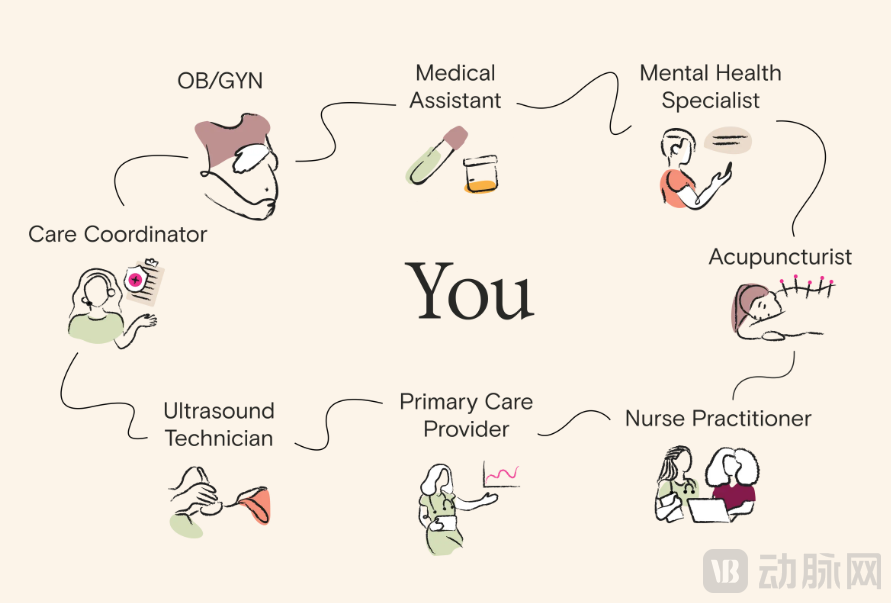
▲Tia provides female users with comprehensive online and offline services. Image source: official company website
Another approach is from the perspective of medical device R&D, where companies build comprehensive women's health management solutions around specific categories to better meet female patients' needs across all aspects of screening, diagnosis, and treatment.At this stage, companies such as Weixin Medical, Shenzhen Dejia Zhilian, and Juhe Biotechnology have already made strategic moves in this direction.
For example, Weixin Medical, founded in 2021, has developed a full-stack portfolio of natural-orifice products spanning the vagina, cervix, uterine cavity, and fallopian tubes, addressing clinical pain points in gynecological scenarios. The company has achieved comprehensive product coverage ranging from diagnostic portable vaginal speculums and hysteroscopes requiring no cervical dilation, to photodynamic therapy and energy-based surgical platforms and electric surgical instruments, as well as integrated fluid management systems.
Another example is Shenzhen Dejia Zhilian, which focuses on the domestic market for postpartum rehabilitation in home settings and has built China’s first intelligent postpartum rehabilitation system. Its brands include “Mamakang,” “Memekang,” “Mother’s Fulcrum,” and “Dejia Education.” Among them, “Mamakang” is an intelligent postpartum rehabilitation brand offering products and services for pelvic floor muscle assessment, pelvic floor muscle rehabilitation and training, diastasis recti abdominis rehabilitation, uterine involution, postpartum urination management, menstrual pain relief, lower back pain relief, lactation initiation, mammary duct clearance, breast care, childbirth experience support, preconception conditioning, and reproductive and intimate health. Additionally, through a one-on-one telemedicine service system, it provides users with medical consultations, interpretation of assessment reports, and customized personalized rehabilitation plans.
Another approach focuses on at-home testing, providing comprehensive solutions tailored to women’s health management across their entire life cycle and family health management needs.Currently, companies such as Yisheng Jiankang, Pinjia Health, Rendu Biology, and Ciyunge Medical are laying out their strategies in this direction.
Taking Yisheng Jiankang, an innovative enterprise established in 2021, as an example, the company focuses on the female endocrine system and proposes the concept of “One Test, Lifelong Management.” It has pioneered a closed-loop service for internal anti-aging health management covering women’s entire life cycles. Specifically, Yisheng Jiankang provides at-home endocrine testing kits, enabling female users to obtain test results without leaving home, thereby saving time and conserving hospital medical resources. Leveraging precise in vitro diagnostic technologies from medical laboratories, combined with big data and artificial intelligence, the company establishes cloud-based health monitoring with continuous updates and personalized report interpretation. This approach constructs a comprehensive closed loop for at-home ovarian health testing and digital health management for women.
From the aforementioned cases, it is evident that emerging companies currently positioning themselves in the market place greater emphasis on holistic, lifecycle management of women’s health, achieving breakthroughs through targeted focus areas.(Flo Health starts with menstrual cycle management, Yisheng Jiankang begins with the female endocrine system, Weixin Medical focuses on reproductive health, and FemTec Health centers on its digital platform),By integrating superior diagnostic products and emerging technologies such as AI, health management can be effectively implemented across a wider range of scenarios.
“Unlike traditional women’s health management companies, newly established enterprises today place greater emphasis on systematic solutions—particularly the end-to-end process from screening to diagnosis—and on the accumulation of user behavioral data. This shift has been driven by breakthroughs in at-home testing technologies and the influx of internet industry talent, thereby creating new growth opportunities for the sector,” said an investor in the industry.
The female health management sector is entering a period of rapid growth.
From the supply side, companies entering this sector are emerging in large numbers, bringing more solutions to the industry; from the demand side, users are placing greater emphasis on whole-lifecycle management of women’s health. Driven by the combined forces of supply and demand, market opportunities are boundless.
Meanwhile, policy measures are also bolstering this trend. In September 2021, the State Council issued the Outline for the Development of Chinese Women (2021–2030),"Ensure access to quality healthcare services for women throughout their entire life cycle" as one of the primary goals, calling for attention to women's health needs, ensuring that women have access to high-quality, efficient, and affordable medical and healthcare services.
However, while the future of entrepreneurship in the women's health management sector looks promising, it alsoThe road is long and fraught with challenges; the industry still faces numerous pain points and bottlenecks.
First, women’s lifecycle health management is still in its infancy; it remains to be seen whether relevant companies can provide truly effective and targeted health services across the various stages of female users’ lives.
Second, awareness among female users and society at large still needs to be raised. Due to physiological differences between men and women, many conditions unique to women are perceived by outsiders as mysterious and stigmatized. As a result, the impact of these diseases on women may go unrecognized and misunderstood, leading to delayed diagnosis and treatment for many female patients, ultimately causing their conditions to worsen.
Moreover, empowered by digital technologies, it has become standard practice for many women’s health management companies to provide longer-term services to female users through data analysis and predictive modeling. However, ensuring robust protection of user data accumulated on these platforms and preventing corporate misuse remain significant challenges for the industry.
Opportunities Lie Behind Challenges: As Market Entrants Gradually Resolve the Above-mentioned Issues, the Industry Is Poised for Better and Faster Growth.
Of course, the fundamental prerequisite here is that enterprises must possess a genuine commitment to establishing a long-term presence in the women’s health management sector and delivering high-quality services to female users.