

QV Bioelectronics Files for IPO: Pioneering Implantable Electric Field Therapy to Target Glioblastoma

QV Bioelectronics
Developer of Brain Tumor Electrotherapy Devices
In March 2023, QV Bioelectronics (QV Bioelectronics, hereinafter referred to as “QV”), a company from the United Kingdom, announced thatReceived a grant of £860,000 (approximately RMB 7.89 million) from the innovation agency Innovate UK.
Innovate UK, part of UK Research and Innovation (UKRI), holds a significant position and influence within the UK’s innovation ecosystem. It is reported that Innovate UK received £2.6 billion in public funding for the 2022–2025 fiscal period, enabling it to provide direct grants to innovative businesses in the UK. However, securing such funding is highly competitive; for instance, during the 2020–2021 fiscal year, tens of thousands of companies applied, yet only slightly more than 800 were ultimately awarded grants.
In fact, this is not the first time Innovate UK has awarded a grant to QV. Several years ago, QV secured funding from the Innovate UK Biomedical Catalyst Award, as well as support from the National Institute for Health Research (NIHR) and the Innovate UK SMART programme. Including this latest grant,QV has received a total of £1.8 million (approximately RMB 16.52 million) in grant funding.。
In addition to donations, QV has also enjoyed considerable success in its fundraising efforts. Just three months prior to receiving the donation, QV Bioelectronics had secured a £2 million pre-Series A financing round. During its seed round miracle, it also attractedConsilience Ventures、SOSVand other renowned investment institutions, securing £735,000 in funding.
Five Years In, Assets Surpassing 10 Million: Who Exactly Is This Startup?
I. The First Implantable Tumor Treating Fields Product, Challenging the Most Aggressive Primary Brain Cancer
QV is a medical innovation company that treats brain tumors by developing current-based implants. Like many medical innovation companies, QV was founded by a team combining researchers and clinicians.
The founding team of QV was initially composed of Dr. Christopher Bullock and Dr. Richard Fu.Dr. Christopher Bullock is a biomedical engineer whose primary research focus during his tenure at the School of Health Sciences, University of Manchester, was on the clinical applications of graphene in medicine. The other co-founder, Dr. Richard Fu, is a neurosurgeon and clinical researcher within the UK National Health Service (NHS).
The team’s extensive clinical and medical-engineering experience provides a solid foundation for scientific research, empowering the team to tackle the most aggressive primary brain cancer in adults—GlioblastomaLaunch the charge.
Glioblastoma is one of the most common primary brain cancers. Its strong drug resistance prevents patients from achieving a complete cure through pharmacological treatment. Additionally, this cancer is highly invasive and prone to dissemination; when it spreads to critical areas such as the thalamus, brainstem, or basal ganglia, complete surgical resection becomes extremely difficult, resulting in a poor prognosis for patients. Consequently, under current treatment modalities, the 5-year survival rate for glioblastoma remains below 3%.
Christopher Bullock and Richard Fu are dedicated to developing a novel cancer therapy known as Tumor Treating Fields (TTFields). This therapeutic approach was first proposed by Professors Grosse and Schwan in 1992. Their research demonstrated that alternating electric fields under steady-state conditions can induce transmembrane voltage in spherical cells. The polarization of molecules induced by alternating current may exert anti-mitotic effects within the medium-frequency range by directing, deforming, and mobilizing cells. They hypothesized that this mechanism could have a positive impact on cancer treatment, particularly for glioblastoma.
However, due to limitations in technical conditions and other factors, this idea remained at the theoretical stage. It was not until 2004 that Dr. Kirson first discovered that very low-intensity alternating electric fields have a specific inhibitory effect on the division of cultured cells. In 2007, he further confirmed that this inhibition is related to the angle between the mitotic axis and the direction of the electric field, thereby validating the hypothesis proposed by Professors Grosse and Schwan years earlier and formally introducing the method of treating glioblastoma with electric fields.
Dr. Kirson’s success drew the attention of research teams worldwide to electric field therapy, inspiring them to translate the concept from theory into reality—among them were Christopher Bullock and Richard Fu. Yet, compared with other teams, they aimed to go further—Disrupting cancer cells through low-intensity electrical current bombardment.
II. First Implantable Electric Field Therapy to Enter Clinical Trials
Prior to the establishment of QV, numerous research teams focused on Tumor Treating Fields (TTFields) had already embarked on commercialization. For instance, Dr. Kirson, the pioneer of TTFields, founded his own company, Novocure, and developed Optune, a non-invasive TTFields therapy device.
However, no company on the market has proposed an invasive treatment regimen.From the perspectives of precision and treatment continuity, invasive approaches are theoretically superior to non-invasive ones. However, invasive devices must address numerous technical challenges, including wireless power transmission, biocompatibility, and self-powering capabilities. Consequently, they entail higher costs and greater technical complexity compared to non-invasive devices.
With extensive expertise in bioengineering, the QV team believes that implantable electric field therapy is certainly achievable now that brain-computer interfaces have become a reality. Within just three years, the QV team expanded from an initial two members to 14, recruiting researchers specializing in cancer biology, biomaterials, and medical engineering.Finally, GRACE was developed.。
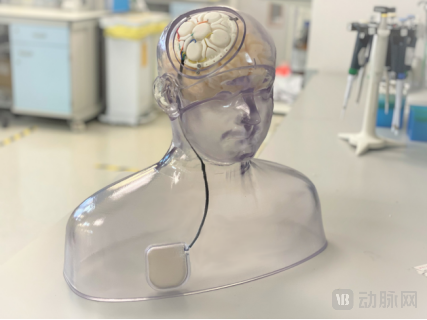
GRACE Schematic (Image source: QV Bioelectronics)
GRACE primarily works by placing invasive electrode arrays in the local anatomical region of the tumor to deliver low-intensity, intermediate-frequency alternating electric fields. This interferes with mitosis in tumor cells and induces apoptosis, thereby exerting an anticancer therapeutic effect.Notably, QV has focused its treatment on the tumor resection margins. Studies show that 90% of glioblastomas recur in this region, and GRACE directly delivers electric field therapy to this area, effectively reducing the recurrence rate.
Meanwhile, the implantable approach enables long-term, continuous electric field therapy for patients, facilitating effective intervention at the early stages of cancer recurrence. While promoting longer survival and improved quality of life, implantable devices are also designed to minimize their impact on patients’ daily living.
Furthermore, this specific electric field frequency and intensity selectively affect rapidly dividing tumor cells while having minimal impact on normal cells, resulting in virtually no side effects. This characteristic also enables the therapy to be combined with other cancer treatment modalities, such as chemotherapy and targeted therapy, potentially enhancing therapeutic efficacy and providing patients with additional treatment options.
Glioblastoma is merely the first indication for GRACE.During the research process, the team discovered that electric field therapy may also exert therapeutic effects by influencing a series of biological processes, including DNA repair, cell permeability, immune response, and blood-brain barrier (BBB) permeability, demonstrating broad mechanisms of action and therapeutic potential. Therefore, the team stated that it plans to develop treatments for a range of neuro-oncology indications in the future.
In addition to the therapy itself, QV is collaborating to further elucidate the mechanisms of action of Tumor Treating Fields. In October 2023, QV announced a collaboration with Incubate Bio. Leveraging Incubate Bio’s ALaSCA software platform, QV can decipher experimental data from complex molecular pathways and simulate “what-if” scenarios to guide preclinical understanding through collaborative efforts. Meanwhile, QV’s data on cellular responses to electric fields also contribute insights into various DNA repair pathways and programmed cell death pathways, thereby enriching the ALaSCA software platform’s database and providing data support for the treatment of glioblastoma.
III. Tumor Treating Fields Therapy Approved for Market Launch in China at an Earlier Stage
Although GRACE has not yet been applied in clinical practice, relevant electric field therapy products have already received approval, laying the foundation for the future approval of GRACE.
In 2022,Novocure’s commercially available tumor treating fields product, Optune, has received FDA approval, making it the first approved tumor treating fields product worldwide.Unlike GRACE, Optune delivers tumor treating fields via an electric field generator and an array of insulated transducer arrays distributed across four adhesive patches. During treatment, the transducers must be placed in close contact with the patient’s scalp, which requires the patient to shave their head completely.
Currently, the FDA has approved tumor treating fields as an effective therapy for glioblastoma, approximately doubling the 5-year survival rate.
In China, tumor treating fields were approved for market launch at an earlier date.In 2020, Zai Lab’s tumor treating fields product, Optune®, was approved for marketing by the National Medical Products Administration (NMPA), becoming the first tumor treating fields product in China and the first therapy approved for glioblastoma.
Furthermore, Professor Yao Chenguo’s team at Chongqing University was the first internationally to propose a novel method for tumor ablation using irreversible electroporation/electropermeabilization via high-voltage pulsed electric fields, and developed the first collaborative pulsed tumor therapy device in China and abroad; Professor Guo Ying’s team at the Third Affiliated Hospital of Sun Yat-sen University independently developed a domestically produced tumor treating fields system; and Professor Lv Yi’s team at the First Affiliated Hospital of Xi’an Jiaotong University successfully performed the world’s first endoscopic pulsed electric field tumor ablation.
Numerous scientific achievements have demonstrated that research on tumor treating fields in China is in a stage of vigorous development. This progress is attributed not only to the enhanced capacity for independent innovation among domestic researchers but also to policies encouraging innovation and the significant market potential within China. The approval of domestically developed tumor treating field products has not only brought new hope to cancer patients but also injected fresh momentum into the development of China’s medical and health industry.