

Ping An Health Achieves First-Ever Profit, Marking a Decade of Internet Healthcare Investment Coming to Fruition

Ping An Healthcare
One-stop Solution Provider for Health Management
After 10 years since its establishment and 6 years since its listing, Ping An Healthcare finally achieved its first profit in the first half of 2024!
On August 20, Ping An Healthcare released its interim results report, showing that in the first half of 2024, the company achieved total revenue of RMB 2.09 billion, net profit exceeding RMB 60 million, and adjusted net profit nearing RMB 90 million.With the steady growth of its F-end business, the rapid development of its B-end business, continuous optimization of resource allocation, and increased investment in technologies such as AI and informatization, Ping An Healthcare has continuously improved its operational efficiency and accelerated its turnaround to profitability.
Li Dou, Chairman of the Board and CEO of Ping An Healthcare, stated in his financial report address,The company’s overall turnaround from loss to profit marks a landmark reversal in performance, which is encouraging.In fact, another listed internet healthcare company has achieved profitability, which serves as an encouragement to the entire industry.
If 2014 is regarded as Year One of internet healthcare, then industry innovation has persisted for a decade. Over the past ten years, participants in the internet healthcare sector have come and gone, with current leading enterprises exhibiting a trend of “multipolar differentiation,” each focusing on specific service segments or payers.
For Ping An Healthcare, which is also exactly “10 years old,” the company has carved out a unique position within the industry’s “multi-polar differentiation” landscape after years of strategic layout and continuous iteration. With profitability as a new starting point, Ping An Healthcare will continue to deliver social service value and unlock commercial value in the next decade.
After years of industry evolution, internet healthcare companies have generally established a “standard” service system encompassing online consultations, prescription issuance, medication delivery, and chronic disease management. In addition to basic services such as online follow-up visits, they continue to diversify their service offerings to meet the varied needs of patients and users.
Over the past decade, Ping An Healthcare has continuously expanded its online and offline service resources. Online, as of the end of June 2024, Ping An Healthcare had assembled a team of approximately 50,000 internal and external physicians covering 29 medical specialties, with around 2,900 expert physicians under contract. In terms of specialized disease and specialty development, the company has established 23 specialized disease centers across eight key specialties, creating standardized solutions for pre-diagnosis, during-diagnosis, and post-diagnosis care.
Offline, as of the end of June 2024, Ping An Healthcare had partnered with nearly 4,000 hospitals and 233,000 pharmacies; it collaborated with 104,000 health service providers and nearly 2,500 physical examination providers; and it worked with over 120 elderly care service providers, offering more than 600 home-based elderly care services.
However,Due to differences in their starting points, advantageous resources, and chosen development paths, various internet healthcare companies have evolved distinct business models, with each placing varying emphasis on specialized sectors such as medical services, pharmaceuticals, nursing care, and insurance.
For a long time, the prevailing public mindset has tended to prioritize treatment after disease onset while neglecting disease prevention and health maintenance. Similarly, the healthcare service system is characterized by an emphasis on treatment at the expense of prevention and rehabilitation. Against the backdrop of population aging, this traditional model of healthcare delivery and health-related beliefs will consume more medical resources and exacerbate the financial burden on all payers.
According to the China Health Statistics Yearbook, over the ten-year period from 2013 to 2022, total national health expenditure increased from RMB 3,166.15 billion to RMB 8,484.67 billion, with government, social, and individual health expenditures all rising in tandem.
Leveraging Ping An Group’s insurance heritage, Ping An Healthcare strives to explore effective models for managing policyholders’ health conditions, reducing disease incidence, and maintaining wellness, thereby lowering premium costs as well as out-of-pocket medical expenses for policyholders.
Therefore,In the field of internet healthcare, in addition to its “standard” services, Ping An Healthcare focuses on “management,” namely managed care.Managed care refers to a system that provides comprehensive healthcare services to a specific population in exchange for predetermined prepaid fees. Under this model, Ping An Healthcare acts on behalf of payers to integrate providers, delivering continuous and comprehensive services to users.
However, integrated service providers do not merely establish simple connections among service resources through the Internet and other technologies. Traditionally, conventional medical and health services have already suffered from shortcomings such as fragmentation and lack of continuity. Consequently,Ping An Healthcare has established two key roles—family doctors and elderly care managers—as the core hub of its managed care model., to integrate service resources and provide users with “rapid diagnosis for minor illnesses, standardized management of chronic diseases, and precise referral for serious conditions,” thereby improving users’ health outcomes.
After a decade of accumulation, the family doctor membership model has become Ping An Healthcare’s unique core competitive advantage.In the first half of 2024, the number of users enjoying family doctor membership benefits exceeded 14 million, with an average annual usage frequency of over 4.0 times per person, representing an 8% increase from the end of 2023, and achieving a 100% coverage rate for proactive services.
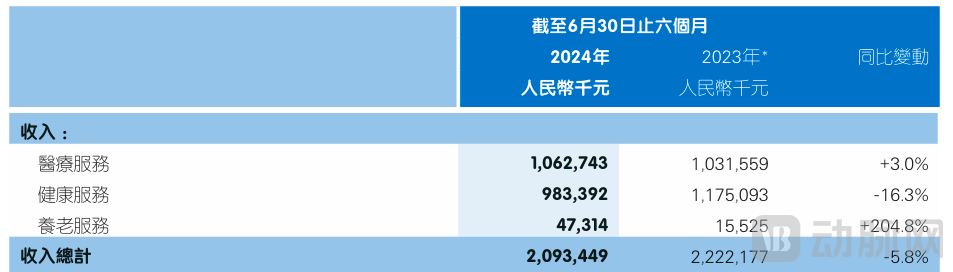
Ping An Healthcare’s Latest Revenue Structure by Product, Source: Company Financial Report
As the aging process accelerates, against the backdrop of Ping An Group’s “Integrated Finance + Healthcare and Elderly Care” strategy,Ping An Healthcare’s managed care model further segments into elderly care services.The 2024 interim report shows that,The Company’s revenue structure by product has been adjusted from the previous two segments—medical services and health services—to three segments: medical services, health services, and elderly care services; among these, revenue from elderly care services increased by 204.8% year on year.It is evident that elderly care services have become one of the core businesses of Ping An Healthcare’s managed care model, injecting new momentum into its performance growth.
The Past Decade of Internet Healthcare: Beyond Service Model Innovation Driven by Market Demand, a Persistent Quest for PayersOver the past decade, internet healthcare has not only innovated its service models in response to market demand but also persistently explored viable payer channels. From initial consumer-facing (C-end) approaches to engaging government and healthcare institutions (G/H-end), enterprises (B-end), as well as commercial and basic medical insurance providers, companies have continuously validated the potential for long-term, scalable payment mechanisms and refined their business strategies accordingly.
Since medical services are not in high-frequency demand, consumer-facing (C-end) paid models must acquire massive traffic at low cost and achieve efficient conversion to remain sustainable; therefore, most C-end-centric paid models rely on platforms that use large e-commerce sites or local public services as entry points.
G-end/H-end paid services primarily involve building technology platforms related to healthcare services for local governments and medical institutions. Although revenue from technical projects accounts for a relatively small proportion of the income sources for most internet healthcare companies, these channels still hold significant value by facilitating the large-scale expansion of offline medical service resources, particularly those from the public healthcare system.
B2B paid services have surged in recent years, holding immense potential.Health issues caused by workplace stress are becoming increasingly prevalent. In corporate group health examinations, the detection rates of thyroid nodules and thyroid cancer are on the rise. Timely intervention is required for employee health concerns; conditions necessitating in-hospital treatment or even surgery call for continuous management. In the long term, the theoretical potential size of China’s corporate health management market is expected to exceed RMB 3 trillion.
In terms of commercial insurance, although its current share in the healthcare payment system remains relatively small, commercial health insurance is an indispensable component of China’s multi-tiered medical security system, with 20% of the cost of commercial health insurance products allowable for use in health management. Therefore,Amid the growth in commercial insurance supply and enhanced payment capacity, health management services leveraging the advantages of internet-based medical services also hold immense potential.
Ping An Healthcare, spun off from Ping An Group, has long maintained a competitive advantage in revenue from the F-side (i.e., comprehensive financial services clients), represented by commercial insurance payers.
Specifically, Ping An Healthcare provides proactive medical, health, and elderly care services to users of Ping An Group’s integrated financial businesses, including life insurance, property and casualty insurance, health insurance, and banking. Based on user profiles and service needs across different financial sectors, it diversifies and combines medical, health, and elderly care services and products. Through business models such as product integration, benefits procurement, and value-added services, it not only empowers cost control for insurance products but also assists integrated financial businesses in customer acquisition, retention, and secondary conversion. Since 2024, building on its “Insurance + Medical Health” model, Ping An Healthcare has significantly expanded its “Insurance + Home-Based Elderly Care” services.
Benefiting from deep collaboration with various comprehensive financial services, Ping An Healthcare’s F-side revenue reached RMB 1.12 billion in the first half of the year, a year-on-year increase of 3.4%.
In recent years, Ping An Healthcare has seized market opportunities to rapidly build its corporate health management services and expand B-end paid channels, achieving initial scale.
Since 2024, Ping An Healthcare has established a dedicated team of health managers composed of general practitioners certified by Peking University Medical Group, providing health management services to corporate employees. Leveraging its two core business models, “Insurance+” and “Service+,” Ping An Healthcare continues to tap into the corporate client resources within the Ping An Group’s medical and elderly care ecosystem. Specifically, the “Insurance+” model ensures the convenience and timeliness of claims settlement, while the “Service+” model offers employees 24/7 comprehensive online and offline support, thereby establishing four service systems encompassing medical services, health management, lifestyle enjoyment, and emotional well-being.
Driven by enhanced service capabilities, the continuous increase in penetration among Ping An Group’s corporate clients, and deepening efforts in independently acquiring corporate clients, Ping An Healthcare has seen rapid growth in its number of corporate clients. As of the end of June 2024, the cumulative number of corporate clients served reached 1,748, representing a year-on-year increase of approximately 46% compared to the same period in 2023.
In the first half of the year, B-side revenue also grew rapidly, reaching RMB 710 million, a significant year-on-year increase of 58.8%, with the scale of paying B-side customers increasingly approaching that of the F-side.
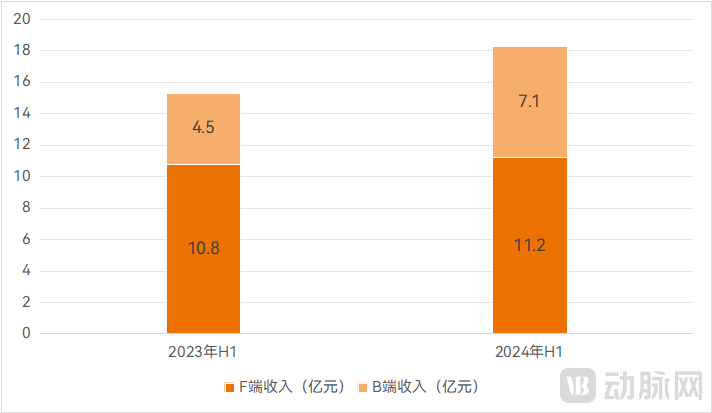
Revenue Growth of Ping An Healthcare’s Two Strategic Business Segments: F-End and B-End. Data Source: Company Financial Reports
In short,Leveraging the resources of the Ping An Group and catalyzed by external market opportunities, Ping An Healthcare has firmly established a dual-pillar payer structure driven by both the F-end (individual consumers) and the B-end (corporate clients). The company’s achievement of profitability further demonstrates that these F-end and B-end segments have significantly diversified the types of sustainable payers in the internet healthcare industry.
Throughout the course of industry development, business model validation often necessitates timely adjustments to business segments and service offerings. To explore broader possibilities, identify more opportunities for paid conversion, and create additional revenue streams, companies typically tend to expand their business scale through acquisitions or in-house development.
VCBeat has identified several typical expansion pathways. The first is to broaden the range of specialized services for specific conditions, particularly those requiring long-term intervention and well-suited for online diagnosis, treatment, and management—for example, large internet healthcare companies acquiring traditional Chinese medicine (TCM) digital health platforms. The second is to diversify service offerings, such as internet healthcare enterprises establishing or acquiring medical institutions and physical examination centers. The third is to extend along the upstream and downstream segments of the industry chain, such as acquiring or investing in pharmaceutical companies and health technology firms closely related to their core business.
Horizontal business expansion can directly drive performance growth, but it also poses challenges to capital resources and management capabilities. It is not suitable for all enterprises and should be implemented in alignment with the company’s stage of development.
Ping An Healthcare has tended to make “subtractions,” divesting businesses that, while revenue-generating, offered lower margins and had limited relevance to its core operations. Since streamlining its portfolio, Ping An Healthcare has continuously optimized and improved its resource allocation efficiency over the past two years, achieving a highly focused business strategy.
However, Ping An Healthcare continues to make “additions” along its vertical business lines to upgrade and iterate.
In terms of products and services, Ping An Healthcare upgraded its family doctor service brand, “Ping An Family Doctor,” in 2024.“Ping An Family Doctor” has launched the “11312” service system, which comprises: one professional family doctor team with registration certification from Peking University International Hospital and end-to-end supervised training certification from the World Organization of Family Doctors (WONCA); one 5A-standard service pathway guided by the General Practice Branch of the Chinese Medical Association; three sets of proactive health management services tailored for sub-healthy individuals, patients with chronic diseases, and patients with acute or specific diseases; and 12 types of scarce medical resources. The upgraded “Ping An Family Doctor” is better equipped to meet users’ diverse and personalized needs.
Services more closely aligned with user needs have also facilitated the conversion of paying users. In the first half of 2024, the company’s strategic businesses (namely F-end and B-end operations) had approximately 17.7 million paying users, representing a 4% year-on-year increase.
In terms of technology, Ping An Healthcare continues to strengthen its medical AI capabilities.In 2024, Ping An Healthcare independently developed the “Ping An Yi Bo Tong” large language model based on five major medical databases: the Disease Database, Prescription Medical Database, Medical Product Database, Medical Resource Database, and Personal Health Database. Additionally, the “Ping An Yi Jia Ren” Physician Workbench underwent a comprehensive upgrade.
Technological applications can simultaneously enhance service quality and efficiency while reducing costs. As of the end of June 2024, Ping An Healthcare has achieved AI empowerment across all medical business scenarios, providing real-time medical knowledge assistance and boosting the efficiency of family doctor services by approximately 30%.
Regarding the O2O service network, since 2024, Ping An Healthcare has enabled medical insurance payments for O2O medication purchases in Dongguan, Guangzhou, and Zhuhai., in which Guangzhou's medical insurance online pharmacy services support both the pooled fund account and the personal account.The expansion of medical insurance coverage for drug purchases enables Ping An Healthcare to provide users with a more comprehensive service process.
The simultaneous implementation of horizontal “subtraction” and vertical “addition” has been Ping An Healthcare’s distinctive innovation path in recent years, driving improved resource allocation and utilization efficiency, reducing cost expenditures, and serving as a key strategy for achieving profitability.
Over the past decade, internet healthcare has been “crossing the river by feeling the stones,” with no one able to definitively predict what sustainable innovative models will look like in the future. Ten years may seem like a long time, but for a company committed to long-termism, or for an industry with enduring social value, it is still just the beginning.
August 21,Ping An Healthcare revealed at its 2024 interim results press conference that there is still room for further reduction in its expense ratio after achieving profitability.In the second half of the year, as customer stickiness on the F-end strengthens and B-end clients renew contracts steadily, the sales expense ratio can be sustainably optimized; meanwhile, administrative expenses can be further reduced as AI drives improvements in operational efficiency.
The financial report indicates that Ping An Healthcare will continue to leverage the customer base and resource advantages of Ping An Group on both the F-end (financial) and B-end (business) sides, strengthen service penetration among Ping An Group’s vast commercial insurance, corporate, and individual customer segments, and deepen synergy and mutual empowerment with Ping An Group. It will further utilize the pivotal role of family doctors and elderly care managers, enhance proactive, tiered, and categorized member operations, vigorously develop and expand its home-based elderly care business, and continuously promote the deep integration of medical-elderly care services with commercial insurance.
Meanwhile, as service quality improves and user habits become more established, Ping An Healthcare plans to continuously drive the conversion of F-end and B-end users into paying customers, thereby creating a second growth curve.
In general,Over the past decade, Ping An Healthcare has steadily validated its business model and pursued strategic innovation, unlocking commercial value while delivering social impact. In the new decade, we believe Ping An Healthcare will move forward with greater clarity of direction and stronger confidence.