

Elemind Secures $12M Seed Funding to Launch AI-Powered Wearable for Sleep Innovation

Elemind
Neurotechnology Platform Developer
Sleep problems have become a malady of the times, giving rise to the “sleep economy.”
According to Time magazine, the sleep entrepreneurship market in the United States and Japan is now valued at over $100 billion, with a flood of products entering the market, including sleep-related books, sleep-aid bedding, calming beverages, and hypnosis software.As people become willing to pay for better sleep, more lifestyle-oriented sleep businesses have begun to emerge.
2Elemind, founded in 2019, is also a player in this dynamic field. Building on its team’s pioneering wearable neurotechnology platform, it leverages algorithms and artificial intelligence (AI) to improve health through non-invasive, active brainwave stimulation, without the side effects associated with pharmaceuticals.. It is understood that in February 2024, Elemind completed a $12 million seed funding round to further develop its first product.
Efficiently Teaching Entrepreneurship, Entering the Sleep Innovation Arena
Elemind’s founding team is primarily composed of academic researchers. Among them, Dr. Edward Boyden has served as a Professor of Neurotechnology at MIT for 17 years, focusing on genetic research and developing optogenetic tools to control electrical impulses in neurons; Dr. Nir Grossman is a Professor of Neuroscience at Imperial College London and a Research Affiliate at MIT, with 11 years of experience in neuroscience research; and Dr. Heather Read is a Professor of Behavioral Neuroscience and Biomedical Engineering at the University of Connecticut.
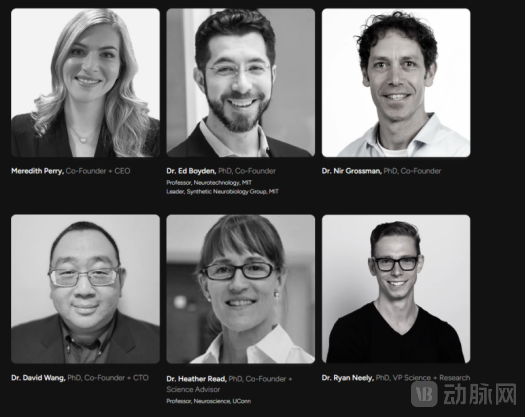
Elemind Founding Team, from the official company website
Moreover, Elemind has recruited a team of industry professionals. Dr. David Wang, Chief Technology Officer, holds a degree in Artificial Intelligence from MIT and brings extensive industry experience; he was also the co-founder and CTO of NuVu Innovation School. Dr. Ryan Neely previously served as Vice President at iota Biosciences.
Dr. David Wang has publicly stated:“Elemind is developing an AI-enhanced neurotechnology wearable device for sleep innovation.”
According to a survey by the World Health Organization, 27% of the global population experiences sleep problems. Previously, the monitoring, diagnosis, and treatment of sleep disorders were almost entirely based on in-laboratory polysomnography conducted at sleep centers. However, changes in the sleep environment and comfort levels can significantly alter sleep patterns. Therefore, accurate quantitative analysis of sleep and circadian rhythms outside of sleep centers is particularly important.
Since their emergence in the early 2010s, wearable devices have rapidly penetrated the consumer market and are now virtually ubiquitous in modern life. In the field of sleep medicine, wearables have garnered significant attention from industry stakeholders because they enable continuous, quantitative monitoring of sleep in relatively natural environments, eliminating the need for cumbersome and specialized monitoring procedures.
Based on this,Elemind leverages neuroscience to read individual brainwaves and guide them in real time through customized stimulation, enabling behavioral change in a smarter, more targeted, and natural manner.。
Elemind refers to this approach as “electronic medicine”—a drug-free, personalized, and adaptive method that fine-tunes stimulation based on the body’s responses until the desired state is achieved. Dr. Meredith Perry, CEO of Elemind, has also publicly stated, “Chemical drugs affect the entire body and often lead to unwanted side effects. Elemind offers a non-chemical, direct, and on-demand solution that can learn and dynamically adjust to each individual’s needs.”
Wearable all night, effectively increasing sleep induction speed by 74%
It is understood that the Elemind headband is a soft, lightweight, and flexible wearable device that can be worn throughout the night, regardless of the user's sleep position.This is because the headband can collect information via brainwaves and pair with a smartphone, allowing users to view detailed insights into their sleep patterns on the device.
Specifically, users need only open Elemind and double-tap the action button at the bottom to initiate a full night of EEG recording and approximately 2 hours and 20 minutes of active stimulation. If users wake up in the middle of the night, they can tap the button to restart the stimulation, leveraging neuromodulation to influence brainwaves and guide them from a wakeful state back into deep sleep.
“The effect of the elements on the brain is like eliminating noise. Users can shut out the world, relieve stress, and fall asleep faster,” explained Dr. Meredith Perry, CEO of Elemind.
Not only that,Elemind has also developed an AI-driven Sleep Tailor that provides users with advanced sleep insights by analyzing data and user feedback., such as overall sleep performance, duration, efficiency, sleep onset latency, time spent in each sleep stage, and activity throughout the night.
Currently, the Elemind headband has completed five clinical studies, with the team testing 112 subjects for a total of 876 nights of sleep and 96 naps. Clinical trials have shown thatElemind’s technology can effectively accelerate sleep onset by 74%, suppress essential tremor with significant reduction after just 30 seconds of stimulation, and enhance memory. Furthermore, the Elemind headband has been proven effective in raising pain thresholds and promoting sedation.
Secured tens of millions of dollars in investment, plans to launch deep sleep stimulation feature
In 2024, Elemind completed a $12 million seed funding round, with investors including Village Global, LDV Partners, Fusheng Venture Capital, The E14 Fund, Wharton Alumni Angels, Embark Ventures, and individual investors, jointly driving the development of its first product. Furthermore, Elemind plans to introduce a deep sleep stimulation feature.
Deep Sleep: The Third Stage of SleepSo-called deep sleep, also known as delta sleep, is the third stage of sleep and represents a state of profound, complete rest. Deep sleep aids in the restoration of the body and brain, enhances memory and learning capabilities, helps prevent cardiovascular diseases and diabetes, and delays aging.
Based on this,Elemind enhances deep sleep by delivering auditory stimulation via a wearable device. Specifically, the wearable device measures the user’s endogenous electrical signals and presents background audio, generating neuromodulatory audio signals based on the measured endogenous electrical activity.
With the emergence of an increasing number of smart monitoring devices, “deep sleep” has been mentioned more frequently. In 2022, researchers at ETH Zurich published a clinical trial paper titled “Auditory deep sleep stimulation in older adults at home: a randomized crossover trial” in the journal Communications Medicine.
The research team developed a wearable device called SleepLoop, which users wear during sleep. Equipped with electrodes and microchips, the system continuously monitors and analyzes brain activity in real time. Upon detecting slow waves characteristic of deep sleep, it triggers a brief auditory signal to enhance these slow waves and promote deep sleep. Its initial clinical trial demonstrated that while most participants indeed exhibited enhanced slow waves through auditory stimulation during deep sleep, there was significant variability among individuals.
Meanwhile, domestic research on wearable devices has also intensified its focus on the sleep sector. Since 2016, Huawei Health has established a closed-loop service model of “healthy sleep management–convenient and precise sleep monitoring–personalized sleep improvement,” encompassing four key dimensions in mass-market sleep scenarios: sleep monitoring, analytical assessment, risk screening, and management-based improvement. Lifesense Medical’s flagship products, including the Health Watch H1 smartwatch and the Mambo HR5 and M6 smart bands, achieve real-time sleep monitoring through heart rate tracking.
In the future, as global wearable device technology continues to innovate, extending battery life, continuously optimizing algorithms, and deeply integrating with professional services will become indispensable and powerful aids in addressing sleep problems.. They not only accurately monitor users' sleep cycles and quality, but also provide customized improvement plans based on personalized data, thereby effectively alleviating and resolving the sleep disturbances of a broad user base.