

Tianjin Presents China's Digital Solution for Chronic Disease Management on the Global Stage
From August 21 to 24, the 2024 World Organization of Family Doctors (WONCA) Asia Pacific Regional Conference was held at the Raffles City Convention Centre in Singapore. Guo Yipeng, a Level II Inspector from the Tianjin Municipal Health Commission, was invited to attend the conference and presented Tianjin’s innovative practices and effective experiences in building the Digital Health Community. He demonstrated to guests from various countries and regions around the world the “Chinese Solution” for leveraging digital and intelligent technologies to empower chronic disease management, as part of China’s efforts to deepen healthcare system reform and advance the Healthy China initiative. As a major global public health challenge, chronic diseases have long been a focal point of international academic attention. The “Tianjin Model” sparked lively discussions among participating experts, who unanimously agreed that it offers valuable reference experience for chronic disease management worldwide.
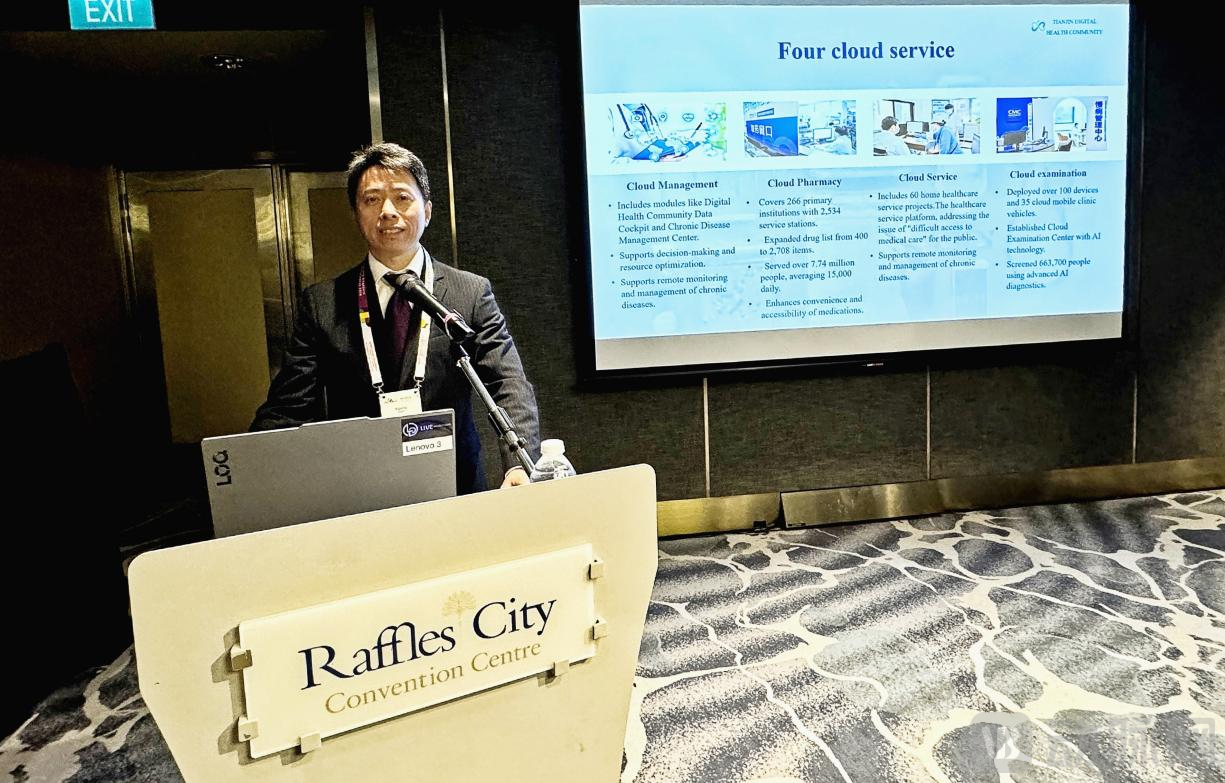
Figure | Guo Yipeng Shares the “Chinese Practice” of Digital Intelligence-Empowered Chronic Disease Management
The theme of the 2024 WONCA Asia Pacific Conference was “The Art and Science of Family Medicine,” aiming to explore diverse approaches and practices in family medicine to provide patients with comprehensive, optimal healthcare. The World Organization of Family Doctors (WONCA) currently comprises 118 member organizations across 131 countries and regions, with China becoming a full member in 1994. As a key subspecialty within family medicine, chronic disease management was a focal point of the conference. The Tianjin Digital Health Consortium has achieved multifaceted outcomes in chronic disease management, including improved patient health indicators, enhanced primary care service capacity, and a reduced growth rate of medical insurance expenditures. These accomplishments vividly and concretely demonstrate Chinese wisdom in implementing value-based healthcare.
In recent years, as China has elevated the Healthy China strategy to a core position in national development, establishing a health service system that provides universal coverage and spans the entire life cycle has become a key objective of healthcare reform. Against this backdrop, Tianjin Municipality has actively responded to the national call by creatively exploring the “Digital Health Community,” a novel healthcare service model designed to address persistent challenges in healthcare reform, such as the uneven distribution of medical resources and weak capacity at the primary care level.
Since 2020, the Tianjin Municipal People’s Government has partnered with WeDoctor Group to launch the “Tianjin Digital Health Community” special healthcare reform initiative. Under the guidance of the Tianjin Municipal Health Commission and the Healthcare Security Administration, and led by Tianjin WeDoctor Digital Intelligence Hospital, the Tianjin Primary Care Digital Health Community was established in collaboration with 266 community health service centers and over 2,000 community health stations and clinics across the city. After several years of development and operation, this innovative model has achieved remarkable results, successfully enhancing resident satisfaction with health services, improving healthcare professionals’ sense of achievement, raising key population health indicators, and strengthening the diagnostic and treatment capabilities of primary care institutions.
“80.3% of enrolled patients proactively returned to primary care institutions, outpatient visits at these facilities increased by 23% to 50%, public satisfaction reached as high as 97%, and the average monthly out-of-pocket medical expenses per patient with diabetes under special outpatient coverage decreased from RMB 1,643 to RMB 1,255, a reduction of 23.6%...” Guo Yipeng introduced that this series of encouraging data vividly illustrates how Tianjin, over the past three years of advancing the construction of a Digital Health Community, has leveraged institutional mechanisms and technological innovation to drive the transformation of its healthcare service system from being “treatment-centered” to “health-centered.”
The AI-empowered Chronic Disease Management Centers and the “Four Clouds” platform are two landmark achievements of Tianjin’s Digital Health Community reform. To date, Tianjin has established 238 chronic disease management centers. Centered on the workflow of “prevention, diagnosis, treatment, management, and health promotion,” these centers employ a grid-based “3+1+N” team model—comprising public health personnel, chronic disease outpatient physicians (family doctors), and nurses, supplemented by specialist physician teams and health managers—to deliver precise and personalized chronic disease management. According to Guo Yipeng, the service scope of these centers is gradually expanding from single-disease management to comprehensive health management for four major categories of chronic conditions: hypertension, diabetes, coronary heart disease, and chronic obstructive pulmonary disease (COPD), with plans to incorporate additional conditions such as cancer and mental health disorders. Currently, nearly 200,000 chronic disease patients in Tianjin have been registered and managed within the Health Community’s chronic disease management centers, with a cumulative total of 697,800 follow-up visits completed.
Driving the transformation of service models is the “Four Clouds” platform, which has propelled a leapfrog improvement in primary healthcare capabilities. By deploying cloud-based management, cloud services, cloud pharmacy, and cloud examination platforms at primary healthcare institutions, data sharing and integrated management of medical services have been achieved. This facilitates interconnectivity of data and optimized allocation of resources, enabling primary healthcare institutions to establish seamless connections across pre-diagnosis, during-diagnosis, and post-diagnosis stages, thereby delivering continuous, full-lifecycle health management. Notably, the “Four Clouds” platform extensively incorporates artificial intelligence technologies, such as AI-driven health management, AI-powered diagnostic and treatment systems for specific diseases, AI-assisted examinations, AI pharmaceutical services, and digital-intelligent regulatory supervision. The application of AI not only enhances the efficiency and quality of medical services but also reduces labor costs.
The management of chronic diseases poses a significant challenge to global public health. Data indicate that the number of deaths from chronic non-communicable diseases (NCDs) is increasing year by year. By 2030, NCDs are projected to cause global economic losses amounting to $47 trillion, making them the greatest health threat of the 21st century worldwide. In addressing this challenge, the application of digital and intelligent technologies in chronic disease management has become particularly crucial. China’s practical experience with Digital Health Communities demonstrates that institutional and technological innovations not only promote the integration of chronic disease prevention and treatment but also establish a health accountability system. This facilitates the implementation of value-based healthcare and value-based medical insurance, reflecting the core values pursued in tackling the global challenge of healthcare reform.
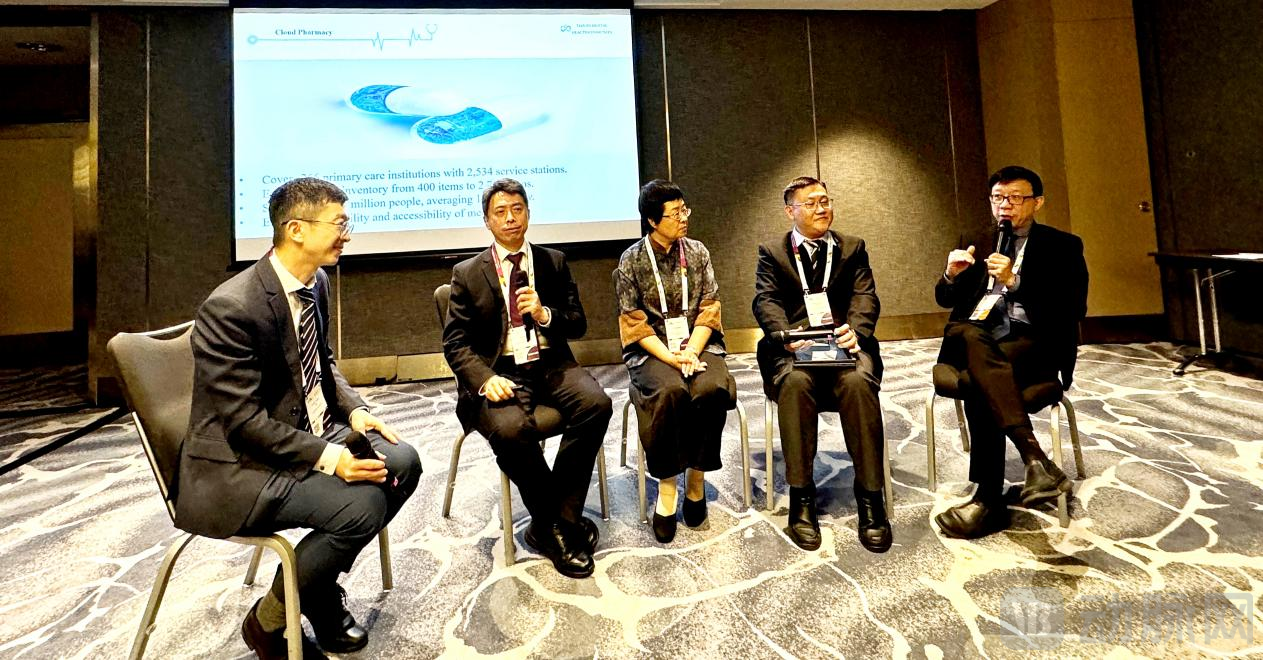
Figure | Conference participants jointly explore national strategies for improving chronic disease management
In Tianjin’s advancement of the Digital Health Community, deepening the reform of medical insurance payment methods has been a critical top-down initiative. Guo Yipeng introduced that, by focusing on chronic disease management and family doctor contract services, Tianjin has implemented phased reforms in payment models, including capitation-based global budgeting for outpatient special care for diabetes and capitation-based global budgeting for family doctor contracts. These efforts have successfully established a “pay-for-performance” system for medical services, effectively addressing challenges such as data interoperability and payment efficiency within the coordinated development of healthcare, medical insurance, and pharmaceuticals. While implementing a health accountability system, this approach has achieved a multi-party win-win outcome for patients, physicians, medical institutions, the government, and enterprises.
Early this year, the Xiqing District People’s Government of Tianjin Municipality signed the “Strategic Cooperation Agreement on Deepening the Construction of the Digital Health Community” with WeDoctor Group. The two parties jointly established a regional close-knit medical consortium and carried out in-depth implementation of capitated global budget payment for family doctor contract services. This marks that Tianjin’s Digital Health Community has entered a new phase of supporting various districts in improving the construction of close-knit medical consortia, launching a “broad per-capita” health insurance reform that expands coverage from patients with special outpatient diabetes benefits to the entire population under family doctor contracts, thereby taking a significant step forward in innovative healthcare payment reform. Currently, administrative districts in Tianjin, including Jinnan District, Hebei District, and Dongli District, are accelerating the construction of district-level Digital Health Communities, continuously advancing refined disease-specific management for common chronic conditions such as diabetes, hypertension, coronary heart disease, and chronic obstructive pulmonary disease (COPD), and promoting the upgrading and innovation of digital and intelligent chronic disease management models.
Chen Zhu, an academician of the Chinese Academy of Sciences and president of the Red Cross Society of China, has publicly pointed out that chronic diseases are complex, multifactorial conditions often characterized by multimorbidity. A systems approach is required to understand, prevent, and intervene early in these conditions. Leveraging technologies such as the internet, big data, and 5G, personal health profiles can be established to enable precision health management, thereby achieving comprehensive chronic disease management for the entire population, across all dimensions, and throughout the full care continuum. The Digital Health Community model facilitates the interconnectivity of clinical and health data through the construction of digital-intelligence platforms, thereby creating regional universal health information platforms. This makes residents’ personal health profiles increasingly “clear,” ultimately enabling lifecycle health management.
“In the future, we will introduce AI-assisted diagnostic and treatment recommendation systems into the management of a wider range of diseases to enhance the precision and scientific rigor of disease management,” introduced Guo Yipeng. Tianjin will continue to promote the application of technologies such as artificial intelligence and big data in chronic disease management, developing more intelligent and personalized chronic disease management systems to improve management efficiency and service quality. Data shows that over the past three-plus years of applying this system, the quality of primary care treatment plans in Tianjin has improved by 22%. It is understood that, leveraging its deep partnership with WeDoctor, the Tianjin Digital Health Community has currently applied AI technology across the entire process—including examinations, health management, diagnosis and treatment, pharmaceutical services, and medical insurance supervision—thereby achieving scaled improvements in efficiency at every stage.
The innovative progress of Tianjin’s Digital Health Community is not only a microcosm of local healthcare reform in Tianjin but also a paradigm for the Chinese healthcare system’s shift toward more human-centric, intelligent, and collaborative development. In the “Key Points for Digital Village Development in 2022,” jointly issued by the Cyberspace Administration of China, the Ministry of Agriculture and Rural Affairs, the National Development and Reform Commission, and the Ministry of Industry and Information Technology, it was explicitly stated that “localities should be guided to explore the establishment of grassroots digital health communities.” This innovative practice in Tianjin not only provides valuable references for the transformation and upgrading of China’s healthcare industry but also contributes precious Chinese experience to the global transition of chronic disease management toward higher-level health service models.