

Surge in Chinese Medical Device Exports to Brazil: Three Product Categories Lead the Boom
Brazil is one of the hottest markets for Chinese medical device companies expanding overseas.
In the first quarter of 2024, the number of Chinese medical device registrations in the European Union and the United States decreased year-on-year, while registrations in markets such as Brazil and Indonesia increased. This shift reflects market saturation for Chinese medical device exports in Western countries, prompting a strategic pivot toward other regions. As the most populous nation in Latin America, Brazil is experiencing growing demand for medical products.
Pure Global, specializing in global regulatory compliance and market access, stated that the Brazilian market has been exceptionally active since last year. The number of newly registered Chinese medical device products in Brazil has surged, with Chinese products accounting for nearly 30% of new medical device registrations in Brazil in 2024.
Registration fees for Chinese companies entering the Brazilian market have also surged, with the registration fee for a single product in Brazil reaching up to RMB 1 million. The entire Latin American market has been ignited as well; in Colombia, a country in northern South America with a population of less than 60 million, the cost to obtain certification for a single product can reach up to RMB 450,000.
Leading Chinese enterprises are also increasing their investments in the Brazilian market. Mindray Medical has positioned Brazil as a high-potential emerging market and established a subsidiary there. In May 2024, Gan & Lee Pharmaceuticals achieved local insulin production in Brazil through technology transfer. Angelalign previously acquired a 51% stake in Aditek, Brazil’s third-largest orthodontics company, in 2022, aiming to leverage Aditek’s extensive local resources and distribution network to successfully enter the Brazilian orthodontics market and other potential emerging markets in South America.
On the other side of the globe, Chinese medical device products are intensively entering the Brazilian market.
Chinese medical device companies began expanding into the Brazilian market as early as 2015. The COVID-19 pandemic accelerated their entry into Brazil, and enthusiasm for this expansion has only grown in recent years.
Pure Global specializes in global regulatory compliance and market access. As both a witness to and participant in the surge of Chinese companies expanding into Brazil, Pure Global established a Brazilian subsidiary after recognizing the growing interest of Chinese medical device manufacturers in the Brazilian market. Within the following year, the company rapidly assisted numerous Chinese enterprises in securing market access approvals in Brazil.
Pure Global stated, “In Brazil in 2024, one out of every three approved medical device products originated from China.” Leveraging its independently developed data platform, Pure Global found that the number of newly registered products by Chinese companies in Brazil has increased year by year since 2015, with their share of the total rising from 10% to 30.9% in 2023. In 2023, the number of registrations by Chinese manufacturers was nearly on par with that of local Brazilian manufacturers.
The primary driver attracting Chinese medical device companies to Brazil is its thriving market, which is not a backward, low-end market but rather a relatively high-quality mid-tier market.
Brazil’s total population reached 203 million in 2023, ranking fifth globally, behind only China, India, the United States, and Indonesia. Brazil also has basic medical infrastructure in place. The country has established a Unified Health System (SUS), implementing a healthcare model that combines public health insurance with private health insurance. While citizens can receive free medical care at public hospitals, these facilities often face high patient volumes, long waiting times, and limitations on diagnostic procedures and medication options. Individuals with middle-to-high incomes typically purchase private health insurance to seek treatment at private hospitals, which offer better medical conditions. This large population base, coupled with the existing medical infrastructure, provides broad market opportunities and significant consumption potential for medical device companies.
In terms of market size, Pure Global stated: “Brazil’s medical device market is valued at $11.4 billion, ranking among the top ten globally. Its market size is comparable to those of South Korea, Canada, and Spain, with a growth rate of 11.9% from 2022 to 2023. By market volume, Brazil is a significant global market for medical devices. The data indicate that this is an overseas market not to be missed.”
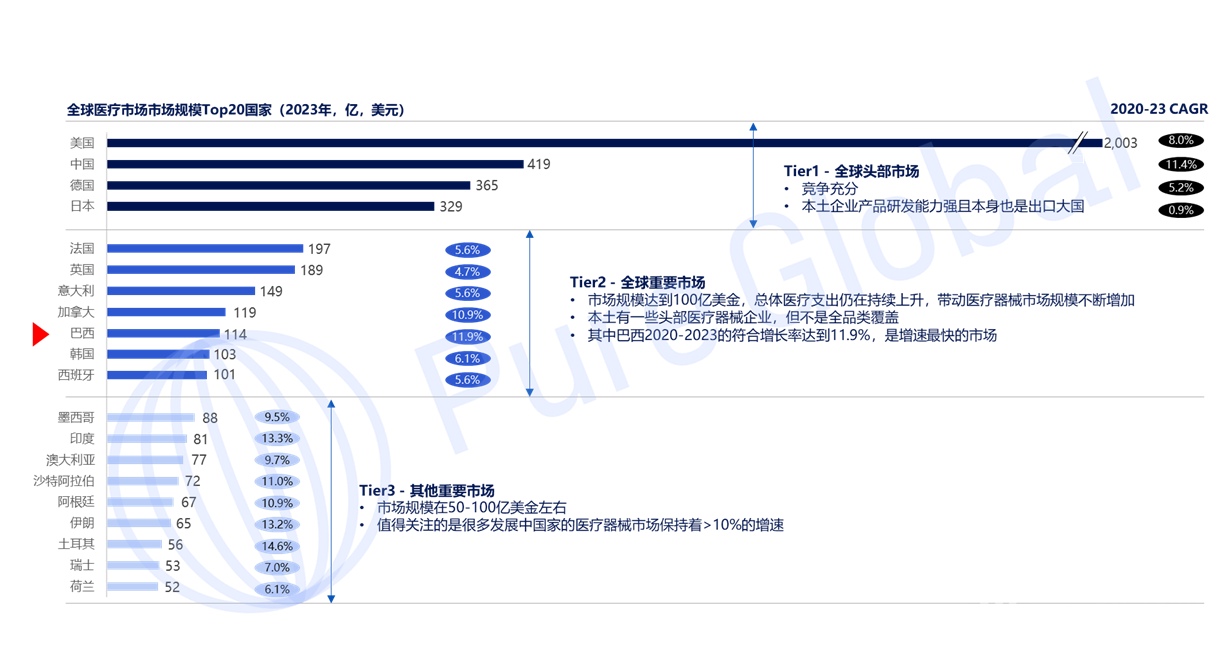
Global Market Size of Major Medical Devices, Data Source: Pure Global
This country, with its massive population, also possesses a certain level of purchasing power for medical products.Brazil’s per capita GDP is not far from that of the Chinese market. In 2022, Brazil’s per capita GDP stood at USD 9,457.7. In terms of per capita healthcare expenditure, Brazil reached USD 761, surpassing China’s USD 671. From the perspective of healthcare spending, there is little difference between Brazil’s consumption level and that of the Chinese domestic market.
Chennuo Medical, a company that has already commercialized its products in the Brazilian market, also stated: “My first impression of Brazil is that local demand is not low-end or backward; on the contrary, the Brazilian market has high requirements for product quality and service. It expects a diverse product portfolio, robust local and global academic support services, superior product quality, and competitive pricing.“Brazilian customers tend to choose our high-end series. In contrast, in Mexico, another core market in Latin America, customers are more price-sensitive and have lower requirements for product quality.” Chennuo Medical’s stapler products have achieved commercialization in Brazil and gained recognition among key opinion leaders (KOLs) who perform a high volume of surgeries in the country.
From the perspective of entry barriers, the overall market entry requirements in Brazil are not stringent.
The import of pharmaceutical and medical products into Brazil requires approval from the National Health Surveillance Agency (ANVISA). Only after obtaining such approval may enterprises and institutions engage in the importation of the authorized products. The agency is also responsible for investigating and penalizing non-compliant companies.
In Brazil, products are classified into Class I, Class II, Class III, and Class IV according to their risk levels, from low to high. Class I and Class II products are subject to simplified registration; relevant documentation must be submitted to the competent authority, and marketing authorization is granted only upon approval. The market authorization for these classes is valid indefinitely. For Class III and Class IV products, a facility audit is required. Manufacturers must obtain compliance with Brazilian Good Manufacturing Practices (BGMP) before submitting product registration applications to the competent authority. Marketing authorization is granted only upon approval, with a validity period of 10 years from the date of publication in the Brazilian Official Gazette. This authorization may be renewed for equivalent and consecutive periods.
The unique aspect of holding a license in the Brazilian market is that if the manufacturer does not have a local registered office, it must designate a qualified Brazilian Registration Holder (BRH) to conduct product registration. In addition, active medical devices must first undergo certification by the National Institute of Metrology, Quality and Technology (INMETRO).
When entering the Brazilian market, Chinese companies can adopt three different marketing authorization holder (MAH) strategies to comply with local regulations. The head of Pure Global elaborated on these models:
Traditional Licensed Distributor Model:Companies choose the general distributor in the Brazilian market as a partner, who is responsible for developing a secondary agency network and undertaking medical insurance operations and maintaining doctor relationships. Domestic companies can quickly start sales by leveraging the distributor's resources, but they face challenges such as limited options for selecting distributors and having to go through cumbersome self-application or re-registration processes when changing distributors. Additionally, companies have relatively weak control over the terminal market in Brazil.
Third-Party Licensed Model:Third-party institutions such as Purui, acting as license holders, enable the separation of licensure from distribution, thereby stripping agents of exclusive distribution rights. Companies are free to select and change their distributors without being constrained by overseas registration requirements, allowing them to cover a broader market through multiple distributors. This model is particularly suitable for vast countries like Brazil, facilitating more flexible market expansion for enterprises.
Local Subsidiary License-Holding Model: Companies choose to establish subsidiaries in Brazil and complete local registration to achieve the flexibility of replacing distributors at will and exert strong control over local channels. Although this model entails higher investment and operational management costs, it is a viable option for companies committed to long-term penetration of the Brazilian market. For instance, Mindray Medical’s establishment of a subsidiary in Brazil demonstrates the feasibility and benefits of this approach.
Within the global regulatory review hierarchy, Brazil’s market entry barriers are less stringent than those in the United States, Europe, and Japan, offering Chinese enterprises greater opportunities for market access.
Although Brazil is an emerging market, its vitality and potential attract Chinese medical device companies to enter. However, blind entry into the market may encounter obstacles. Domestic enterprises need to gain a deep understanding of market conditions and demands before entering.
Expanding into Brazil: Which Products Have Greater Opportunities in This Vast Market?
Pure Global told VCBeat: “Brazil holds market potential in multiple sectors, particularly in consumer healthcare related to the beauty industry, chronic disease management, and IVD solutions for infectious diseases.”
Brazilian culture places a high value on beauty and appearance, with the pursuit of aesthetics regarded as an integral part of life; certain plastic surgery procedures are even covered by public health insurance. Bariatric surgeries, which are closely related to the aesthetic industry, require the use of surgical staplers. Chinese manufacturers of surgical staplers have already established a significant presence in the Brazilian market. Fenghe Medical, a domestic stapler manufacturer, generated RMB 29.09 million in revenue from South America in 2022, accounting for one-third of its total export income.
The medical aesthetics market, which is most closely linked to the beauty industry, also warrants attention. According to a report by Frost & Sullivan, the three countries with the highest penetration rates of medical aesthetics are South Korea, the United States, and Brazil. On the supply side, Brazil’s medical aesthetics service system is relatively well-developed. In recent years, driven by private equity (PE) investment, the rapid expansion of medical aesthetics clinics in Brazil has made non-surgical, minimally invasive procedures more accessible. There is broad potential for Chinese medical aesthetics products to enter the Brazilian market.
The invisible orthodontics industry, which is related to the beauty sector, is also well-developed in Brazil.. The Brazilian market sees approximately 250,000 clear aligner orthodontic cases annually. For comparison, China recorded 335,500 such cases in 2020. With Brazil’s population being only one-seventh that of China, the penetration rate of clear aligner orthodontics in Brazil is significantly higher than in the Chinese domestic market. Furthermore, Brazil boasts a relatively developed dental care service capacity. According to IDS data, there are currently over 300,000 registered dentists in Brazil, equating to one dentist per 713 people, which exceeds the World Health Organization’s standard.
However, Brazil’s orthodontics market has given rise to several leading domestic players, with a relatively developed local industry and significant price sensitivity. Consequently, Angelalign, a Chinese company, entered the Brazilian market by acquiring an equity stake in Aditek, the third-largest local orthodontics firm.
In the field of serious medical care, opportunities in the Brazilian market mainly lie in areas related to chronic diseases and infectious diseases.
First, chronic diseases associated with aging. Although Brazil is commonly perceived as a young and vibrant country, it is in fact facing the challenge of an aging population. According to data from The Lancet, individuals aged 65 and older currently account for 11% of Brazil’s total population, meeting the standard definition of an aging society.
The burden of chronic disease treatment brought about by population aging is increasingly heavy, with diabetes and cardiovascular diseases being the most prominent.There is a significant market gap for devices, consumables, and instruments related to these two major chronic disease areas. Domestic enterprises have substantial room for expansion.
Coronary stents and artificial heart valves required for the treatment of cardiovascular diseases: Relevant domestic products have already been approved in Brazil. Companies such as Sino Medical, MicroPort NeuroTech, Vibri Medical, MicroPort Endovascular, and Venus Medtech are actively expanding into the Brazilian market.
The Brazilian market for diabetes treatment is also worth attention.Brazil is the country with the largest number of diabetes patients in Latin America. According to the 10th edition of the IDF Diabetes Atlas, as of 2021, the number of people with diabetes in Brazil (aged 20–79 years) reached approximately 15.7 million, accounting for 47.5% of the total number of patients in Latin America.
Gan & Lee Pharmaceuticals, a Chinese enterprise, began its strategic expansion into the Brazilian market a decade ago. This April, through technology transfer to a local Brazilian pharmaceutical company, it achieved local production of insulin in Brazil. Gan & Lee has become a key player in Brazil’s insulin supply chain. Its success in the Brazilian diabetes market has demonstrated the market’s potential, offering valuable insights for other Chinese medical device companies.
Chinese continuous glucose monitoring (CGM) companies are also exploring expansion into the Brazilian market. Currently, MicroTech Medical’s CGMS has received regulatory approval in Brazil and entered into a strategic partnership with Medlevensohn, a prestigious local distributor of blood glucose devices. As one of Brazil’s earliest and most significant professional providers of chronic disease diagnostics, Medlevensohn specializes in diabetes diagnostic solutions and operates an extensive distribution network across Latin America, covering hospitals, clinics, pharmacies, and retailers. The introduction of MicroTech Medical’s CGMS products into Brazil will provide new therapeutic options for patients with diabetes in the country.
Finally, in the IVD sector, Brazil faces significant pressure in controlling infectious diseases, with major prevalent diseases including COVID-19, yellow fever, dengue fever, and Zika virus. The key players in Brazil’s IVD market are primarily companies from Europe, the United States, and Japan. As there are no prominent local brands yet, Chinese enterprises have substantial room for market entry.
In exploring niche markets, domestic enterprises must take into account both the local market environment and their compatibility with the domestic industrial chain.
Chinese medical device companies are still in the early stages of development in the Brazilian market. Although they have gained market entry, their share of sales revenue remains relatively low. Data from Pure Global shows that in 2023, Chinese companies accounted for as high as 28% of new product registrations in Brazil, yet their share of sales revenue was only 6%, significantly lower than their registration share.
In stark contrast, Brazilian companies account for 31% of registrations but a substantial 42% of sales; meanwhile, U.S. and German firms exhibit sales shares that are roughly commensurate with their registration shares. This indicates that boosting sales has become the core challenge for Chinese companies in the Brazilian market.
Although the Brazilian market is vast, it is highly price-sensitive and fiercely competitive. Even companies that have established mature overseas channels face numerous challenges in their international expansion. In its response to inquiries from the STAR Market, Fenghe Medical noted that the overseas market is intensely competitive, with overall overseas sales and growth falling short of expectations.
Chinese companies face competitive pressure in the Brazilian market from global giants, local brands, and other Chinese enterprises.Global giants have cultivated the Brazilian market for many years, establishing certain competitive advantages. Taking the stapler market as an example, Johnson & Johnson has maintained its market position through measures such as patent litigation, which has impacted the sales of Fenghe Medical’s staplers in Brazil.
In competition with global giants, price is the greatest advantage for Chinese domestic enterprises. Meanwhile, Brazilian customers also value innovative designs that meet clinical needs, showing a preference for innovative products with a price advantage. Therefore, Chinese domestic companies can compete with global giants through differentiated innovative designs. Taking Chennuo Medical as an example, its Longwen 75 stapler, promoted in overseas markets, offers an effective cutting and stapling length of up to 75 mm. In bariatric surgery, the elongated staple cartridge can reduce the number of firings required during the procedure, thereby decreasing the incidence of anastomotic leakage and bleeding. Furthermore, in addition to accommodating 75 mm staple cartridges, the Longwen 75 stapler is backward compatible with 60 mm and 45 mm cartridges, eliminating the need to replace the stapler when using cartridges of different lengths during surgery.
However, competition among Chinese enterprises in overseas markets is equally fierce, with price cuts being the primary means of competition.However, unbridled price cuts will only lead to vicious competition and unnecessary erosion of profits. To this end, domestic enterprises should leverage industry associations and other organizations to promote the sustained, healthy, and standardized development of the sector.
The Brazilian market also features several leading domestic companies.Domestic companies are primarily concentrated in the fields of dentistry, orthopedics, surgical instruments, and consumer medical products. For instance, Alliage, a leader in the orthodontics sector, produces 250,000 orthodontic kits annually. In competing with local enterprises, domestic companies can collaborate to jointly develop the market. This model allows for full utilization of local companies’ resources and experience, facilitating better integration into the local market.
Overall, Brazil’s medical device market is thriving and holds substantial potential. However, it is not a supply-scarce market. For Chinese enterprises to successfully commercialize their products in Brazil, they must collaborate with professional partners, leverage technological innovation to expand market reach, strengthen channel control through comprehensive services, and gain a thorough understanding of local customs, business practices, and the healthcare environment. The vast opportunities in the Brazilian market await visionary and capable Chinese companies to explore and seize.