

Shanghai Ninth People's Hospital Announces Nine Patent Transfers Worth RMB 7.8 Million in a Single Day
On August 27, Shanghai Ninth People’s Hospital, affiliated with Shanghai Jiao Tong University School of Medicine, issued a public notice announcing that nine patent transfers have entered the public notification period.
These include the utility model patent “A Novel Drainage Bag,” the utility model patent “A Tension-Reducing Device for Areolar Incisions,” the invention patent “An AI-Combined AR Interactive Method and Device for Popularizing Eye Health Knowledge,” the utility model patent “An Areolar Measuring Manipulator for Breast Surgery,” as well as a set of auxiliary orthodontic kits for dentofacial deformities (comprising three granted patents, including two utility model patents).
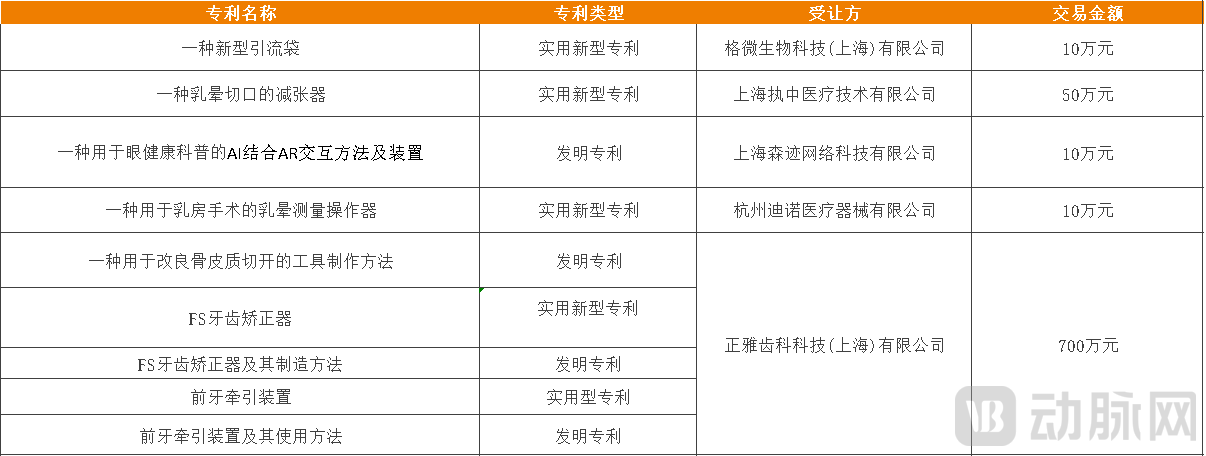 Specific Information on the Patent Transfer by Shanghai Ninth People's Hospital on August 27
Shanghai Ninth People’s Hospital transferred the patent rights for “A Novel Drainage Bag” (Patent No.: ZL202121074354.2) to Gewei Biotechnology (Shanghai) Co., Ltd. for RMB 100,000.
Traditional drainage bulbs are spherical plastic devices. During use, the bulb is compressed to create a vacuum; relying on the elasticity of the plastic, it aspirates blood and exudate, allowing the bulb to return to its original shape. However, these plastic drainage bulbs contain numerous chemical constituents and exhibit certain toxicity, which can significantly impair the tissues requiring repair. Furthermore, the presence of pathologic blood within the drainage bulb complicates transportation and disposal.
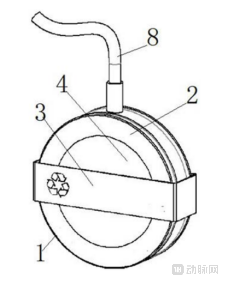
A Novel Drainage Bag
To address the aforementioned challenges, Shanghai Ninth People’s Hospital has developed a novel drainage device by integrating its designed components—including the main body of the drainage bag, paper accordion shield, protective ring, observation window, absorbent paper pulp, outlet, elastic sponge, and medical drainage tube. This system employs an accordion-style telescopic structure that leverages the high absorbency and swelling properties of elastic sponges and paper pulp when exposed to blood. The flowing blood is absorbed by the paper pulp, facilitating easier mobility, storage, and reprocessing. Furthermore, the paper material is non-toxic, odorless, energy-efficient, and environmentally friendly.
“A Tension-Reducing Device for Areolar Incisions” (Patent No.: ZL202321399792.5) was transferred to Shanghai Zhizhong Medical Technology Co., Ltd. for RMB 500,000.
In breast augmentation surgery, due to the convex, rounded shape of the breast, wounds from periareolar incisions are difficult to secure effectively after suturing, and the high tension at the incision site predisposes patients to hypertrophic scarring. Therefore, a tension-reducing device suitable for periareolar incision procedures is needed to address this issue.
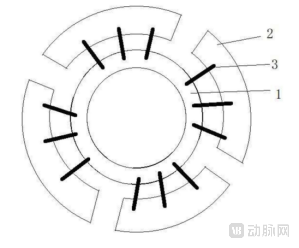
A Tension-Reducing Device for Areolar Incisions
The tension-reducing device from Shanghai Ninth People’s Hospital features two fixed adhesive films, internal and external, which are joined by curved adhesive strips to form a ring for better conformity to the areolar contour. The fastening straps allow adjustment of the distance between the inner and outer films as needed, promoting wound approximation and reducing tension.
“Areolar Measuring Manipulator for Breast Surgery” (Patent No.: ZL202121209447.1) was assigned to Hangzhou Dinuo Medical Device Co., Ltd. for RMB 100,000.
In existing breast surgeries, accurate positioning is often difficult to achieve, which can easily lead to issues such as asymmetry in the size and position of the bilateral nipples, discrepancies in the position between the new nipple-areola complex and the inframammary fold, and uneven resection of bilateral breast glandular tissue.
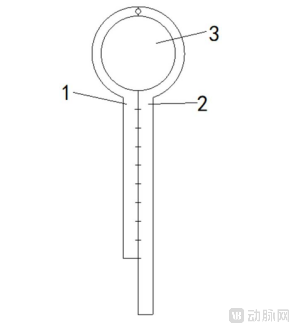
A Areola Measuring Manipulator for Breast Surgery
This areolar measurement device secures the main body via pins, allowing the left and right plates to open and close. The breast is placed on the positioning ring, and alignment is achieved using the scale at the lower end, ensuring simple, convenient, and highly practical operation. This device not only effectively resolves issues of inaccurate measurement and positioning but also shortens preoperative design time, thereby guaranteeing surgical quality. Furthermore, the two available scale sizes accommodate the design needs of different patients.
“AI-AR Interactive Method and System for Popularizing Eye Health Knowledge” (Patent No.: 202410184511.7) was transferred to Shanghai Senji Network Technology Co., Ltd. for RMB 100,000.
Major Pain Points in Eye Health Science Popularization: First, content is predominantly text-based, lacking intuitive perception and remaining abstract, while static information presentation limits effective communication. Second, there is a lack of user engagement, fun, and interactivity. Third, it fails to authentically replicate patients’ visual experiences, resulting in insufficient empathy toward patients.
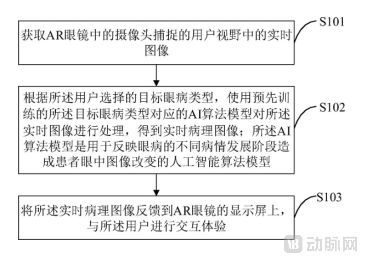
An AI-Combined AR Interaction Method for Eye Health Science Popularization
This invention from Shanghai Ninth People’s Hospital provides an AI-integrated AR interactive method and device for public education on eye health, which can intuitively and immersively demonstrate the impact of various eye diseases on vision, thereby enhancing users’ awareness of ocular conditions.
In addition, on August 27, Shanghai Ninth People’s Hospital transferred a set of adjunctive orthodontic kits for dentomaxillofacial deformities for RMB 7 million. The portfolio includes one patent related to an improved method for fabricating tools used in corticotomy, two patents aimed at improving the management of idiopathic condylar resorption, and two patents primarily focused on optimizing anterior tooth traction devices.
Overall, the total value of the nine transferred patents reached RMB 7.8 million.
Notably, Shanghai Ninth People’s Hospital also completed the transfer of nine patents in June, with all public notice dates being June 3.
The patent right for “A 3D-Printed Shaping Cervical Spine Stretching Pillow (ZL201920062764.1)” was transferred to Shanghai Hongjiao Medical Technology Co., Ltd. at a price of RMB 250,000.
This invention enables the corrective curvature of the extension pillow to be programmatically designed based on the patient’s original cervical spine curvature. The pillow features a firmer texture, providing superior and stable corrective effects. Additionally, the extension pillow incorporates a vacuum-formed soft cushion that conforms to the contours of the patient’s neck, shoulders, and back. This design addresses three major limitations of existing cervical pillows: insufficient firmness leading to inadequate corrective force and efficacy; fixed curvature that fails to accommodate varying degrees of cervical rigidity; and lack of support at the cervicothoracic junction.
The utility model patent “A Cranio-Auricular Angle Bracket” (Patent No.: ZL202020810403.3) and the design patent “Cranio-Auricular Angle Bracket” (Patent No.: ZL202030223106.4) were assigned to Taizhou Laisai Medical Device Co., Ltd. for a consideration of RMB 1 million.
In existing techniques, the reconstruction of the cranioauricular angle using autologous rib cartilage or bone cement often results in technical issues such as a shallow cranioauricular sulcus and narrowing of the cranioauricular angle. Shanghai Ninth People’s Hospital has developed a novel cranioauricular angle scaffold that occupies minimal space and exhibits excellent strength. This scaffold can replace cartilage in cranioauricular angle reconstruction, providing robust support to achieve a stable cranioauricular angle and a more aesthetically pleasing cranioauricular sulcus contour.
The patent rights for the utility model patent "A Mobile Medication Cart with an Expandable Worktop (ZL202121026216.7)" and the invention patent "A Drug Management System with Full-Process, Fully Automated, Closed-Loop, and Traceable Management (202110525025.3)" were transferred to Suzhou Xunji Zhixing Robot Technology Co., Ltd. at a price of RMB 1.5 million.
Most existing mobile medication carts suffer from issues such as a relatively narrow work surface and the inability to freely hang and combine items. This patent optimizes the structure of the mobile medication cart by adding left and right auxiliary platforms, thereby facilitating the widening of the work surface. The handles on the left and right auxiliary platforms, together with the through-holes in the main workbench, enable the cart to be pushed from different directions, accommodating multi-directional maneuverability.
The fully automated, closed-loop, traceable medication management system achieves comprehensive monitoring of drug dispensing and retrieval, implements individualized tracking for each medication unit, and ensures full traceability of drug movement.
Shanghai Ninth People’s Hospital also transferred three patents related to LIPO dialysate to Shanghai Shenlian Technology Service Co., Ltd. for RMB 3.1 million. In addition, it assigned the right to apply for the invention patent “Use of Lipid Emulsions in the Preparation of Peritoneal Dialysis Solutions for Clearing Protein-Bound Toxins (2023104343211)” to Shanghai Shenlian Technology Service Co., Ltd. for RMB 500,000.
In addition, Shanghai Ninth People’s Hospital has completed the transfer of multiple patents, as summarized by VCBeat in the figure below:
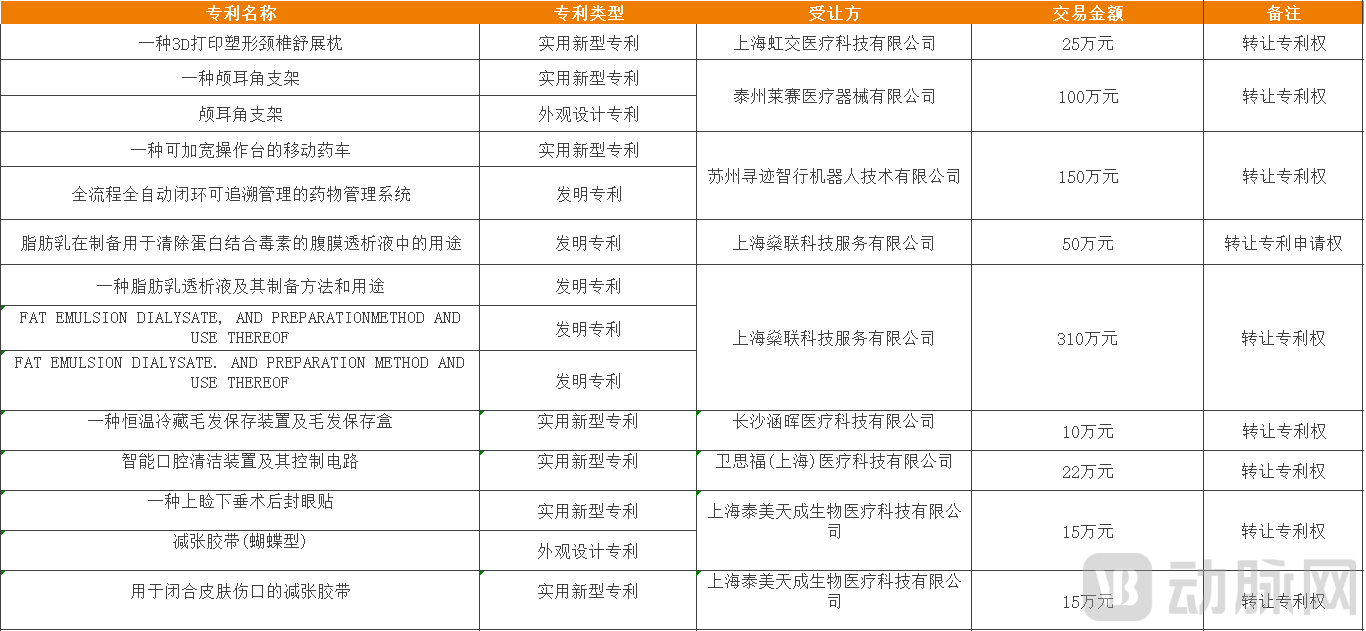
Specific Information on the Patent Transfer by Shanghai Ninth People's Hospital on June 3
According to statistics, on June 3, Shanghai Ninth People's Hospital completed the transfer of 14 patents, with a total transaction amount of RMB 6.97 million.